

The best RocketReach alternative is the one that matches your job, not the one with the biggest database. UpLead suits verified accuracy, Lusha suits mobile numbers, Snov.io and Hunter.io suit tight budgets, and Apollo.io suits high-volume prospecting. Credit price alone misleads, so compare cost per usable contact.
That holds when you already know whether you need phones, emails only, or both, and you can run a small test list through each tool.
Vendor accuracy claims are self-reported, so none of these picks replaces a test on your own list.
If you run a SaaS company and want comparison pages like this one working for your own pipeline, see how our SaaS content marketing service builds them.
📋 Get Listed / Advertise
We update this guide monthly. Want your tool featured? Contact: [email protected].
RocketReach Alternatives At A Glance
Five tools, five jobs. Apollo.io fits high-volume prospecting, UpLead fits verified accuracy, Lusha fits mobile numbers, Snov.io fits budget-limited teams that also send email, and Hunter.io fits email-only finding. Every price below comes from the vendor's own pricing page, and the profiles that follow link each one.
| Tool | Best For | Pricing Model | Entry Price | Free Option | CRM Note |
|---|---|---|---|---|---|
| Apollo.io | High-volume prospecting on one platform | Per user, tiered | Pricing on request | Free tier listed | Core integrations on the Basic plan |
| UpLead | Verified accuracy and transparent credit pricing | Credits | $99 per month (Essentials) | 7-day trial with 5 credits | Not covered here |
| Lusha | Mobile numbers on a small budget | Credits, 5 per phone | Pricing on request | 40 credits per month | Not covered here |
| Snov.io | Budget-limited teams finding and sending | Credits | $39 per month (Starter) | Not covered here | Not covered here |
| Hunter.io | Email-only finding with built-in verification | Credits, monthly reset | $49 per month (Starter) | 50 credits per month | Native HubSpot and Pipedrive, Zapier for others |
1. Apollo.io: Best For High-Volume Prospecting On One Platform
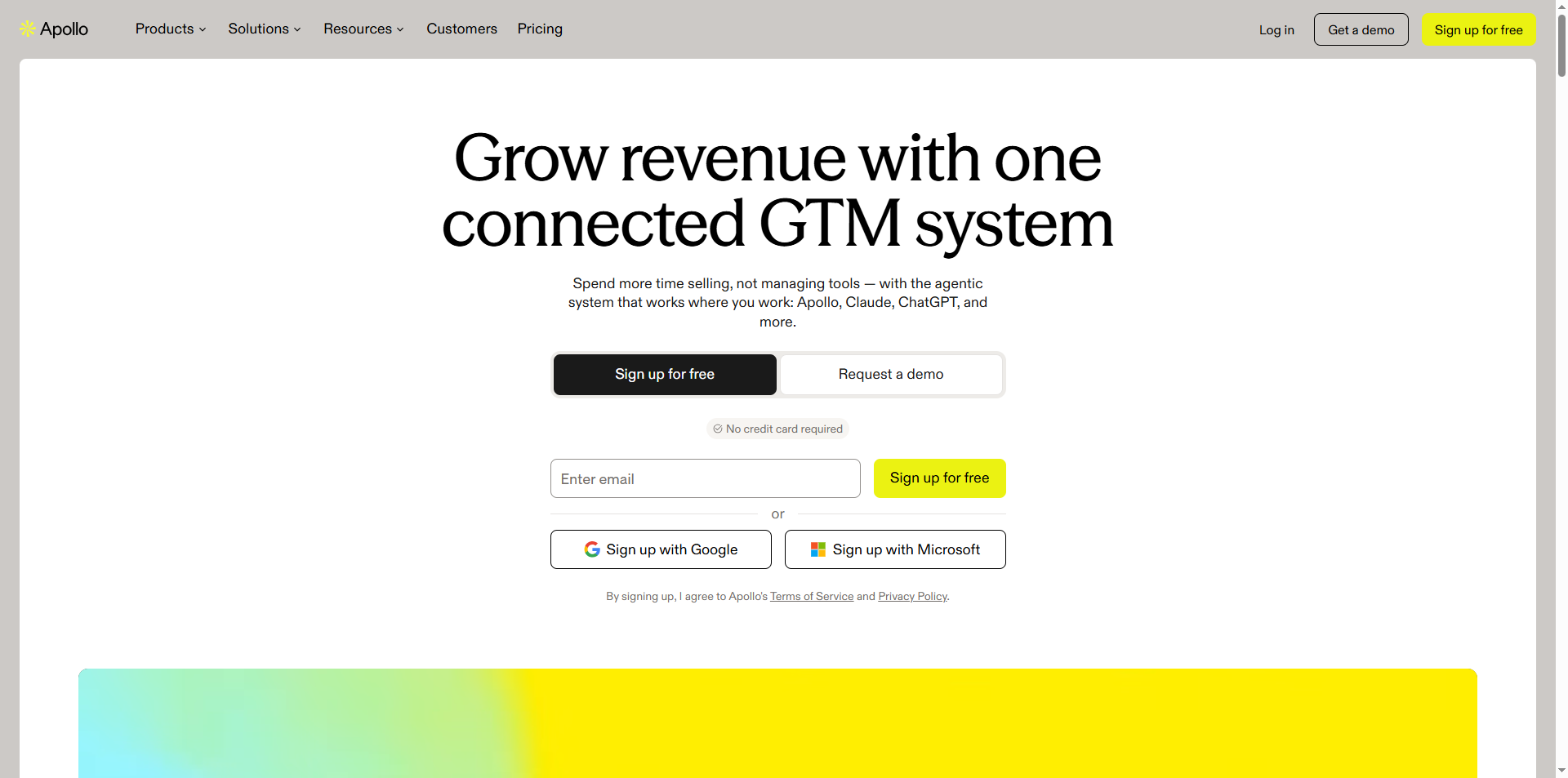
Apollo.io suits teams that want finding and sequencing in one seat. The plan page lists email sequencing and core integrations on the Basic tier, then higher credit limits, AI features and call recording on Professional. That is a platform pitch. You are buying one login that covers more of the outbound workflow, not a single-purpose lookup tool.
It is built for a sales team that would rather pay per user for one system than stitch a finder, a sequencer and a dialer together. If you send outbound at volume and your reps live in one tool all day, that trade makes sense. If one person pulls a list a month and sends it from somewhere else, you are paying for a platform you will not use.
Pricing:
| Plan | Price | Billing Basis | What It Includes |
|---|---|---|---|
| Free | Free tier listed | Per user | Entry tier, credit counts not shown on the page |
| Basic | Pricing on request | Per user | Email sequencing and core integrations |
| Professional | Pricing on request | Per user | Higher credit limits, AI features and call recording |
| Custom | Pricing on request | Per user | Tailored terms |
Plan names and contents come from Apollo.io's pricing page. Apollo.io's pricing is on request, so ask for a quote before you compare it with a credit-priced tool.
Strengths:
- One seat, several jobs: Sequencing sits on the Basic plan, so finding and sending can live together.
- Clear tier ladder: Four named tiers make it easy to see where call recording and AI features start.
- A free tier exists: You can open an account and look at the data before you talk to sales.
Trade-offs:
- Per-user billing: Every added rep adds a seat, so cost grows with headcount rather than with list size.
- No prices to compare: You cannot put Apollo.io next to UpLead or Hunter.io on cost until you get a quote.
- Higher limits sit on higher tiers: The credit limits that matter for volume work are on Professional and above.
Key capabilities:
- Email sequencing on the Basic plan
- Core integrations on the Basic plan
- Higher credit limits on the Professional plan
- AI features and call recording on the Professional plan
Good fit:
- Outbound teams that want finding and sequencing under one login
- Teams that already count cost per rep rather than cost per contact
Not a fit:
- Solo users who need a handful of contacts a month
- Buyers who must see a public price before they open a conversation
The limitation that matters most is cost planning. The plans are billed per user and the credit limits climb with the tier, so you need a quote before Apollo.io can be compared with a credit-priced tool. If team workflow and CRM handoff are what you are weighing, our guide to email finder tools for sales teams covers that angle.
2. UpLead: Best For Verified Accuracy And Transparent Credit Pricing
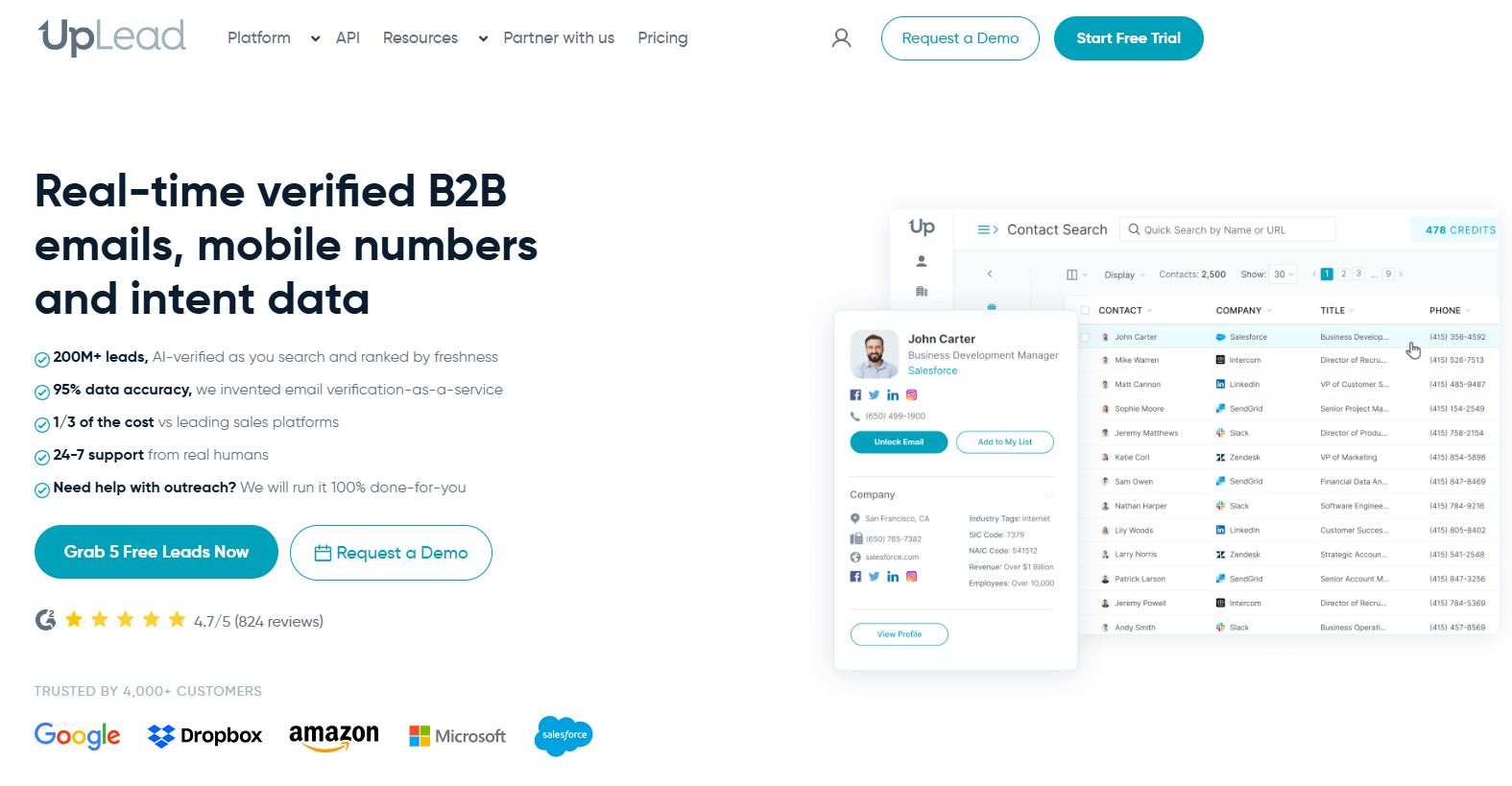
UpLead is the easiest tool on this list to budget for. It sells credits, it prints the credit allowance for each plan, and it prints the overage rate. You can work out what a month costs before you open a trial.
Accuracy is UpLead's pitch, and the pitch is the vendor's. We did not read an accuracy guarantee on UpLead's own pricing page, so we do not repeat one. This pick rests on pricing clarity and on a credit structure you can model. The accuracy question belongs to your trial list.
Pricing:
| Plan | Price | Billing Basis | What It Includes |
|---|---|---|---|
| Free Trial | Free | 7 days | 5 credits |
| Essentials monthly | $99 per month | Monthly | 170 credits, $0.60 per extra credit |
| Plus monthly | $199 per month | Monthly | 400 credits, $0.50 per extra credit |
| Essentials annual | $74 per month | Annual | 2,040 credits per year |
| Plus annual | $149 per month | Annual | 4,800 credits per year |
| Professional | Pricing on request | Annual only | Team seat management |
UpLead's pricing page shows Essentials at $99 per month for 170 credits and Plus at $199 per month for 400 credits. Extra credits cost $0.60 on Essentials and $0.50 on Plus. Annual billing brings Essentials to $74 per month and Plus to $149 per month.
Strengths:
- Published prices: Every tier except Professional shows a price and an allowance.
- Known overage rate: You know what a spike in demand costs before it happens.
- Cheaper per credit on annual billing: Annual Plus works out far below monthly Essentials per credit.
Trade-offs:
- Small trial: Five credits in seven days is a look, not a test.
- Credit caps: A busy month forces an upgrade or per-credit overage.
- Professional is annual only: Team seat management sits behind a custom quote.
Key capabilities:
- Credit allowances stated per plan
- Overage priced per extra credit
- Annual billing with a lower monthly rate
- Team seat management on Professional
Good fit:
- Buyers who want to model cost before committing
- Teams whose monthly volume sits close to a plan allowance
Not a fit:
- Teams that need hundreds of lookups on a free plan
- Buyers who will not commit to annual billing for the lowest rate
The limitation that matters most is the credit cap. Run past 170 or 400 credits in a month and you either upgrade or pay the per-credit overage. For readers who care mostly about verification, our list of tools to find work emails widens the shortlist.
3. Lusha: Best For Verified Mobile Numbers On A Small Budget
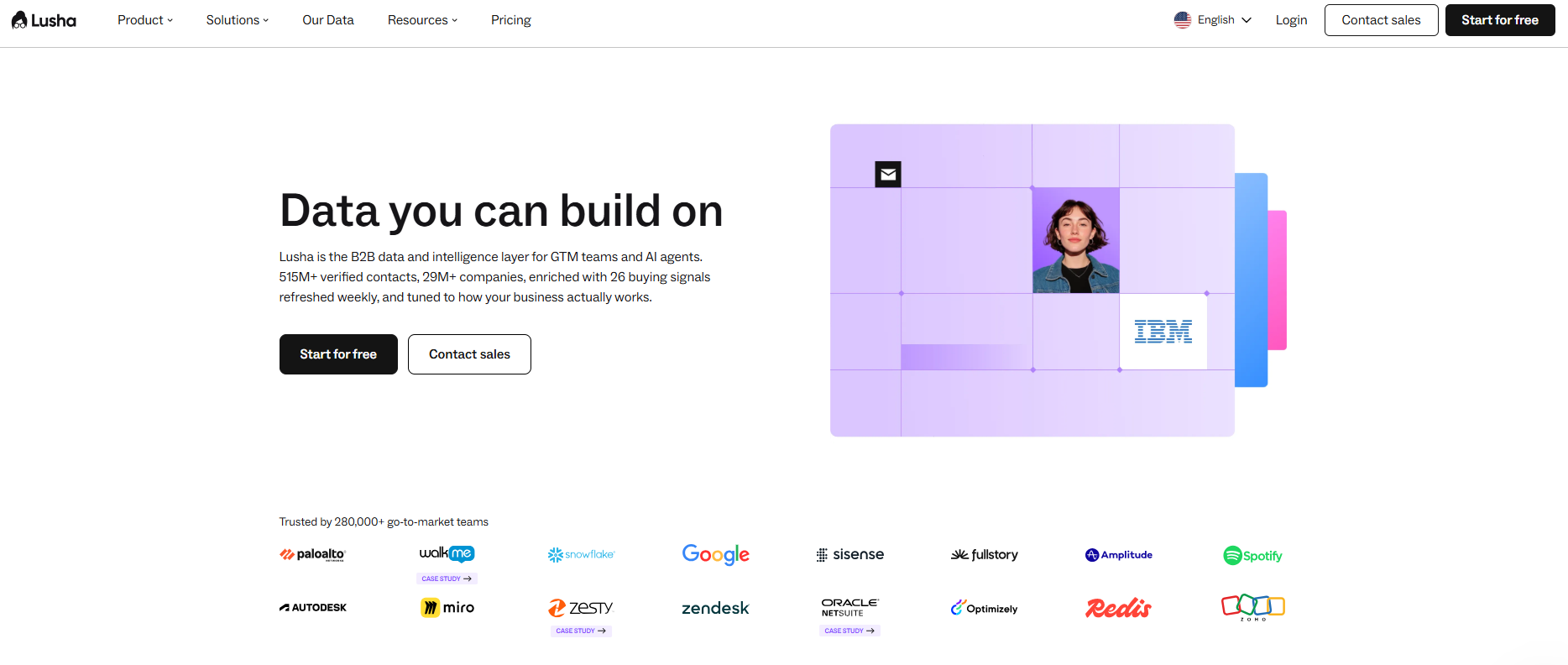
Lusha is the pick when phone numbers are the job. Its credit weighting tells you the whole story. Lusha's pricing page charges 1 credit for a verified email reveal and 5 credits for a phone number reveal. A phone costs five times what an email costs, so a phone-heavy workflow burns through credits five times faster than an email-only one.
The free plan includes 40 credits per month. That buys 40 email reveals or 8 phone number reveals, according to the same page. Eight mobile numbers is enough to judge a handful of known contacts, not enough to judge a list.
Pricing:
| Plan | Price | Billing Basis | What It Includes |
|---|---|---|---|
| Free | Free | Monthly | 40 credits per month |
| Paid plans | Pricing on request | Monthly or annual | Credits that roll over up to twice the plan limit on monthly plans |
| Scale | Custom | Annual | Custom terms |
Rollover rules are on Lusha's pricing page. On monthly plans, unused credits roll over up to twice the plan limit. On annual plans, credits are issued upfront and reset at the end of the annual cycle.
Strengths:
- A free plan with 40 credits: Enough to check a few contacts before you pay.
- Rollover on monthly plans: A slow month does not waste the whole allowance.
- Phone numbers are a first-class product: The credit table prices them in plainly.
Trade-offs:
- Phones cost 5 credits: A phone-heavy list drains a plan quickly.
- No public paid prices: You need a quote to size a paid plan.
- Annual credits reset: Unused annual credits do not carry past the cycle.
Key capabilities:
- Verified email reveals at 1 credit each
- Phone number reveals at 5 credits each
- A free plan with 40 credits per month
- Rollover up to twice the plan limit on monthly plans
Good fit:
- Reps who call before they email
- Small teams that want to test phones on a free plan first
Not a fit:
- Anyone who only needs email addresses at scale
- Buyers who need a published price for every paid tier
The limitation that matters most is that phone work burns credits five times faster than email work, so a phone-first team should size the plan on phones, not on emails. If budget is the constraint, our roundup of the best free email finder tools lists more free ways in.
4. Snov.io: Best For Budget-Limited Teams Combining Finding And Outreach
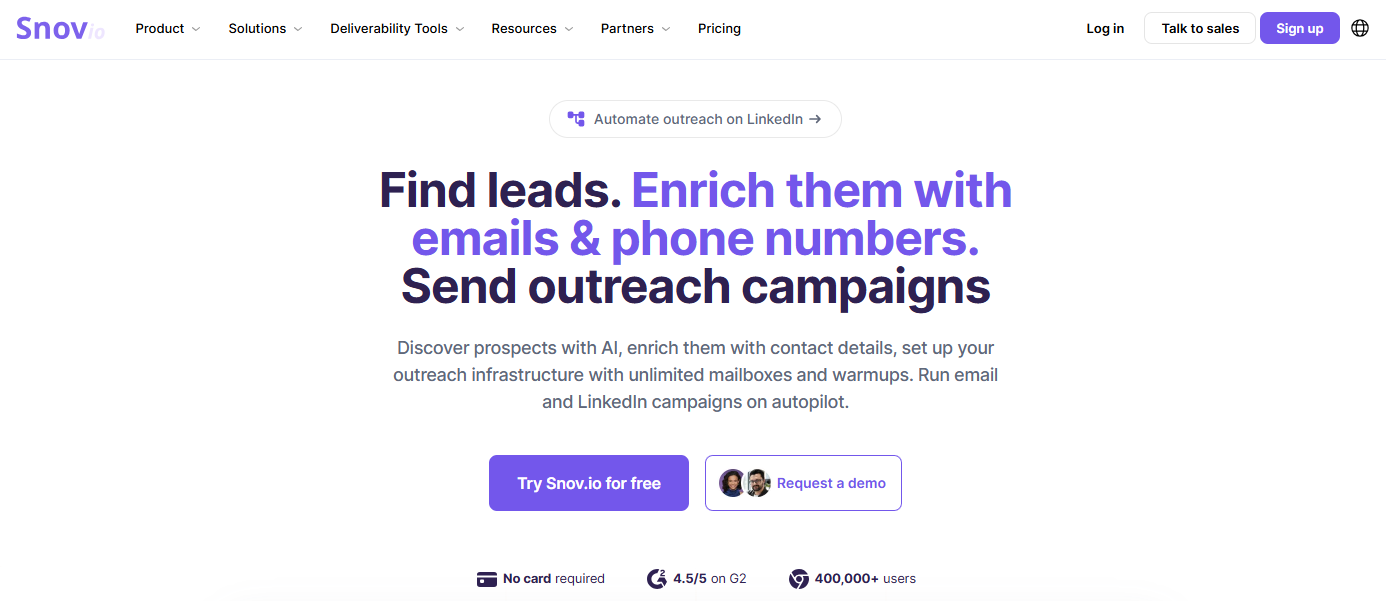
Snov.io has the lowest published paid entry price on this list, and it also covers sending. Snov.io's pricing page puts Starter at $39 per month with 1,000 credits and unlimited team seats. That seat note matters. A tool that charges per user gets more expensive every time you hire. A tool with unlimited seats on its cheapest plan does not.
Starter also includes 5,000 recipients, 75 enrichment tokens and 3 warm-up accounts, so it leans toward teams that find contacts and send from the same place. The trade-off against single-purpose finders is focus. You pay for outreach features whether or not you use them.
Pricing:
| Plan | Price | Billing Basis | What It Includes |
|---|---|---|---|
| Starter | $39 per month | Monthly | 1,000 credits, 5,000 recipients, 75 enrichment tokens, 3 warm-up accounts, unlimited team seats |
| Pro S | $99 per month | Monthly | 5,000 credits, 25,000 recipients |
| Pro M | $189 per month | Monthly | 20,000 credits |
| Pro L | $369 per month | Monthly | 50,000 credits |
| Ultra | $738 per month | Monthly | 100,000 credits |
Snov.io's pricing page lists three-month billing at 5% off and annual billing at 25% off. The annual prices are not shown, so the table carries monthly figures only.
Strengths:
- Low entry price: $39 per month is the lowest published paid price on this list.
- Unlimited seats on Starter: Headcount does not change the bill.
- Steep credit ladder: Ultra gives 100,000 credits, so one vendor can grow with you.
Trade-offs:
- Credit meaning is unclear: The page we read does not say how many credits one lookup uses, so a credit is not a contact.
- Outreach features come with it: Teams that only want a finder pay for more than they use.
- Annual prices are not shown: The 25% discount cannot be turned into a figure from the page.
Key capabilities:
- Credits from 1,000 up to 100,000 per month
- Unlimited team seats on Starter
- 5,000 to 25,000 recipients on the lower plans
- Warm-up accounts on Starter
Good fit:
- Small teams that want finding and sending in one subscription
- Companies that expect to add reps without adding seat fees
Not a fit:
- Buyers who need to know exactly what one credit buys before they sign
- Anyone who wants a phone-first product
The limitation that matters most is that credits and contacts are different things, and the pricing page does not say how many credits one lookup uses. Price the plan per credit, then test how many credits your own list actually consumes.
5. Hunter.io: Best For Email-Only Finding With Built-In Verification
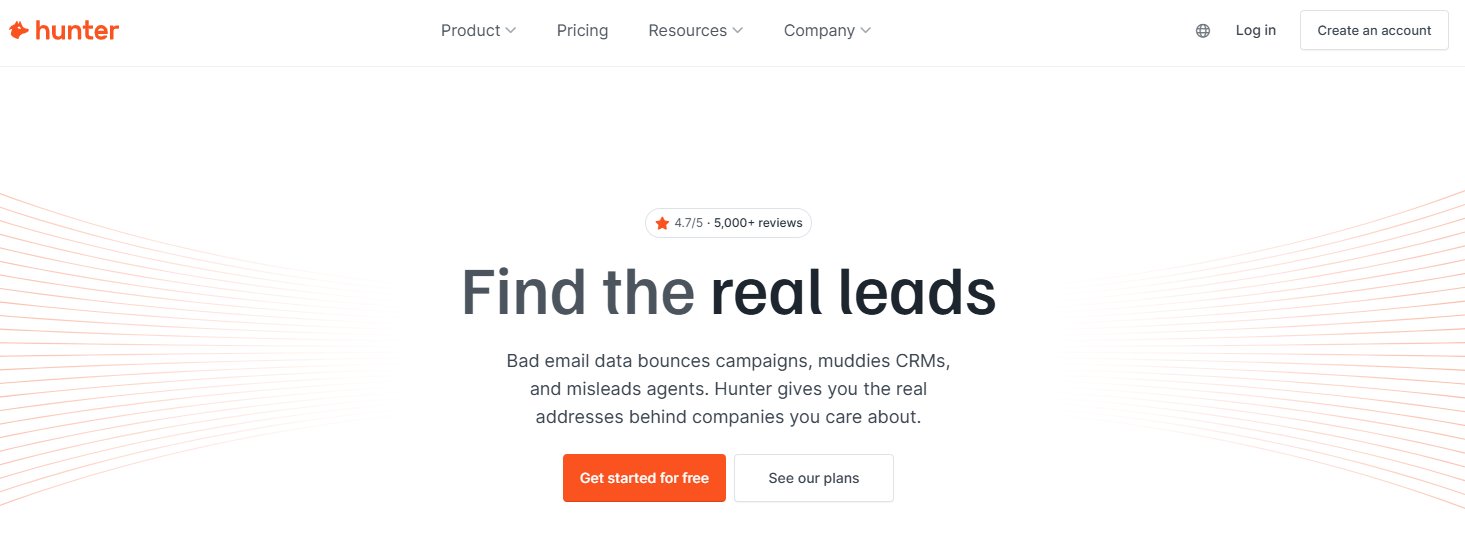
Hunter.io does one job and says so. It finds and verifies email addresses. If you do not need phone numbers, that focus is a feature. Hunter.io's email verifier page says the verifier runs nine checks per address. They are format, gibberish, disposable domain, webmail, MX, SMTP reachability, SMTP mailbox, accept-all detection and accept-all verification. It sends no emails while doing it.
The same page states a bounce rate below 1% for addresses Hunter.io verifies as valid. That is the vendor's own claim, with no independent test behind it, and the page itself says verification cannot prevent all bounces. Read it as a target to test against, not a guarantee.
Pricing:
| Plan | Price | Billing Basis | What It Includes |
|---|---|---|---|
| Free | Free | Monthly | 50 credits per month, 1 connected email account |
| Starter | $49 per month ($34 yearly) | Monthly or yearly | 2,000 credits, 3 email accounts |
| Growth | $149 per month ($104 yearly) | Monthly or yearly | 10,000 credits, 10 email accounts |
| Scale | $299 per month ($209 yearly) | Monthly or yearly | 25,000 credits, 20 email accounts |
| Enterprise | Pricing on request | Custom | Custom terms |
All figures are from Hunter.io's pricing page, which also states that credits reset monthly with no rollover.
Strengths:
- Verification is built in: Nine named checks run on every address, and no email is sent.
- Low cost per credit at scale: Scale works out to about $0.012 per credit.
- Native HubSpot and Pipedrive integrations: Hunter.io lists Zapier for most other platforms and a free API for all users.
Trade-offs:
- Email only: There is no phone number product on the pages we read.
- No rollover: Unused credits vanish at the end of each month.
- Credit use is unclear: The pages we read do not say how many credits one verification uses.
Key capabilities:
- Nine verification checks per address
- Native HubSpot and Pipedrive integrations
- Zapier for most other platforms
- A free API for all users
Good fit:
- Teams that only need email addresses and want them checked
- HubSpot or Pipedrive users who want a native connection
Not a fit:
- Anyone who needs phone numbers
- Teams with lumpy monthly volume, because credits do not roll over
The limitation that matters most is that credits reset monthly with no rollover, so a quiet month wastes the allowance. If email is the whole job, our guides to the best email finder tools and Hunter.io alternatives go further.
📋 Get Listed / Advertise
We update this guide monthly. Want your tool featured? Contact: [email protected].
How Credits, Lookups, And Seats Change What A Contact Costs
Plan price is not contact price. Two plans with the same sticker price can hand you very different numbers of contacts, because the unit being sold is different. There are three models in play.
- Credit-based plans: Credit-based plans charge per reveal or lookup, and they favour buyers who know their monthly volume.
- Lookup-and-export plans: Lookup-and-export plans, which is how RocketReach sells, charge per found contact inside a quota, and they favour buyers whose lists have a high hit rate.
- Seat-based plans: Seat-based plans charge per user with credit limits that vary by tier, and they favour small teams that will not grow.
The RocketReach side of this is easy to misread. Emelia's calculation puts RocketReach Essentials at about $0.19 per export on annual billing with the full quota used, and RocketReach Ultimate at about $0.07 per export. Those are the author's figures, not RocketReach's own price list. Emelia also notes that RocketReach counts lookups and exports rather than credits, and that a lookup counts only when an email or phone is found and verified.
That detail changes the comparison. A credit-based tool charges you when you reveal a contact, whether or not the contact later bounces. A lookup-and-export tool charges you only for a found and verified one. The headline price per unit is not comparable until you account for the difference.
Seats add a second distortion. Under per-seat billing, adding a rep adds a fee even if the list stays the same size. Under credit billing, adding a rep costs nothing until that rep burns credits. Snov.io's Starter plan shows the other end, with unlimited team seats at $39 per month. Apollo.io shows the seat model, with plans billed per user. Neither is better in general. Per-seat billing favours a small team with heavy use per person. Credit billing favours a larger team with light use per person.
How We Evaluated These RocketReach Alternatives
We judged each tool on five criteria. Each one changes the decision.
- Verification method: A tool that checks addresses before you send protects your sender reputation, and one that does not pushes that cost onto your bounce rate.
- Credit weighting: One credit for an email and five for a phone number means the same plan buys very different volumes depending on the job.
- Free test option: A free plan or trial lets you test on your own list before you pay, but only if its size is big enough to mean something.
- CRM fit: Contacts that cannot reach your CRM without a manual export cost you hours, so native integrations count.
- Pricing transparency: A published price lets you model cost, and a quote-only plan forces a sales call before you can compare.
The sourcing rule is simple. Prices come only from each vendor's own pricing page. Vendor accuracy claims are attributed to the vendor and never presented as findings. A tool whose pricing page we could not read shows Pricing On Request, with nothing guessed in its place. We did not run our own hit-rate test, so no accuracy ranking appears in this guide. If you want a broader criteria-led list before narrowing down, see our tools for finding B2B contact information.
The Rank Masters also sells SaaS content marketing work, which is why we say plainly how a page like this is built. Read the picks as reasoned from vendor pages, not as lab results.
What One Usable Contact Costs: A Worked Calculation
Cost per usable contact is the price of a credit, divided by the share of lookups that return a contact, then divided by the share of those contacts that do not bounce. Plan price per credit alone ignores both, which is why a cheap credit can still be an expensive contact.
Here is the method in three steps.
- Find the price per credit. Divide the monthly plan price by the credits it includes.
- Divide by the hit rate. If 70 of every 100 lookups return a contact, divide by 0.70.
- Divide by one minus the bounce rate. If 5 of every 100 sent emails bounce, divide by 0.95.
The inputs below are illustrative. We assume a 70% hit rate and a 5% bounce rate. They are not measured results for any tool, and you should replace them with the numbers from your own test. The credit prices are calculated from UpLead's pricing page, Hunter.io's pricing page, Snov.io's pricing page and Lusha's pricing page.
- UpLead Plus, annual: About $0.37 per credit ($149 x 12 / 4,800), divided by 0.70 and by 0.95, is about $0.56 per usable contact.
- UpLead Essentials, monthly: About $0.58 per credit ($99 / 170), divided by 0.70 and by 0.95, is about $0.87 per usable contact.
- Hunter.io Starter: About $0.025 per credit ($49 / 2,000), divided by 0.70 and by 0.95, is about $0.038 per usable contact.
- Snov.io Starter: About $0.039 per credit ($39 / 1,000), divided by 0.70 and by 0.95, is about $0.059 per usable contact.
- Lusha, 40 free credits: One credit per email and five per phone number. Dividing by the same 0.70 and 0.95, an email costs about 1.5 credits and a phone number about 7.5 credits.
| Tool And Plan | Price Per Credit | Illustrative Cost Per Usable Contact |
|---|---|---|
| UpLead Plus annual | About $0.37 | About $0.56 |
| UpLead Plus monthly | About $0.50 | About $0.75 |
| UpLead Essentials annual | About $0.44 | About $0.66 |
| UpLead Essentials monthly | About $0.58 | About $0.87 |
| Hunter.io Starter | About $0.025 | About $0.038 |
| Hunter.io Scale | About $0.012 | About $0.018 |
| Snov.io Starter | About $0.039 | About $0.059 |
| Snov.io Pro S | About $0.020 | About $0.030 |
Read this table with care. A credit is not always a contact. The pages we read for Hunter.io and Snov.io do not say how many credits one lookup or verification uses, so those rows assume one credit per lookup. If a lookup uses two credits, double the result. UpLead's row makes the same assumption for the same reason. The gap between UpLead and Hunter.io here comes from how many credits each plan includes at its price, and the products are not like for like, so the table shows how to do the sum and nothing more.
RocketReach does not fit this formula cleanly. Emelia's calculation is per export, and an export already counts only found and verified contacts, so the hit rate is partly inside the number. Compare it with the other rows only after you have run your own test.
How To Choose: A Decision Rule By Job
Pick the tool for the job you do most, and let a trial overrule the table. Before you switch anything, run one check. If a test on your own list shows no measurable gap in hit rate or bounce rate against RocketReach, stay where you are. A cheaper tool with the same results is a saving. A cheaper tool with worse results is a cost that shows up later in your reply rate.
| Job | Pick | Runner-Up | Reason |
|---|---|---|---|
| High-volume prospecting | Apollo.io | Snov.io | Apollo.io puts finding and sequencing in one seat, and Snov.io offers credit tiers up to 100,000 per month. |
| Verified accuracy | UpLead | Hunter.io | UpLead publishes credit allowances and overage rates, and Hunter.io runs nine verification checks on emails. |
| Mobile numbers | Lusha | No second pick in our research | Lusha prices phone reveals at 5 credits each, so you can plan phone volume exactly. |
| Budget-limited solo use | Snov.io | Hunter.io | Snov.io starts at $39 per month, and Hunter.io offers a free plan with 50 credits. |
| Email-only finding | Hunter.io | Snov.io | Hunter.io focuses on email finding and verification with native HubSpot and Pipedrive integrations. |
Two rules sit behind the table. If you need phones, start with Lusha and size the plan on phone credits, not email credits. If you need emails only, start with Hunter.io and ignore anything that charges you for features you will not use.
Enterprise buyers need a different shortlist, and profiling enterprise tools here would only blur this one. Our ZoomInfo competitors guide covers that end of the market.
Once the list is clean, the next gap is usually the demand that feeds it. If you want help building that demand, look at the GEO + SEO Growth Programme.
How To Test Any Alternative On Your Own List
A test beats a comparison page, including this one. The method below takes about a week and costs little. The sample sizes and stop rules are practitioner advice, not research findings.
- Pull a sample from your current RocketReach export. Take 200 records you already know the outcome for. Record the hit rate RocketReach gave you on them.
- Check what the free tier can cover. Lusha's free plan gives 40 credits a month, which is 8 phone numbers. Hunter.io's free plan gives 50 credits a month. UpLead's trial gives 5 credits over 7 days. None covers 200 records, so test a small slice free and pay for one month to run the full sample.
- Run the same list through each shortlisted tool. Use identical records every time. Record the hit rate, which is the share of records the tool returns.
- Verify before you send. Run every returned address through a verifier. Record how many fail.
- Send a small batch. Send to 50 verified addresses from each tool, from a mailbox you can afford to stress. Record the bounce rate, which is the share of sent emails that fail.
- Compare against RocketReach. Put hit rate, bounce rate and your credit cost side by side. Work out cost per usable contact with the method above.
Our stop rule is simple. Drop any tool whose test batch bounces above 5%, and shortlist a tool that lands below 2%. This is our rule of thumb, not a finding. Bounces damage the mailbox you send from, which is why clean contact data and outbound performance belong in the same conversation.
A cleaner list is one part of a pipeline. If you also want the organic side working, our GEO and SEO growth programme is built for that.
When Staying On RocketReach Still Makes Sense
Stay when a test shows no gap and switching would cost more than it saves. Switch when the same test shows a lower bounce rate or a lower cost per usable contact on your own list.
Two conditions favour staying. The first is workflow. If RocketReach is already wired into your CRM and your reps know it, the switching cost is real, and a small saving will not pay it back. The second is a test that shows no measurable difference. Marketing claims are not a reason to move.
Three signals favour leaving. Your bounce rate climbs, your cost per usable contact is higher than a rival's on the same list, or you need phones and your current plan prices them badly.
On satisfaction, Capterra's alternatives page rates Apollo.io 4.5 out of 5 from 398 reviews and RocketReach 4.1 out of 5 from 140 reviews. Those are user ratings. They measure how reviewers feel about the product, not how accurate the data is, and the review counts differ a lot, so they do not settle anything.
We could not read RocketReach's plan prices on its own pricing page, so this guide quotes none. Check them on the vendor's page before you decide.
FAQs
Are There Any Free RocketReach Alternatives?
Which RocketReach Alternatives Offer Email Verification?
Can One Tool Replace RocketReach For Both Emails And Phone Numbers?
Which Tool Is Best For Scaling Outbound Campaigns?
Is RocketReach Data Accurate?
How Does Per-Seat Licensing Affect A Growing Sales Team Compared With Credits?
How Many Contacts Should I Put In A Trial List?
What Bounce Rate Is Acceptable When I Test A New Tool?
Do These Alternatives Work With HubSpot And Salesforce?
Why Do Vendor-Written Alternatives Lists All Rank Their Own Product First?
If you want a second opinion on your shortlist or on the pipeline behind it, book a thirty-minute call.