

Pick marketing attribution software by where your revenue is recorded, not by feature count. Ecommerce teams that record revenue at checkout should shortlist Triple Whale. B2B teams that record revenue as closed-won deals in a CRM should shortlist Dreamdata or HockeyStack. Ruler Analytics and Adobe Analytics fit narrower cases covered below.
That mapping holds when most conversions follow two or more tracked touches. If they do not, last-click reporting already tells you most of what a paid tool would.
The Rank Masters has not tested these tools first-hand, and most paid prices are not published, so every figure below comes from vendor pages and needs confirming in a demo.
If you want a team to own the reporting around whichever tool you pick, see how the GEO + SEO Growth Programme works. Read the shortlist first, the page will still be there.
📋 Get Listed / Advertise
We update this guide monthly. Want your tool featured? Contact: [email protected].
Marketing Attribution Software At A Glance
Here are the five tools, with entry prices taken from each vendor's own pricing page as checked in October 2026.
| Tool | Best For | Best Fit When Revenue Is Recorded In | Attribution Capability | Entry Price | Free Plan |
|---|---|---|---|---|---|
| Triple Whale | Ecommerce teams led by ad spend | Store checkout | First and last click on Free, multi-touch from Foundation | Pricing on request (paid plans, GMV-based) | Yes |
| Dreamdata | B2B teams led by pipeline | CRM deals | Custom and AI attribution models on Advanced | Pricing on request (Advanced) | Yes |
| HockeyStack | Go-to-market teams reporting on pipeline and ARR | CRM deals | Real-time ROI tracking and performance reporting | Pricing on request (custom plans) | None listed |
| Ruler Analytics | Teams that want published, visit-based pricing | Any, priced by traffic | Multi-touch in every plan | USD 400 per month (up to 10k monthly visits) | None listed |
| Adobe Analytics | Enterprises combining MMM and multi-touch | Enterprise suite | Marketing mix modelling and multi-touch with budget optimisation | Pricing on request (quote only) | None listed |
1. Triple Whale: Best For Ecommerce Teams Led By Ad Spend
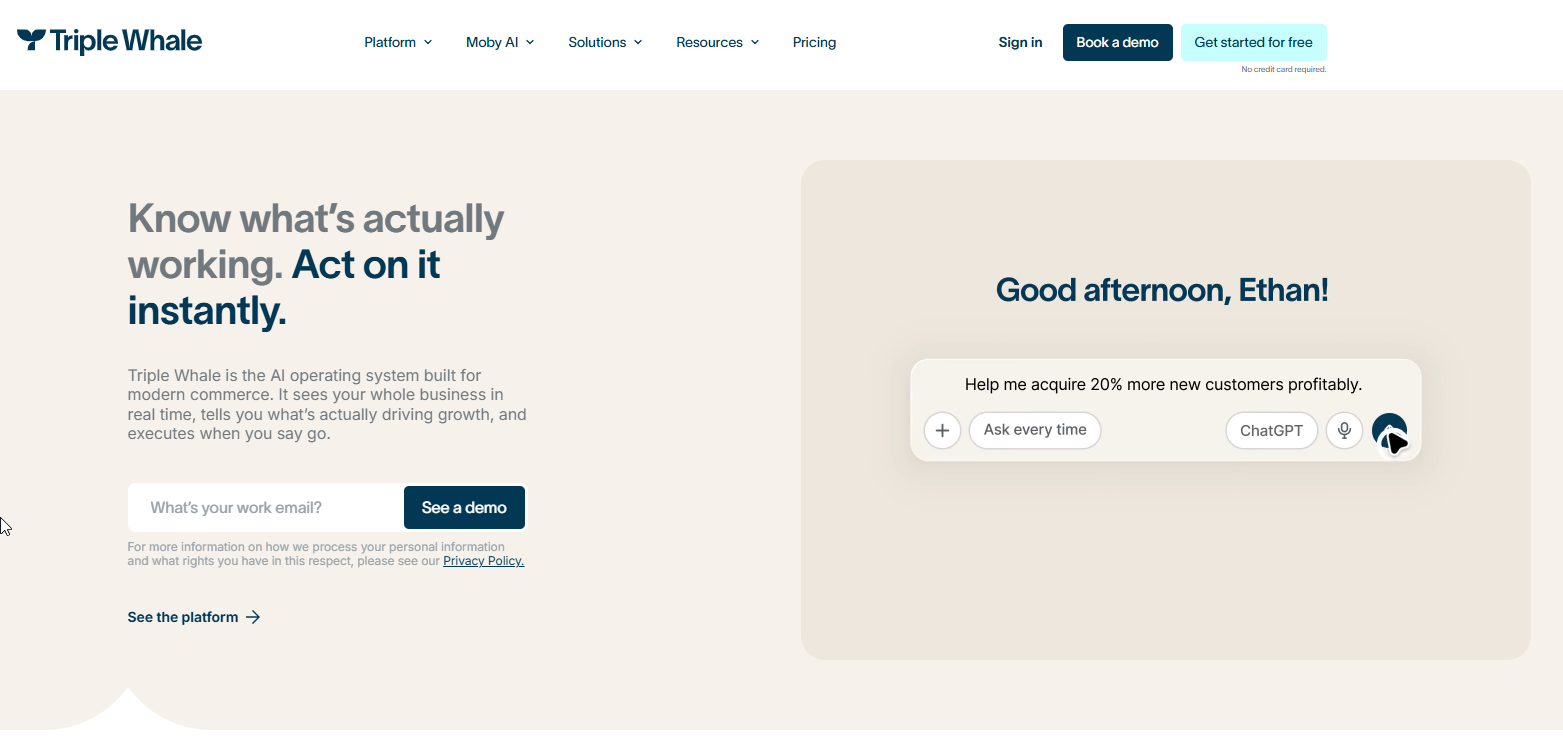
Triple Whale is ecommerce attribution led by ad spend, and its pricing page shows the free plan stops at first and last click attribution, with multi-touch starting on the Foundation plan.
It gives you one unified view of the business, then adds dashboards, customer segments and first-party data activation as you move up the tiers. The top tier adds marketing mix modelling and incrementality, so a store that outgrows plain attribution does not have to switch products.
If you sell through an online store, spend most of your budget on paid channels and want the revenue number to come from checkout, this is your shortlist entry. If you are building the wider stack around it, our guide to AI marketing tools for ecommerce covers the rest.
Triple Whale's pricing page says paid plans run on a 12-month subscription, billed monthly or annual prepaid with two months free, with price set by annual GMV.
| Plan | Price | Billing Basis | What It Includes |
|---|---|---|---|
| Free | Free | No charge | Up to 10 users, unified business view, AI search tracking, first and last click attribution, limited Moby AI, 12 months retention |
| Foundation | Pricing on request | Annual GMV, 12-month subscription | Multi-touch attribution, no-code dashboards, SQL editor, customer segments, first-party data activation |
| Automate | Pricing on request | Annual GMV, 12-month subscription | Adds paid-media actions, scheduled automations and a creative studio |
| Enterprise | Pricing on request | Annual GMV, 12-month subscription | Adds Compass with multi-touch attribution, marketing mix modelling and incrementality, retail integrations, SOC 2 Type 2 |
- Free tier: Yes, with first and last click attribution only.
Strengths:
- The free plan allows up to 10 users and keeps 12 months of data, which is enough to test against a real ledger.
- Paid plans include unlimited users, so reporting access does not become a seat-count argument.
- Multi-touch attribution starts at the first paid tier, Foundation.
- Enterprise puts marketing mix modelling and incrementality in the same product as attribution.
Trade-offs:
- Paid prices depend on annual GMV and need a sales conversation.
- Paid plans run on a 12-month subscription, so a wrong pick costs a year.
- The free plan cannot show you multi-touch results.
- Marketing mix modelling and incrementality sit on Enterprise only.
Key Capabilities:
- Triple Pixel first and last click attribution on the free plan.
- Multi-touch attribution from Foundation upwards.
- No-code dashboards and a SQL editor.
- Customer segments and first-party data activation.
- Scheduled automations and a creative studio from Automate.
Good Fit:
- Online stores where revenue is recorded at checkout.
- Teams that report on ad spend and return on it.
Not A Fit:
- Teams whose revenue closes as deals in a CRM.
- Teams that need a firm budget number before talking to sales.
The limitation that matters most is that you cannot see multi-touch results without paying, and the paid price is only given on a call.
2. Dreamdata: Best For B2B Teams Led By Pipeline
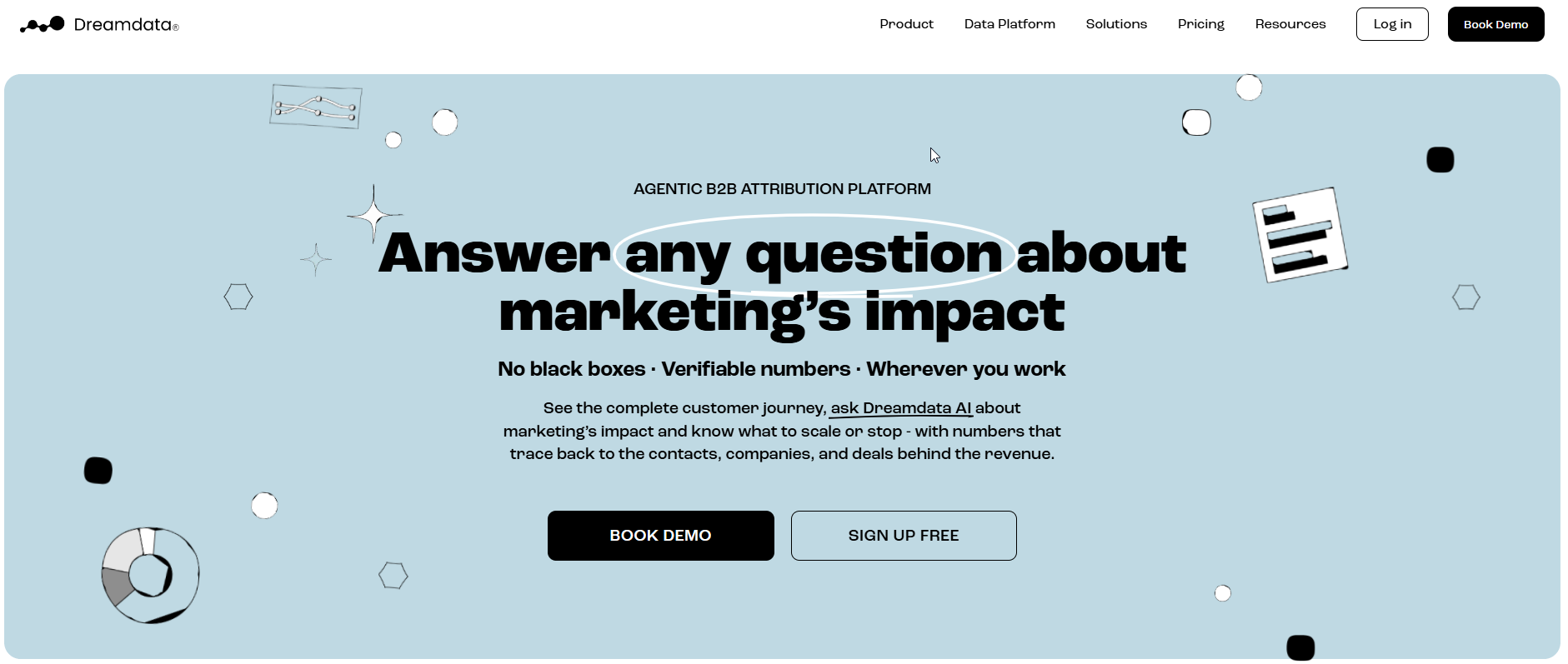
Dreamdata is B2B attribution led by pipeline, and its pricing page lists a free plan with 5 seats and 2 months of history, while the Advanced plan carries no published price.
The free plan covers B2B web analytics, company identification, engagement scoring and an ad spend report, which is a useful first look at which accounts are visiting before you commit to anything. Advanced adds custom and AI attribution models, custom ROI and ROAS reporting, SSO and SAML, an MCP server and a guided trial.
If your revenue is recorded as closed-won deals in a CRM and your board asks about pipeline, Dreamdata belongs on the list. Pipeline-led teams often score leads from the same behaviour data, so our guide to AI lead scoring tools is a sensible next read.
Dreamdata's pricing page shows two plans and a short list of add-ons.
| Plan | Price | Billing Basis | What It Includes |
|---|---|---|---|
| Free | USD 0 per month | No credit card | 5 seats, 2 months of history, B2B web analytics, company identification, engagement scoring, ad spend report |
| Advanced | Pricing on request | Not stated on the page | Custom and AI attribution models, custom ROI and ROAS reporting, SSO and SAML, MCP server, guided trial |
| Add-ons | Pricing on request | Add-ons on Advanced | Data warehouse and SCIM |
- Free tier: Yes, USD 0 per month with no credit card.
Strengths:
- The free plan needs no credit card and includes company identification and engagement scoring.
- Advanced offers custom and AI attribution models rather than a fixed set.
- Custom ROI and ROAS reporting is included on Advanced.
- A guided trial comes with Advanced, which gives you a structured way to run the pre-purchase test below.
Trade-offs:
- The Advanced price is not on the page.
- Add-on prices for the data warehouse and SCIM are also not on the page.
- The free plan keeps only 2 months of history, so it cannot show a long sales cycle.
- The free plan is capped at 5 seats.
Key Capabilities:
- B2B web analytics and company identification.
- Engagement scoring.
- Ad spend reporting.
- Custom and AI attribution models on Advanced.
- SSO, SAML and an MCP server on Advanced.
Good Fit:
- B2B teams whose revenue is recorded as CRM deals.
- Teams that want to see which companies are engaging before they buy.
Not A Fit:
- Stores where revenue is recorded at checkout.
- Teams that need a published paid price before any call.
The limitation that matters most is that the free plan keeps two months of history, which is short for any sales cycle longer than that.
3. HockeyStack: Best For Go-To-Market Teams Reporting On Pipeline And ARR
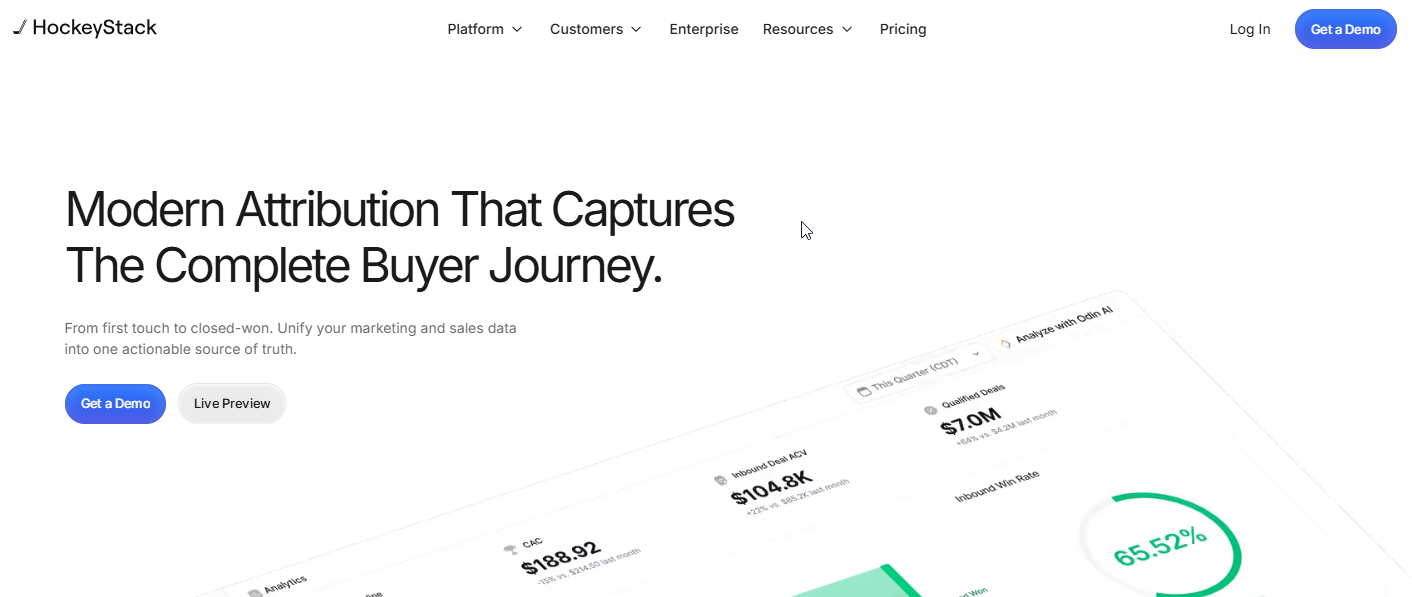
HockeyStack is attribution for go-to-market teams reporting on pipeline and ARR, and its pricing page shows custom plans with no entry price, tiers or currency published.
The pricing page lists integrations with go-to-market tools and CRM, and real-time ROI tracking and performance reporting, as included in every plan. HockeyStack's own best marketing attribution software article frames the product around tying every touchpoint to pipeline and ARR. That is the vendor's positioning, not an independent finding, so test it against your own deals.
It sits in the same decision bucket as Dreamdata. If your revenue closes as CRM deals and the number your leadership wants is pipeline or ARR, you should put HockeyStack in front of both and compare what each does with your ledger.
HockeyStack's pricing page is the source for the table below.
| Plan | Price | Billing Basis | What It Includes |
|---|---|---|---|
| Custom plans | Pricing on request | Custom, no tiers published | Integrations with go-to-market tools and CRM, real-time ROI tracking and performance reporting in every plan |
- Free tier: None listed on the pricing page.
Strengths:
- Integrations with go-to-market tools and CRM are included in every plan.
- Real-time ROI tracking and performance reporting come in every plan, so there is no feature gate to negotiate around.
- The product is aimed squarely at pipeline and ARR reporting.
Trade-offs:
- No price, tier or currency is published.
- No free plan is listed, so you cannot run a self-serve test before talking to sales.
- Without published tiers, you cannot compare what each plan includes.
Key Capabilities:
- Integrations with go-to-market tools and CRM.
- Real-time ROI tracking.
- Performance reporting.
Good Fit:
- Go-to-market teams that report on pipeline and ARR.
- B2B teams whose revenue is recorded as CRM deals.
Not A Fit:
- Teams that want a price they can put in a budget before a sales call.
- Stores that record revenue at checkout.
The limitation that matters most is that with no published price you need a sales call before any budget sign-off.
4. Ruler Analytics: Best For Teams That Want Published, Visit-Based Pricing
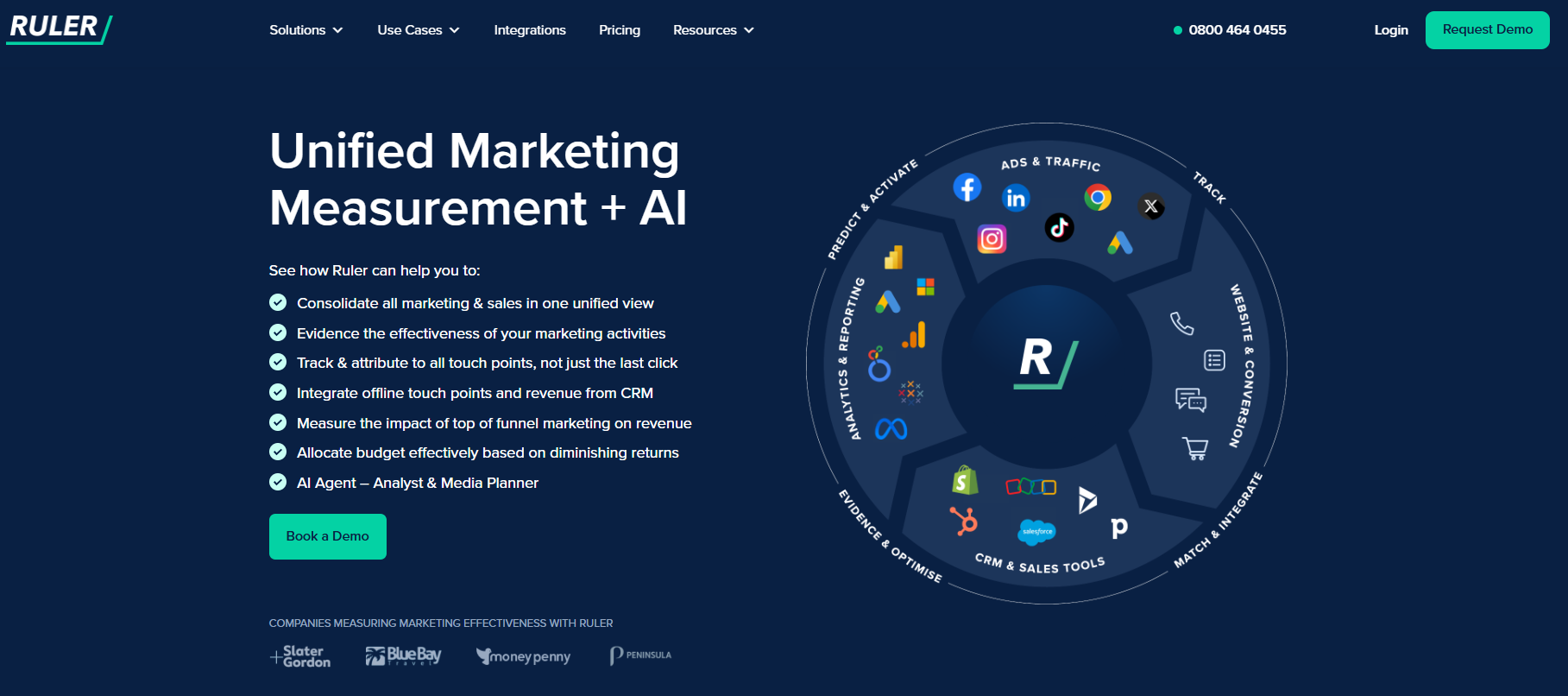
Ruler Analytics is the only tool here with a published paid price table, and its pricing page puts the entry tier at USD 400 per month for up to 10k monthly visits, with multi-touch attribution in every plan.
The page lists four tiers, Small, Medium, Large and Advanced, and prices rise with monthly visits. Data-driven and impression attribution start on Medium. Marketing mix modelling and an AI analyst and media planner agent are on Advanced only.
If you want a budget number before you speak to anyone and your traffic is modest, Ruler gives you one. The page calls the pricing indicative and lists a second, lower figure for each tier, which reads as annual billing.
Ruler Analytics' pricing page is the source for the table below. The second figure in brackets is the lower one.
| Plan | Price Per Month | Billing Basis | What It Includes |
|---|---|---|---|
| Small | USD 400 (USD 360) | Up to 10k monthly visits | Multi-touch attribution |
| Medium | USD 668 (USD 601) | Up to 50k monthly visits | Adds data-driven and impression attribution |
| Large | USD 1326 (USD 1193) | Up to 100k monthly visits | Multi-touch, data-driven and impression attribution |
| Advanced | USD 2000 (USD 1800) | From 100k monthly visits | Adds marketing mix modelling and an AI analyst and media planner agent |
- Free tier: None listed on the pricing page.
Strengths:
- It is the only paid tier table in this set, so you can put a number in a budget today.
- Multi-touch attribution is included in all plans, even Small.
- Data-driven and impression attribution arrive at Medium, not at an enterprise tier.
- Marketing mix modelling is available on Advanced.
Trade-offs:
- The page labels the pricing indicative.
- Price rises with monthly visits, so a high-traffic site climbs tiers fast.
- Marketing mix modelling and the AI agent sit on Advanced only.
- No free plan is listed.
Key Capabilities:
- Multi-touch attribution on every plan.
- Data-driven and impression attribution from Medium.
- Marketing mix modelling on Advanced.
- An AI analyst and media planner agent on Advanced.
Good Fit:
- Teams that want a budget number before a sales call.
- Sites with modest monthly traffic.
Not A Fit:
- High-traffic sites, where the visit-based price climbs through the tiers.
- Teams that want a free plan to test with.
The limitation that matters most is that price follows monthly visits, so growth in traffic pushes you into a higher tier whether or not your marketing spend grew.
5. Adobe Analytics: Best For Enterprises Combining MMM And Multi-Touch
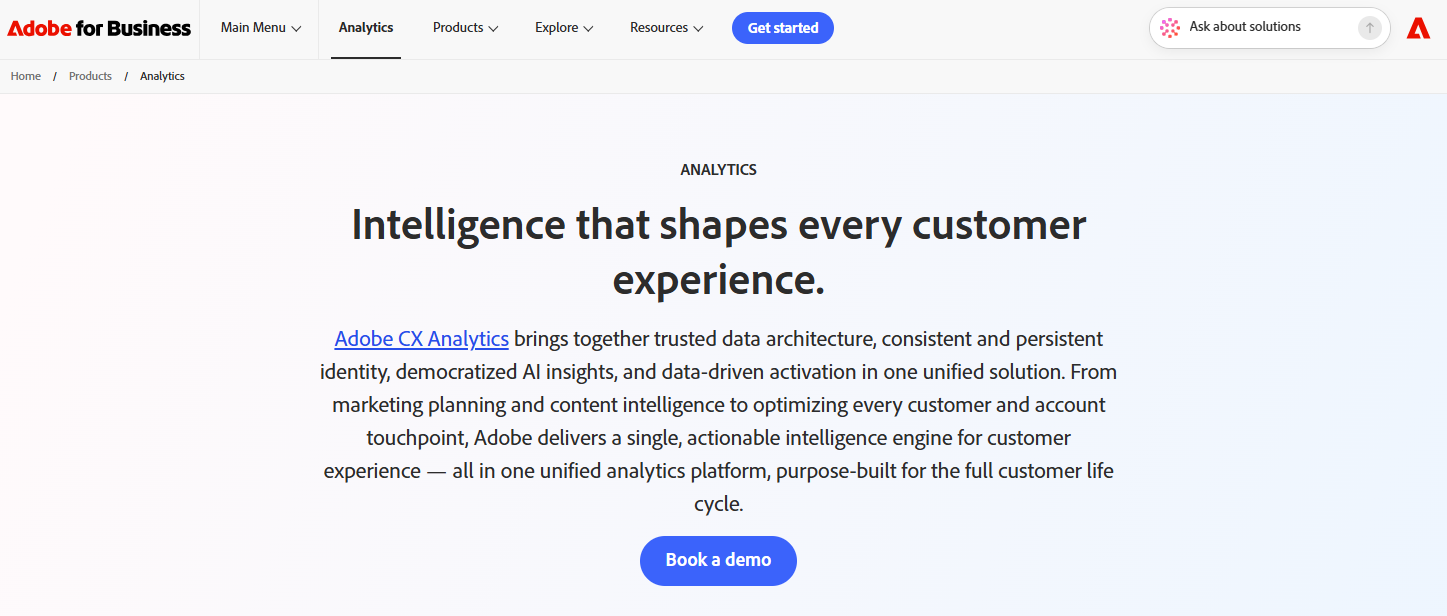
Adobe Analytics is the enterprise pick that combines marketing mix modelling and multi-touch attribution, and its pricing page says pricing is quote only.
Adobe prices on scope, data volume, users and contract length. Its digital analytics packages are named Select, Prime and Ultimate, but the page gives no prices and no per-tier feature lists. Marketing Campaign Analytics unifies marketing mix modelling and multi-touch attribution with budget optimisation.
Cross-channel identity resolution sits in Customer Journey Analytics Prime, with field-based stitching on Select. Enterprise buyers comparing suites should read our guide to AI tools for enterprise SaaS marketing, which covers multi-touch attribution in an enterprise stack.
Adobe's pricing page is the source for the table below.
| Plan | Price | Billing Basis | What It Includes |
|---|---|---|---|
| Digital analytics packages (Select, Prime, Ultimate) | Pricing on request | Quote based on scope, data volume, users and contract length | Per-tier features not itemised on the page |
| Customer Journey Analytics | Pricing on request | Quote only | Cross-channel identity resolution on Prime, field-based stitching on Select |
| Marketing Campaign Analytics | Pricing on request | Quote only | Marketing mix modelling and multi-touch attribution with budget optimisation |
- Free tier: None listed on the pricing page.
Strengths:
- Marketing mix modelling and multi-touch attribution are unified in one product.
- Budget optimisation is part of Marketing Campaign Analytics.
- Cross-channel identity resolution is available in Customer Journey Analytics Prime.
Trade-offs:
- Pricing is quote only and depends on scope, data volume, users and contract length.
- The page names Select, Prime and Ultimate but lists no per-tier features.
- No free plan is listed.
Key Capabilities:
- Marketing mix modelling and multi-touch attribution together.
- Budget optimisation.
- Cross-channel identity resolution on Prime.
- Field-based stitching on Select.
Good Fit:
- Enterprises already running an analytics suite.
- Teams that want mix modelling and multi-touch in one product.
Not A Fit:
- Small teams that want a price before a call.
- Teams that want a free plan to test with.
The limitation that matters most is that every price and tier detail sits behind a quote, so you cannot compare Adobe with the others until you have spoken to sales.
📋 Get Listed / Advertise
We update this guide monthly. Want your tool featured? Contact: [email protected].
What Marketing Attribution Software Does And How The Models Differ
Last-click attribution gives the final interaction 100 percent of the credit, while multi-touch attribution spreads credit across the interactions in a buyer journey and needs stitched journey data and consistent identifiers. Which one suits you depends on journey length and data. Last-click suits short single-touch purchases and small analytics teams, and multi-touch suits multi-step B2B or high-consideration journeys with sizable cross-channel spend.
Marketing attribution software connects your ad spend and customer touches to the revenue they produced. The category runs from simple last-click reporting to journey-level models and, at the top end, marketing mix modelling. Here are the three models you will meet.
- Last-click: The final interaction gets all the credit. It is simple to explain and report, but it over-credits branded search and retargeting.
- Multi-touch: Credit is spread across the buyer journey. It only works if journey data is stitched together and identifiers are consistent.
- Marketing mix modelling: Credit is worked out at aggregate level rather than for individual journeys. Multi-touch complements it rather than replacing it.
That is also why attribution is only as good as the data behind it. If the tool cannot match a visit to a buyer, the model has nothing to spread. Two tracked touches is the point where multi-touch starts to say something last-click cannot.
On size, Grand View Research, as cited in G2's roundup, valued the attribution software market at about USD 5.34 billion in 2025 and projects about USD 10.10 billion by 2030. We have not read the original report, so use it as a signal that the category is large and crowded, nothing more.
A crowded category is why a shortlist rule matters more than a feature list. If you are new to this category and want the broader tool set around it, our guide to AI tools for digital marketing is a useful companion.
How To Evaluate Marketing Attribution Software
We assessed these tools from their vendor pages as checked in October 2026. We did not test them hands-on, and you should not treat this guide as a lab result. Use the criteria below to run your own check against your own data.
Each line names the criterion, then what to check on a vendor page or in a demo.
- Data source and revenue join: Check whether the tool reads revenue from your store or CRM and can match it to your ledger.
- Models by plan: Check which models are on which plan. Multi-touch starts on Foundation at Triple Whale and is in every Ruler Analytics plan.
- Integrations: Check the CRM and ad-platform integrations you already run.
- Cross-channel and cross-device tracking: Check whether one buyer is recognised across channels and devices.
- Privacy and first-party tracking: Check for first-party or server-side tracking and for the privacy features your market requires.
- Speed to first report and ease of use: Ask in writing how long until the first usable report, and who on your team will maintain it.
- Price transparency: Check whether a price is on the page or only on a call.
Weigh your marketing goals, budget and team experience against that list. G2 reports 74 percent satisfaction with HubSpot Marketing Hub's custom attribution models (data pulled 2025), one signal that custom models are rated. Check which plan unlocks them.
If your integration list includes tools that feed attribution data, our guide to AI marketing automation tools covers the other side of that connection.
If AI-search referrals matter to you, ask each vendor whether its tool can separate them from other traffic. If you also want help earning those referrals, our generative engine optimization service covers AI search visibility.
Which Attribution Model And Data Source Fits Your Stack
This rule is the editor's reasoning, not a study. It is built to remove tools from your shortlist, and it takes three questions.
- Where does revenue get recorded? Store checkout points to Triple Whale. CRM closed-won deals point to Dreamdata or HockeyStack. A team that wants a published budget number and pays by traffic looks at Ruler Analytics. An enterprise already running a suite looks at Adobe Analytics.
- Do most conversions follow two or more tracked touches? If not, last-click is enough and the purchase is a reporting purchase. If so, multi-touch is worth paying for.
- Is spend or pipeline the number your board asks about? Spend sets ROAS-style reporting, and pipeline sets ARR-style reporting.
| Stack | Data Source | Model | Shortlist |
|---|---|---|---|
| Online store, revenue at checkout | Store orders and ad spend | Multi-touch, reported as ROAS | Triple Whale |
| B2B, revenue as closed-won CRM deals | CRM deals and web visits | Multi-touch, reported to pipeline and ARR | Dreamdata, HockeyStack |
| Any stack, wants a published budget number | Site visits, priced by traffic | Multi-touch in every plan | Ruler Analytics |
| Enterprise running a suite | Existing suite data | Marketing mix modelling plus multi-touch | Adobe Analytics |
| Few buyers touch more than one channel | Your current platform reports | Last-click | No paid tool needed yet |
Here is a worked example using your own figures. Say you sell through an online store and spend most of your budget on paid channels. Revenue lands at checkout, so question one points to Triple Whale. Open the last ninety days of orders and count how many buyers touched two or more channels before buying. If most did, question two says multi-touch earns its fee. If your board asks about return on ad spend, question three says ROAS-style reporting. If few did, you have saved yourself a purchase.
Attribution is best used to find channels that consistently contribute to revenue, not to assign exact credit. Combine it with incrementality testing and marketing mix modelling when the budget at stake is large. If your team manages paid channels, our guide to AI tools for PPC marketing covers the tools that sit upstream of these reports.
Attribution software only counts the touches your content earns. If those touches are your next gap, see how our SaaS content marketing service builds them.
The Pre-Purchase Test To Run Before You Sign
Run this before you sign anything. Triple Whale and Dreamdata offer free plans, and Dreamdata's Advanced plan comes with a guided trial.
- Pull the last ninety days of revenue from your system of record, whether that is the store or the CRM. The step passes when you have one total you trust.
- Connect the free tier or a trial. Triple Whale's free plan gives only first and last click, so ask for a trial of a plan with multi-touch if you want to test that. The step passes when the tool shows revenue for the same ninety days.
- Compare the tool's revenue total to your ledger, and agree the tolerance before you look. The step passes when the gap is inside that tolerance.
- Compare channel ranking under last-click and under multi-touch, and check the shift in organic credit against keyword rankings over the same period. Semrush Position Tracking shows those rankings over time, so you can tell whether organic moved or only the credit did, and our guide to SEO rank tracking software lists the alternatives. If the ranking barely moves, last-click is enough. The step passes when you can say which channels gained and which lost.
- Ask each vendor in writing how long until the first usable report. The step passes when you have a written answer from every vendor on your shortlist.
If a tool fails step three, do not buy it on the strength of its demo dashboard.
What Marketing Attribution Software Costs
Most paid prices in this category are not published, so the number comes from a demo. Four pricing patterns show up across these five tools.
- Visit-based: Ruler Analytics' pricing page lists tiers from USD 400 per month for up to 10k monthly visits.
- GMV-based: Triple Whale's pricing page says paid plan prices depend on annual GMV.
- Quote only: Adobe's pricing page says pricing is quote only, and HockeyStack and Dreamdata Advanced are also priced on request.
- Free tier: Triple Whale and Dreamdata both offer free plans, with Dreamdata's free plan at USD 0 per month and no credit card.
| Tool | Pricing Basis | Published Price |
|---|---|---|
| Ruler Analytics | Monthly visits | USD 400 to USD 2000 per month, indicative |
| Triple Whale | Annual GMV | Pricing on request for paid plans |
| Dreamdata | Plan | USD 0 on Free, Pricing on request on Advanced |
| HockeyStack | Custom | Pricing on request |
| Adobe Analytics | Quote | Pricing on request |
Work out whether the tool earns its keep with your own numbers. Ruler's published entry price is the one real anchor in this set.
- Annual tool cost: USD 400 per month times 12 is USD 4,800 per year on Ruler's Small tier at the listed monthly figure. Replace this with your quote.
- Annual ad spend or influenced pipeline: Use your own figure.
- Cost ratio: Divide the annual tool cost by the annual ad spend, or by the pipeline the tool influences.
If the ratio looks high, a free tier plus last-click reporting may be enough for now. Reporting setup is a cost too, and our SEO and AI-visibility reporting work is one way teams cover it. Get the final price from a demo before you decide.
FAQs
Is Google Analytics Enough For Marketing Attribution?
What Is The Difference Between Multi-Touch Attribution And Marketing Mix Modelling?
What Is Incrementality Testing, And When Do You Need It?
Why Does My Facebook Ads Revenue Not Match My Actual Revenue?
How Long Does Attribution Software Take To Implement?
Which KPIs Should I Track Once Attribution Is Live?
Is There Free Marketing Attribution Software Worth Using?
Does Multi-Touch Attribution Make Sense With A Short Sales Cycle?
Can One Tool Cover Both Ecommerce And B2B Sales?
If you want a second opinion on your shortlist before you sign anything, book a thirty-minute call. A founder takes it, and you leave knowing which two tools we would trial first.
📑 Disclosure!
Some links in this article are affiliate links. If you sign up through them, The Rank Masters may earn a commission at no additional cost to you. This does not influence which tools we recommend or what we say about them.