The global generative engine optimization (GEO) services market reached an estimated $1.01 billion in 2025 and is projected to grow to $1.48 billion in 2026, according to IntelMarketResearch's GEO Services Market Outlook.
The search landscape has fractured. Google still processes roughly 80% of global query volume, but AI platforms now absorb an estimated 15% to 20% of all informational queries, per Presenc AI's analysis of Similarweb January 2026 AI-chat assistant share data.
ChatGPT alone handles between 250 million and 500 million weekly search-intent queries, Perplexity processes approximately 50 million, and Google AI Overviews now trigger on 25% to 30% of informational queries in the United States. The result is a new category of agency, one that optimizes your brand not just for blue links but for the AI-generated answers your buyers read before they ever visit a website.
This guide evaluates the best AI SEO agencies operating in 2026, ranked by methodology, AI search surface coverage, implementation depth, and transparency. The list is built for B2B SaaS founders, heads of growth, and marketing leaders who need a partner that can connect search visibility to pipeline, not one that repackages keyword reports with AI buzzwords.
▶️ If your ranked pages are not showing up in AI answers and you want a content system that fixes that, book a SaaS content strategy call.
What an AI SEO Agency Actually Does in 2026
An AI SEO agency optimizes your brand for citation and inclusion inside AI-generated search results across Google AI Overviews, ChatGPT, Perplexity, Gemini, and Copilot, in addition to traditional organic rankings.
The discipline combines classical search optimization with entity engineering, structured data layering, and AI visibility monitoring to ensure large language models recognize, trust, and surface your content when buyers ask category-relevant questions.
The distinction from traditional SEO is structural, not cosmetic. Traditional SEO targets page rankings in a list of ten results. AI SEO shifts the optimization unit from pages to entities, meaning your brand, products, expertise, and the relationships between them.
When a buyer prompts ChatGPT with "best project management tool for remote teams" or triggers a Google AI Overview for "compare CRM platforms for mid-market SaaS," the AI engine selects which brands to present as trusted answers rather than which individual pages rank highest.
| Capability | Traditional SEO Agency | AI SEO Agency |
|---|---|---|
| Primary optimization target | Page rankings on Google SERPs | Brand citations across AI answer surfaces |
| Unit of optimization | Individual pages and keywords | Entities, i.e., brand, products, relationships |
| Content structure | Keyword-optimized long-form | Citation-ready, extractable, entity-rich |
| Technical foundation | Crawlability, Core Web Vitals, schema | AI crawler access, structured data for LLMs, entity disambiguation |
| Authority signals | Backlinks and domain authority | Earned media mentions, third-party citations, brand salience |
| Measurement | Rankings, traffic, conversions | AI citations, share of voice in LLM responses, mention rate |
| Platforms covered | Google, sometimes Bing | Google, AI Overviews, ChatGPT, Perplexity, Gemini, Copilot |
Two distinct service categories exist under the "AI SEO" label, and confusing them is the most expensive mistake buyers make. The first category includes agencies that use AI-powered tools to automate traditional SEO workflows, such as faster audits, AI-generated content, and automated reporting. The second category, and the focus of this guide, includes agencies that optimize your brand to be cited in AI-generated answers.
A Muck Rack Generative Pulse analysis from May 2026 found that 84% of AI citations come from earned media rather than brand-owned pages, reinforcing that AI visibility is an authority and content architecture problem, not a content volume problem.
For a deeper look at how these services break down by function, see the guide to SEO and AEO services for AI search visibility.
How We Evaluated These AI SEO Agencies
Every agency on this list was assessed against six criteria designed to separate genuine AI search optimization capability from rebranded traditional SEO.
| Evaluation Criterion | What It Measures | Weight |
|---|---|---|
| AI search surface coverage | Optimization across Google AI Overviews, ChatGPT, Perplexity, Gemini, and Copilot, not just one platform | High |
| Technical SEO foundation for AI extractability | Ability to diagnose crawlability for AI crawlers, JavaScript rendering, entity ambiguity, and content duplication | High |
| Published methodology and original research | Whether the agency has published frameworks, studies, or case data demonstrating how its approach works | Medium |
| Implementation support and shipping speed | Whether recommendations get deployed or remain in slide decks | Medium |
| Measurement and reporting maturity | Tracking AI citations, share of voice, and brand mentions across platforms, not just traditional rankings | Medium |
| Pricing transparency | Willingness to publish or discuss pricing ranges rather than hiding behind sales calls | Lower |
The list is unranked. Each agency serves a different buyer profile, and the right choice depends on whether your bottleneck is technical scale, content authority, AI citations, or revenue measurement.
Comparison Table of All AI SEO Agencies
| Agency | Best For | Core AI SEO Strength | Pricing Model (2026) | AI Platforms Covered |
|---|---|---|---|---|
| iPullRank | Large, technically complex sites | Technical SEO + GEO thought leadership | Custom retainer | AIO, ChatGPT, Perplexity, Gemini |
| Omniscient Digital | B2B SaaS organic growth | Content-led GEO with digital PR | Retainer from ~$10,000/mo | AIO, ChatGPT, Perplexity |
| First Page Sage | Enterprise and AI software companies | Thought leadership SEO + early GEO adoption | Custom retainer | AIO, ChatGPT, Claude, Gemini, Perplexity |
| Grow and Convert | B2B teams needing BOFU-first strategy | Pain-point SEO with AI visibility layer | Custom retainer | Custom retainer |
| Onely | Enterprise teams with JavaScript-heavy sites | Technical SEO for AI extractability | Custom retainer | AIO, ChatGPT, Perplexity, Gemini |
1. iPullRank
Best for: Large, technically complex websites that need to win classic rankings and AI citations together.
iPullRank is a technical SEO and content engineering agency led by Mike King, one of the most cited practitioners in generative engine optimization. The New York-based firm pairs deep technical SEO with applied research on how AI engines parse, extract, and cite web content.
Key capabilities:
- AI search optimization scope: Combines technical SEO audits with entity optimization, structured data engineering, and AI crawler accessibility testing across Google AI Overviews, ChatGPT, and Perplexity
- Content engineering methodology: Builds content specifically for LLM extractability using entity-attribute-value frameworks, citation-ready data structures, and semantic density optimization
- Technical depth: Addresses JavaScript rendering issues, crawl budget optimization for AI bots, and structured data deployment at enterprise scale
- Published research: Regularly publishes original research and frameworks on GEO, making its methodology transparent and auditable
Pricing: Custom retainer based on scope. Enterprise technical SEO engagements in 2026 typically start at $10,000 to $15,000 per month, per Stackmatix's AI SEO Services Pricing Guide (2026).
Pros:
- Among the deepest technical SEO capabilities in the market
- Original, published thinking on GEO methodology
- Strong track record with technically complex, large-scale sites
Cons:
- Premium pricing puts it beyond reach for early-stage companies
- Primarily serves enterprise clients, so engagement structure may not flex for smaller teams
When to choose it: Your site has thousands of pages, complex JavaScript rendering, and you need an agency that can solve both technical crawlability and AI citation problems simultaneously.
For teams evaluating technical SEO tooling alongside agency support, the best AI visibility tools for crawler analytics comparison covers the monitoring side of this work.
2. Omniscient Digital
Best for: B2B SaaS companies seeking organic growth through content-led generative engine optimization.
Omniscient Digital focuses exclusively on organic growth for B2B software companies, combining SEO, content strategy, digital PR, and analytics into a unified engagement. Its GEO work includes LLM visibility analysis, competitor citation analysis, technical optimization, and ongoing monitoring of AI search visibility.
Key capabilities:
- GEO-specific services: LLM visibility analysis, brand mention growth campaigns, and content restructuring for AI extractability
- Content strategy depth: Builds topic clusters mapped to buyer journey stages, with content structured for both traditional rankings and AI citation
- Digital PR integration: Earned media campaigns designed to generate the third-party mentions that AI engines preferentially cite
- Measurement maturity: Tracks AI citations and share of voice alongside traditional SEO metrics
Pricing: Full-service retainers start at approximately $10,000 per month, per publicly available pricing. Project-based GEO audits are available for teams testing the approach.
Pros:
- Pure B2B SaaS focus means every benchmark and playbook maps to software buying cycles
- Integrates content, digital PR, and GEO into a single retainer rather than selling them separately
- Transparent about methodology and outcomes
Cons:
- Does not serve e-commerce, local businesses, or non-software verticals
- Retainer minimums exclude companies in the earliest stages
When to choose it: You are a growth-stage or mid-market B2B SaaS company that needs a content partner who understands software buying cycles and can build AI citation authority alongside organic rankings.
3. First Page Sage
Best for: Enterprise and AI software companies needing expert-driven thought leadership content.
First Page Sage has operated since 2009, building a methodology centered on expert-driven thought leadership content that earns both Google rankings and AI citations. The firm was among the first agencies to publish original research on GEO, and its clients earn recommendations across ChatGPT, Claude, Gemini, Perplexity, and Google AI Overviews.
Key capabilities:
- Thought leadership focus: Produces expert-level content for highly technical industries, earning trust from sophisticated B2B buyers
- Multi-platform AI optimization: Tracks and optimizes for citations across five major AI platforms, not just Google AI Overviews
- GEO research: Published original studies on generative engine optimization, providing a transparent, research-backed methodology
- Long track record: Over 17 years of operation provides stability and institutional knowledge
Pricing: Custom retainer based on scope and vertical competitiveness. Enterprise engagements typically align with the $10,000 to $25,000 per month range for comprehensive AI SEO strategy, according to Passionfruit's AI SEO Agency Services and Pricing guide.
Pros:
- Deep expertise in AI and enterprise software verticals
- Original GEO research provides transparency and credibility
- Covers all five major AI search platforms
Cons:
- Premium positioning means less flexibility for smaller budgets
- Content style is expert-driven rather than product-led, which may not fit all B2B SaaS motions
When to choose it: You are an AI or enterprise software company that needs thought leadership content produced by subject-matter writers, and you want multi-platform AI visibility coverage.
To understand how expert content translates into AI citations, the B2B SaaS content benchmarks for 2026 provide the underlying performance data.
4. Grow and Convert
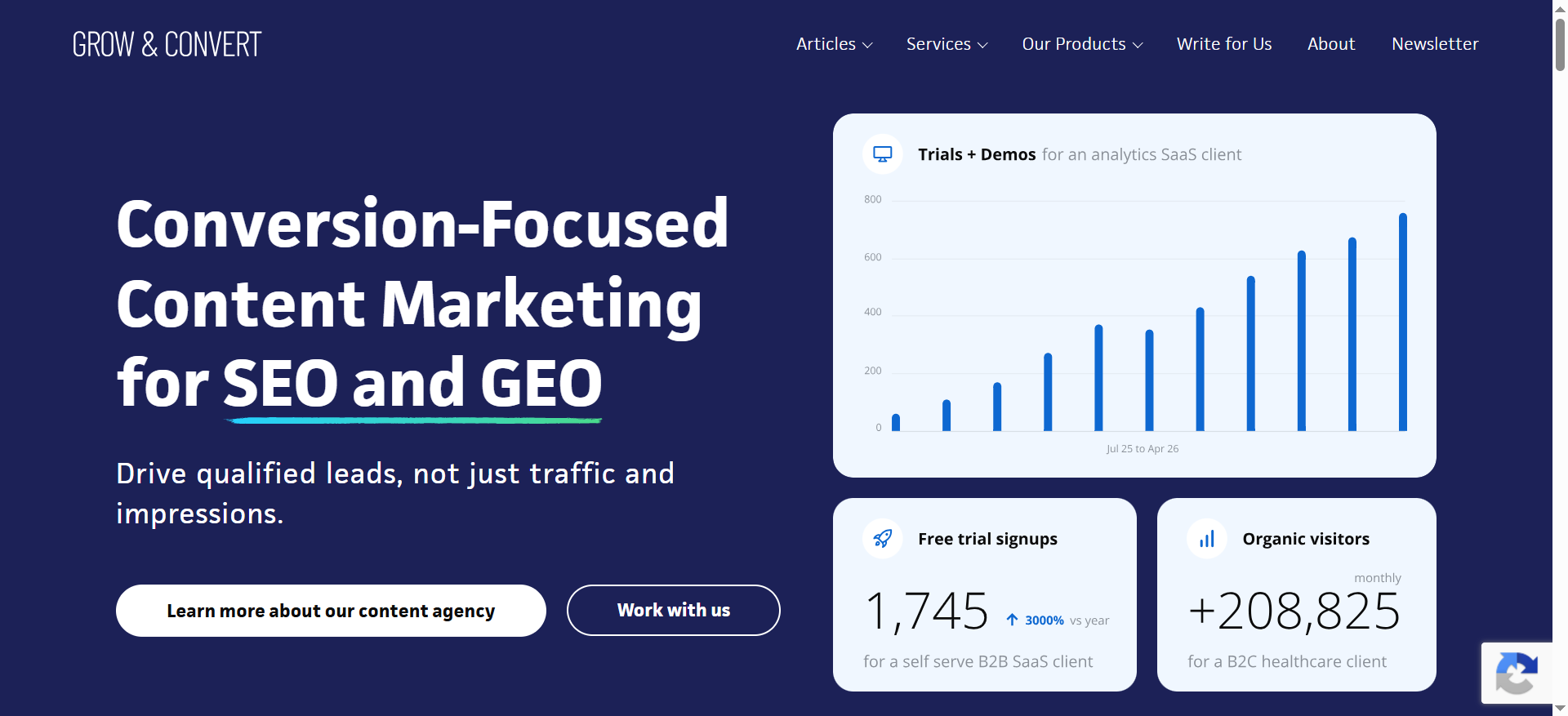
Best for: B2B teams that need bottom-of-funnel content strategy aligned with AI search visibility.
Grow and Convert originated the "Pain Point SEO" framework, which prioritizes bottom-of-funnel content where buyers are actively researching solutions rather than top-of-funnel content that generates traffic but rarely converts. The agency has expanded its approach to cover AI search visibility while maintaining its conversion-first philosophy.
Key capabilities:
- BOFU-first content strategy: Targets decision-stage queries where buyers compare solutions, evaluate alternatives, and research specific problems, i.e., the queries AI engines increasingly answer
- AI visibility integration: Tests and publishes findings on what actually moves AI search visibility, filtering out unproven tactics
- Transparent methodology: Publishes detailed strategy breakdowns and case studies, including data on what works and what does not
- Human-led content: Content is produced by humans with subject-matter depth, not AI-generated at scale
Pricing: Custom retainer. The agency publishes detailed breakdowns of what is included at each tier, which is uncommon in the space.
Pros:
- Conversion-first philosophy means content maps to pipeline by design
- Publishes original research and testing on AI visibility tactics
- Transparent about what it recommends and what it avoids
Cons:
- Primarily focused on content strategy, with less emphasis on heavy technical SEO
- Smaller team, which may limit capacity for very large engagements
When to choose it: You have reasonable technical SEO foundations already in place and need a content partner that will build the BOFU assets that both rank and get cited by AI engines.
5. Onely
Best for: Enterprise teams with JavaScript-heavy sites needing technical SEO for AI extractability.
Onely specializes in technical SEO and has built proprietary tools, including ZipTie.dev, for diagnosing and fixing the structural reasons AI systems ignore websites. Founded in 2012, the agency's founder has been at the forefront of research into how Google and Bing incorporate machine learning and artificial intelligence into their search technologies.
Key capabilities:
- AI extractability diagnostics: Identifies and fixes crawlability issues specific to AI crawlers, including JavaScript rendering failures, entity ambiguity, and content duplication
- Technical depth: Addresses the structural layer that most agencies skip entirely, namely the technical reasons AI engines cannot parse a site
- Published evaluation frameworks: Released detailed AI SEO agency evaluation criteria, contributing transparent methodology to the market
- Platform coverage: Optimizes across Google AI Overviews, ChatGPT, Perplexity, and Gemini
Pricing: Custom retainer based on site complexity and scope.
Pros:
- Among the deepest technical SEO capabilities for AI search
- Proprietary tooling for AI extractability diagnostics
- Research-led approach with published evaluation frameworks
Cons:
- Technical focus means content production is not the primary deliverable
- Best suited for complex sites, so smaller, simpler sites may not need this depth
When to choose it: Your site has complex JavaScript rendering, multiple subdomains, or architectural issues that prevent AI crawlers from accessing and parsing your content effectively.
For teams auditing their own technical readiness before hiring, the best AI search visibility checkers and audit tools covers the diagnostic step.
AI SEO Agency Pricing in 2026
Monthly retainers for AI SEO services in 2026 range from approximately $2,000 to $25,000 or more, depending on business size, industry competitiveness, and the number of AI platforms targeted. According to the Clutch.co April 2026 SEO pricing survey, as reported by OuterBox, the average monthly SEO cost is $3,199, though AI SEO services command a 30% to 50% premium over traditional SEO due to multi-platform optimization requirements and specialized expertise.
| Pricing Tier | Monthly Range (2026) | Typical Scope | Best Fit |
|---|---|---|---|
| Entry-level AI SEO | $2,000 to $5,000 | Basic AI search audit, content optimization for one to two platforms, monthly reporting | Small businesses entering AI search |
| Growth-stage AI SEO | $5,000 to $10,000 | Multi-platform optimization, content production, entity strategy, citation monitoring | Growth-stage SaaS, mid-market companies |
| Full-service AI SEO | $10,000 to $25,000 | Comprehensive GEO, digital PR, technical SEO, AI crawler optimization, multi-platform tracking | Mid-market to enterprise |
| Enterprise AI SEO | $25,000+ | Custom programs spanning technical infrastructure, content engineering, earned media, and global AI visibility | Enterprise, competitive verticals |
Several forces are pushing AI SEO pricing upward in 2026. AI platform fragmentation increases scope because agencies must now optimize for Google AI Overviews, ChatGPT, Perplexity, Gemini, and Copilot rather than Google alone.
Demand for AI SEO expertise outpaces supply, creating a seller's market among agencies with proven track records. Measurement sophistication is improving, allowing top agencies to demonstrate ROI more precisely, which justifies premium positioning.
Executing this well is exactly the gap The Rank Masters closes for B2B SaaS teams, building an ICP-led content system that maps each topic cluster to a money page and to pipeline, rather than publishing posts that never convert.
For a detailed look at how content connects to AI citations and revenue, explore The Rank Masters' AEO case study.
AI SEO Agency Vs Traditional SEO Agency
Traditional SEO agencies optimize for page-level rankings on Google. AI SEO agencies optimize for brand-level citations across multiple AI answer surfaces. The difference is not cosmetic but rather reflects a fundamental shift in what "winning" means in search.
| Dimension | Traditional SEO | AI SEO |
|---|---|---|
| What you win | A ranking position in a list of links | A citation or mention inside an AI-generated answer |
| How the engine selects you | PageRank, relevance signals, backlinks | Entity authority, citation history, semantic clarity, information gain |
| Content requirements | Keyword-optimized, link-worthy | Citation-ready, factually dense, entity-rich, extractable |
| Authority signals | Backlinks from referring domains | Earned media mentions, third-party editorial coverage, brand salience in training data |
| Measurement | Rank position, organic traffic, conversions | AI share of voice, citation rate, mention frequency, referral quality |
| Competitive dynamics | Compete for 10 blue-link positions | Compete for inclusion in a single synthesized answer |
The strategic implication is clear. A brand that loses Google clicks but wins AI citations preserves influence. A brand that loses both loses the market.
According to Cloudflare Radar data from May 2026, as compiled by TechnologyChecker, Google still sends 87.63% of all search referral traffic, meaning traditional SEO remains essential. But AI search referrals reached 0.9% of total visits, up fivefold year-over-year, and convert at materially higher rates than organic search on transactional queries, per Digital Applied's 2026 Search Engine Market Share report citing Similarweb AI referral measurement.
The strongest programs in 2026 treat traditional SEO and AI SEO as complementary layers rather than competing budgets. Teams that understand this dual-surface approach can start with the AI visibility strategies for enhancement framework.
How AI SEO Agencies Improve Your LLM Citation Rate
AI SEO agencies build citation authority through four interconnected workstreams, each targeting a different mechanism that AI engines use to select which brands to include in generated answers.
| Workstream | What It Addresses | Typical Deliverables |
|---|---|---|
| Entity optimization | Making your brand, products, and expertise unambiguous to AI systems | Entity audits, schema markup, knowledge panel optimization, brand disambiguation |
| Content architecture | Structuring content so AI engines can extract clean, citable answers | Answer-first formatting, FAQ schema, structured data, citation-ready data blocks |
| Earned media and authority | Building the third-party mentions that AI engines preferentially cite | Digital PR campaigns, guest placements, industry report contributions, review acquisitions |
| Technical AI accessibility | Ensuring AI crawlers can access and parse your site | AI crawler audits, robots.txt configuration, JavaScript rendering fixes, structured data validation |
The entity optimization layer is particularly critical because AI engines build internal knowledge graphs that map brands to attributes and relationships. When an AI engine encounters the prompt "best CRM for mid-market SaaS," it queries its knowledge graph for entities tagged with the relevant attributes, namely mid-market fit, CRM functionality, and trust signals.
Brands with weak or ambiguous entity profiles are simply excluded from the answer.
Content architecture determines whether AI engines can extract clean, quotable passages from your pages. The AI visibility tools for citation source targets guide explains how to identify which sources AI engines currently cite for your category and how to position your content as a replacement.
What AI Platforms Do AI SEO Agencies Optimize For
The best AI SEO agencies in 2026 optimize across all five major AI search surfaces simultaneously. Each platform has different content preferences, citation patterns, and retrieval behavior.
| AI Platform | Estimated Weekly Queries (2026) | Citation Behavior | Key Optimization Focus |
|---|---|---|---|
| Google AI Overviews | Triggers on ~25% to 30% of informational queries | Draws heavily from top-ranking pages with structured data and clear entity signals | Traditional SEO + structured data + entity optimization |
| ChatGPT Search | 250 to 500 million | Cites authoritative, factually dense pages, favoring sources with strong earned media profiles | Earned media, entity authority, citation-ready content |
| Perplexity | ~50 million | Real-time retrieval with inline citations, heavily favors pages with verifiable data and expert attribution | Data-rich content, expert quotes, structured answers |
| Gemini | Growing rapidly, 157% growth per Similarweb 2026 data | Draws from Google's index with additional LLM-specific retrieval logic | Google SEO + entity clarity + structured data |
| Microsoft Copilot | 80 to 120 million search-intent queries | Skews toward enterprise and workplace contexts, disproportionately important for B2B | Entity optimization, structured data, Bing optimization |
Source data for query volumes and platform behavior is triangulated from Presenc AI's May 2026 AI Search Engine Market Share report and Digital Applied's 2026 AI Search Engine Statistics.
The practical implication is that single-platform optimization is no longer sufficient. An agency that only optimizes for Google AI Overviews leaves your brand invisible in the ChatGPT and Perplexity responses your buyers increasingly read.
For teams building their own multi-platform monitoring, the GEO prompt monitoring tools comparison provides the monitoring layer.
Red Flags When Hiring an AI SEO Agency
AI-generated answers are probabilistic. They vary based on query phrasing, user context, model version, and retrieval conditions. Any agency promising guaranteed positions in AI answers does not understand how large language models work.
| Red Flag | Why It Matters |
|---|---|
| Guaranteed AI citations or rankings | No agency can guarantee LLM output. Credible agencies show methodology and track records, not guarantees |
| No published methodology or case studies | If an agency cannot explain how its approach works, it likely does not have one |
| Only optimizes for one AI platform | Single-platform optimization leaves your brand invisible on other surfaces buyers use |
| Relies entirely on AI-generated content | AI engines preferentially cite human-expert content with original data, not AI-generated material |
| Cannot separate AI SEO from traditional SEO | If the agency treats them as identical, it has not adapted to the new landscape |
| No AI visibility measurement | Without citation tracking, share-of-voice monitoring, and prompt testing, there is no way to prove results |
| Pricing below $1,500 per month | Comprehensive AI SEO requires multi-platform optimization and specialized expertise that cannot be delivered at commodity pricing |
Teams evaluating agencies should ask for specific examples of AI citation improvements for named brands with specific metrics, request a sample of how the agency measures AI visibility, and verify whether the agency's recommendations have been implemented for current clients rather than remaining in strategy documents.
For a structured approach to evaluating your own AI visibility before talking to agencies, the B2B SaaS content audit checklist provides the diagnostic foundation.
GEO Vs SEO Vs AEO Services Explained
Three overlapping but distinct disciplines now make up the AI search optimization landscape. Understanding their boundaries prevents both overbuying and underinvestment.
| Discipline | What It Optimizes For | Primary Measurement | Relationship to the Others |
|---|---|---|---|
| SEO (Search Engine Optimization) | Page rankings in Google and Bing organic results | Rankings, organic traffic, click-through rate, conversions | Foundation layer, required for both GEO and AEO |
| GEO (Generative Engine Optimization) | Brand citations and inclusion in AI-generated answers across all platforms | AI citation rate, share of voice in LLM responses, mention frequency | Extends SEO into AI answer surfaces, requires entity and authority work |
| AEO (Answer Engine Optimization) | Being selected as the answer source in answer boxes, featured snippets, and AI summaries | Featured snippet ownership, AI Overview inclusion, voice search selection | Subset of GEO focused on structured answer formats |
The GEO services market is projected to grow from approximately $1.48 billion in 2026 to $17.02 billion by 2034 at a 45.5% compound annual growth rate, according to IntelMarketResearch's GEO Services Market Outlook.
That trajectory reflects both the rapid adoption of AI search by consumers and the growing recognition among marketing leaders that AI visibility is not optional.
Most agencies in 2026 bundle all three disciplines into a single retainer. The right question is not "do I need SEO or GEO?" but rather "does this agency cover the full surface area where my buyers search?"
For a detailed breakdown of how these services layer together, the AEO tools for AI Overviews guide shows the tooling and workflow behind each discipline.
How to Evaluate an AI SEO Agency Before Signing
Choosing the right AI SEO agency requires evaluating capabilities that most traditional SEO scorecards do not cover. Use the framework below to structure your evaluation.
| Evaluation Question | What a Strong Answer Looks Like | What a Weak Answer Looks Like |
|---|---|---|
| "Which AI platforms do you optimize for?" | Named platforms with specific tactics for each | "We optimize for AI" without platform specifics |
| "Show me a case where you improved AI citations for a named brand" | Specific metrics, named client, before-and-after data | Vague references to "clients seeing improvements" |
| "How do you measure AI search visibility?" | Named tools, specific KPIs such as citation rate and share of voice | "We track rankings" with no AI-specific measurement |
| "What is your content production process?" | Human-led with AI-assisted research and QA | Fully automated AI content production |
| "How do you approach entity optimization?" | Schema markup, knowledge panel work, brand disambiguation, entity auditing | "We do structured data" without entity specifics |
| "What does the first 90 days look like?" | Phased plan with audit, strategy, and implementation milestones | "We'll get you ranking in AI answers quickly" |
For teams that want to start competitive benchmarking before hiring, the AI visibility tools for competitor benchmarking guide covers the platforms and workflow for measuring where your brand stands relative to competitors in AI answers.