
According to the 6sense 2025 Buyer Experience Report, 94% of B2B buyers now use large language models somewhere in their purchase journey, which means the content creation service you hire is no longer judged only by Google rankings but by whether ChatGPT, Perplexity, and Google AI Overviews can find and cite your work.
The best content creation services for B2B SaaS in 2026 are the ones that connect topic strategy to pipeline and structure every asset for both classic search and AI answer engines.
Volume alone is dead weight.
This guide ranks ten services by fit rather than by a single performance score, gives you a full comparison table, and breaks down what each one is best for so you can shortlist without sitting through ten pitch decks.
The shortlist spans strategy-led programs, conversion-first writing, AI-search specialists, scalable subscriptions, and visual production, so there is a defensible pick for almost any stage and budget.
▶️ If your ranked pages are not showing up in AI answers and you want a content system that fixes that, book a SaaS content strategy call.
Best Content Creation Services for B2B SaaS at a Glance
The strongest overall pick for B2B SaaS teams that need content tied to pipeline and AI discoverability is The Rank Masters, with Animalz, Grow and Convert, and Skale leading for editorial depth, conversion writing, and AI-search visibility respectively.
Here is the fit-based shortlist before the detail below.
- Best for content-to-pipeline systems: The Rank Masters, an ICP-led SaaS content marketing partner.
- Best for premium editorial thought leadership: Animalz.
- Best for conversion-first SEO writing: Grow and Convert.
- Best for organic-growth strategy at scale: Omniscient Digital.
- Best for AI search and GEO visibility: Skale.
This list is organized by best-fit use case rather than ranked by a single score, because the right service depends on your stage, motion, and whether your bottleneck is strategy, volume, conversion, or AI visibility.
Content Creation Services Compared for B2B SaaS
The table below maps all ten services to their best-fit segment, signature strength, core formats, and reported 2026 pricing, so you can scan the field as a single entity-attribute-value grid.
| Service | Best For | Signature Strength | Core Formats | Pricing (Reported, 2026) |
|---|---|---|---|---|
| The Rank Masters | B2B SaaS content-to-pipeline systems | ICP-led system tied to money pages and AI visibility | SEO blogs, BOFU pages, refreshes, AEO | Custom quote |
| Animalz | Mid-market and enterprise thought leadership | Research-heavy editorial quality | Long-form, thought leadership, whitepapers | Retainers reportedly from ~$10,000/mo |
| Grow and Convert | Conversion-first SEO programs | Pain-point content engineered to convert | High-intent SEO articles, BOFU | Custom, premium tier |
| Omniscient Digital | Organic-growth strategy at scale | Topical authority and SEO strategy | SEO content, strategy, optimization | Custom retainer |
| Skale | AI search and GEO visibility | Measurement tied to AI answers and SQLs | GEO content, schema, AI visibility | GEO content, schema, AI visibility |
For a complementary view of the tooling layer behind these services, our roundup of the best AI content generator tools for SaaS covers the platforms many of these teams use under the hood.
1. The Rank Masters
Best for B2B SaaS and AI companies that want content built as a system connecting search visibility and AI discoverability to demos, trials, and pipeline rather than traffic for its own sake.
The Rank Masters is an ICP-led content marketing partner for B2B SaaS that plans topic clusters around buyer roles and objections, repairs and refreshes existing archives, builds missing bottom-funnel assets, and ties every URL back to a money page. It positions itself as the content system between discovery and pipeline rather than a generic blogging shop or a heavy technical SEO vendor.
- System over deliverables: The Rank Masters builds a repeatable five-step model from ICP alignment to commercial measurement, so each cycle strengthens the next instead of shipping disconnected posts.
- Refresh before publish: The team strengthens pages that already rank before stacking new content, which recovers authority trapped in stale archives.
- AI discoverability: The program structures content for citation across Google and AI answer engines, supported by a documented GEO case study.
- Senior delivery: Engagements run through senior strategists with direct client access rather than layers of account managers, as described on the team page.
Pricing: Custom quote with no public rate card, scoped to content gaps and goals.
Pros: Pipeline-focused measurement, strong refresh discipline, built for Google plus AI search, boutique and senior.
Cons: Not a fit for buyers who want cheap article volume, backlink-only programs, or full website and CMS operation. You can review outcomes in the published case studies.
When to choose it: Pick The Rank Masters when you already have a site and some content but the engine is under-built, and you need refresh discipline, bottom-funnel coverage, and a credible link from content to commercial outcomes.
2. Animalz
Best for mid-market and enterprise SaaS teams that need premium thought leadership and research-driven long-form content to strengthen category positioning.
Animalz is a content marketing agency known for editorial depth and a "speakeasy brand" reputation, namely low-key, high-quality work rather than content at scale. It supports growth-stage and enterprise software companies with long-form articles, thought leadership, and survey-driven whitepapers.
- Editorial depth: Animalz produces research-heavy narrative articles designed to clarify positioning and elevate authority in a technical category.
- Whitepaper capability: The team offers survey-driven whitepaper production that can move a brand narrative forward with original data.
- Strategic planning: Content planning emphasizes durable topical authority over high-volume publishing.
Pricing: Retainers reportedly start around $10,000 per month for 2026, with per-piece work reported between $1,000 and $3,000 depending on complexity.
Pros: Exceptional editorial quality, strong brand and positioning work, deep SaaS experience.
Cons: Premium pricing, less suited to lean budgets or pure high-volume needs.
When to choose it: Pick Animalz when positioning and category authority matter more than raw volume, and you have the budget to invest in research-grade editorial that competitors cannot easily replicate.
3. Grow and Convert
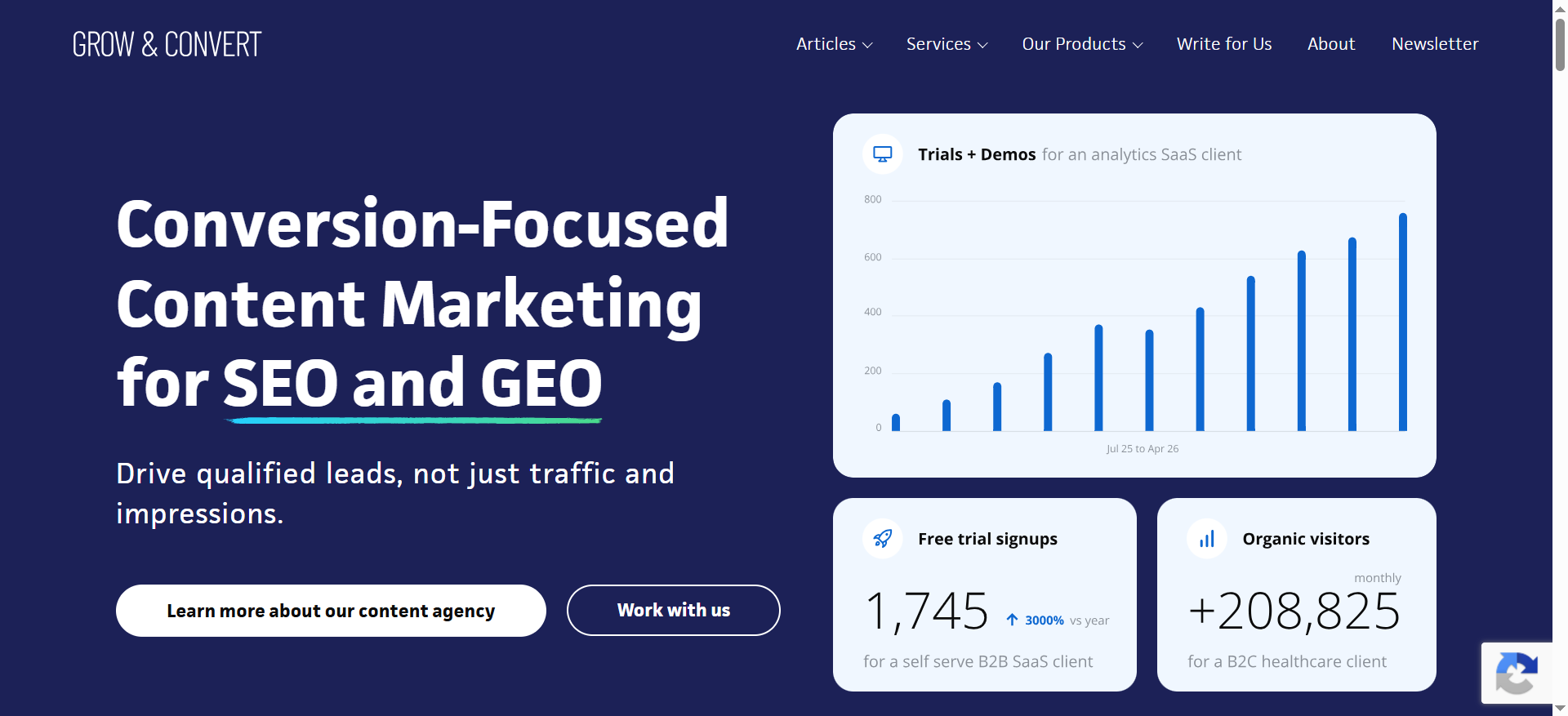
Best for SaaS teams that are done chasing traffic that does not convert and want pain-point content engineered to move readers toward trials and demos.
Grow and Convert is a content marketing agency built on the belief that volume-focused SEO misses the mark. The team runs deep interviews with client experts, then produces long-form, pain-point-driven articles aimed at high-intent queries that lead directly to product evaluation.
- Conversion-first model: Grow and Convert targets high-intent, bottom-funnel queries so content maps to closed-won revenue rather than vanity sessions.
- Quality bar: The team prefers a small number of strong pieces over many shallow ones, which suits brands prioritizing pipeline over output.
- Documented methodology: A published approach and course make the process transparent before you sign.
Pricing: Custom and positioned at the premium end, with no standardized public rate.
Pros: Clear focus on conversion and pipeline, strong methodology, transparent thinking.
Cons: Pricing and low-volume cadence may not suit early-stage teams needing scale.
When to choose it: Pick Grow and Convert when you are tired of traffic that does not convert and want a small number of high-intent pages engineered to produce trials, demos, and closed-won revenue.
4. Omniscient Digital
Best for B2B software companies that want a strategic organic-growth program built on topical authority and high-intent search capture.
Omniscient Digital focuses on organic growth for B2B SaaS, combining SEO and content marketing into comprehensive programs. The team operates more like a content strategy partner, using deep audience and competitive research to inform what gets created and promoted.
- Strategy-led production: Omniscient Digital builds topical authority through research-informed clusters rather than isolated keyword posts.
- Stage flexibility: The team works with companies from foundational content needs through established programs scaling organic presence.
- Optimization and links: Services extend from content optimization to internal linking and technical-content support.
Pricing: Custom retainer, not publicly listed.
Pros: Strong strategic foundation, research depth, durable authority building.
Cons: Strategy-heavy engagements can carry longer ramp times before compounding results appear.
When to choose it: Pick Omniscient Digital when you want a strategy-first organic-growth program and can accept a longer ramp in exchange for durable topical authority that compounds.
5. Skale
Best for B2B SaaS brands that want AI search and GEO visibility measured against pipeline rather than rankings alone.
Skale is an AI-search-first organic growth agency helping SaaS brands improve visibility across traditional engines and AI platforms such as ChatGPT, Perplexity, and Google AI Overviews. It uses a measurement framework that connects AI-result presence to bottom-line impact.
- AI search measurement: Skale ties visibility in AI-generated results to SQLs, signups, pipeline, and revenue.
- GEO services: The suite covers schema markup, technical crawlability, gap analysis, attribution, and brand mentions.
- Rapid iteration: An agile model is built for fast execution and measurable progress.
Pricing: Custom, not publicly listed.
Pros: Specialized AI-search focus, revenue-tied measurement, modern GEO capability.
Cons: Narrower than a full-service content partner if you also need heavy editorial production.
For the in-house view of this discipline, see our guide on how to audit brand visibility on LLMs.
When to choose it: Pick Skale when AI search visibility is the priority and you want a partner that reports on citations and answer-engine presence tied to SQLs rather than rankings alone.
Content Creation Services vs AI Content Tools
Content creation services deliver strategy, production, and accountability for an outcome, while AI content tools give your own team faster drafting power, so the choice is between buying a managed result and buying leverage for in-house effort.
The two are complements more often than substitutes. Most strong services already use AI tools inside their workflow, then add the judgment that tools cannot supply.
- What a service provides: A managed engagement covering strategy, briefs, SME interviews, editing, optimization, and measurement, with someone accountable for the result.
- What a tool provides: Drafting speed and scale that still require your team to supply strategy, fact-checking, brand voice, and pipeline alignment.
- Where tools fall short: AI follows inputs literally, so weak prompts produce filler, and models do not know your product nuances, compliance rules, or positioning without human direction.
The honest framing is that AI raises the floor on production speed but not the ceiling on strategy. A buying team that lacks a scalable model will not fix that by adding a writing tool, because the missing piece is the system, not the words.
If you want to evaluate the tool layer in parallel, our guide to the best AI content generator tools for SaaS breaks down where each platform fits, and the wider AI content category covers workflows and guardrails.
The winning play in 2026 pairs AI velocity with human strategy and a service or owner accountable for revenue impact.
Best Content Creation Services by Company Stage
The best content creation service depends heavily on stage, namely budget-friendly subscriptions for seed teams, strategy-plus-execution partners for growth-stage SaaS, and premium full-service or specialist programs for enterprise category leaders.
The table maps stage to the most defensible model and the services from this guide that fit each band.
| Company Stage | Primary Need | Best-Fit Models | Services to Shortlist |
|---|---|---|---|
| Seed to Series A | Affordable cadence and foundations | Subscription, freelancer, lean partner | The Rank Masters |
| Series B to growth | System, refresh, and BOFU coverage | Boutique agency plus strategy | The Rank Masters, Grow and Convert, Omniscient Digital |
| Mid-market to enterprise | Authority, scale, and AI visibility | Full-service or specialist program | Animalz, Skale |
Content Agency vs Freelancer vs In-House vs Subscription
Choose an agency for strategy plus execution, a freelancer for focused expertise on a budget, an in-house hire for deep product context, and a subscription service for predictable volume, since each model trades cost against control and depth.
The table maps the four common models against the attributes that matter most when scoping content production.
| Model | Best For | Strength | Trade-Off |
|---|---|---|---|
| Full-service agency | Strategy plus execution at scale | Senior strategy, breadth, measurement | Higher cost, onboarding time |
| Specialist freelancer | Focused, high-craft writing | Direct access, lower cost, deep niche skill | Limited bandwidth and capacity ceiling |
| In-house hire | Deep product and brand context | Full control, embedded knowledge | Slow to hire, single point of failure |
| Subscription service | Predictable, scalable volume | Simple budgeting, reliable cadence | Lighter strategy and positioning |
Most growth-stage SaaS teams end up blending models, namely a strategic partner for the system, a subscription or freelancer for volume, and an internal owner for product truth and approvals. The reason a blended model wins is execution capacity.
Per the Content Marketing Institute 2026 B2B research, nearly half of B2B marketers say they lack a scalable content creation model, which is the single most common execution bottleneck. A service exists to close exactly that gap.
For a tooling-versus-services view, browse our AI content category and the broader strategy library.
How to Choose a Content Creation Service for SaaS
Choose a content creation service by matching its specialization, measurement model, AI search capability, and proof to your specific bottleneck, then pressure-test pricing and process before signing anything.
Run every candidate through this checklist, which extends the selection criteria used for this guide.
- Relevant SaaS experience: Confirm they have worked with software companies, understand subscription metrics, and support multi-stakeholder buying cycles, not just "B2B experience" in the abstract.
- Measurement language: Favor partners who connect content to pipeline and assisted conversions over those who lead with impressions and keyword counts.
- AI search readiness: Ask how they structure content for citation in AI answers, since buyers now synthesize research with LLMs across the journey.
- Scope clarity: Get specific about whether the service covers strategy, production, optimization, distribution, and design, or only a slice.
- Proof you can verify: Look for named case studies with measurable outcomes rather than generic traffic graphs.
Executing this well is exactly the gap The Rank Masters closes for B2B SaaS teams, building an ICP-led content system that maps each topic cluster to a money page and to pipeline rather than publishing posts that never convert.
The AI search dimension deserves its own scrutiny, which is why answer-engine readiness now sits alongside classic SEO in any serious evaluation.
To go deeper on definitions and vocabulary while you evaluate, the SEO glossary is a useful reference, and our breakdown of what happened to SEO after AI search arrived frames why the criteria changed.
What Content Creation Services Cost in 2026
Content creation services in 2026 range from low-hundreds-per-post subscriptions to premium agency retainers reported between roughly $5,000 and $30,000 or more per month, with most B2B SaaS programs landing in the mid four to low five figures monthly.
The table groups the field into practical pricing tiers so you can match budget to model.
| Tier | Typical Model | Reported 2026 Range | Best For |
|---|---|---|---|
| Entry | Subscription or freelancer | Low hundreds per post to ~$2,500/mo | Early-stage volume and cadence |
| Mid-market | Boutique agency or custom retainer | ~$5,000 to ~$12,000/mo | Growth teams needing strategy plus execution |
| Premium | Full-service or enterprise program | ~$10,000 to ~$30,000+/mo or per quarter | Mature programs and category leaders |
Two budget realities shape these tiers.
First, content spend has grown into a core line item, and personalization investment is rising alongside it. Per the StackAdapt and Ascend2 State of Personalization research for 2026, 87% of brands plan to increase personalization spend this year even though 68% remain in early implementation stages.
Second, the value question is not cost per article but cost per pipeline-qualified outcome, which is why measurement-led services often justify higher rates.
For benchmarks on what good looks like, see our benchmarks category.
What Content Creation Services Actually Do
Content creation services are agencies, subscription platforms, or specialist studios that plan, produce, optimize, and sometimes distribute marketing content on your behalf, from blog clusters and comparison pages to video and lifecycle email.
The category is wider than blog writing. A modern B2B SaaS engagement usually spans several content types that map to different buyer stages and search surfaces.
- Top-of-funnel education: Definitional and how-to content that captures early research demand and trains AI engines on your category language.
- Middle-of-funnel evaluation: Comparison guides, alternatives pages, and implementation playbooks that help buyers shortlist vendors.
- Bottom-of-funnel conversion: Case studies, pricing explainers, and money-page support that move evaluation toward demos and trials.
- Distribution and repurposing: Turning one core asset into social, newsletter, and short-form derivatives so production cost spreads across channels.
The strategic difference between a commodity writing vendor and a genuine partner is whether the service treats content as a system connected to revenue.
The discipline matters because, per the Content Marketing Institute 2026 B2B research of 1,015 B2B marketers fielded in mid-2025, only 12% rated their content marketing as highly effective over the prior year. The gap is rarely writing talent. It is the absence of strategy, measurement, and a repeatable model.
How We Selected and Compared These Content Services
We selected services using five weighted criteria, namely B2B SaaS specialization, content-to-pipeline focus, AI search readiness, transparency of process and proof, and fit across budgets and stages.
The criteria below are the same lens we recommend you apply to any shortlist.
- B2B SaaS specialization: The service understands subscription metrics, multi-stakeholder buying, and product-led or sales-led motions, not just generic content.
- Content-to-pipeline focus: The work connects to money pages, assisted conversions, and sales conversations rather than reporting only impressions and rankings.
- AI search readiness: The service structures content for citation in AI answers, a capability buyers increasingly expect given LLM use across the journey.
- Proof and process transparency: Named case studies, clear methodology, and a defined production workflow rather than vague promises.
- Stage and budget fit: Whether the model suits a lean startup, a growth-stage team, or an enterprise program.
Pricing in this guide is presented as reported reference points for 2026 or marked as custom where a service does not publish rates. Agency pricing is rarely listed officially, so treat every figure as a directional starting point to confirm directly.
For a deeper framework on scoping vendors, see our guide on how to choose an AI-ready SEO agency.
Are Content Creation Services Worth It for B2B SaaS
Content creation services are worth it for B2B SaaS when the bottleneck is strategy, capacity, or AI visibility rather than budget alone, because a system that connects content to pipeline compounds while ad spend expires.
The economic case rests on two structural facts. Buyers complete most research before they ever contact a vendor, and they set their shortlist early.
Per the 6sense 2025 Buyer Experience Report, 94% of buying groups ranked a preferred vendor before first contact and purchased from that early favorite about 77% of the time, which means the content a buyer finds during independent research is doing the persuading.
If your content is thin or invisible in AI answers, you lose the deal before a conversation starts.
The risk to manage is quality and alignment, not effort. Per the Salesforce State of Marketing research, 83% of marketers recognize the shift toward personalized, two-way messaging, yet only one in four are satisfied with how they use data to power it. A service earns its fee by closing that execution gap with strategy, measurement, and consistent production. A poor service simply adds volume.
The decision, then, is less about whether to outsource and more about choosing a partner whose model matches your bottleneck. You can compare vendor approaches further in our vendors category and review the broader SEO and AEO services landscape.
If thin BOFU coverage is costing you pipeline, book a SaaS content strategy call and we will map your highest-intent topics to revenue.