
📜 TL;DR – What The Rank Masters Achieved for Avaza in ~5 Months
Context
Avaza was already a mature PSA and time-tracking platform, growing mainly through existing users and branded traffic. Most sessions landed on the homepage from people logging in or searching the brand name. They were skeptical that a blog or SEO-focused content would add meaningful, measurable value.
What we did?
- Designed an ICP-first, problem-led, product-led content strategy around time tracking, PSA, project financials, resource management, and key verticals.
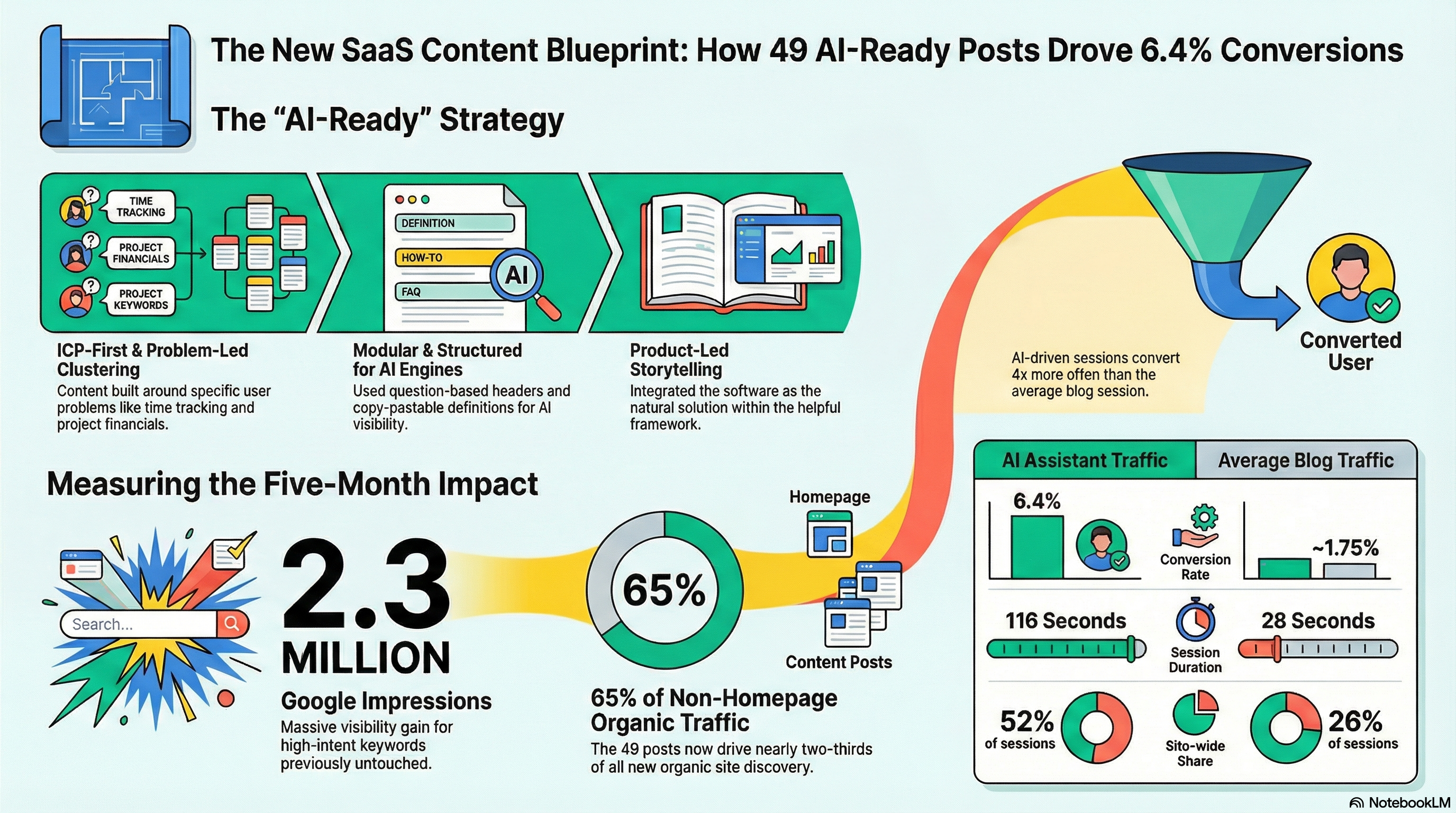
- Created 49 high-intent, AI-ready blog posts aligned with how Avaza’s ideal customers actually search and buy.
- Optimized content for both traditional SEO (Google organic) and AI assistants / answer engines (ChatGPT, Perplexity, Gemini, Copilot, etc.), focusing on answerable, modular content.
What happened (GA4 + GSC, 1 July – 25 Nov 2025)?
1. Organic traffic
- 7,113 organic sessions landed on the 49 blog posts.
- The blog now drives about 26% of all organic sessions to the site.
- When you exclude the homepage (which is heavily branded/log-in traffic), those 49 posts capture roughly 65% of all non-homepage organic sessions.
2. Conversions (key events)
- 121 organic key events came from blog traffic alone.
- The blog delivers around 22.5% of all non-homepage organic key events.
- Several product-led posts convert extremely well, with session-to-key-event rates in the 8–14%+ range.
3. Search Console impact
- Blog URLs generated 5,497 clicks and 2,336,335 impressions in Google Search.
- The blog accounts for roughly 35.5% of all organic clicks and about 57.6% of all impressions for avaza.com in the same period.
4. AI assistant impact
- 423 sessions came from AI assistants such as ChatGPT, Perplexity, Gemini, Copilot and others, landing on the 49 blog posts.
- Those AI-driven sessions produced 27 key events, with a conversion rate of about 6.4% (roughly 3.5–4 times higher than the average blog session).
- Blog content captures around 52% of all AI-sourced sessions and about 31% of all AI-sourced key events across the entire site.
Bottom line: In roughly five months, a focused set of 49 product-led, AI-ready posts turned Avaza’s previously quiet blog into a core acquisition, conversion, and AI-discovery engine — without needing hundreds of articles or a bloated content program.
"They are attentive to our requests, responsive to our needs, and consistently deliver all agreed items on time."
The Rank Masters has helped the client grow organic site traffic, secure top 10-20 Google rankings for their target key terms, extend average time on their blog page, improve CTR, reduce bounce rates, and drive sign-ups via CTAs. Their Google Console Search data has also shown increased impressions.
Client Background & Stakes: Why Change Anything?
Client: Avaza
Category: Professional Services Automation (PSA) & time tracking
Core functionality: Time tracking, project management, expense tracking, invoicing
By 2024, Avaza wasn’t a scrappy early-stage startup. They were:
- A mature SaaS with long-term customers
- Growing via existing channels (brand, referrals, etc.)
- Handling a lot of return user traffic straight to the homepage to log in
That homepage traffic is great for retention but it tells us something important:
The site was heavily skewed toward branded / log-in behaviour, not non-branded discovery.
Why this was a problem (and a risk)
1. Limited non-branded reach
If nearly everything lands on /, you’re getting:
- People who already know you
- Existing users logging in…but not nearly enough new people who are asking questions like “best time tracking software” or “how to calculate billable vs non-billable hours.”
2. Over-reliance on non-SEO channels
Without a strong content footprint:
- Paid, direct, and partner channels carry most of the acquisition load.
- There’s less compounding benefit from organic, which is one of the few sustainable, compounding channels in SaaS.
3. AI & answer-engine risk
As Google rolls out AI Overviews and people start asking tools like ChatGPT and Perplexity for recommendations, brands that don’t have helpful, in-depth content face a simple outcome i.e., they’re just… not mentioned.
Google’s documentation and SEO industry research both emphasize that helpful, people-first content is increasingly important for visibility in both search and AI features.
So the question wasn’t “Can Avaza survive without a blog?” — clearly they already had.
The question was:
“Can Avaza afford to ignore organic & AI-driven discovery for the next 3–5 years?”
We believed the answer was no.
The Trial Post: Why Start Small, and Why That Topic?
When Avaza said, “We’re not convinced content will change much,” that was rational. Many SaaS blogs are:
- Generic
- Misaligned with the product
- Impossible to connect to real revenue
Why we proposed a single bottom-of-funnel trial
Instead of pitching a huge retainer, we suggested a one-post experiment for two reasons:
1. Lower perceived risk for Avaza
- One post is easy to say yes to.
- If it flops, they’re not locked into anything.
2. Maximum signal-to-noise
- A bottom-of-funnel (BOFU) keyword is closer to purchase.
- If it hits, you’re likely to see trials, sign-ups, or at least late-stage evaluation traffic.
Why “timesheet software for small business”?
From our discovery call:
- Many customers come in via time tracking / timesheet needs, not “PSA software” per se.
- Their real job-to-be-done is often: “I need a reliable way to track hours, bill clients, and see project profitability.”
We could have chosen a vague, high-volume “project management software” keyword, but we didn’t, because:
- It’s hyper-competitive
- It’s not tightly aligned with how people start with Avaza
- It’s harder to tie to concrete “we won this because of content” outcomes
Instead, we chose:
“timesheet software for small business” → /timesheet-software-for-small-business/
How we executed the trial post
- We wrote from the small business owner / agency founder perspective
- Compared typical timesheet options (spreadsheets, standalone tools, PSA suites)
- Highlighted how Avaza simplifies:
- Time capture
- Billing
- Reporting
- Multi-project visibility
- Embedded clear next-step CTAs:
- Try Avaza for this exact use case
- View pricing
- Explore full PSA features
Why the trial post impact was valuable
The trial post showed:
- The keyword was winnable
- The traffic was qualified (people actively evaluating tools)
- Content could bring net-new, non-branded visitors — not just log-ins
That single experience de-risked the decision for Avaza and turned a skeptical “maybe” into:
“Okay, let’s see what happens if you do this systematically.”
Engagement Scope: Why 49 Posts, Not 10 or 200?
We settled on a lean but deep program:
- 49 blog posts
- Focused on Avaza’s core differentiation zones (time tracking, PSA, project financials, resource management, verticals)
Why not hyper-aggressive volume?
Because:
- Volume ≠ impact
- Publishing dozens of generic posts rarely moves the needle
- Avaza didn’t need noise; they needed ownable territory around high-value problems
Why not just 10 posts?
With only 10, you can’t:
- Cover enough problem/solution clusters
- Saturate long-tail intent
- Build a meaningful topical footprint in Google’s and AI systems’ view of your site
At ~50 posts, you get:
- Enough surface area to:
- Rank across clusters
- Feed AI systems
- Support sales/CS enablement
- A manageable library to maintain and refresh
This approach mirrors how we design programs for other clients in our SaaS SEO agency and SaaS content marketing engagements: lean, focused, and deeply tied to revenue.
Strategy: Why This Strategy, Not “Just Write Articles”
ICP & Problem-First Clustering — Why It Had to Be Done
Problem: If content is not anchored in real ICP problems, you end up with:
- Fluffy posts that get unqualified traffic
- No meaningful impact on trial sign-ups or sales cycles
- A blog that annoys product and sales teams (“no one uses this stuff”)
So we built clusters around:
- Time tracking & billing
- Project profitability & budgets
- Resource & workload management
- Project management fundamentals
- Vertical- and geo-specific searches
Why this matters:
- It aligns with how real buyers think and search.
- It means every post has a plausible path to revenue.
- It’s easier to get internal buy-in (“this post helps us sell to X ICP”).
We explain the same logic in our best SaaS keyword research workflow article and use it across our client base.
Answer-Engine & AI Search Readiness — Why Now?
Google’s own documentation on search and AI features is clear on two things:
- They want helpful, reliable, people-first content.
- AI features (like AI Overviews) rely heavily on trusted, high-quality sources to synthesize summaries.
At the same time, SEO industry sources like Search Engine Journal and others are sounding the same alarm:
If you don’t create answer-worthy content, AI assistants will highlight your competitors instead.
So for Avaza, not adapting was a risk:
- No content → no mentions in AI answers
- No mentions → fewer high-intent visits from AI assistants over time
- Fewer AI-driven visits → competitors get the “future” search traffic
How we made Avaza AEO or GRO-ready
We built each article to be:
- Modular: sections that can stand alone as answers
- Structured: question-based H2/H3s that mirror real queries
- Copy-pastable: clean definitions and explanations that LLMs can safely use as references
- Entity-rich: clear mentions of tools, roles, industries, and use-case labels
We talk about this approach in more depth in our AEO-ready SaaS blogs guide and best SEO strategies for AI visibility.
You can also explore our “Generative Engine Optimization (GEO) Case Study: 8,337% ChatGPT Referral Growth in 90 Days.”
Why this is valuable:
It makes Avaza indexable, answerable, and recommendable not only in traditional SERPs, but in AI Overviews and AI assistants — which is exactly what we see in the data (Section 9).
Execution: Why We Wrote This Way & How It Led to Conversions
Product-Led Outlines — Why?
Problem if you don’t do this:
You get nice, generic content that:
- Ranks a bit
- But barely mentions your product
- Or feels bolted-on at the end (“oh yeah, we exist too”)
We wanted the opposite:
Posts that genuinely help the reader and also demonstrate why Avaza is a natural answer.
So we:
- Started with the problem in the ICP’s words
- Put in frameworks, formulas, and examples
- Then wove Avaza into the solution steps: “here’s how you’d do this inside Avaza”
This is classic product-led content, which we also apply and explain in our CRO + product-led content offer.
Impact / value:
- Readers don’t have to “connect the dots” between theory and the product — we do it for them.
- It turns blog posts into mini product tours, increasing odds of trial sign-ups.
Query Fan-Out — Why?
If you target a head term like “calculating hours worked” with just a short definition, you:
- Miss dozens of related questions users actually ask
- Leave SERP room for competitors
- Make it less likely Google or AI assistants will see your post as the comprehensive answer
So we:
- Pulled 10–30 queries around each topic
- Grouped them (definitions, mistakes, calculations, FAQs, tool comparisons)
- Ensured the post addressed each cluster clearly
Impact / value:
- Makes each article rank for multiple long-tail queries
- Increases chances of capturing People Also Ask and AI overview snippets
- Helps Google see Avaza as a topical authority, not a one-off.
We teach the same in keyword research best practices for SaaS.
CRO Inside the Content — Why It Matters
If you treat the blog as “education only,” you get:
- A lot of traffic
- Minimal impact on pipeline
We know from working with other SaaS clients that you need conversion paths inside content, so we:
- Included soft CTAs (“see this workflow in Avaza”)
- Linked to product pages, pricing, and relevant industry pages
- Ensured each article suggested a logical next action
This is the same philosophy we use in our SaaS content audit + fix sprint: don’t just fix content for rankings; fix it for journeys and conversions.
Impact / value:
The result is posts like:
- /freelance-time-tracking-and-invoicing/ with ~13.8% session → key-event conversion
- /project-management-tool-with-time-tracking/ with ~12.7% conversion
— which are extremely high for organic content.
GSC Results: Why These Clicks & Impressions Matter
From GSC (1 July – 24 Nov 2025):
- Whole site: 15,478 clicks, 4,058,938 impressions
- Blog URLs (46 of 49 with measurable data):
- 5,497 clicks
- 2,336,335 impressions
- ≈ 0.24% CTR
- Avg position ≈ 29.8
Why this had to be measured this way
Looking at page-level data (not just queries) tells us:
- Exactly which URLs act as entry points
- How much “share of demand” the blog is capturing vs the rest of the site
Key impact
- Blogs drive ~35.5% of all organic clicks.
- Blogs generate ~57.6% of all impressions.
Why that’s valuable:
- It proves the blog isn’t a side project; it’s a major discovery surface.
- High impression share means Avaza is present in a huge chunk of relevant searches, even when people don’t click.
- This presence feeds:
- Brand familiarity
- AI training data
- Long-term “who do I think of” effects when buyers are ready to choose tools.
GA4 Results: Why We Focused on Organic & Non-Homepage Traffic
From GA4 “Landing page” (1 July – 25 Nov 2025):
Why we separated homepage vs non-homepage
If we count everything, especially homepage /, we mostly measure:
- Brand searches
- Log-in behaviour
- Existing users
That’s not the story we care about for SEO-led growth.
So we separated:
- Homepage / (branded, log-in heavy)
- Non-homepage URLs (true acquisition pages)
Organic blog performance
For the 49 blog URLs:
- All channels:
- 9,896 sessions
- 173 key events
- ≈ 1.75% session → key-event rate
- Organic only (* / organic sources):
- 7,113 organic sessions
- 121 organic key events
- ≈ 1.7% organic session → key-event rate
Across the entire site (organic):
- 27,403 organic sessions
- 1,282 organic key events
Homepage / alone:
- 16,497 organic sessions
- 745 organic key events
So non-homepage organic looks like:
- 10,906 non-homepage organic sessions
- 537 non-homepage organic key events
The 49 TRM blog posts account for:
- 7,113 / 10,906 ≈ 65% of non-homepage organic sessions
- 121 / 537 ≈ 22.5% of non-homepage organic key events
Why that impact is valuable
- Traffic: The blog is doing most of the non-branded discovery work — almost two-thirds of all organic landings outside the home page.
- Conversions: Nearly one-quarter of all important organic actions outside homepage (trials, sign-up-related events) happen on blog content.
That’s exactly what you want from content: owning problem-aware and solution-aware demand, not just publishing posts for the sake of it.
Conversion Heroes: Why These Posts Are Special
Posts like:
- /freelance-time-tracking-and-invoicing/
- /free-time-management-software/
- /project-management-tool-with-time-tracking/
- /time-tracking-for-consultants/
are converting way above average, with 8–14%+ session → key-event rates.
Why that happened
- They’re tightly aligned with specific ICP segments.
- They describe real jobs-to-be-done (freelancers billing clients, consultants tracking hours).
- They show how Avaza solves the job in detail and then invite the user to try it.
Why this is valuable
- These posts function almost like landing pages disguised as content.
- They give Avaza evergreen “mini funnels” for specific segments that will keep acquiring new users over time.
- They provide sales and CS teams with educational assets to share with prospects (“here’s how you can handle this in Avaza”).
When we do lifecycle content strategy and SaaS content audits for other clients, we look for exactly these kinds of opportunities.
AI Assistant Traffic: Why It’s a Big Deal, Not a Rounding Error
From GA4 AI-source segmentation:
- 423 AI-assistant sessions landed on the 49 blog posts.
- That’s ~4.3% of all blog sessions.
- They generated 27 key events.
- AI session → key-event rate ≈ 6.4% (vs ~1.75% overall).
Why this had to be measured
Most teams still look only at:
- google / organic
- bing / organic
But as tools like ChatGPT, Perplexity, Gemini, Copilot and others become how people “search,” traffic from:
- chatgpt.com / referral
- perplexity.ai / referral
- gemini.google.com / referral
- copilot.microsoft.com / referral
…becomes real acquisition volume, not novelty.
How we measured it
We:
- Pulled GA4’s Session source / medium
- Flagged rows containing AI domains (chatgpt.com, perplexity.ai, gemini.google.com, claude.ai, copilot.microsoft.com, etc.)
- Grouped these into a logical “AI assistants” bucket and analysed:
- Sessions
- Key events
- Engagement time
This approach is consistent with how leading GA4 practitioners now recommend tracking new AI referrers.
What we found and why it’s valuable
- AI visitors spend ~1.93 minutes per session (~116 seconds) vs ~28 seconds average.
- They convert 3.5–4× more often than typical blog traffic.
- Sitewide, there were:
- 813 AI sessions
- 86 AI key events
The 49 blog posts capture:
- ~52% of AI sessions (423 / 813)
- ~31% of AI key events (27 / 86)
Why that matters:
- It shows Avaza is already being recommended inside AI answers.
- It proves the content is LLM-friendly and helpful enough to be cited and clicked.
- It future-proofs Avaza’s discovery against shifts in how people search and evaluate tools.
We explore these AI trends in more detail on the TRM blog (see: AI Overview SEO BOFU case study and best tools for tracking brand visibility in AI search).
Summary: Why This Case Study Matters Beyond Avaza
In ~5 months, with 49 deliberately chosen posts, Avaza moved from:
“We’re not convinced blogging will do anything”
to a reality where their blog:
- Drives ~26% of all organic sessions and ~65% of non-homepage organic sessions
- Contributes ~9.5% of all organic key events, and ~22.5% of non-homepage organic key events
- Generates 5,497 clicks and 2.3M+ impressions in GSC (≈35.5% of clicks, 57.6% of impressions)
- Captures ~52% of AI-assistant sessions and ~31% of AI-assistant key events sitewide
And did it all via:
- ICP-first, problem-first clustering
- Product-led, AEO-ready content
- Built-in CRO and detailed execution
This is exactly the kind of outcome we design for in our SaaS SEO agency and Answer Engine Optimization work.
If You Want This for Your SaaS
If your situation feels similar (strong product, decent growth, weak content) but you’re skeptical, Avaza’s story is your proof-of-concept.
You don’t need:
- Hundreds of generic posts
- A content treadmill no one believes in
You do need:
- A small number of high-impact, ICP-aligned, AI-ready articles
- A clear measurement framework (GA4 + GSC)
- And a partner who understands both SaaS and the new AI search landscape
If that sounds like something you’d like to explore, your next step is simple:
👉 Book a strategy call with The Rank Masters
We’ll review your current traffic, product story, and content, then tell you honestly whether a similar blog + AI visibility program makes sense for your SaaS and if it does, exactly how we’d approach it.
▶️ Explore our services: