

Most AirOps alternatives replace only half of what AirOps does, so choose by job, not by popularity. Metaflow AI, Writesonic and Surfer SEO replace the content workflow. Gauge and Profound replace AI-answer tracking. Only Gauge and Metaflow AI cover both halves, at different depths.
That holds when you use AirOps for content production, AI-search measurement or both. If you use both, expect to pair two tools or accept one of the two platforms that span the halves.
Prices and plan limits change, so check each vendor's pricing page before you commit. Where this guide shows no price, the vendor page was not read for it.
If you want to see where your brand shows up in ChatGPT, Perplexity and Google AI Overviews before you choose software, start with our AI Search Visibility work. It shows the gap first, so the tool you pick fits a real problem.
📋 Get Listed / Advertise
We update this guide monthly. Want your tool featured? Contact: [email protected].
AirOps Alternatives At A Glance
Every AirOps alternative sits in one of two families. Content workflow tools produce articles and pages. AI-answer tracking tools measure whether ChatGPT and its rivals mention you. Gauge and Metaflow AI are the two that touch both. If five options are too few, our list of the best AI SEO tools goes wider.
| Tool | AirOps Job Replaced | Trade-Off | Entry Price |
|---|---|---|---|
| Metaflow AI | Content workflow, plus light AI visibility tracking | Tracking is limited to 30 prompts on the cheapest plan | $99/month |
| Writesonic | Content workflow | Leans to content production before measurement | Pricing on request |
| Surfer SEO | On-page content optimisation only | No workflow automation and no answer tracking | Pricing on request |
| Gauge | AI-answer tracking, plus part of content | Measurement-led, 18 articles a month on Growth | $599/month |
| Profound | AI-answer tracking only | Leaves content production uncovered | Pricing on request |
The prices above come from vendor pricing pages, and only two were read. Metaflow AI and Gauge show a figure. The other three say "Pricing on request" because the vendor page was not read for a price.
1. Metaflow AI: Best For Replacing The Content Workflow Cheaply
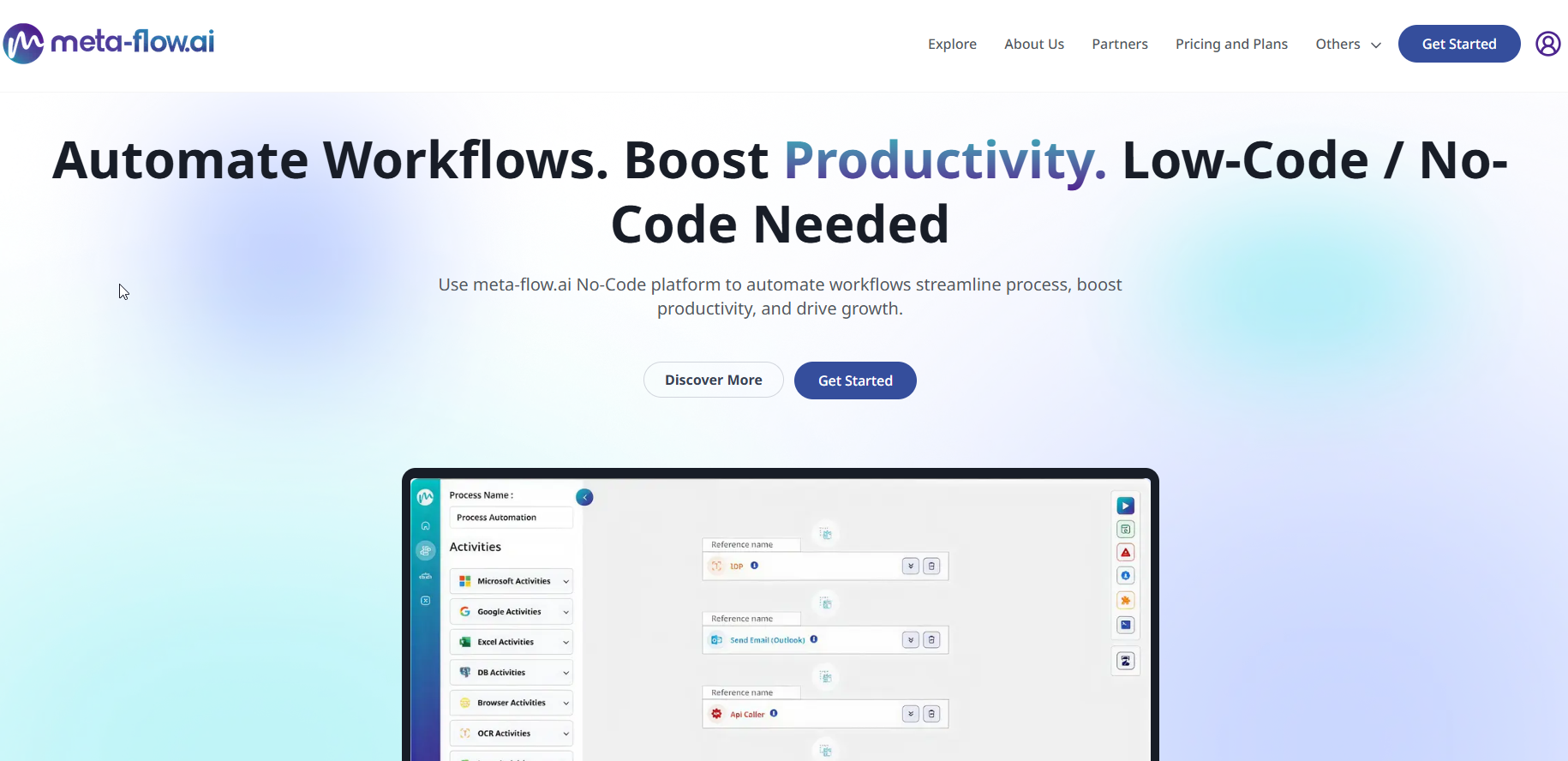
Metaflow AI is the cheapest paid way in this list to replace AirOps' content workflow, among the vendor pages that were read. It runs scheduled content jobs, publishes blog posts at volume and adds a small layer of AI visibility tracking on top. If your AirOps usage is mostly "generate and ship articles on a schedule", this is the closest match at the lowest verified paid entry price. It also overlaps with the tools in our guide to SEO automation tools, because workflow automation is the job it takes over.
Who it is for: Small content teams and solo marketers who want AirOps-style output without an enterprise contract.
Metaflow AI's pricing page lists a 14-day free trial, then $99/month for the Solo Growth plan. The plans run up from there.
| Plan | Price | Seats | Posts Per Month | Tracked Prompts |
|---|---|---|---|---|
| Solo Growth | $99/month | 2 | 20 | 30 |
| Scale Pro | $299/month | 4 plus team workspaces | 100 | 100 |
| Starter (expert-led) | From $399/month | See pricing page | See pricing page | See pricing page |
| White Glove | $1,750/month | See pricing page | See pricing page | See pricing page |
| Platform | $2,499/month | See pricing page | See pricing page | See pricing page |
Metaflow AI fits teams that publish 20 to 100 blog posts a month, track 30 to 100 prompts and want a custom MCP server and scheduled runs on the Solo Growth plan at $99/month. The pricing page labels the Starter plan expert-led, and it lists White Glove at $1,750/month and Platform at $2,499/month.
One wording point matters if AI search is why you are leaving AirOps. Metaflow AI's pricing page uses the term AEO only in the Starter plan description, and it does not mention GEO at all. The Solo Growth plan describes AI visibility tracking across ChatGPT, Perplexity and Claude, but the expert-led Starter plan is the only place the vendor frames the work as answer engine optimisation.
Strengths:
- Lowest verified paid entry price in this list at $99/month after a free trial.
- Custom MCP server and scheduled runs on the entry plan.
- Tracks prompts across ChatGPT, Perplexity and Claude, so it is not content-only.
- Higher plans add seats and team workspaces without a change of tool.
Trade-offs:
- Only 30 tracked prompts on Solo Growth, which is thin for a serious measurement programme.
- The step from $299/month to the expert-led plans is large.
- GEO is not mentioned on the pricing page.
- Content-led, so measurement is a secondary feature.
Key capabilities:
- Blog post production at 20 or 100 posts a month depending on plan.
- AI visibility tracking across three assistants.
- Custom MCP server.
- Scheduled runs.
- Video ads generation on Scale Pro.
Good fit:
- Teams replacing AirOps mainly for content production.
- Buyers who want to test the switch on a free trial before paying.
- Solo operators and small teams who value a low monthly cost.
Not a fit:
- Teams whose main AirOps job is serious AI-answer measurement.
- Buyers who need Google AI Overviews or Gemini coverage, which the pricing page does not list.
The limitation that matters most is measurement depth. Thirty tracked prompts will not tell you how your brand performs across a real buyer vocabulary.
2. Writesonic: Best For GEO And SEO Content In One Platform
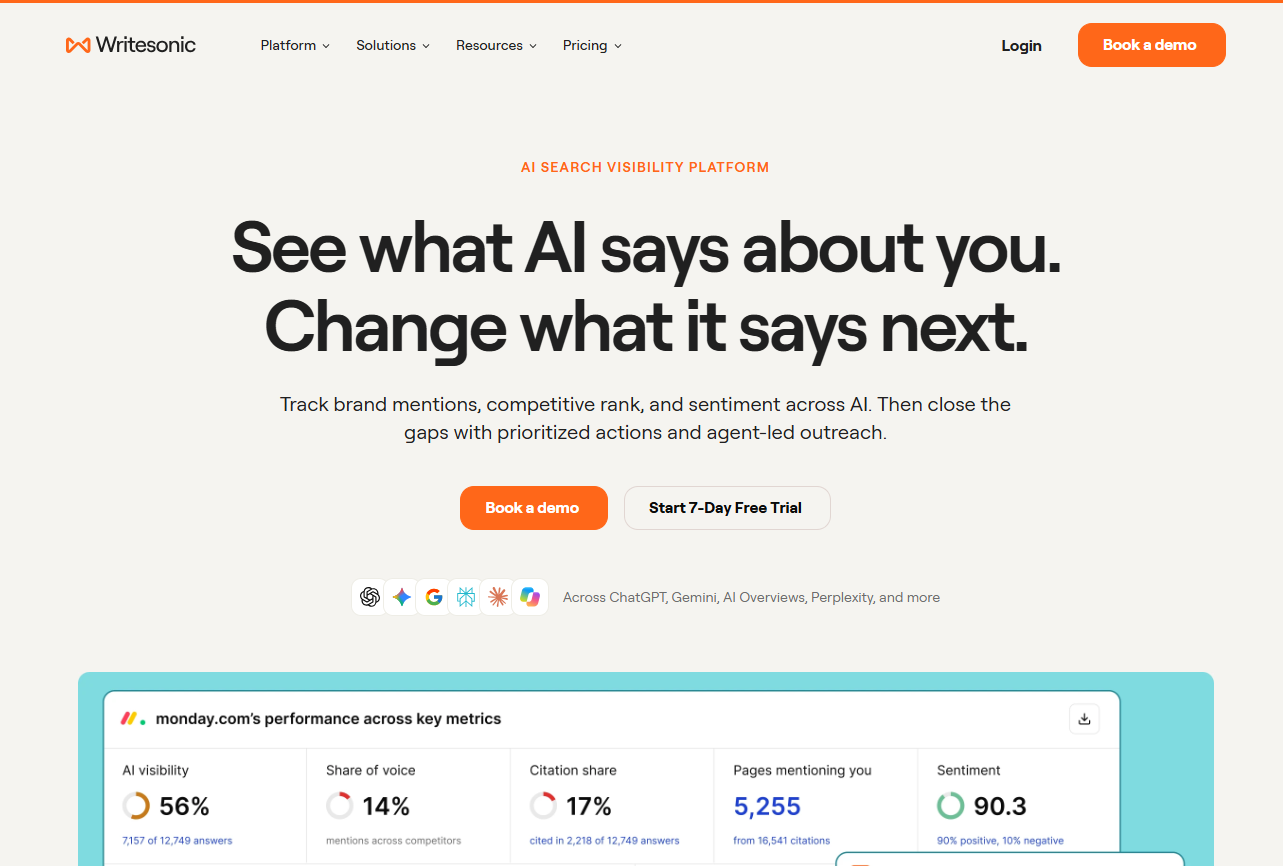
Writesonic is the option for teams that want one subscription to cover content and some visibility work. The vendor presents it as an all-in-one GEO and SEO platform, which is the pitch to AirOps users who are tired of stitching tools together. It leans to content production first, so treat it as a content workflow replacement with visibility features attached, not a tracking specialist.
Who it is for: Marketers who want drafting and some AI-search positioning in a single tool and do not need deep measurement.
| Plan | Price |
|---|---|
| All plans | Pricing on request |
Writesonic's pricing is shown as "Pricing on request" because its pricing page could not be read for this guide, and the figures that circulate on third-party pages disagree with each other. Check the vendor's own pricing page before you compare it with anything else here. The single check that matters is how many articles a month your plan includes, because that number decides whether it can replace the volume you produce on AirOps today.
Writesonic fits teams that want a content-first platform with GEO and SEO under one roof, and it should be avoided by teams whose main need is trustworthy AI-answer tracking across many platforms.
Strengths:
- Positioned as one platform for both GEO and SEO work.
- Content production is its centre of gravity, which suits a workflow replacement.
- One vendor to manage instead of two.
Trade-offs:
- Leans to content before measurement.
- Pricing could not be read for this guide, so cost is unverified.
- A broad platform may do fewer things deeply than a specialist.
Key capabilities:
- Content production for SEO.
- GEO positioning from the vendor.
Good fit:
- Teams whose AirOps usage is mostly articles.
- Buyers who prefer a single platform over a pair of tools.
Not a fit:
- Teams that need to prove AI-answer visibility with detailed tracking.
- Buyers who cannot move until a price is confirmed.
The limitation that matters most is that nothing here confirms its tracking depth, so a team that leaves AirOps for measurement should test it hard before cancelling.
3. Surfer SEO: Best For Teams That Write In-House And Need An Editor
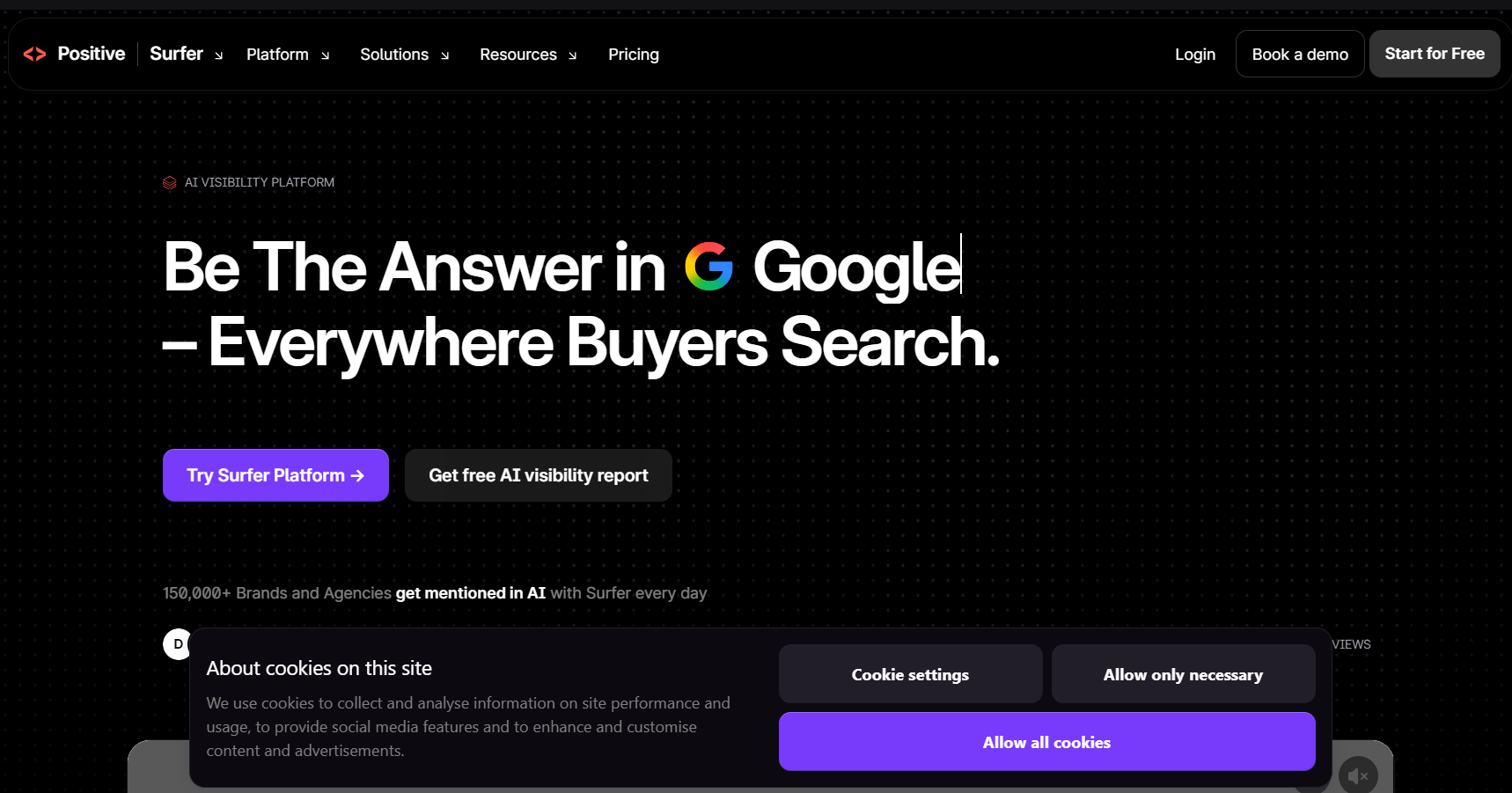
Surfer SEO replaces the narrowest slice of AirOps. It is an on-page content optimisation tool, not a workflow engine. It will help a writer hit optimisation targets before a page goes live, so it covers the drafting-quality part of the content job. It does nothing for AI-answer tracking, and it will not run your content pipeline for you. For a team that already writes its own drafts, Surfer is a practical way to hold each page to on-page optimisation targets before it is published.
Surfer SEO changed hands recently. It was acquired by Positive Group, formerly Sarbacane Group, in late October 2025, as reported by Rankability. Ownership changes do not decide a purchase, but they are worth knowing when you sign an annual plan.
Who it is for: In-house writers and editors who want a quality gate on each draft.
| Plan | Price |
|---|---|
| All plans | Pricing on request |
Surfer's pricing is "Pricing on request" in this guide because its vendor pricing page was not read for a figure. Look at Surfer SEO's own site for the current plans. Readers who want the wider field of this tool's rivals can read our guide to Surfer SEO alternatives.
Strengths:
- Narrow, well-defined job in on-page optimisation.
- Works alongside whatever drafting method you already use.
- Easy to explain to writers because it sits at the editing stage.
Trade-offs:
- No workflow automation.
- No AI-answer tracking.
- Ownership changed in late October 2025.
Key capabilities:
- On-page content optimisation targets.
- Editing guidance for drafts before publication.
Good fit:
- In-house teams with writers who already produce drafts.
- Teams that want to keep the content process human-led.
Not a fit:
- Anyone who used AirOps to automate production.
- Anyone who used AirOps to track AI answers.
The limitation that matters most is scope. Surfer replaces one slice of AirOps, so most teams will need a second tool beside it.
4. Gauge: Best For Tracking AI Answers And Acting On Them
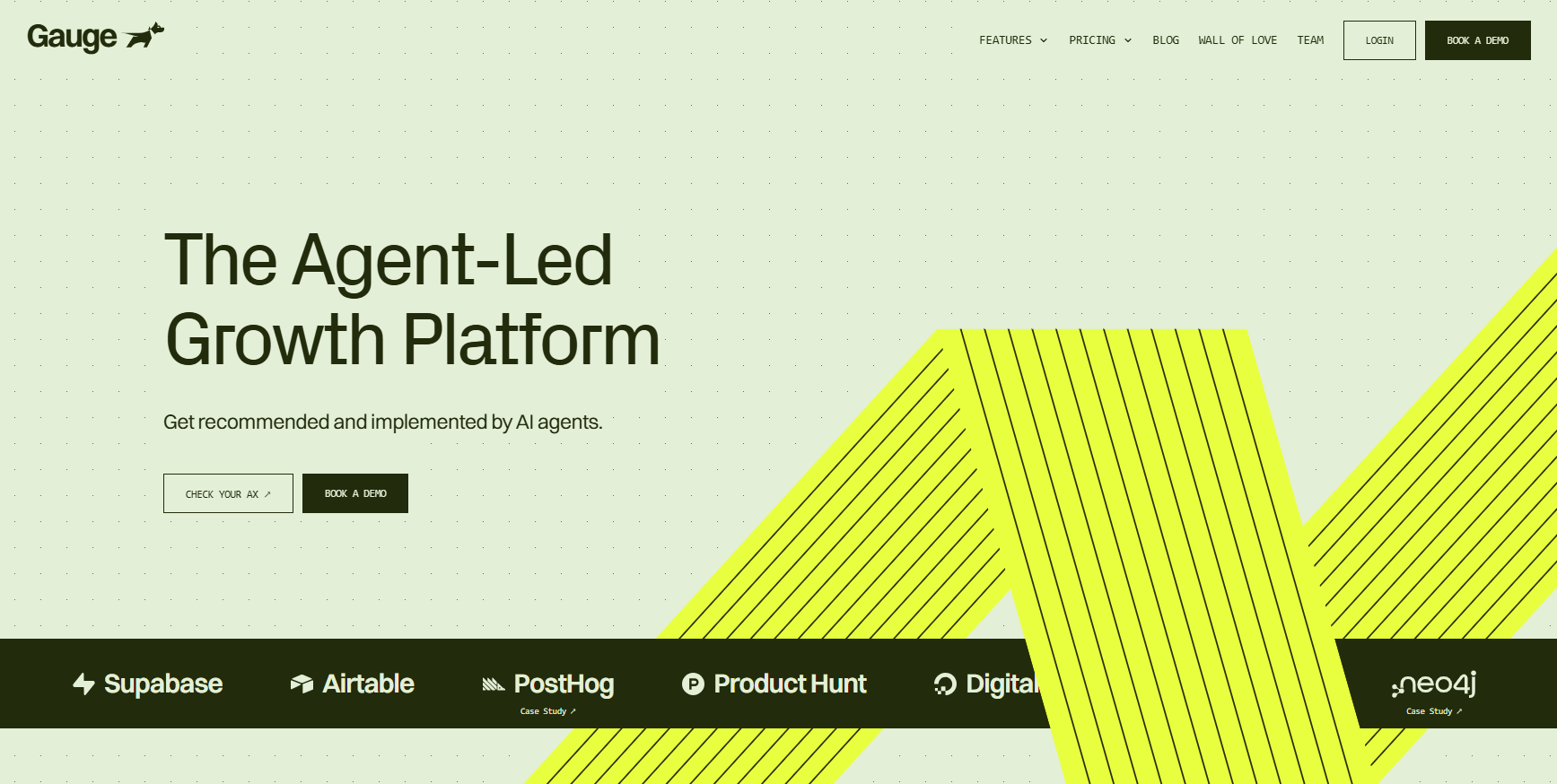
Gauge has the most verified detail in this list, and it is a measurement-led tool that also produces content. It is measurement-led. You find where AI assistants leave you out, and then it helps you act on the gap.
Gauge's pricing page shows three tiers. The Growth plan costs $599/month and covers 3 seats and 600 prompts run daily, which adds up to 54,000 answers a month, across ChatGPT, Google AI Mode and Microsoft Copilot. It includes 18 articles a month and integrates with GA4, Search Console and DataForSEO. Enterprise is custom priced and widens coverage to six AI platforms, including Google AI Overviews, Gemini and Perplexity, with sentiment analysis, exports and custom seats.
| Plan | Price | Inclusions |
|---|---|---|
| Growth | $599/month | 3 seats, 600 prompts run daily, ChatGPT, Google AI Mode and Microsoft Copilot, 18 articles a month, GA4, Search Console and DataForSEO |
| Enterprise | Custom pricing | Six AI platforms including Google AI Overviews, Gemini and Perplexity, sentiment analysis, exports, custom seats |
| Agents | Free tier, then $100 to $1,000/month | Credit-based, free tier starts with 1,000 credits refilled to 300 weekly |
The Agents tier is the odd one. Gauge's pricing page describes a free tier that starts with 1,000 credits and refills to 300 weekly, with paid credit-based plans from $100 to $1,000/month. It also lists an open-source command line tool that runs locally with your own Claude Code or Codex subscription.
On Gauge's own site, the Action Center assigns recommended actions, and the Content Engine generates briefs, outlines and articles and publishes them. Publishing connects to Webflow, Framer, GitHub and Sanity, while analytics connect to Google Analytics 4, Google Search Console and PostHog.
Gauge replaces the AI-answer tracking half of AirOps and part of the content half because the Growth plan includes both daily prompt tracking and a content engine capped at 18 articles a month. That cap is the number to hold against your AirOps output. If you publish well beyond 18 articles a month, Gauge covers your measurement and some of your content, not all of it.
Strengths:
- Deepest verified feature set in this guide.
- Tracking and content in one product.
- Action Center turns gaps into assigned tasks.
- Free Agents tier lets you test before spending.
Trade-offs:
- $599/month is the highest published entry price here.
- Growth covers three AI platforms, with the wider six reserved for Enterprise.
- Eighteen articles a month is a hard ceiling on content volume.
Key capabilities:
- Daily prompt tracking at 600 prompts on Growth.
- Action Center recommendations.
- Content Engine for briefs, outlines and articles.
- CMS publishing to Webflow, Framer, GitHub and Sanity.
- GA4, Search Console and PostHog analytics connections.
Good fit:
- Teams who care first about AI-answer measurement and want content from the same tool.
- Teams already on Webflow, Framer or Sanity.
Not a fit:
- High-volume content teams that publish far beyond 18 articles a month.
- Buyers who need the cheapest possible entry point.
The limitation that matters most is that the pricing page did not confirm MCP or Slack support, so check that before you rebuild any AirOps workflow that depends on either.
5. Profound: Best For Enterprise AI Answer Monitoring
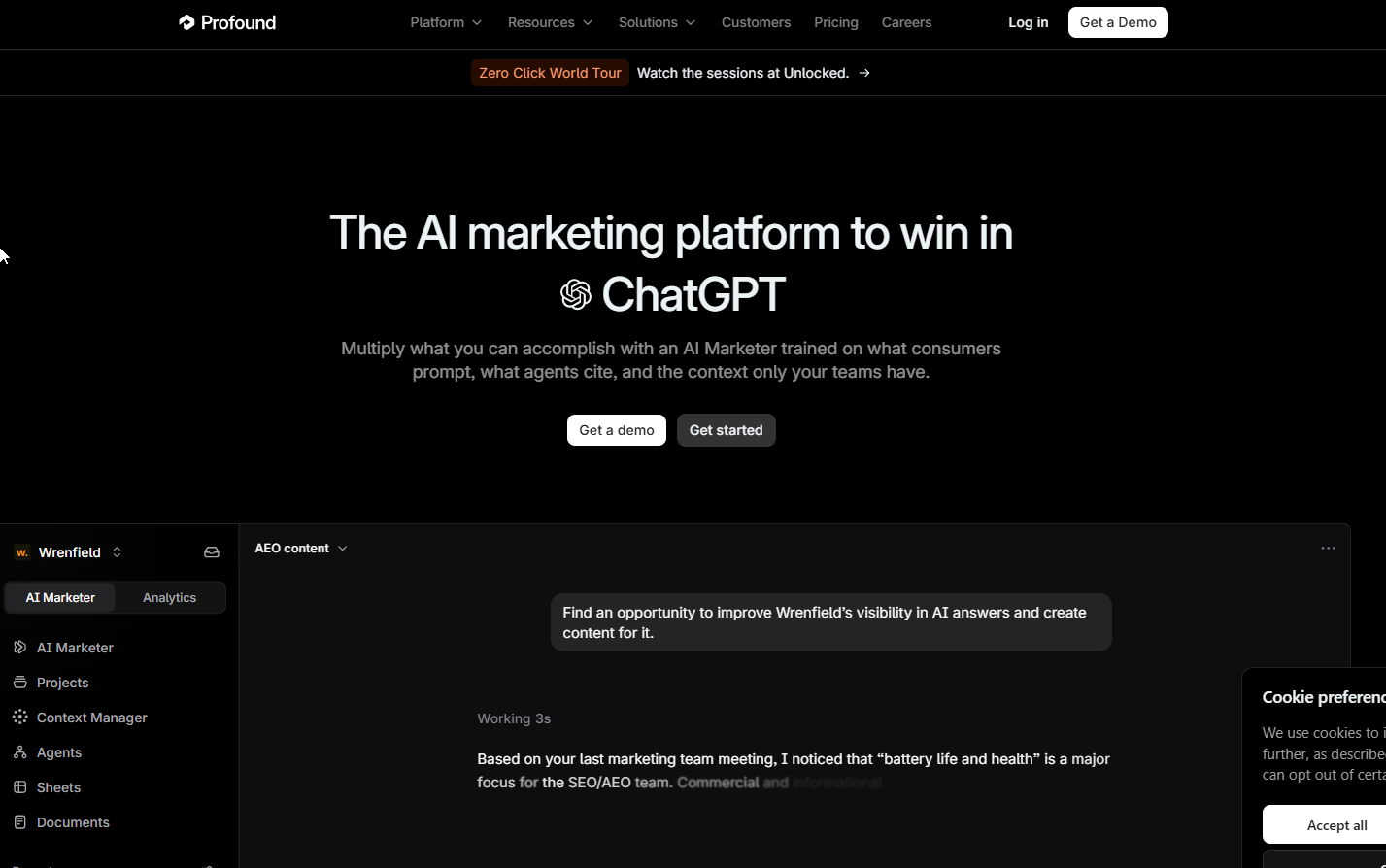
Profound is the tracking-only option. It replaces the measurement half of AirOps and nothing on the content side, so a team that used AirOps for content needs a second tool beside it. It earns its place here because it appears in every roundup of AirOps alternatives that this guide drew on, which makes it a common name on enterprise shortlists. The enterprise buying frame is covered in our guide to enterprise SEO suites.
Who it is for: Larger organisations that treat AI answer monitoring as a reporting function separate from content production.
| Plan | Price |
|---|---|
| All plans | Pricing on request |
Profound shows "Pricing on request" in this guide because its vendor pricing page was not read, and no feature or price claim is made beyond its positioning as an AI answer monitoring tool. Check Profound's own site before you shortlist it.
Strengths:
- Clear single purpose in AI answer monitoring.
- Appears in every roundup of AirOps alternatives this guide drew on, so it is easy to put on a shortlist.
- Suits a monitoring function that sits apart from content.
Trade-offs:
- No content workflow, so AirOps' production half goes uncovered.
- Pricing could not be verified for this guide.
- Needs a second tool for content, such as Metaflow AI or Writesonic from the switching map below.
Key capabilities:
- AI answer monitoring.
Good fit:
- Enterprise teams with a separate content stack, where measurement is owned by a different person than production.
- Buyers who want measurement from a specialist and are happy to run a second contract for content.
- Teams that plan to pair it with a content tool from the switching map, so each half of AirOps has its own owner.
Not a fit:
- Teams that used AirOps mainly to produce articles, because Profound leaves that half untouched.
- Small teams that need one tool to do both jobs and would rather manage a single login and contract.
The limitation that matters most is that Profound leaves the whole content job behind, so budget for a second tool before you cancel anything.
📋 Get Listed / Advertise
We update this guide monthly. Want your tool featured? Contact: [email protected].
Why Teams Look For An AirOps Alternative
The reasons below are the common objections in competitor roundups. None of them comes with a figure here, because AirOps' own numbers were never read from its own pages. Each one points to a different half of the job.
- Complicated workflows: Teams describe workflows that take effort to build and more effort to maintain. That is a content workflow problem.
- Repetitive AI writing: Output starts to sound the same across pages. That is also a content problem, and it hits hardest on scaled page production. Our guide to AI tools for programmatic SEO covers the tools built for that.
- Usage-based costs: Costs that scale with volume surprise teams that grow. That is a cost problem, and it can belong to either half.
Each reason sends you somewhere different. Workflow pain points to the content workflow tools. Repetitive writing points to a better editor or a different production method. Cost pain needs a rule rather than a tool, which is why the stay-or-switch section further down exists. If content programmes are the heart of the problem, our SaaS content marketing service is the managed alternative to any software.
Which AirOps Job Are You Replacing? A Switching Map
This is the section to bookmark. Find the job you use AirOps for, then read across.
| If You Use AirOps For | Replace It With | Expect |
|---|---|---|
| Content workflow and article production | Metaflow AI | A low entry price and light tracking |
| Content workflow with GEO positioning | Writesonic | Content first, measurement second |
| Drafting quality only | Surfer SEO | An editor, not an automation engine |
| AI-answer tracking | Gauge or Profound | Gauge adds content, Profound is tracking only |
| Both jobs | Gauge, or Metaflow AI | Gauge is measurement-led, Metaflow AI is content-led |
| Both jobs, via two tools | Profound plus Metaflow AI | Two contracts, two logins |
If you use AirOps for content workflow, replace it with Metaflow AI and expect a low price and light tracking. If you use it for AI-answer tracking, replace it with Gauge if you also want content, or Profound if you want a pure monitoring tool. If you use it for both, Gauge is measurement-led and Metaflow AI is content-led, so pick by which half you care about more.
If your team already pays for Semrush, its rank tracking, site audits and AI visibility tracking can cover the measurement half of AirOps without a second contract, which leaves you replacing only the content workflow. You can start with Semrush for the measurement side and put the saved budget toward a content tool.
Adjacent content optimisation tools belong in the content row too. Our roundup of Clearscope alternatives covers those. For the tracking row, generative engine optimization is the service layer that turns tracking data into pages that AI assistants actually cite.
Should you consolidate your SEO stack while you switch? Only if the consolidation removes a contract you were going to cancel anyway. A switch is a good moment to cut overlap, and a bad moment to add new categories of tool you have not tested.
If you would rather have a team run the content and the AI-visibility reporting than stitch two tools together, the GEO + SEO Growth Programme covers both. See what it includes and how the work is reported.
When To Stay On AirOps
Switching has a cost, and sometimes that cost is bigger than the saving. The rule is simple.
Stay on AirOps if you use both halves heavily, your workflows are already built and working, or your real problem is cost rather than fit. A cheaper tool that breaks a working pipeline is not a saving.
- You use both halves heavily: Replacing AirOps then means two tools, two contracts and two sets of logins.
- Your workflows already work: A working pipeline is an asset. Rebuilding it in a new tool takes weeks you could spend publishing.
- The problem is cost, not fit: If the product does the job and the bill is the only complaint, negotiate or trim usage before you migrate.
Here is the one test that settles it. Write down the AirOps job you would replace first, name the tool in the table above that replaces it, and ask whether you can run both for a month without disrupting output. If the answer is no, stay. If yes, the migration checklist below tells you how. Do this with your own numbers, because AirOps' prices are not stated in this guide.
How We Chose These AirOps Alternatives
Three criteria decided who made the list.
- Coverage: The tool replaces one or both of AirOps' two jobs.
- Roundup presence: The tool appears across the competitor roundups on AirOps alternatives.
- Readable pricing: The vendor's own page could be read for a price.
Only the Gauge and Metaflow AI pricing pages were read, which is why the other three rows say "Pricing on request". That is a limit of this guide, not a verdict on those vendors. Profound, Peec AI, AthenaHQ and Semrush also appear in roundups, and the five-tool cap is why Peec AI, AthenaHQ and Semrush are not profiled. Profound is covered because it appears in every roundup. If you are weighing a suite instead, see our list of Ahrefs alternatives, which covers AI visibility inside the larger suites.
How To Switch Without Losing Work: A Migration Checklist
Do these in order. Each step is a small job you can finish in a sitting.
- List every AirOps workflow and write down what it outputs, who uses the output and how often it runs.
- Export your content from AirOps, including drafts, published pages and any templates.
- Export your prompts and any instructions your workflows depend on, so you can rebuild them elsewhere.
- Pick the replacement per job using the switching map above, and decide whether you need one tool or two.
- Rebuild the smallest workflow first in the new tool, and check its output against the AirOps version.
- Run both tools in parallel for a month so you can compare outputs on the same topics.
- Compare outputs and costs side by side, and write down what the new tool does worse.
- Cancel AirOps only after the replacement has handled a full cycle of your normal work.
If you want a baseline before you touch anything, the free AI Visibility Report shows where you stand today, so you can tell afterwards whether the switch helped.
FAQs
Can I Use ChatGPT Instead Of AirOps?
Is An AirOps Alternative Better For In-House Teams?
Can I Run An Alternative Alongside AirOps?
What Is The Cheapest AirOps Alternative?
Which AirOps Alternative Is Best For Non-Technical Teams?
Does Any Alternative Replace Both AirOps Jobs?
Should I Consolidate My SEO Stack When I Switch From AirOps?
What Should I Export Before Cancelling AirOps?
Book a free 30-minute call. One of the founders takes it, and you leave knowing which half of AirOps to replace first and what we would fix before you sign for anything.
📑 Disclosure!
Some links in this article are affiliate links. If you sign up through them, The Rank Masters may earn a commission at no additional cost to you. This does not influence which tools we recommend or what we say about them.