

Choose Peec AI if your job is tracking how AI answers describe your brand and a team will read the dashboard weekly. Choose Profound if the job is acting on that tracking inside the tool, or if procurement wants SOC 2 Type II certification, which Profound's own article claims.
This rule holds for a B2B SaaS team picking one tool to trial this quarter, and it assumes you can name the person who will read the output every week.
Both vendors' pages contradict each other, and sometimes themselves, on engines, entry prices and certification, so confirm each point on the live vendor page before you commit.
If you would rather have a team track where your brand shows up in ChatGPT, Perplexity and Google AI Overviews, see how TRM approaches AI search visibility. The page shows what we look at first.
The Short Answer: Pick By The Job, Not The Feature List
Most comparison pages skip the part that matters, which is that they are written by someone with a stake. Profound's comparison article, dated 16 April 2026, frames the choice as monitoring versus execution and names Profound as the stronger choice where the goal is more than a dashboard. That is a useful split. It is also a split drawn by a company that sells one of the two tools, so read it as a claim, not a verdict.
The cleanest gut check comes from the other direction. If you cannot name who reads the weekly dashboard, start with Peec. A tool nobody opens every week is a tool you pay for and do not use.
Peec's own comparison page gives a steering rule. It points buyers with high daily prompt volume or a need for unlimited seats toward Peec, and buyers who need SOC 2 certification now toward Profound. TRM sells neither tool, and the rule above comes from lining those sources up against each other. If your shortlist is wider than two, read the full multi-tool comparison instead. This page stays a two-way fight. And if your job is being cited as the answer rather than watching for it, that is work for answer engine optimization, not for either dashboard.
| Your Job | Lean | What To Verify |
|---|---|---|
| Watching how AI answers describe your brand, with a weekly dashboard reader | Peec AI | Who reads the output every week, by name |
| Acting on tracking inside the tool, with drafts and actions after approval | Profound | What the agent does on your own prompts, shown in a demo |
| Procurement needs SOC 2 Type II now | Profound, once the report is in hand | The report itself and its audit period |
Peec AI Vs Profound At A Glance
The three biggest differences are the job each tool is built for, what each vendor publishes about plans, and the compliance claim.
| Attribute | Peec AI | Profound |
|---|---|---|
| Built for | Tracking and opportunity ranking | Tracking plus an agent that drafts and acts after approval |
| Published plan structure | Three self-serve tiers (Starter, Pro, Advanced) plus a custom Enterprise tier | A free trial and a custom Enterprise plan, plus an agency plan whose price is not shown |
| Engines on the entry offer | 3 engines you choose on each self-serve tier | 3 engines on the free trial (ChatGPT, Gemini, Google AI Overviews). Peec's comparison page says ChatGPT only on a Profound starter, see the disagreement section |
| Seats | Unlimited on all plans | Unlimited on the free trial |
| Content and agent actions | Ranks opportunities and produces briefs without publishing, per Profound's article | Drafts and acts on projects after approval, per its own article |
| Compliance claim | Contested, see the compliance section | SOC 2 Type II and HIPAA, claimed in its own article |
| Free trial | Not covered by the sources read | Seven days, 50 prompts daily |
| Where the claim was read | Peec AI pricing page and comparison page | Profound pricing page and Profound article |
Two cells in that table come from a competitor's description of the other tool, and the cells say so. Make those the first things you confirm on a demo call.
What Each Tool Is Built To Do
The short version is tracker versus agent. The longer version is that both descriptions come from people with something to sell, so each profile below names where it was read.
Peec AI
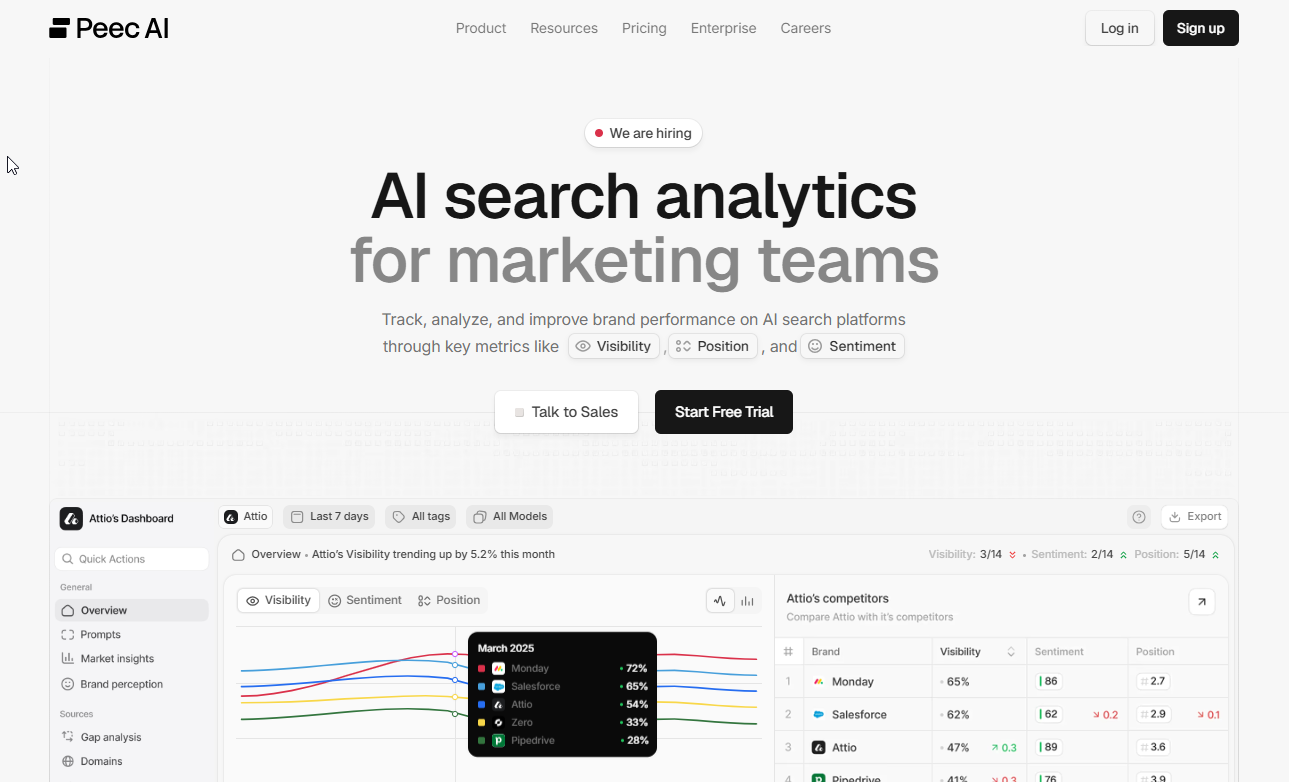
Peec AI is a tracking tool that, according to Profound's article, ranks opportunities and produces briefs without publishing anything. That is the answer to the question most readers ask first. Does Peec AI create content? On the evidence reviewed, it produces briefs and rankings, and it does not draft and publish for you. The source is Profound, so confirm the brief output in a Peec demo.
Who it suits is the team with a named dashboard reader and a lot of prompts to watch. The Dupple guide calls Peec the cleaner but less granular option. One limitation matters most. Less granular means you see the pattern, and you may not see the individual conversation that produced it.
Profound
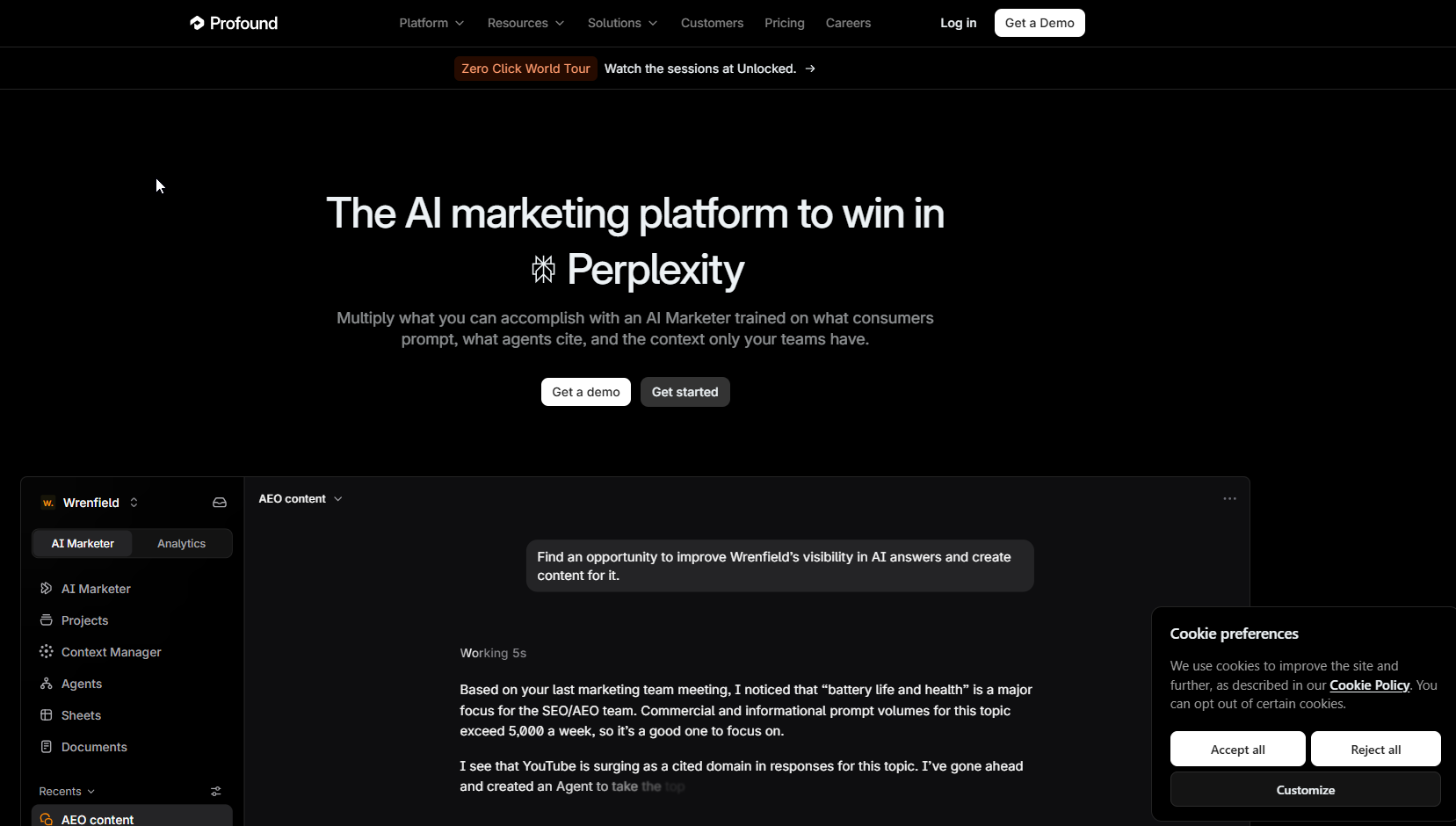
Profound is positioned in its own article as an AI marketing agent that drafts and acts on projects after approval. AirOps, which sells a competing product, says in its comparison that Profound's agents can draft articles, briefs and landing pages. Two sources agree on the description, and neither is neutral.
Dupple credits Profound with a conversation viewer that shows real prompts, answers and the source pages cited. That helps a team that wants to read the raw answers behind a score. Who it suits is the team that wants the tool to do work after it spots a gap, and has someone to approve the output. The limitation is the same as the strength. An agent that acts needs a person who reviews what it drafts, and that person has to exist before you buy.
The Question Neither Page Answers
Crawler and log visibility is the part no fetched source states in detail. Whether either tool shows which AI crawlers hit your site, or reads your server logs, is a question to put to each vendor, not a feature to assume. The same goes for how it connects to your stack. If crawler access is your real worry, start with TRM's note on LLM SEO and AI crawler access. And if what you want is a reliable count of when your brand is named, the test for brand mention counts shows how to check one.
Engines, Prompts And Data Depth
This is where the two tools look most alike on paper and differ most in what you get on the entry offer. The numbers below are from each vendor's own pricing page.
| Plan | Prompts | Engines |
|---|---|---|
| Peec AI Starter | 50 tracked daily | 3, your choice |
| Peec AI Pro | 150 tracked daily | 3, your choice |
| Peec AI Advanced | 350 tracked daily | 3, your choice |
| Peec AI Enterprise | Unlimited | Up to 13 on the plan card, 14 in the comparison table |
| Profound free trial | 50 unique prompts daily | 3 (ChatGPT, Gemini, Google AI Overviews) |
| Profound Enterprise | Tailored prompt-tracking plan | Up to 9 |
Peec AI's pricing page lists Starter at 50 prompts tracked daily, Pro at 150 and Advanced at 350, with 3 engines of your choice on each and unlimited seats on every plan. Profound's pricing page lists a free seven-day trial that runs 50 unique prompts daily across 3 engines, 1 region and 1 language, and a custom Enterprise plan with up to 9 answer engines. Read side by side, the entry offers match on engines and prompts. The gap opens at the top, where Peec AI's Enterprise page lists up to 13 or 14 engines against Profound's 9.
Prompt count is a ceiling on how much of your buyer's language you can watch at once. If your category has hundreds of buyer questions, the entry tier on either side will not cover it. For that case, TRM's guide to large-scale prompt monitoring is the better starting point.
Data depth is the second question. The Dupple guide credits Profound with a conversation viewer and calls Peec the cleaner but less granular option. How the answers are collected matters too. HubSpot's comparison, updated 28 October 2026, found that Peec queries AI engines through browser automation rather than APIs. HubSpot sells a competing product. The sources reviewed did not explain how Profound collects answers, so that is a demo question, not a gap to fill with a guess.
Two things to check before you rely on any score. First, whether the tool reports citations at the domain level or the page level, which page-level citation attribution explains. Second, whether citation tracking is in the tier you are buying, which the guide on tools with citation tracking covers. Ask both vendors in writing.
What Each Vendor Publishes About Plans
Peec AI publishes three self-serve tiers plus a custom Enterprise tier on its pricing page, while Profound's pricing page shows a free seven-day trial and a custom Enterprise plan. That is the whole structural difference, and it is bigger than it sounds.
Rework's comparison, updated 2 October 2026, says the same thing in its own words. Peec publishes prices on three of its four tiers, while Profound publishes only a free trial and a custom Enterprise quote. Profound's page also shows no Starter or Growth monthly price, and no price for its Agency Growth plan, which its pricing FAQ describes as 400 credits per month per client workspace.
| Structure | Peec AI | Profound |
|---|---|---|
| Self-serve tiers shown | Three, with prompts rising by tier | None, a free seven-day trial only |
| Top tier | Custom Enterprise | Custom Enterprise |
| Agency path | Multi-brand tracking, unlimited seats | Agency Growth plan, price not shown |
| Seats | Unlimited on all plans | Unlimited on the trial |
This article leaves amounts out on purpose. Prices on these pages move, and a number copied into a comparison goes stale faster than the structure does. Use the vendors' live pricing pages for current figures, and TRM's multi-tool comparison for a wider view.
When a plan is quote-only, the quote is your price. Rework advises buyers to write down the real workload, request an itemised quote with cost per tracked prompt, and ask for a written pilot window or a month-to-month term. That is good advice for either vendor. It also answers the upgrade question. Move up a tier when your frozen prompt set no longer fits the one you are on, not when a sales call says so.
Where The Sources Disagree, And How To Settle It
Three disagreements show up once you read the vendor pages against each other. None is a scandal. Each is a reason to read the live page on the day you buy.
Engines on the entry offer. Peec's comparison page says Profound's starter plan covers ChatGPT only, while Profound's pricing page lists three engines on its free trial. Peec's page also lists a Profound Starter plan and a Growth plan with monthly prices, and Profound's own pricing page shows neither. The two pages describe different things, and only one belongs to Profound.
Entry price. Peec's pricing page shows the Starter plan in dollars, while Peec's own comparison page shows it in euros, as EUR 89 and, elsewhere on the same page, 85. This is the one figure in the article, and it is here only to show that a vendor's own pages can disagree with each other.
Enterprise engine count. Peec's pricing page lists the Enterprise engine count as up to 13 on the plan card and 14 in the comparison table. One page, two numbers.
| The Claim | Side A | Side B | How To Settle It |
|---|---|---|---|
| Engines on Profound's entry offer | Peec's comparison page says ChatGPT only | Profound's pricing page lists 3 engines on its trial | Ask Profound which engines your pilot covers, in writing |
| Peec AI Starter price | Peec's pricing page shows dollars | Peec's comparison page shows euros, EUR 89 and 85 | Ask Peec for the price in your currency, in writing |
| Peec AI Enterprise engines | Plan card says up to 13 | Comparison table says 14 | Ask Peec for the engine list in your contract |
The rule is simple. The vendor's live page wins, and you read it on the day you decide. A competitor's description of a plan is a lead to check, not a fact. Where the answer matters to your decision, ask for it in writing and keep the reply with your notes.
Enterprise Readiness: Compliance And Security
Compliance is contested, and the decision rule at the top depends on it, so here are the three statements side by side.
Profound's article, from April 2026, says Profound holds SOC 2 Type II and HIPAA compliance. The same article describes Peec's SOC 2 work as in progress. HubSpot, in a comparison updated 28 October 2026, says Peec publishes no SOC 2 Type II or HIPAA certification. Two of the three sources sell something. HubSpot sells a competing product, and Profound sells one of the two tools.
Notice what each statement proves. A vendor saying it holds a certification is a claim. A competitor saying a vendor lacks one is also a claim. Neither is the report. If procurement needs SOC 2 Type II, ask the vendor for the document and its audit period, whichever tool you favour.
- Ask Profound for: The SOC 2 Type II report, its audit period, and the HIPAA documentation it says it holds.
- Ask Peec AI for: Its current SOC 2 status in writing, and the date it expects any report to be issued.
- Ask both for: The scope of the audit and which products it covers.
Two things this article does not say. It does not say whether either tool supports single sign-on, because the sources are silent. And it makes no claim about support quality, because the sources offer testimonials only. If those matter, make them written questions too.
Which Team Should Pick Which Tool
There is no single winner, because the winner depends on who sits in the chair. Each row below gives a lean and the one fact that could overturn it.
| Team Situation | Lean | What Could Change The Answer |
|---|---|---|
| A team with a named person who reads the dashboard every week | Peec AI | That person cannot be named, which is a reason to start with Peec anyway |
| High daily prompt volume or many seats | Peec AI, per Peec's own steering rule | Profound quoting a plan that covers your prompt count |
| A team that wants the tool to draft and act after approval | Profound | A demo where the agent output is not usable on your prompts |
| Procurement that needs SOC 2 Type II now | Profound, once the report is verified | The report, or its audit period, does not match the claim |
| An agency with many client workspaces | Test both, since each has an agency path | The cost per client workspace in a written quote |
| A first-time AI visibility team on the cheapest honest trial | Profound's free trial, with its fixed 50 preset prompts | The preset prompts not matching your buyers' questions |
A tool's connections can also tip the choice. Peec's comparison page lists an API, an MCP server and a Looker Studio connector, all vendor-stated and not checked against documentation. If your reporting runs through Looker Studio, that line is worth testing in a trial. For an agency, the guide on agency reporting covers what to ask for.
A tracker only shows you the gaps. If you want a team to work through them every month, look at the GEO + SEO Growth Programme.
The Same-Prompt-Set Test To Run Before You Pay
This test runs both tools on one frozen set of buyer prompts for the same period, and it produces one decision against a baseline you set before you start. It is a method, not a TRM result. A fair comparison fixes the prompt set, engines, region, language and date window for both tools, because AI answers vary between runs and a single run proves little.
- Write 30 to 50 prompts. Mirror real buyer questions across three intents, such as learning, comparing and buying. The output is a list you can paste into either tool. Add wording variants if you want to see how fragile a result is, using the guide on prompt variation testing.
- Freeze the conditions. Fix the prompt set, engines, region, language and date window. The output is a one-page spec both tools must meet.
- Run both tools on the identical set. Use the same period for each. The output is two result sets that can be compared line by line.
- Log answer-level results. Record what each tool says for each prompt, not the dashboard score. Scores hide the answers that produced them.
- Compare the same five outputs. Brand mention rate, citation sources, sentiment direction, run-to-run stability and time to a usable action. For stability, the method in answer change detection applies.
- Decide against a baseline. Set the baseline before you start. HubSpot advises testing impact against a pre-set baseline over several weeks, so one good day decides nothing.
| Prompt | Intent | Tool | Mentioned | Citation Sources | Sentiment | Stable Across Runs | Time To Action |
|---|---|---|---|---|---|---|---|
| Example buyer question | Comparing | Peec AI | Yes or no | Domains cited | Positive, neutral or negative | Same or changed | Minutes to a usable next step |
| Example buyer question | Comparing | Profound | Yes or no | Domains cited | Positive, neutral or negative | Same or changed | Minutes to a usable next step |
There is one constraint to plan around. Profound's pricing page lists a trial with 50 unique prompts daily across 3 engines, and HubSpot says that is a fixed set of 50 preset prompts that cannot be customised. You have two options. Use Profound's preset set in Peec AI as the common set, or ask Profound for a pilot on your own set, as Rework advises. The first is quicker. The second is a truer test.
To keep a classic baseline beside the AI numbers, run the same topic list through Semrush for keyword and rank data, so you can tell whether a gain in AI answers moves with your organic rankings or stands alone.
Put these questions to each vendor before you sign:
- Data collection: How are answers gathered, and from which engines and regions?
- Crawler and log visibility: Does the tool show AI crawler activity or read server logs?
- API: What can be pulled out programmatically, and on which plan?
- Export: Can you export full answer history, and in what format?
Switching Later Or Running Both
Switching is easier than most buyers fear if you froze your prompt set. Peec's comparison page lists data export on all plans, which is a vendor statement, so confirm it before you rely on it.
- Export your history. Take every answer and score the old tool will give you.
- Re-run the frozen prompt set. Run it in the new tool so trends stay comparable.
- Run both for one cycle. Compare the two on the same days.
- Cut the old tool. Once the new one matches or beats it on the five outputs, stop paying.
Running both for a cycle is worth the cost when the tool you are leaving holds the only history of your brand's AI answers, or when you are switching from Peec AI to Profound and want to see whether the agent's output beats your current brief process. It is not worth the cost when your prompt set is small and a one-week overlap shows the same picture. The overlap pays for itself only when it settles a question.
After the choice, the next work is the fixes. Start with citation gap analysis, then set up a competitor benchmarking protocol so the baseline keeps moving. And if you want the gaps fixed rather than only tracked, that is the work of generative engine optimization.
FAQs
Which Is Better For Agencies Managing Several Clients, Peec AI Or Profound?
Does Peec AI Create Content, Or Only Track Visibility?
Does Profound Publish A Self-Serve Price?
How Many AI Engines Can Each Tool Track?
How Does Each Platform Collect AI Answers?
Can I Try Profound For Free, And What Does The Trial Include?
How Many Seats Do Peec AI And Profound Allow?
When Should I Move Up A Tier For More Prompts Or Engines?
Which Visibility Metrics Map To Traditional SEO KPIs?
What Should I Ask Each Vendor Before I Sign?
If you have narrowed it to these two tools and want a second opinion before you commit, book a thirty-minute call. One of the founders takes it, and you leave knowing which test to run first.
📑 Disclosure!
Some links in this article are affiliate links. If you sign up through them, The Rank Masters may earn a commission at no additional cost to you. This does not influence which tools we recommend or what we say about them.