
AI Visibility is shifting from “Do we rank?” to “Do AI systems recommend us, and can we prove why that changed?” Your leadership team doesn’t want a dashboard screenshot. They want before/after evidence: Week 1 vs Week 4, what the AI said, what sources it cited, and whether your campaign moved the needle (the exact angle from the brief: “Campaign impact proof”).
(Spreadsheet brief: commercial investigation intent; ideal angle “week 1 vs week 4”; focus on history + comparisons + attribution + exports; tools to pitch: Peec, OtterlyAI, Profound, Conductor, Akii.)
If prompt result history + before/after comparisons are your #1 requirement, choose a tool that (1) reruns prompts on a schedule, (2) stores historical responses as dated snapshots, and (3) lets you compare time ranges with exports you can send to stakeholders.
- Best for fast prompt setup + marketing-friendly reporting: Peec
- Best for citation + prompt tracking with an AI-search-first focus: OtterlyAI
- Best for deeper enterprise AI visibility insights: Profound
- Best for enterprise workflows + tying AI visibility to outcomes: Conductor
- Best for quick visibility scoring + “get started fast”: Akii
📋 Get Listed / Advertisement
We update this guide monthly. Want your tool featured? Contact: [email protected].
Best 5 AI Visibility Tools with Prompt Result History (Quick Comparison)
| Tool | Best for | Prompt Result History | Before/After Comparison | Notable strengths |
|---|---|---|---|---|
| Peec | Marketing teams + competitive tracking | ✅ Stores prompt tracking over time | ✅ Trend/range comparisons | Competitive visibility reporting + easy stakeholder reporting |
| OtterlyAI | Citation-first AI visibility | ✅ Prompt + citation tracking history | ✅ Compare changes + citations | Strong for “why did it change?” via source/citation visibility |
| Profound | Enterprise AI visibility + prompt insights | ✅ Historical visibility + prompt insights | ✅ Range comparisons (enterprise-style) | Good for broader AI visibility intelligence + prompt research concepts |
| Conductor | Enterprise workflows + tying to outcomes | ✅ Ongoing AI search performance tracking | ✅ Trend/range comparisons + rollups | Competitive market share + workflow + traffic/conversion positioning |
| Akii | Fast baseline tracking | ✅ Visibility trend history | ✅ Basic before/after trends | Quick to start; good for early-stage monitoring |
📋 Get Listed / Advertisement
We update this guide monthly. Want your tool featured? Contact: [email protected].
▶️ Explore
1. Peec
What it does
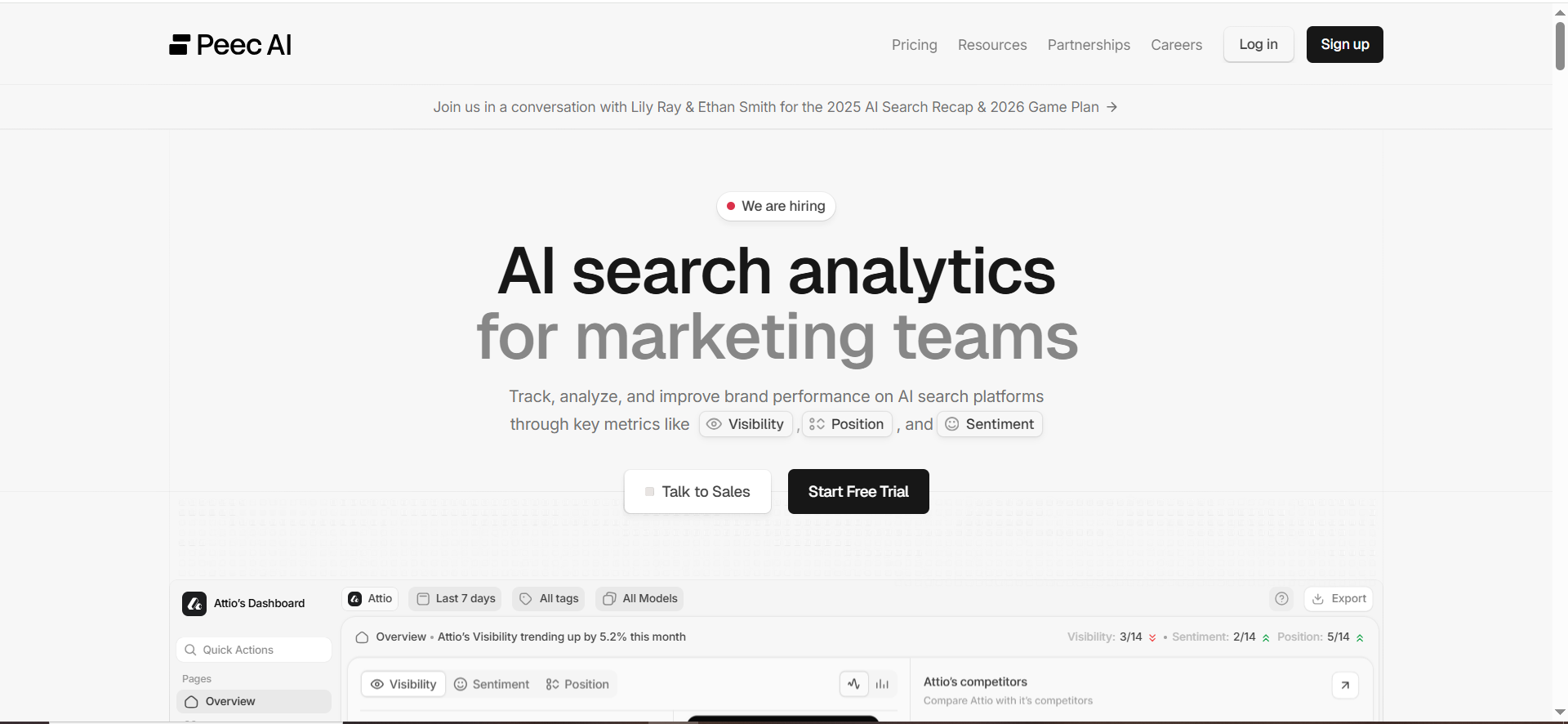
Peec positions itself as AI search analytics for marketing teams, focused on identifying prompts, monitoring performance, and acting before competitors.
Why teams use it
If you need “prompt result history” plus practical reporting, Peec is often framed around day-to-day monitoring: prompts are “the foundation,” and teams track changes over time to see whether they’re winning or losing key conversations.
What it’s good for
- Before/after comparisons that are easy to explain to non-technical stakeholders (date ranges, prompt groups, “what changed?”)
- Competitor benchmarking (the moment your brand drops out and a rival appears)
- Category-style reporting if you build prompt sets by topic (e.g., “best invoice software,” “SOC2 compliance tools,” “CRM for SMB”)
When it’s a good fit
- You’re a B2B SaaS marketing team that needs a repeatable weekly reporting ritual.
- You need exports for leadership updates, client reporting, or internal decks.
- You want to track competitive comparison and share-of-voice by prompt/category.
When it’s not a good fit
- You need deep enterprise governance, complex integrations, or multin toward Conductor/Profound depending on your environment).
- Your main goal is advanced research into what people ask about AI (Profound’s prompt research angle can be stronger).
How to use it
- Create a “Campaign Set” of 25–50 prompts tied to the thing you’re changing (new landing page, PR push, product launch).
- Create a “Control Set” of 25–50 stable prompts where you didn’t change anything (to detect broad volatility).
- Tag prompts by intent: problem-aware, solution-aware, comparison, alternatives, best-of.
- Run Week 1 baseline and export it (this becomes your “before” artifact).
- Repeat Week 2–4, then export a Week 4 view and compare.
Key capabilities to demand
Even if a tool says “tracking,” ask whether it supports:
- Historical snapshots of the full AI response (not just a score)
- Source/citation capture (so you can explain why results changed)
- Prompt grouping + tagging (so you can report by category)
Pricing
Peec’s pricing starts at €89/month. Its Enterprise plan is custom (by quote).
Free tier?
Peec’s site shows a “Start for free” signup option, but it doesn’t clearly specify whether that is a free tier or a time-limited free trial.
Downsides / limitations
A common limitation across AI visibility tools is that LLM answers vary by time, region, and experiment flags. Your comparisons are only as trustworthy as your prompt set and rerun strategy (we’ll cover how to prevent “false wins” later).
2. OtterlyAI
What it does
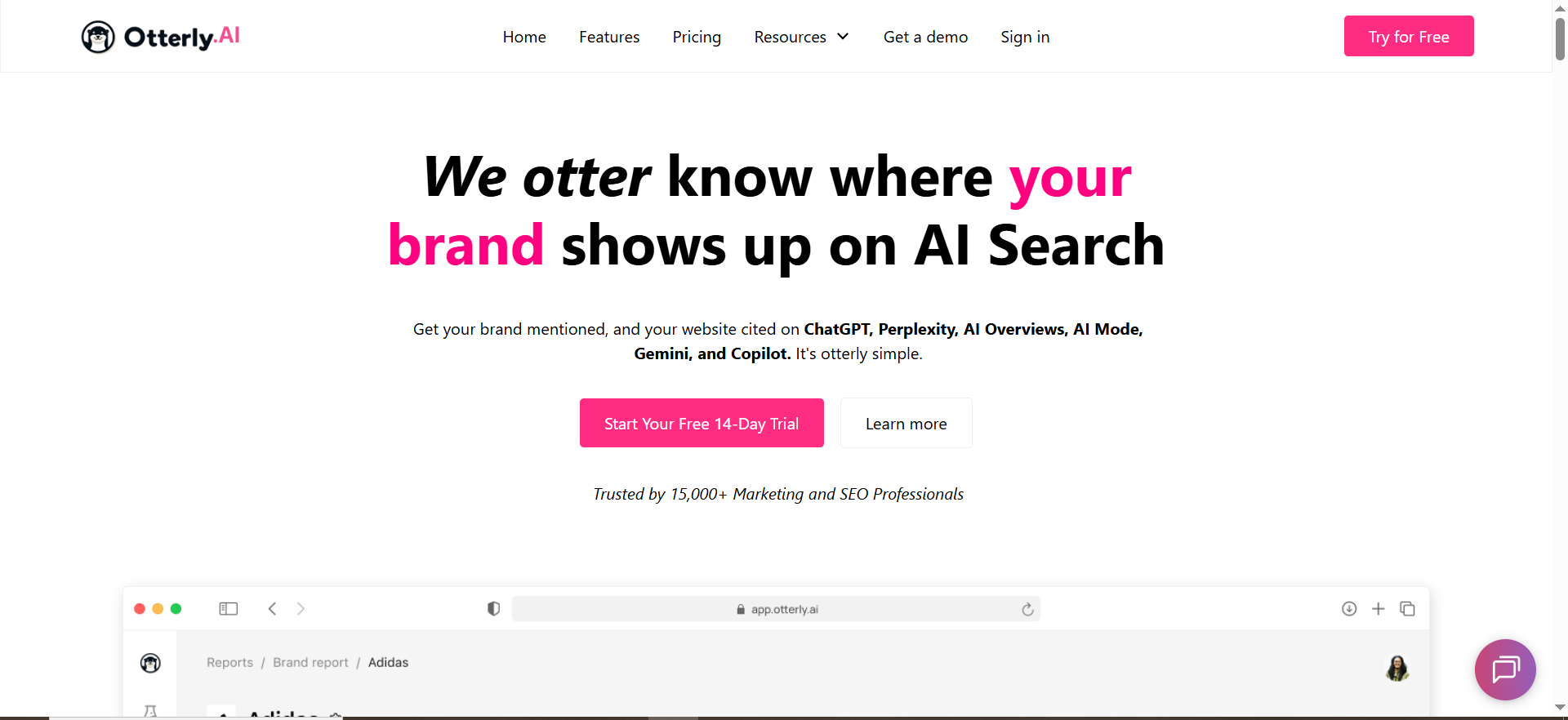
OtterlyAI is positioned as an AI search visibility platform with emphasis on tracking how you show up in AI search engines, including citation and prompt tracking and dashboards for action.
Why teams use it
Teams that care about “prompt result history” typically care about evidence. OtterlyAI’s positioning leans into that: visibility into what AI engines display for key terms, plus citation/prompt tracking that supports actionable content and PR strategy decisions.
What it’s good for
- Citation tracking + prompt tracking when your question is: “Which sources are powering these answers, and are we one of them?”
- Before/after storytelling where you want to show: “We earned citations,” not just “We got mentioned.”
- Creating a repeatable prompt monitoring program that content + PR can collaborate on.
When it’s a good fit
- You want to optimize for AI answers that cite sources and you’re actively working on authority + citations (digital PR, expert content, linkable assets).
- You need to diagnose which sources AI uses so you can build a source strategy (become the cited page, or get cited by the pages AI already trusts).
When it’s not a good fit
- You need a broader enterprise SEO suite that integrates directly into your existing workflow stack (Conductor may fit better).
- You want heavy “prompt demand” research (Profound’s prompt insights products may be more directly aligned).
How to use it (citation-first before/after)
Week 1 (baseline):
- Track 25–100 prompts across your core categories.
- Export the baseline: capture the AI response, whether you’re cited, and which domains are cited.
Week 4 (after changes):
- Compare:
- Did you gain citations?
- Did your cited URL change (homepage vs deep page)?
- Did competitor citations drop?
If the tool can’t show you the source-level changes over time, it’s not really supporting “prompt result history” for decision-making.
Key capabilities to demand
- Citation capture + history
- Prompt-level change tracking
- Dashboards that support exporting evidence (PDF/CSV)
Pricing
Otterly’s pricing starts at ts at $29/month.
Free tier?
OtterlyAI doesn’t offer a free tier, but it does offer a free trial (14 days).
Downsides / limitations
Citation tracking is only powerful if your team is prepared to act on it (content refresh, link building, digital PR, schema/technical changes).
3. Profound
What it does
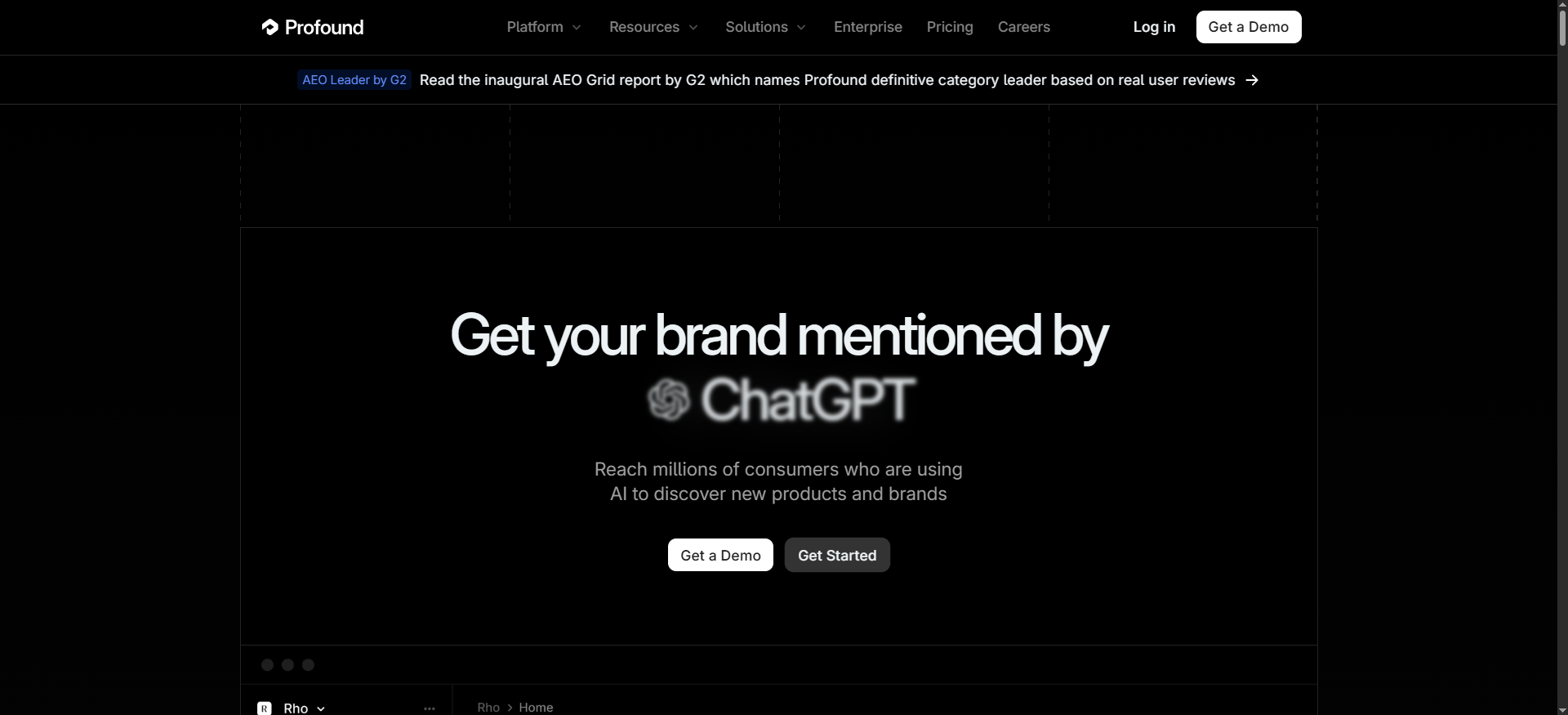
Profound positions itself around tracking AI visibility, understanding mentions, and uncovering insights to improve your presence in AI search.
Why teams use it
Profound is a fit when you want deeper enterprise-grade AI visibility intelligence, not just a surface-level tracker. It also offers prompt insight features (e.g., “Prompt Volumes”) focused on what people ask answer engines.
What it’s good for
- Prompt research + trend awareness: knowing what people are asking AI systems, and how that demand changes.
- Enterprise visibility measurement when you need to coordinate between SEO, content, PR, and brand/reputation teams.
- Potentially richer views into “how AI is talking about your brand,” which matters for messaging accuracy and narrative control.
When it’s a good fit
- You have multiple stakeholders and need a platform that supports deeper analysis.
- You’re measuring more than “mentions”: you care about prompt landscapes, narratives, and source ecosystems.
When it’s not a good fit
- You just need a lightweight “week 1 vs week 4” proof report and don’t need broader research.
- Your team prefers a tool optimized for fast setup and lightweight reporting.
How to use it
- Use prompt insights to identify high-leverage question areas (what your market asks AI).
- Build a tracked set from those questions.
- Run before/after comparisons following the same prompt set, same cadence.
- Export changes at the category level (not only prompt-by-prompt) for exec reporting.
Key capabilities to demand
- Snapshot history of AI answers
- Source/citation tracking (if relevant to your strategy)
- Segmentation by topic/category and competitor
Pricing
Profound’s paid plans start at $99/month (Starter), with Growth at $399/month and Enterprise pricing available by quote.
Free tier?
Profound doesn’t offer a free tier, but it does offer a demo (and a free AEO report on its site).
Downsides / limitations
With enterprise platforms, the risk is adoption: you need an owner, a weekly ritual, and clear definitions of success (or you’ll end up with a dashboard nobody trusts).
4. Conductor
What it does
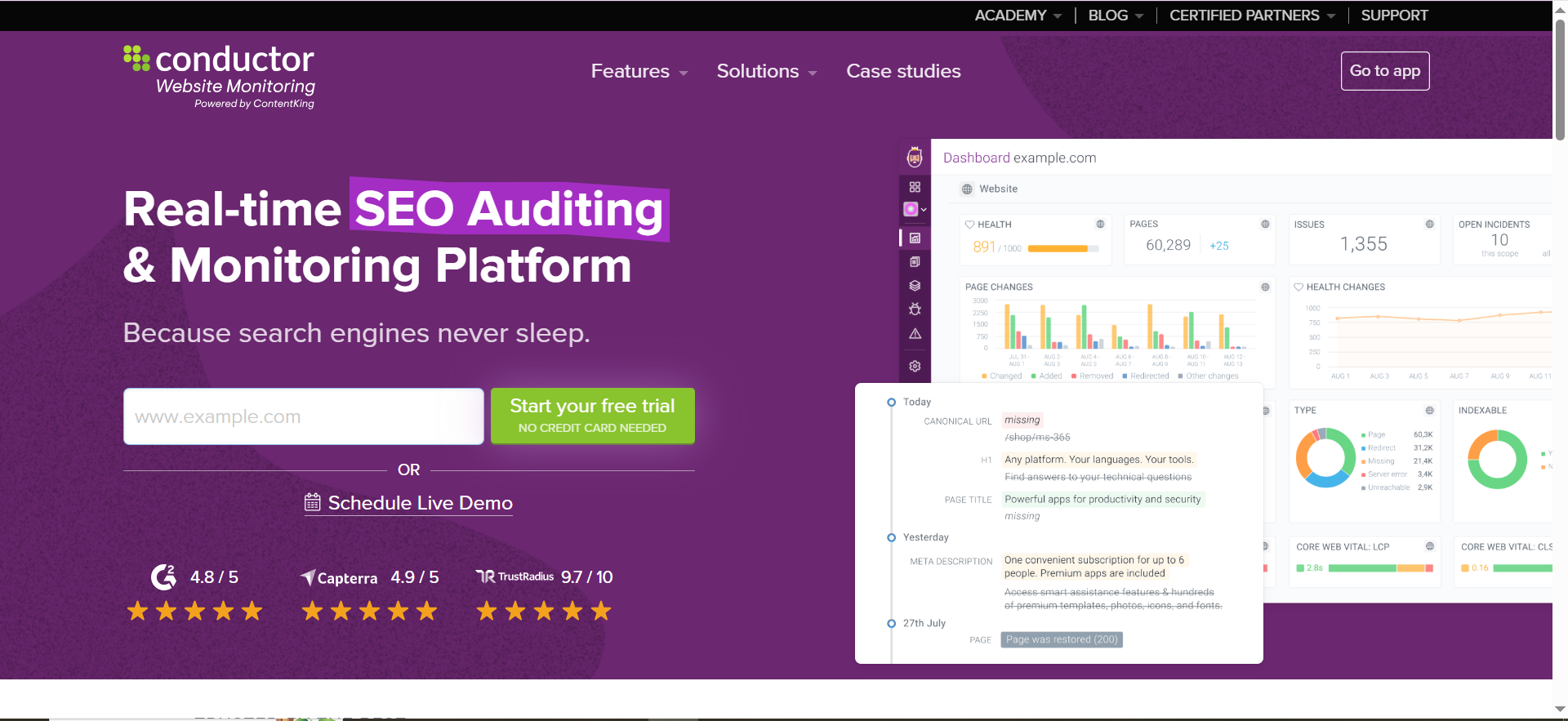
Conductor positions AI Search Performance around maximizing visibility across AI experiences (e.g., ChatGPT-style answers, Perplexity, Google AI experiences), and includes features like competitive market share, topic/prompt tracking customization, workflow integration, and traffic/conversion insights to tie visibility to business outcomes.
Why teams use it
If your leadership asks, “Cool, did this drive the pipeline?” Conductor’s positioning directly addresses that by linking AI visibility insights to traffic and conversions and integrating with content workflows.
What it’s good for
- Enterprise-grade reporting and ROI narratives (visibility → traffic → conversions)
- Competitive market share views that help you explain “who’s dominating the conversation” by topic.
- Prompt tracking strategy guidance (their educational content emphasizes choosing topics, balancing branded/unbranded prompts, and building a tracking strategy).
- Teams that want an API-first / data-integrity stance (as positioned in their feature messaging).
When it’s a good fit
- You’re in the Growth/Enterprise stage and want AI visibility measurement inside a broader SEO/content operating system.
- You need a tool that works across teams and turns insights into workflows (not just monitoring).
When it’s not a good fit
- You want a cheap, lightweight tracker.
- You only need a simple prompt history report and don’t need workflow integration.
How to use it
- Create a topic-level structure first (category → prompt sets).
- Track prompts within each topic (so your results roll up into exec-ready dashboards).
- Run weekly comparisons and annotate changes (new page launch, PR hit, content refresh).
- Export monthly: topic-level share and prompt-level evidence.
Key capabilities to demand
- Topic-level rollups + prompt drilldowns
- Competitive market share
- Traffic & conversion insights
- Reliable data collection approach
Pricing
Conductor doesn’t publish list pricing; plans vary and are provided by quote based on your configuration and products.
Free tier?
Conductor doesn’t offer a free tier; it offers a free trial and a demo instead.
Downsides / limitations
Enterprise tools require process maturity: you need prompt governance, naming conventions, and a consistent rerun cadence. Without that, “before/after” becomes “random variance.”
5. Akii
What it does
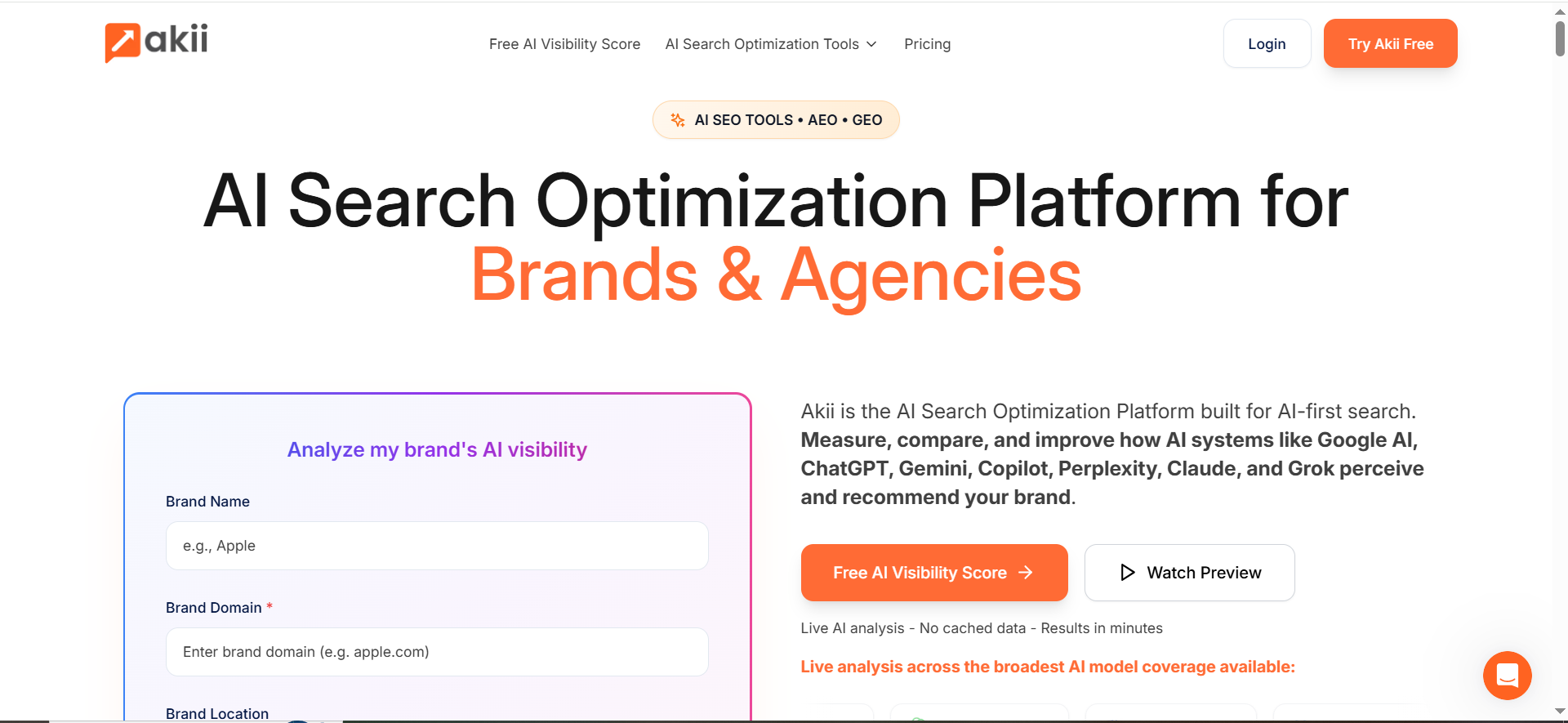
Akii positions itself as an AI search optimization / visibility platform for monitoring mentions, recommendations, and citations across AI search engines, with visibility trends over time and an easy start experience.
Why teams use it
Akii can be appealing when you want to start tracking quickly, get a baseline, and monitor trends without heavy setup overhead.
What it’s good for
- Getting a fast “are we present?” baseline
- Trend monitoring (week-over-week visibility)
- Teams that want a lightweight path to AI visibility measurement
When it’s a good fit
- You’re early in AI visibility and need to prove the problem exists before investing heavily.
- You need quick wins and a simple weekly ritual.
When it’s not a good fit
- You need deep enterprise workflow integration or rigorous attribution reporting.
- You want highly detailed citation/source diffing across many prompt sets.
How to use it (baseline → upgrade path)
- Start with a focused set of prompts for your top product category.
- Track weekly trend movements.
- If stakeholders demand deeper before/after evidence (sources, exports, workflows), expand into a tool with more robust history + reporting.
Pricing
Akii’s pricing starts at $49/month.
Free tier?
Akii doesn’t list a free tier, but it does offer a 14-day free trial (and a free AI visibility test).
Downsides / limitations
Lightweight tools can be great starters, but your before/after story can fall apart if you can’t export the underlying evidence or capture full prompt answer history.
What “Prompt Result History” Actually Means (and what to demand)
Most teams think they want “prompt tracking.” What they actually need is audit-grade history, the ability to answer:
- What did the AI say then?
- What did it say now?
- What changed in between?
- Which sources/citations changed?
- Did we move in prominence (top vs bottom), not just “present vs absent”?
Here are the four “levels” of prompt history maturity:
Level 1: A single visibility score
Useful to spot trends, but weak for proof. Executives will ask, “What does the score mean?”
Level 2: Mention presence + basic trendline
Better, but still not enough. A mention could be buried, negative, or irrelevant.
Level 3: Full answer snapshots over time (dated)
Now you can do real before/after. You can show Week 1 and Week 4 outputs and highlight differences.
Level 4: Comparisons + diffs + evidence exports
This is the gold standard for “campaign impact proof.” You can export:
- Prompt-by-prompt changes
- Category rollups
- Source/citation movement
- Notes/annotations tied to campaign actions
Non-negotiables (based on the brief’s focus on history, comparisons, attribution, exports):
- A way to store historical snapshots of responses
- A way to compare date ranges (before vs after)
- Exports that stakeholders accept (CSV/PDF)
- A consistent rerun cadence (weekly at minimum; often daily for volatile topics)
How to Set Up Prompt Tracking the Right Way (so comparisons are valid)
Conductor’s prompt tracking guidance emphasizes choosing the right topics, balancing branded/unbranded prompts, and building a tracking strategy that reflects real customer conversations.
Here’s the practical version.
1) Balance prompt intent types
Build prompt sets across:
- Unbranded “best” prompts (“best invoice software for startups”)
- Comparison prompts (“Tool A vs Tool B”)
- Alternatives prompts (“alternatives to X”)
- Branded prompts (“Is [Brand] good for enterprise?”)
- Use-case prompts (“How to do SOC2 reporting”)
AI answers often behave differently by search intent.If you only track one type, your before/after can be misleading.
2) Use prompt clusters (not one-offs)
A single prompt is noisy; a cluster gives you a signal.
Example cluster: “best AP automation”
- best AP automation software
- AP automation for mid-market
- AP automation tool for NetSuite
- Bill.com alternatives for AP automation
- AP automation vs manual invoice processing
3) Lock a rerun schedule
Pick one:
- Weekly: good for executive reporting and change management
- Daily: good for active campaigns and volatile categories
Many “AI mode” / AI visibility tool discussions emphasize continuous reruns because the answers change; your tracker must reflect that reality.
4) Decide your “engines” and “personas”
Different AI experiences answer differently. Choose the set that matches your buyers. (If your buyers use Perplexity and ChatGPT-style assistants, track those. If you care about Google’s AI experiences, include them where supported.)
5) Standardize naming and tagging
This is what makes exports usable:
- Topic: Billing / Security / CRM
- Funnel: TOFU / MOFU / BOFU
- Intent: Best / Vs / Alternatives / How-to
- Market: US / UK / EU (if you do geo)
Scoring & Reporting Templates (Share-of-answer, citations, prominence)
Template A: Prominence scoring (0–3)
- 0 = not mentioned
- 1 = mentioned but buried / not recommended
- 2 = recommended but not primary / not early
- 3 = top recommendation / early placement / clearly endorsed
Why it matters: a “mention” can be meaningless. Prominence is closer to revenue impact.
Template B: Citation scoring
- Direct citation: your domain is cited
- Indirect citation: you’re recommended but sources cite third parties
- No citation: you’re mentioned with no sources (harder to defend)
Tools that emphasize citation tracking make this easier to operationalize.
Template C: Share-of-answer rollups
For each topic cluster, compute:
- % prompts you appear in
- % prompts you’re top-3
- average prominence score
- most common competitor appearing instead
This is the language executives understand: “Where do we win the conversation?”
Common pitfalls (why your “before/after” lies)
Pitfall 1: You changed the prompt list mid-test
If Week 1 uses different prompts than Week 4, you didn’t run a comparison, you ran two different studies.
Fix: freeze the prompt set for the test window.
Pitfall 2: You didn’t use a control set
If the whole ecosystem moved because of a model update, you might mistakenly credit your campaign.
Fix: maintain a control prompt set.
Pitfall 3: You only measured presence, not prominence
Presence can go up while quality goes down (e.g., you’re mentioned as an inferior option).
Fix: add prominence scoring and sample screenshots.
Pitfall 4: You can’t export evidence
If you can’t export prompt-level changes, your story collapses under scrutiny.
Fix: prioritize exports as a selection criterion (matches the brief’s “exports” requirement).
Pitfall 5: You treat AI visibility like classic rank tracking
AI answers are not ten blue links. They’re generated narratives influenced by sources, citations, and context.
How do AI visibility tools store prompt result history (snapshots vs timelines)?
When a tool says it “tracks prompts,” it usually means one of two storage models:
1) Snapshot-based history
A snapshot is a saved capture of the AI result at a specific time (e.g., Jan 1, Jan 8, Jan 15). Each snapshot typically stores:
- The prompt text (and any persona/locale settings)
- The full AI response (or a structured extraction of it)
- Mentions: whether your brand appears and where
- Citations/sources (if the engine provides them)
- Competitors shown
- A score (optional) computed from the snapshot
Pros
- Best for before/after comparisons (Week 1 vs Week 4)
- Easy to export as evidence (“Here’s the answer on these dates”)
- Works well with annotations (“On Jan 10 we launched page X”)
Cons
- You can miss volatility between snapshots (if you only run weekly)
- Snapshots can be noisy if the engine output is highly variable
Best for: campaign reporting, stakeholder proof, audits, compliance-style evidence.
2) Timeline-based history (continuous/time-series)
A timeline treats results like a stream of data points (daily/hourly), often storing:
- A score over time (share-of-answer, presence, prominence)
- Mention frequency, competitor frequency
- Citation/domain frequency trends
- Alerts when something materially changes
Sometimes the “timeline” is not storing full responses every time—just structured metrics derived from them.
Pros
- Great for monitoring and alerts
- Easier to spot pattern shifts (competitor surge, citation drops)
- Useful for “always-on” visibility programs
Cons
- If it only stores metrics (not full responses), you lose evidence
- Before/after can become “trust our score” rather than “here’s the text”
Best for: operations, ongoing tracking, volatility detection, leadership dashboards.
What to demand (non-negotiables if you care about history)
If “prompt result history” is a key requirement, ask the vendor:
- Does it store full response snapshots, or only scores?
- Can you view Week 1 vs Week 4 side-by-side for the same prompt?
- Does it store citations/sources and allow historical comparison?
- Can you export prompt-level history (CSV/PDF) with timestamps?
- Can you lock prompt settings (persona/region) so results are comparable?
What’s the best way to do before/after comparisons (date ranges, annotations, diffs)?
A credible before/after comparison is not “the score went up.” It’s a controlled evaluation with consistent inputs.
The cleanest method: “Frozen baseline + fixed comparison window”
- Week 1 baseline: run the full prompt set and export it (your “before artifact”)
- Implement changes (content, PR, technical)
- Week 4 comparison: run the same prompt set again and export it
- Compare Week 1 vs Week 4 at:
- Prompt level (exact text differences)
- Topic level (rollups)
- Evidence level (citations/sources)
Use date ranges instead of single-day snapshots (reduces noise)
AI answers can vary day-to-day. Better comparisons often use:
- Before window: 7–14 days average (or median)
- After window: 7–14 days average (or median)
This smooths variance and produces more defensible reporting.
Add annotations (so your stakeholders believe you)
Annotations turn data into attribution:
- “Jan 10: Published ‘Alternatives to X’ landing page”
- “Jan 14: Earned PR mention on [Industry Site]”
- “Jan 18: Updated comparison page with pricing + FAQ + schema”
A tool that supports annotations (or at least lets you export and annotate externally) makes reporting dramatically easier.
Diffs: what you actually want to see
For each prompt, your “diff” should highlight:
- Mention changes: absent → present, present → absent
- Prominence changes: buried → top, top → buried
- Recommendation framing: “best choice” → “one option”
- Citation changes: new cited URL, new cited domains, lost citations
- Competitor substitution: who replaced you or who you displaced
A practical “Before/After” scoring rubric
Use a simple 3-layer system:
- Presence: 0/1 (mentioned or not)
- Prominence: 0–3 (not mentioned → top recommendation)
- Evidence: direct citation / indirect citation / none
This creates stakeholder-ready reporting without overcomplicating.
How many prompts do you need to track a category, not just a brand?
The right number depends on category size and how precise you need to be, but here are practical baselines.
Minimum viable category tracking
- 25–50 prompts per category if you want directional insights
- Use 5–8 subtopics, each with 3–8 prompts
Example category: “Invoice automation”
- “best invoice automation software”
- “invoice automation for NetSuite”
- “AP automation vs invoice automation”
- “Bill.com alternatives”
- “invoice OCR tools for finance teams”
- “how to automate invoice approvals”
More reliable (recommended for reporting)
- 75–150 prompts per category
- Build clusters across intent types:
- Best-of (unbranded)
- Vs / comparison
- Alternatives
- Use-case / “how to”
- Branded evaluation
Enterprise-grade coverage
- 200–500+ prompts if you have multiple segments, regions, personas, and strong competition.
The key principle: clusters beat single prompts
Single prompts are noisy. Clusters (multiple prompts expressing the same intent) create stable signals.
Include a control set
If you’re tracking a category (not just your brand), maintain:
- A campaign set (directly tied to what you changed)
- A control set (similar prompts with no changes)
This is how you avoid attributing ecosystem volatility to your efforts.
What’s the best tool if you need prompt result history specifically (not just a score)?
If your top requirement is history as evidence, your tool selection should prioritize snapshot quality, comparison views, and exports.
Choose tools that treat prompts as first-class objects
The best “prompt history” tools typically provide:
- Prompt library + tagging
- Scheduled reruns
- Stored answer snapshots
- Side-by-side comparisons
- Exports (CSV/PDF)
- Citation/source capture (ideally)
Use this decision checklist
Pick the tool that answers “yes” to most of these:
- Can I see the full answer from Week 1 and Week 4?
- Can I compare two date ranges for the same prompt?
- Can I export prompt-level history to share with stakeholders?
- Does it store citations/sources over time?
- Can I tag prompts by topic and roll up reporting?
Practical recommendation by need
- If you need the clearest before/after story for stakeholders: pick the tool that provides the cleanest side-by-side snapshot comparisons + exports.”
- If you need to explain “why did it change?”: favor tools with strong citation/source tracking.
- If you need organization-wide reporting: choose a platform with topic rollups + workflow/enterprise reporting.
- If you’re early-stage and proving the problem: a lightweight tracker is fine, but confirm it stores enough history to be credible.
Rule of thumb:
If the tool can’t show you exactly what the AI said then vs now, it’s a scoring tool, not a history tool.
FAQs
What is AI visibility, in plain English?
What counts as “prompt result history” in a tool?
For a single campaign, start with 25–75 campaign prompts plus 25–75 control prompts. If you’re tracking multiple categories, build separate clusters per category to avoid mixing signals.
How often should prompts be rerun?
Can these tools track citations and sources, not just mentions?
How do I prove ROI from AI visibility improvements?
Changing the prompt set midstream, not using a control set, and relying on a single score instead of storing/exporting the underlying evidence.
Which tool should I pick if I'm a Growth-stage B2B SaaS?
📋 Get Listed / Advertisement
We update this guide monthly. Want your tool featured? Contact: [email protected].