

If you want a small, high-signal competitive analysis stack in 2026, start with Semrush for SEO/share-of-voice, Similarweb for market-level traffic narratives, Adbeat for competitor paid creative and spend signals, Visualping for website/pricing change alerts, and MarketMuse for content gap and content strategy planning. Together, these five cover the moves that usually change pipeline fastest: search visibility, messaging/creative, channel mix, and on-site changes. Use the comparison table below to pick your first two tools, then follow the setup workflow to turn intel into weekly actions.
📋 Get Listed / Advertisement
We update this guide monthly. Want your tool featured? Contact: [email protected].
Best AI Tools for Competitive Analysis Marketing (Quick Comparison)
| Tool | Best for | What you get (AI-assisted) | Pricing / free tier |
|---|---|---|---|
| Semrush | SEO + share-of-voice + competitor research | Keyword + page intel, clustering, recommendations, reporting | Paid plans; trial often available |
| Similarweb | Market and channel mix narratives | Traffic estimates, audience overlap, referrals, trend explanations | Paid plans; limited free access |
| Adbeat | Competitor paid creative intel | Creative history, landing pages, placement patterns, directional spend signals | Paid plans; demo/trial varies |
| Visualping | Website + pricing + page change monitoring | Change detection, diff alerts, workflows to route updates to owners | Paid plans; free tier varies |
| MarketMuse | Content gap + planning against competitors | Topic modeling, gap scoring, briefs and prioritization | Paid plans; trial varies |
📋 Get Listed / Advertisement
We update this guide monthly. Want your tool featured? Contact: [email protected].
1. Semrush
What it does
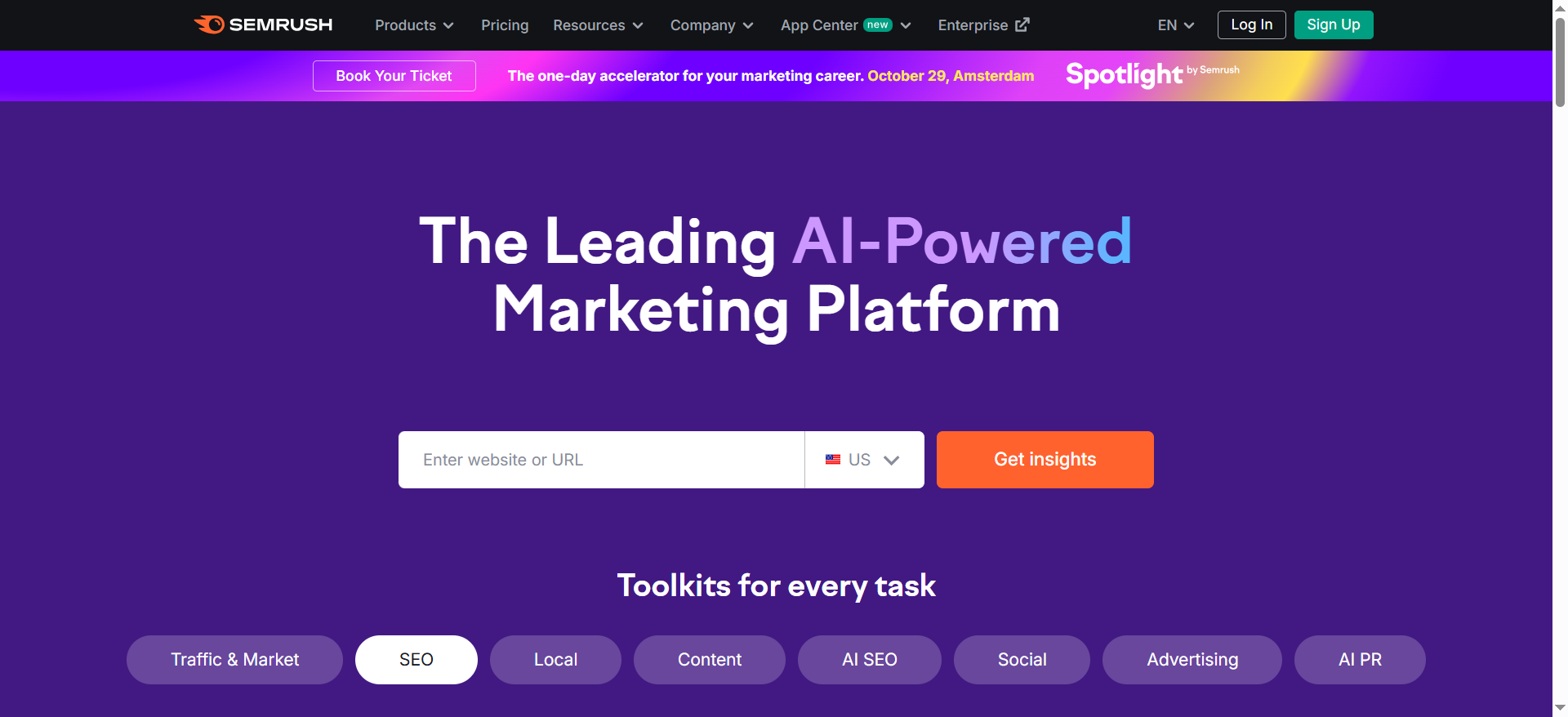
An SEO and competitive research suite that helps you track rankings, identify competitor pages and keywords, and translate changes into prioritized actions.
Why teams use it
Teams use it to answer: What competitors are winning in search, what changed this month, and what we should publish or fix next.
What it's good for
- Share-of-voice tracking across a keyword set
- Finding competitor pages driving organic growth
- Spotting keyword gaps and fast-win topics
- Packaging insights into reports for leadership
When it's a good fit
Best fit if you want one platform for SEO visibility, competitor research, and reporting.
When it's not a good fit
If you only need a single narrow job (like change monitoring) and already have a primary SEO platform.
How to use it
- Create a competitor list (3-10 domains) and a keyword set tied to revenue pages.
- Track weekly share-of-voice and watch for big deltas (new pages or new keywords).
- For each delta, capture: what changed, why it likely changed, and your next action.
- Ship a one-page weekly memo: 3 moves to copy, 3 moves to counter, 1 test to run.
Key capabilities
- Keyword and SERP tracking with competitor comparisons
- Competitive domain and page research
- Keyword/topic clustering to prioritize content
- Reporting exports for dashboards and stakeholder updates
Pricing
Semrush’s pricing starts at $139.95/month for the Pro plan (with higher tiers at $249.95/month and $499.95/month).
Free tier?
Semrush offers a free account with limited access, and it also offers free trials (typically 7 days) for many toolkits.
Downsides / limitations
- All-in-one suites can be heavy; teams often underuse advanced modules.
- Estimates and difficulty metrics require spot-checking against real SERPs.
2. Similarweb
What it does
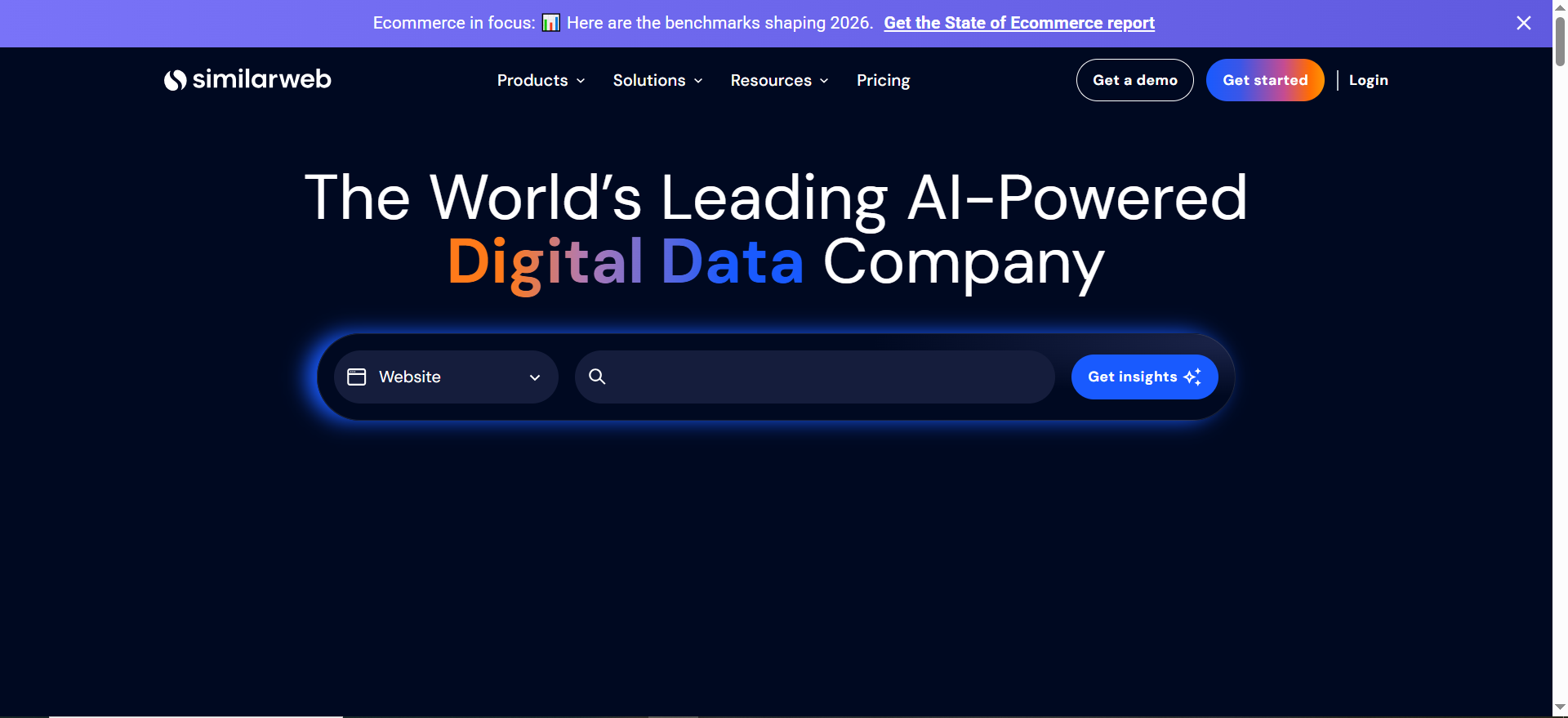
A digital market intelligence platform that estimates competitor traffic and channel mix so you can see where growth is coming from (or disappearing).
Why teams use it
Teams use it to decide where to invest: SEO vs paid, which partners matter, and which segments or geos are heating up.
What it's good for
- Channel mix shifts (search, referral, direct, social)
- Top referring sites and partnership discovery
- Audience overlap and category benchmarking
- Explaining market movement to leadership
When it's a good fit
Best fit when you need market-level narratives (channel mix, traffic trends, audience overlap) for exec decisions.
When it's not a good fit
If you only need keyword-level SEO decisions (use your SEO suite first).
How to use it
- Pick 5-10 closest competitors and one category benchmark set.
- Review channel mix weekly and flag any 20%+ swings.
- When a channel spikes, inspect top pages/referrers to identify the cause.
- Turn each finding into a test: page update, partner outreach, or spend reallocation.
Key capabilities
- Traffic and engagement trend estimates
- Referrals and partner discovery
- Audience and category benchmarking
- Competitive comparisons across multiple domains
Pricing
Similarweb’s pricing starts at $199/month for its Web Intelligence self-serve package, and larger business/enterprise packages are custom.
Free tier?
Similarweb offers limited free access on its site, and it also offers a free trial.
Downsides / limitations
- Traffic numbers are directional estimates; use trends and comparisons more than absolute values.
- May overlap with existing BI for teams with strong first-party analytics.
3. Adbeat
What it does
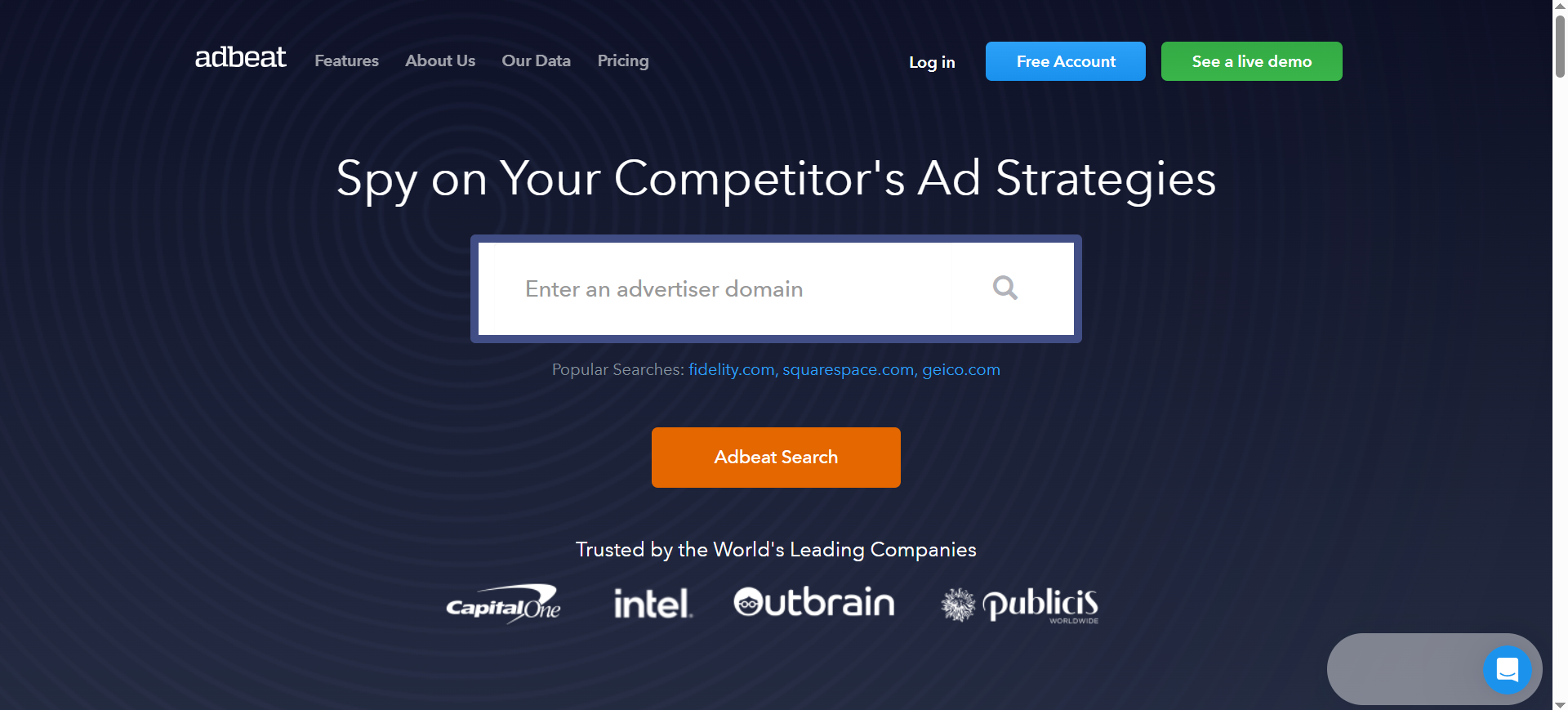
An ad intelligence tool that surfaces competitor creatives and landing pages so you can see patterns in offers, messaging, and funnel design.
Why teams use it
Teams use it to speed up creative strategy: what angles are repeating, what's new, and what seems to be scaling.
What it's good for
- Creative and offer research (hooks, CTAs, landing pages)
- Identifying which ads persist (a signal of performance)
- Capturing competitive examples for briefs and swipe files
- Mapping competitor funnels and positioning
When it's a good fit
Best fit if paid media matters and you want to learn what competitors run, where they run it, and how long it lasts.
When it's not a good fit
If you rely only on organic channels and do not plan to run paid tests.
How to use it
- Pick 3 competitors and capture their last 30-90 days of top creatives.
- Cluster creatives by angle (pain, outcome, proof, objection).
- Translate clusters into 3 new creative hypotheses to test.
- Review weekly: keep angles that persist; kill angles that disappear quickly.
Key capabilities
- Creative history and landing page capture
- Filtering by competitor and time window
- Pattern spotting across placements and creative themes
- Easy exports for internal briefs
Pricing
Adbeat’s pricing starts at $249/month.
Free tier?
Adbeat offers a free Basic account, but it doesn’t offer a free trial for Adbeat Pro plans (it does offer a live demo).
Downsides / limitations
- Spend signals and coverage vary by channel and geography.
- Use it for pattern learning, not exact budget accounting.
4. Visualping
What it does
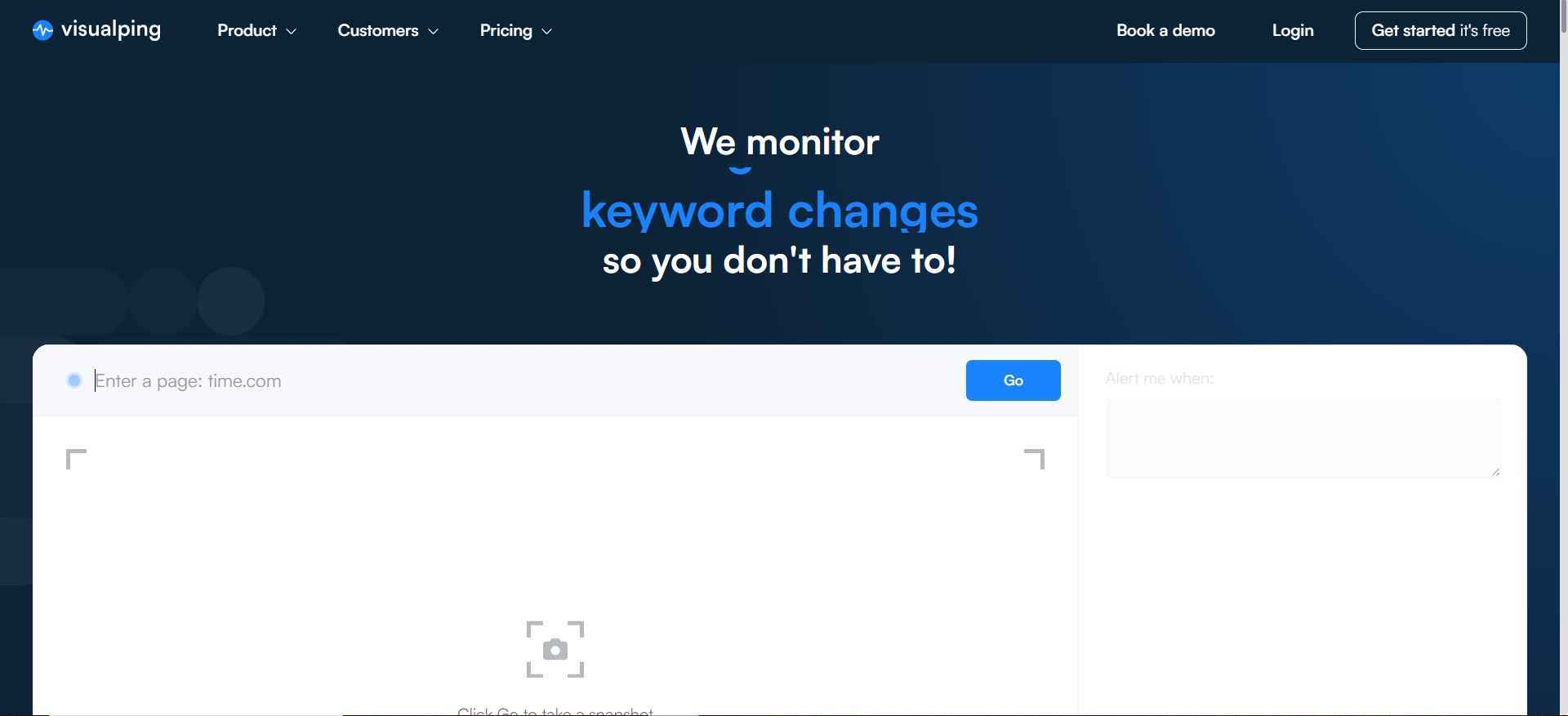
A monitoring tool that watches competitor URLs and alerts you when something changes, so you can react before the quarter is over.
Why teams use it
Teams use it to catch: pricing changes, new feature pages, headline swaps, and conversion funnel updates.
What it's good for
- Pricing and packaging pages
- Homepage and key landing pages
- Product/feature pages and docs
- Competitor comparison pages
When it's a good fit
Best fit if you need early alerts on competitor page changes (pricing, positioning, product pages, or landing pages).
When it's not a good fit
If you do not have an owner who will review alerts and convert them into actions (otherwise it becomes noise).
How to use it
- Make a watchlist of 10-25 URLs across 3-5 competitors (pricing, homepage, 2-3 key landers each).
- Set frequency: weekly for most pages, daily for pricing during active quarters.
- Route alerts to one owner who summarizes changes in a weekly memo.
- For each change, assign a next step: copy test, sales enablement note, or product positioning update.
Key capabilities
- Scheduled page checks and change diffs
- Alert routing to the right owner (marketing, product, sales)
- Monitoring lists by competitor and page type
- Evidence capture for enablement
Pricing
Visualping’s paid plans start at $14/month (with Business plans starting at $100/month).
Free tier?
Visualping offers a free tier, and it also offers a 14-day free trial on paid plans.
Downsides / limitations
- Too many monitored pages creates alert fatigue; start small.
- Some dynamic pages require tuning to avoid false positives.
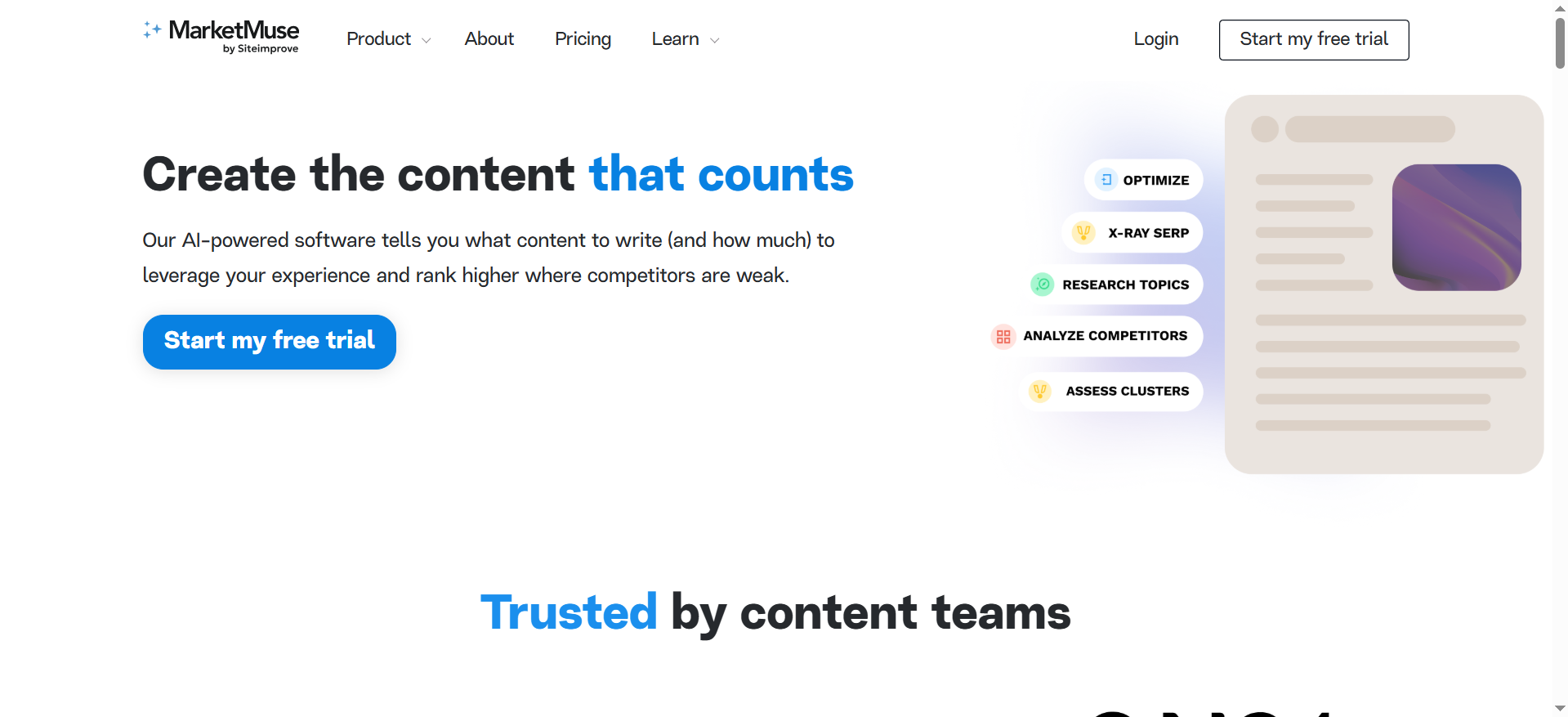
5. MarketMuse
What it does
An AI-assisted content strategy platform that models topics, identifies gaps versus competitors, and helps prioritize what to publish next.
Why teams use it
Teams use it to turn competitive content research into a roadmap and consistent briefs (instead of scattered keyword lists).
What it's good for
- Topic modeling and competitive gap analysis
- Prioritized content roadmaps
- Briefs that align writers and SMEs
- Reducing rework by clarifying coverage upfront
When it's a good fit
Best fit if content is a primary growth lever and you want a system to find gaps, prioritize topics, and build briefs faster.
When it's not a good fit
If you only need on-page optimization for a small set of articles and already have a strong strategy process.
How to use it
- Choose one product line and build a topic model for it.
- Pull the gap list against your top 3 competitors.
- Prioritize 5-10 topics by impact and effort, then generate briefs.
- Review monthly: add new gaps and prune topics that no longer matter.
Key capabilities
- Competitive gap scoring by topic
- Content planning and prioritization
- Brief generation and coverage guidance
- Workflow support for content ops
Pricing
MarketMuse offers paid tiers starting from $149/month (or $999/year).
Free tier?
MarketMuse offers a free tier (Free plan), and it also offers a free trial.
Downsides / limitations
- Requires process discipline (briefs, reviews, roadmap) to realize value.
- Teams may still need editorial judgment for positioning and POV.
How to choose (a 15-minute trial checklist)
In any trial, your goal is simple: answer "what changed and what do we do next?" in under 15 minutes.
- Data reliability: can you spot-check the underlying pages/creatives behind the insight?
- Time-to-insight: can a non-expert find the delta and next action quickly?
- AI usefulness: does it prioritize and explain, or just generate text?
- Workflow fit: can you export/share insights into the tools your team actually uses?
- Scalability: does it work for 5 competitors and for 50?
Minimum viable stacks (by team size)
Pick 2 tools first, then expand only when the workflow is stable.
Lean team (1-3 marketers)
Start with Semrush + Visualping. Add MarketMuse when content volume increases.
Scaling team (4-10 marketers)
Start with Semrush + Similarweb. Add Adbeat for paid learnings and Visualping for alerts.
Growth/enterprise motion (cross-functional intel)
Start with Similarweb + Semrush for the shared narrative. Add Adbeat for creative, Visualping for change alerts, and MarketMuse for roadmap consistency.
Template: Weekly Competitive Intel Tracker
| Signal | What to monitor | Frequency | Owner | Output / decision |
|---|---|---|---|---|
| SEO share-of-voice | Top 20 keywords and winning pages | Weekly | SEO Manager | Content or on-page action list |
| Website/pricing changes | Pricing and key landing pages | Weekly (daily in launches) | PMM or Growth | Enablement note + test plan |
| Paid creative patterns | Top offers and hooks used by competitors | Weekly | Paid lead | 3 creative hypotheses |
| Traffic/channel mix | Search vs paid vs referral shifts | Monthly | Growth/Analytics | Budget and channel priorities |
FAQ
What is competitive analysis marketing (in 2026 terms)?
What is the best tool for competitor SEO analysis?
Are ad intelligence tools worth it if you already have swipe files?
What should I monitor weekly vs monthly?
How do I know if an AI feature is actually useful?
How to turn competitor insights into pipeline (not just reporting)
Use a weekly cadence that forces decisions:
- One owner compiles a 1-page weekly memo (3 insights, 3 actions, 1 experiment).
- Every insight must map to a lever: content, creative, landing page, positioning, or budget.
- Every action has an owner and a deadline inside your normal workflow.
- Track outcomes (rank movement, CTR, CVR, pipeline) so intel improves over time.
📋 Get Listed / Advertisement
We update this guide monthly. Want your tool featured? Contact: [email protected].