

By March 2026, G2's The Answer Economy report found that 51% of B2B software buyers now start their purchase research inside an AI chatbot rather than a search engine, and ChatGPT was the tool they reached for most.
If your buyers now build their shortlist inside ChatGPT, then the most important question in your marketing is no longer "where do we rank on Google." It is "does ChatGPT mention us when someone asks about our category, and is it saying the right thing." That is what brand visibility in ChatGPT means, and unlike a keyword ranking, most teams have no idea what their number is.
This guide shows you how to find that number and watch it move. You will learn what to measure, how to check ChatGPT by hand, how to run a repeatable tracking system inside Semrush on your own domain, and what to do with the readings once you have them. We will use therankmasters.com as the live worked example throughout, so you see real data rather than a demo account.
▶️ If your ranked pages are not showing up in AI answers and you want a content system that fixes that, book a SaaS content strategy call.
What Metrics Measure Brand Visibility in ChatGPT?
The metrics that matter are AI Visibility Score, Mentions, Share of Voice, Sentiment, Cited Pages, and Average Position. Each answers a different question, so treat them as a set rather than chasing one headline number.
Before you open any tool, get fluent in what each metric actually tells you. The table below maps each one to the buyer question it answers, using the definitions Semrush documents in its AI visibility metrics reference.
| Metric | What It Measures | The Question It Answers |
|---|---|---|
| AI Visibility Score | A 0 to 100 benchmark of how often you appear in AI answers versus competitors | How present am I overall in my category? |
| Mentions | The number of prompts where your brand appears in an AI response | In how many buyer conversations do I show up? |
| Share of Voice | Your share of all brand mentions in a category, where every brand sums to 100% | How much of the category conversation is mine versus rivals? |
| Sentiment | The balance of favorable versus general framing in your mentions | When ChatGPT talks about me, is it flattering or flat? |
| Cited Pages | The specific URLs on your domain that AI answers reference | Which of my pages is ChatGPT actually using? |
| Average Position | Where your citation typically lands within an answer | Am I the first option named or an afterthought? |
Two of these deserve a warning.
A high Mentions count with weak Sentiment is a trap, because volume without a good story can actively cost you deals. And Share of Voice only means something relative to a named competitor set, so define your rivals before you read the number.
How Do You Manually Check if ChatGPT Mentions Your Brand?
The fastest free check is to ask ChatGPT the prompts your buyers use and record whether your brand appears. It gives you a first read in ten minutes, but it does not scale and it does not remember.
Here is a simple manual routine you can run today.
- Write down 10 to 15 prompts a real buyer would type, mixing category prompts like "best time tracking software for agencies" with comparison prompts like "[your brand] vs [competitor]".
- Open ChatGPT and run each prompt in a fresh chat so earlier answers do not bias the next one.
- Record, for each prompt, whether your brand appears, in what position, and how it is described.
- Repeat the same prompts two or three times, because the answers vary, and note how often you appear across runs.
- Log which competitors show up alongside you and which sources ChatGPT cites.
That last step is the valuable one, because the cited sources tell you which third parties are shaping your category's answers. The trouble is that manual checking falls apart the moment you take it seriously. You cannot eyeball 200 prompts a week, the answers drift between runs so a single check is noise, and there is no history, so you can never prove whether last month's content push actually helped.
This is exactly why dedicated tracking exists, and it is where we move from spot-checking to a system.
How Do You Set Up ChatGPT Visibility Tracking in Semrush?
You get your baseline in minutes by opening Semrush's AI Visibility Toolkit and running Visibility Overview on your domain. It returns your AI Visibility Score, total mentions, cited pages, and how your presence is distributed across ChatGPT and other engines.
Here is the exact path to your first real number.
- Log in to Semrush and open the AI Visibility Toolkit from the left navigation.
- Select Visibility Overview and enter your domain, for example therankmasters.com.
- Set the date range and location so the baseline matches the market you sell into.
- Read the AI Visibility Score at the top, then the Mentions and Cited Pages figures beside it.
- Scroll to the Distribution by LLM module to see how much of your visibility comes from ChatGPT specifically versus Gemini, Perplexity, and Google AI Overviews.
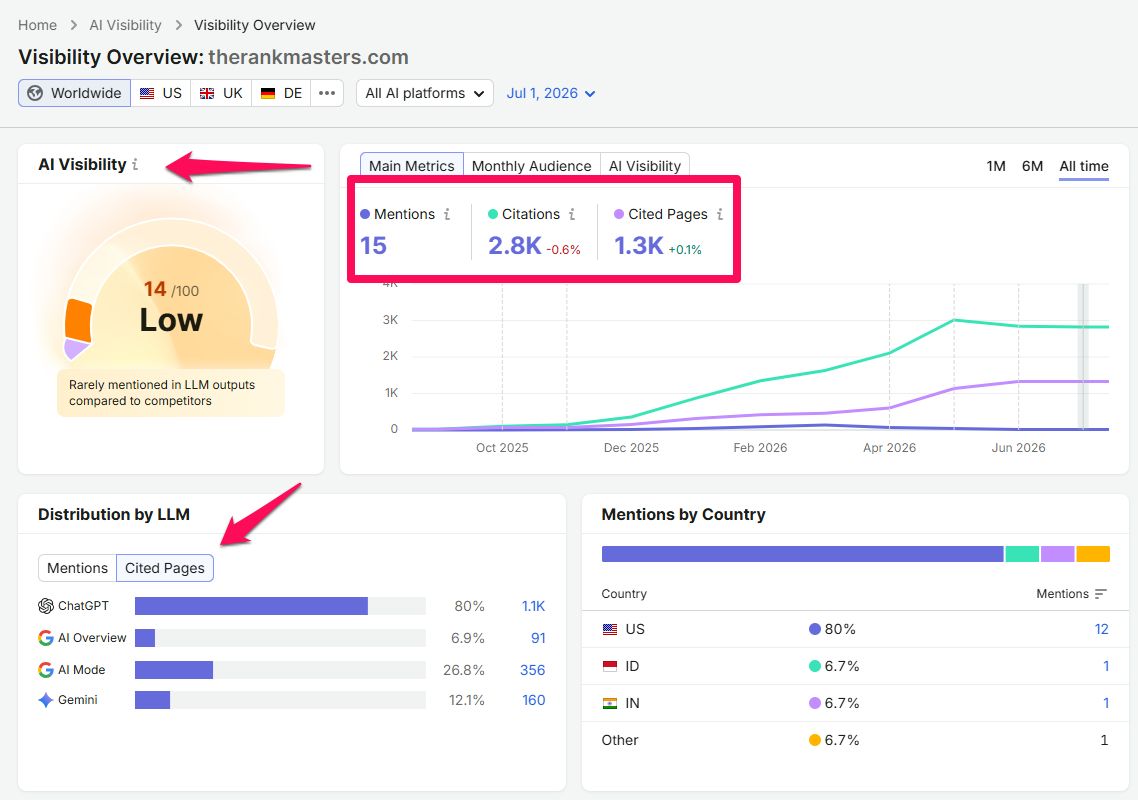
Read the score as a starting line, not a grade. A modest number simply means you have room, and the honest move is to write it down with today's date so next month's number has something to beat.
Distribution by LLM is the part most people skip and should not, because it tells you whether your visibility problem is a ChatGPT problem or a whole-engine problem, and those get fixed differently.
Want to follow along on your own domain? Start a 14-day Semrush One trial and run this report before the next step.
How Do You Measure Your AI Share of Voice vs Competitors?
Semrush's Brand Performance suite shows your Share of Voice against a competitor set and plots it against sentiment, so you can see both how much of the category conversation is yours and whether those mentions help you. Across all brands in a category, Share of Voice sums to 100%, so a gain for you is a loss for someone else.
The path to the view that matters takes about a minute.
- Open Brand Performance inside the AI Visibility Toolkit.
- Add your brand and two or three named competitors so the comparison is real, not abstract.
- Land on the Share of Voice tab to see your slice of category mentions as a donut and a trend line.
- Switch to the Share of Voice vs. Sentiment chart, where each brand is a bubble positioned by visibility on one axis and sentiment on the other.
- Note any competitor sitting high on visibility but low on sentiment, because that is a gap you can attack.
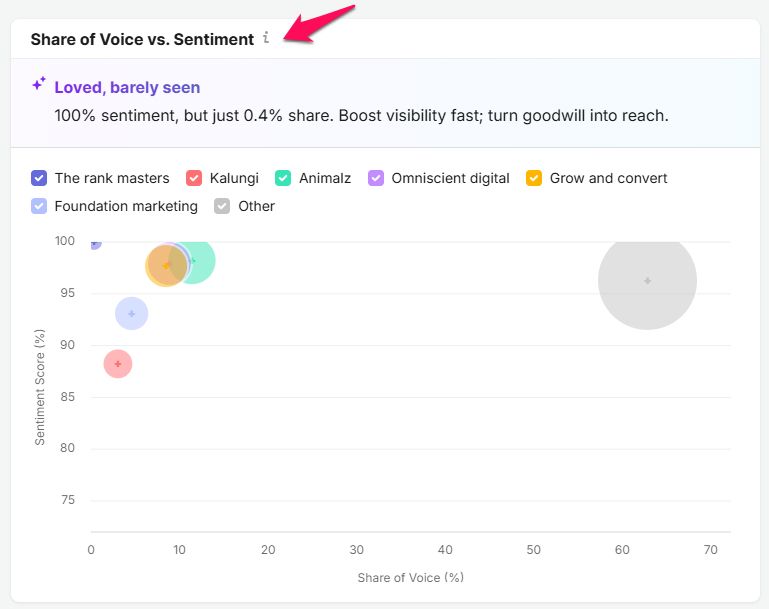
The reading you want is directional, not perfect. If you own a big slice of voice but your sentiment bubble sits low, more mentions are not your problem, your narrative is. If your slice is thin but sentiment is strong, you are trusted where you appear and simply need to appear more, which is a content and mentions problem rather than a reputation one.
This distinction is the whole reason Semrush documents how to measure AI Share of Voice as a competitive metric rather than a solo score.
For a broader look at platforms that surface this comparison, our roundup of tools for tracking brand visibility in AI search puts them side by side.
Follow along live. Open Semrush One on a 14-day trial and compare your Share of Voice to a competitor.
How Do You Track ChatGPT Sentiment About Your Brand?
The Perception report in Brand Performance shows favorable versus general sentiment and tracks it over time, so you can catch a negative narrative forming in ChatGPT answers before it hardens into how the market sees you. Semrush refreshes this data weekly, which is fast enough to react to.
Getting to the trend takes a few clicks.
- From Brand Performance, open the Perception report.
- Review Overall Sentiment to see the split of favorable versus general framing in your mentions.
- Open Favorable Sentiment Over Time to watch the trend rather than a single snapshot.
- Drill into the Key Sentiment Drivers to see the specific themes pulling your perception up or down.
- Compare your sentiment by platform to spot an engine where you are described worse than elsewhere.
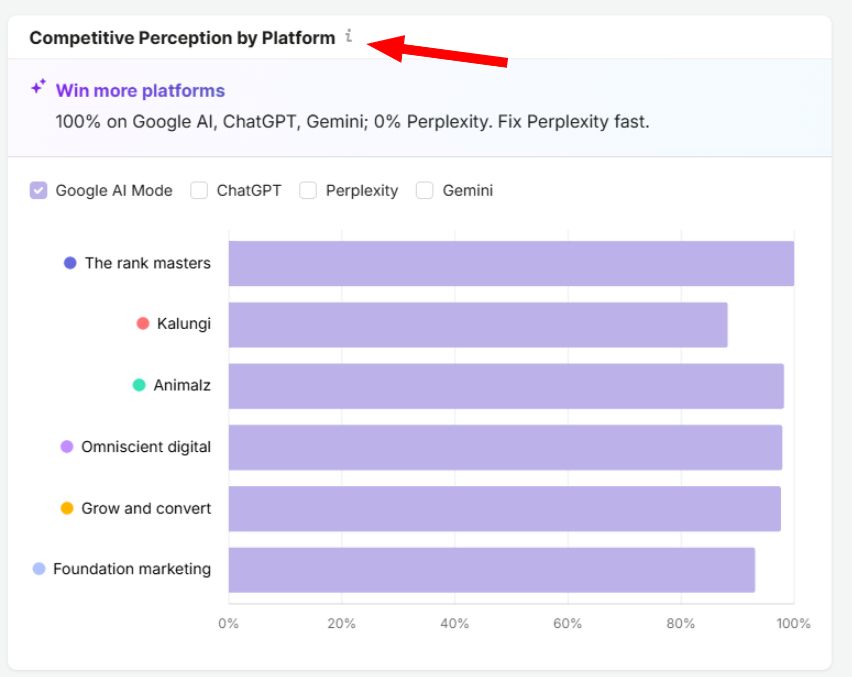
Sentiment is where AI visibility stops being a vanity exercise and starts protecting revenue. A model that mentions you often but frames you as "expensive" or "hard to set up" is doing quiet damage on every prompt, and because the framing comes from third-party sources, you fix it upstream by improving what those sources say, not by editing your own homepage.
The value of the report is early warning, so treat a downward sentiment line the way you would treat a spike in churn, namely as a signal to investigate now rather than at the quarterly review.
Want your own numbers? Try the AI Visibility Toolkit free for 14 days and pull your Perception trend.
How Do You Find Which Prompts Trigger or Miss Your Brand?
Narrative Drivers and the Questions report reveal the specific prompts and cited domains shaping your category, so you can see not just where ChatGPT mentions you but, far more usefully, where it mentions competitors instead. Pair them with Prompt Research to size the opportunity before you write anything.
The workflow that turns this into a content roadmap runs like this.
- Open the Narrative Drivers report to see the Top Cited Domains and the questions shaping your category's answers.
- Open the Questions report to see the exact prompts where you and your competitors are mentioned.
- Filter to non-branded questions, because those are the discovery prompts where new buyers meet you.
- Flag every high-interest prompt where a competitor appears and you do not.
- Use Prompt Research to check the AI topic volume and intent behind those gap prompts so you prioritize the ones with real demand.
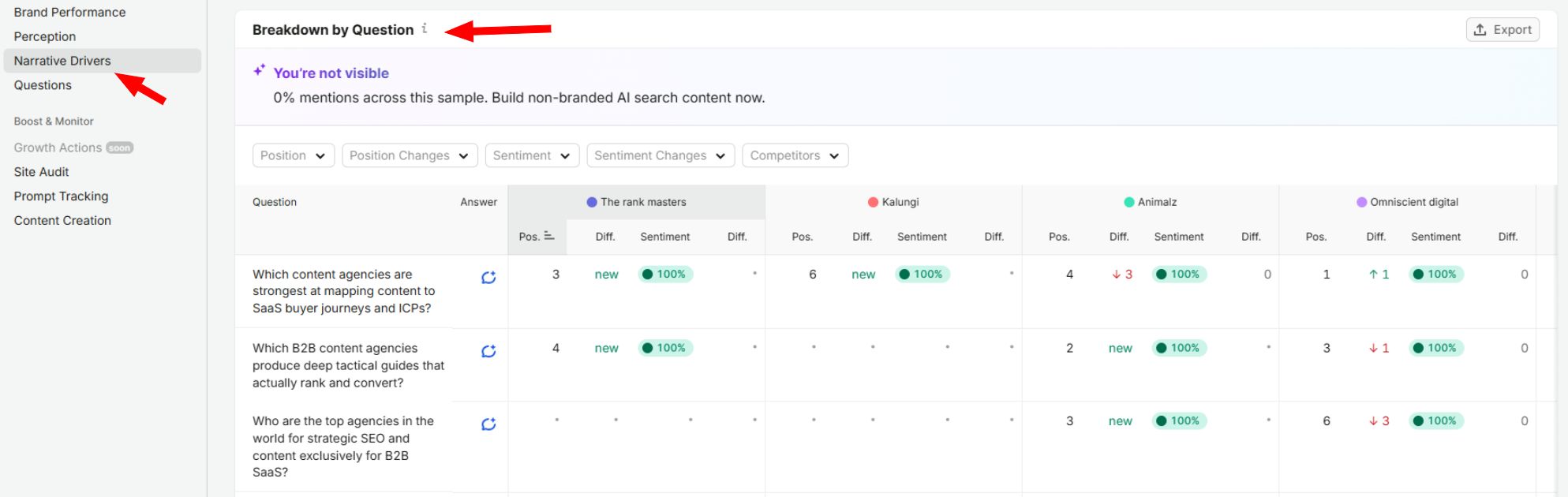
Two lists come out of this that are worth more than the score itself. The Top Cited Domains list is your outreach and digital-PR target list, because those are the third parties ChatGPT already trusts in your space, and earning a mention there feeds your visibility at the source. The gap-prompt list is your editorial brief, because each prompt you are missing is a page or an update you can ship.
If you want a repeatable way to organize a large prompt set as this grows, our notes on bulk prompt tracking and tagging cover the operations side.
See this on your own site. Start your 14-day Semrush One trial and pull your gap-prompt list.
How Do You Track Daily ChatGPT Visibility for Key Prompts?
Prompt Tracking, which lives inside Semrush's Position Tracking tool, monitors your daily visibility and average position for the specific prompts you choose across ChatGPT and Google AI Mode. It turns a one-off audit into a moving number you can defend in a meeting.
Here is how to stand it up.
- Create a Position Tracking campaign for your domain.
- Add ChatGPT, or Google AI Mode, as the search engine rather than a standard Google target.
- Enter the priority prompts from your gap analysis, focusing on your highest-intent topics.
- Enable multitargeting so you can watch the same prompt on ChatGPT and Google side by side.
- Check the daily Visibility percentage and Average Position, and set alerts for sudden drops.
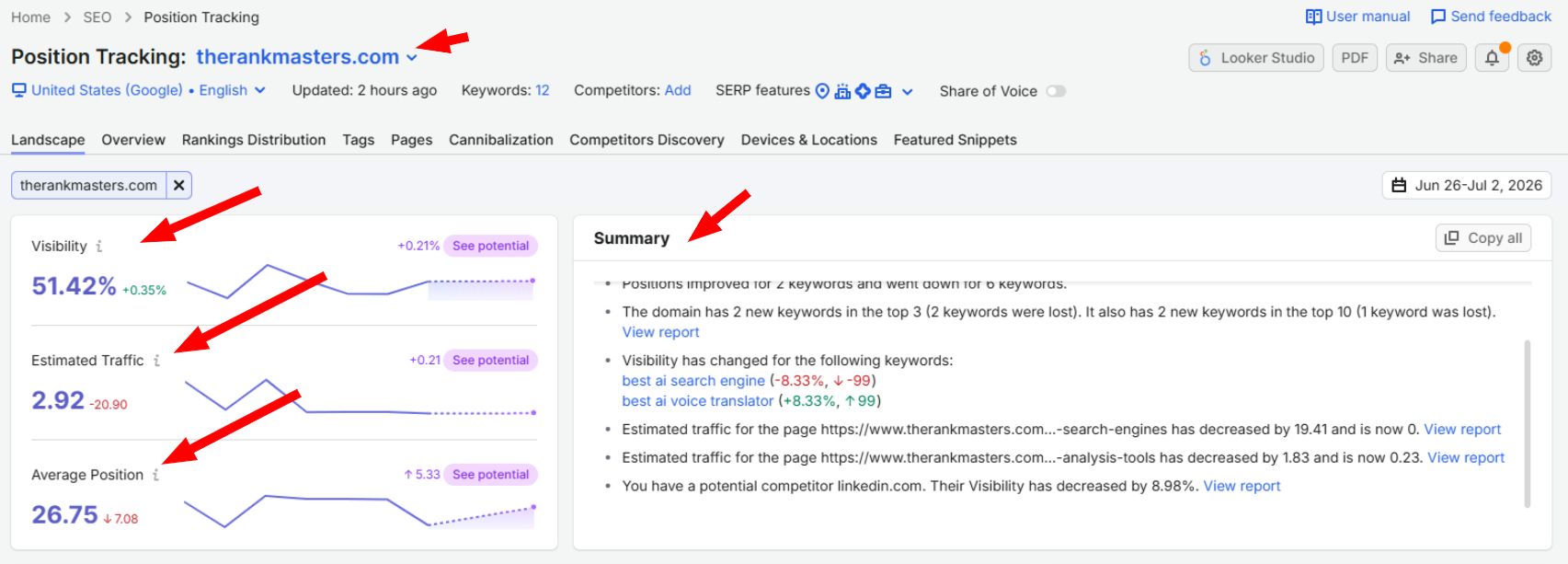
The reason daily tracking beats a monthly audit is that ChatGPT answers move, and a single check cannot tell a real gain from random variation. When you track the same prompts every day, a content update that lifts you from absent to cited shows up as a step change you can point to, and a competitor's push that knocks you out shows up as a drop you can respond to.
Pick a focused prompt set rather than everything, because ten prompts watched closely beat a hundred watched never.
Follow the same steps on your domain. Open the AI Visibility Toolkit on a 14-day trial and start tracking your priority prompts.
How Do You Find Competitor Gaps and AI-Readiness Issues?
Competitor Research surfaces the topics and prompts where rivals are cited but you are absent, and Site Audit's AI Search Health flags the technical issues that stop ChatGPT from crawling and citing you in the first place. Run them together, because a content gap and a crawl blocker are different diseases with the same symptom.
The combined pass looks like this.
- Open Competitor Research in the AI Visibility Toolkit and add your rivals' domains.
- Review Missing Topics and Prompts, meaning the ones where competitors appear and you do not.
- Review Weak Topics and Prompts, where you appear but rivals are mentioned more often.
- Switch to Site Audit and open the AI Search Health widget.
- Fix flagged blockers, such as an AI crawler that is blocked, thin structured data, or a missing llms.txt, so your pages can actually be read.
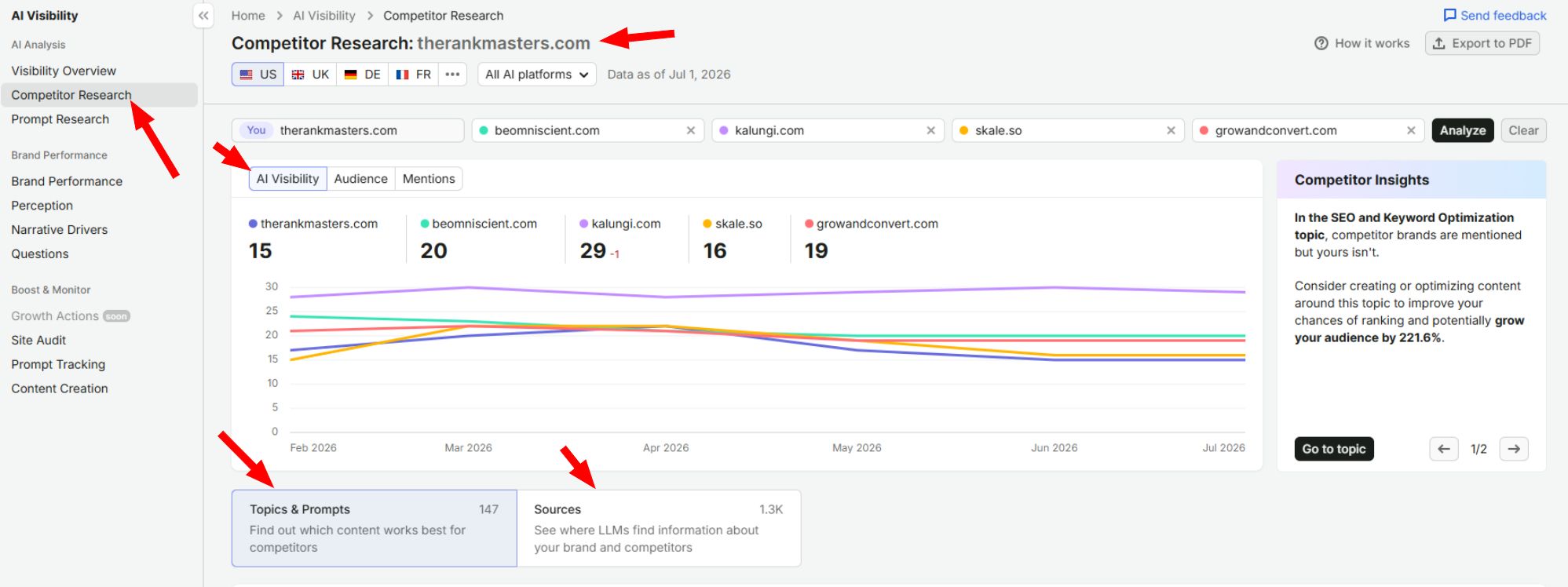
The uncomfortable finding here is often technical. A brand can have great content and still be invisible because an AI crawler is blocked or its key pages are not snippet-eligible, so the model never gets to read them. That is the invisible handbrake, and it is worth ruling out before you commission a single new article.
Once the plumbing is clean, the Missing Topics list becomes your priority queue. If a full teardown helps, our guide to the most effective AI visibility strategies sequences the work.
A dashboard like this one will hand you the numbers, namely your score, your cited pages, and your competitor gaps. It will not tell you which of them to act on first, or how to turn them into a plan.
That interpretation layer, reading the metrics and mapping your ICP's buying journey to the SEO and AEO content that wins it, is the work The Rank Masters does for B2B SaaS teams.
Spin up your own view. Open your own 14-day Semrush One trial and pull your competitor gaps.
How Do You Connect ChatGPT Visibility to Traffic and Pipeline?
You connect it by pairing your ChatGPT visibility data with the referral traffic ChatGPT already sends, then tying both to demos and pipeline. Visibility that never touches revenue is a vanity score, and the fix is to instrument the click that follows the mention.
Some of this is free and you should turn it on today. In Google Analytics 4 and Google Search Console, filter for chatgpt.com as a referral source to see the sessions ChatGPT is already driving to your site, and layer Cloudflare or server logs if you want to see AI crawler activity.
Those tools show volume and landing pages but not the answer-level detail, so they complement rather than replace prompt tracking.
The point is to build one view where a rise in mentions lines up with a rise in AI-referred sessions and, eventually, pipeline, because that is the chart that gets AI visibility funded.
This is also where interpretation earns its keep. A dashboard can tell you that mentions rose and that AI-referred sessions rose, but it cannot tell you which cited pages to defend, which competitor gaps map to revenue, or which prompts to win first.
Executing that well, mapping each topic cluster to a money page and to pipeline rather than publishing posts that never convert, is exactly the gap The Rank Masters closes for B2B SaaS teams. For proof of how that plays out on real programs, our case studies show the before and after.
How Do You Improve Your Brand's Visibility in ChatGPT?
Once tracking is live, you improve visibility by acting on the data in a specific order, namely earn credible third-party and YouTube mentions, tighten your entity clarity, and publish answer-first, citable content on the exact prompts you are missing. Tracking without action is just a nicer way to watch yourself lose.
The order is set by what the evidence says drives ChatGPT visibility. Because branded web and YouTube mentions correlate most strongly with AI visibility while raw page count barely correlates, the highest-leverage work is off your own site, in the sources ChatGPT already trusts.
That is why your Top Cited Domains list from the Narrative Drivers report is so valuable, because it names the third parties worth pitching. The moves that tend to pay off:
- Earned third-party mentions: Get named in the review sites, roundups, and publications that appear on your Top Cited Domains list, since those feed the consensus ChatGPT reflects.
- YouTube presence: Ensure your brand and category appear in video titles, transcripts, and descriptions, because that surface correlates unusually well with AI visibility.
- Entity clarity: Make your "what we do, who it is for, what category we are in" consistent across your site, your profiles, and third-party listings so the model has no ambiguity to resolve.
- Citable, answer-first content: Lead each strategic page with a direct answer in the first block, because the model favors the early, self-contained sentence with the highest information gain.
- Structured data and clean crawlability: Keep pages snippet-eligible and machine-readable so the model can actually extract them.
None of this is a one-week sprint, and any tool that promises an overnight jump is selling something. The realistic path is a multi-month program where your tracked prompts move from absent to cited as your mention footprint grows.
For the deeper play on formats the models extract, our notes on the content formats AI cites are a useful companion.
ChatGPT vs Google AI Overviews vs Perplexity: Does Tracking Differ?
Yes, and the difference is the whole reason to track more than one engine. Each platform pulls from a different source pool, so a brand that is highly visible in ChatGPT can be nearly absent in Perplexity, which means a single-engine reading will mislead you about your real exposure.
The table below sketches how the major answer engines differ for tracking purposes, drawn from the platform behavior documented across recent AI brand visibility research.
| Engine | How It Sources Answers | Tracking Implication |
|---|---|---|
| ChatGPT | Blends training data with selective web retrieval; leans on broad third-party consensus | Track branded mentions and non-branded category prompts, not just rankings |
| Google AI Overviews | Tied closely to Google's index and ranking signals | Traditional SEO strength carries over more here than to ChatGPT |
| Google AI Mode | Google-owned, consensus-leaning, favors well-known brands | Branded search and anchors matter more; strong brands compound |
| Perplexity | Real-time retrieval with transparent numbered citations | Fresh, well-structured, citable pages win; easiest to monitor by URL |
The takeaway is not that ChatGPT is the only game, it is that your visibility is engine-specific, so your tracking has to be too. Semrush handles this by covering ChatGPT, Google AI Overviews, AI Mode, Perplexity, and Gemini in the same toolkit, which is why the Distribution by LLM view from your baseline matters, because it tells you which engine to prioritize.
If you are choosing between platforms based on engine coverage, our comparison of AI visibility solutions for content teams breaks down who covers what.
How Much Does ChatGPT Brand Visibility Tracking Cost?
You can start free and scale into paid tooling as the work gets serious. Manual prompting, GA4, and Search Console cost nothing, while dedicated tracking in Semrush's AI Visibility Toolkit starts around $99 per month as of mid-2026, with Semrush One bundling the AI and SEO toolkits together.
Here is the rough shape of the market, with the caution that AI-tool pricing changes fast, so verify current terms before you buy.
| Option | Typical Cost (as of mid-2026, verify current terms) | Best For |
|---|---|---|
| Manual ChatGPT checks | Free | A first read and a handful of prompts |
| GA4 and Search Console referral filtering | Free | Seeing the ChatGPT traffic you already earn |
| Semrush AI Visibility Toolkit | Around $99 per month per domain | Teams that want tracking plus SEO in one place |
| Semrush One bundle | Higher tier that pairs AI and SEO toolkits | Teams treating AI visibility as an ongoing program |
The honest read is that the tool cost is the small line item. The expensive part is the earned-mention, content, and interpretation work that actually moves the number, which is why the buying decision is less "which tracker" and more "who turns the tracking into a strategy." If you want to weigh options first, our guide to AI visibility tools for tracking brand visibility in AI search and our look at Hall AI alternatives both help you shortlist.
What Is Brand Visibility in ChatGPT?
Brand visibility in ChatGPT is how often and how prominently ChatGPT mentions, cites, or recommends your brand when people ask about your category. It is measured across a set of prompts, not against a single keyword.
Think of it as the answer-engine version of share of shelf. When a buyer types "what's the best PSA software for a 40-person agency" into ChatGPT, the model returns a shortlist and a few sentences of reasoning. If your brand is in that shortlist, you have visibility. If a competitor is there and you are not, you are invisible at the exact moment the decision is being framed.
The shift that makes this matter is a shift in where the decision happens. A traditional ranking wins a click. A ChatGPT mention wins a place on the list before any click exists. Those are different games with different scoreboards, and the second one has been invisible to most marketing dashboards until very recently. If you want the wider backdrop on how this changed the discipline, our breakdown of how AI search reshaped SEO walks through the mechanics.
Two features of ChatGPT visibility trip people up. First, it is probabilistic, so the same prompt can return slightly different brands on different runs. Second, it is plural, meaning you are not visible or invisible overall, you are visible for some prompts and absent for others. A good tracking setup accepts both facts and measures across many prompts over time rather than trusting one lucky answer.
Why Track Brand Visibility in ChatGPT for B2B SaaS?
You track it because the buying journey now begins in a place your funnel cannot see. When a prospect asks ChatGPT to compare tools, that research happens with no visit to your site, no form fill, and no retargeting cookie, so if you are not measuring presence in the answer you are flying blind through the first and most formative stage of the deal.
The behavioral data is blunt. G2's 2026 survey of 1,076 software buyers found that 69% chose a different vendor than they had originally planned based on AI chatbot guidance, and a third bought from a vendor they had never heard of before the chatbot surfaced it.
For a SaaS marketer, that means the shortlist is no longer downstream of your brand awareness. It is being written live, inside the chat, by a model that either knows you or does not.
There is a scale point too.
ChatGPT reached 900 million weekly active users by February 2026, roughly double its base a year earlier, so even a small share of category-relevant prompts represents a large number of buying conversations you are either in or out of. Volume alone would not matter if the intent were idle, but it is not.
OpenAI's own research on how people use ChatGPT shows that the bulk of usage is practical guidance and information seeking, exactly the research behavior that used to drive traffic to your comparison pages.
Here is the uncomfortable part. Most brands are absent precisely where it counts.
The 2X AI Visibility Index, which analyzed 70 B2B companies in 2026, found that only 4.3% maintained a healthy discovery funnel, meaning their brand appeared in early-stage buyer questions. The rest surfaced mostly in late-stage queries where the buyer already knew the name.
As Lisa Cole, Chief Marketing, Product and AI Officer at 2X, put it, "you can't manage what you don't show up for." Tracking is how you find out whether you show up at all.
A quick internal audit before you invest heavily is worth the hour. Our guide to running an AI visibility audit covers how to baseline before you commit to a platform.
How Does ChatGPT Decide Which Brands to Mention?
ChatGPT tends to surface brands with broad, consistent third-party presence, not the brands with the single highest Google ranking. Its source pool overlaps surprisingly little with the top of the SERP.
This is the finding that reorganizes everything else.
Ahrefs studied 75,000 brands to see which signals correlate with AI visibility across ChatGPT, Google AI Mode, and AI Overviews, and the strongest correlate was mentions in YouTube videos, followed closely by branded web mentions across the open web. Classic authority metrics that SEO teams obsess over, such as domain rating, showed a much weaker relationship with ChatGPT visibility, and the sheer number of pages on your site barely correlated at all.
The practical translation is that ChatGPT is looking for consensus, meaning it reflects what many credible sources already say about your category. When enough third parties describe your product as a strong option for a specific job, the model learns that association and repeats it. When they do not, publishing your fiftieth blog post will not move the needle.
Placement inside a source matters as much as the mention itself. Ahrefs' analysis of how to rank on ChatGPT found that an insight buried deep in a page was roughly 2.5 times less likely to be cited than the same insight placed near the top, because the model favors the sentence carrying the highest information gain in an early, self-contained block.
That is a content-engineering problem, and it is one you can act on. Our field notes on content engineering for AI search visibility go deep on the page-level patterns that get extracted.
What this means for tracking: You cannot understand your ChatGPT number by looking at rankings. You need to measure the answer layer directly and, ideally, connect it to the third-party mention footprint that feeds it.
Frequently Asked Questions
How often should you track ChatGPT brand visibility?
Can you track ChatGPT brand visibility for free?
Why is my brand invisible in ChatGPT if it ranks well on Google?
How long does it take to improve ChatGPT visibility?
Is ChatGPT visibility tracking worth it for a small SaaS team?
What counts as a good AI Visibility Score?
Does ChatGPT brand visibility actually affect revenue?
Track the Number, Then Build the Strategy Around It
Brand visibility in ChatGPT is now a first-class metric, not a curiosity. You can baseline it in an afternoon, watch it daily, and connect it to pipeline, and the tools to do that are real and affordable. The number itself is the easy part.
If your ranked pages are not showing up in AI answers and thin AI visibility is costing you pipeline, book a SaaS content strategy call and we will map your highest-intent prompts to revenue.
And if you want to run the tracking yourself first, try Semrush One free for 14 days and pull your baseline before your next planning meeting.
📑 Disclosure!
Some links in this article are affiliate links. If you sign up through them, The Rank Masters may earn a commission at no additional cost to you. This does not influence which tools we recommend or what we say about them.