

Digital PR used to be mostly about getting a story into the right inbox and turning coverage into links. That’s still true, but now the same coverage can influence whether brands get mentioned or cited in AI answers and AI summaries, too. This is why the “best” tools in 2026 aren’t just media databases; they’re systems that help you (1) build PR assets worth referencing, (2) match them to the right writers, and (3) measure impact across coverage, links, and brand mentions.
Here are the best 5 AI-enabled tools for digital PR and link earning, based on the core jobs most teams need: journalist discovery, pitching, distribution, monitoring, and analytics.
📋 Get Listed / Advertisement
We update this guide monthly in our Insights. Want your tool featured? Contact: [email protected].
Best 5 AI Tools for Digital PR & Link Earning (Quick Comparison)
| Tool | Best for | Standout capability | Pricing notes |
|---|---|---|---|
| Muck Rack | Media database + pitching workflow | AI-assisted pitching / recipient fit + monitoring | Pricing is “contact sales” style |
| Roxhill | UK/EU media database + opportunities | Strong UK journalist intelligence + alerts | Annual bands; pricing varies by licenses |
| Prowly | All-in-one PR for lean teams | Outreach + newsroom + monitoring in one stack | Transparent plans; free trial available |
| BuzzSumo | Link-earning angles + influencer discovery | Content research + journalist/influencer discovery | Transparent monthly pricing tiers |
| Brand24 | Brand mention + sentiment monitoring | Broad monitoring + AI insights | Transparent monthly pricing tiers |
1. Muck Rack
What it does
This is a full PR platform built around three core workflows: (1) finding journalists and outlets, (2) pitching and managing outreach, and (3) monitoring coverage and producing reports. It’s typically chosen by teams that want a “single source of truth” for media relationships, campaign execution, and measurement.
Why teams use it
Two reasons come up repeatedly in the way the product positions itself:
- Database depth and freshness: it emphasizes up-to-date journalist/outlet info across media types and formats.
- Pitching + measurement tied together: it markets pitching, engagement tracking, follow-ups, and reporting as an integrated loop.
If your link earning model depends on volume (multiple campaigns per quarter), tight relationship management, and reporting that survives exec scrutiny, these “closed loop” systems matter for SaaS content marketing.
What it’s good for
- Journalist discovery: building targeted lists by beat/topic and keeping them current.
- Pitch execution: drafting, sending, following up, and tracking engagement.
- Attribution-adjacent reporting: showing coverage gained, reach, and impact outputs.
When it’s a good fit
- You’re an agency or an in-house team running continuous outreach (not a one-off launch).
- You have multiple stakeholders and need a repeatable system: lists → pitches → coverage → reporting.
- You can justify a higher total cost because PR is a revenue-supporting channel (pipeline influence, brand demand, category leadership).
When it’s not a good fit
- You only need a lightweight media list and send occasional pitches.
- You want transparent self-serve pricing without sales calls (Muck Rack’s pricing page is “contact us” oriented).
- Your team mainly needs social listening or SEO link prospecting rather than PR workflows.
How to use it
A practical way to run a monthly campaign loop:
- Start with a link-earning asset (data story, benchmark, interactive, expert commentary page).
- Build journalist segments by beat, outlet type, and story fit (don’t do one mega list).
- Draft 2–3 pitch angles per asset (the same dataset can yield multiple narratives).
- Send in batches, watch early engagement signals, and iterate subject lines and framing.
- Tag outcomes: coverage earned, link earned, unlinked mention, declined, no response.
- Turn coverage into a link sweep: follow up politely where the brand is mentioned but not linked.
- Report impact monthly and feed learnings back into the next asset.
Key capabilities
- Media database coverage + profile freshness claims.
- Pitching workflow + engagement tracking.
- AI-assisted list/recipient fit features (positioned as “AI-Optimized Pitch Recipients”).
Pricing
Pricing is not publicly listed; it’s available by quote (pricing depends on factors like number of users).
Free tier?
Muck Rack doesn’t offer a free tier for PR teams, but it does offer a demo and trial access.
Downsides / limitations
- Opaque pricing makes early-stage budgeting harder.
- For smaller teams, you may pay for workflows you won’t use (CRM depth, advanced reporting).
- If your primary goal is only link prospecting in SEO contexts, you may still need SEO tooling alongside it.
2. Roxhill
What it does
Roxhill is a media intelligence platform best known for strong UK/EU media coverage: journalist profiles, social and article feeds, topic-led searching, and alerts. It’s often used by PR teams who need UK media precision more than global breadth.
Why teams use it
- It emphasizes more than contact details, including social feeds and pitching preferences.
- Official documentation shows an annual subscription model with features like topic-led searching, social searching, international/broadcast data, and bespoke alerts.
If your link earning depends on UK coverage (finance, fintech, B2B, policy, enterprise tech), the “local strength” of your media database is a competitive advantage.
What it’s good for
- UK journalist discovery by topic, beat, sector, and real-time signals.
- Opportunity-led pitching: spotting journalist moves, requests, and emerging angles via alerts.
- Structured list building that supports repeated monthly campaigns.
When it’s a good fit
- You need excellent UK media targeting, not just a generic global list.
- You value topic-led discovery and monitoring built into the platform.
- Your PR program runs frequently enough that lists, alerts, and workflows compound.
When it’s not a good fit
- You want a lightweight tool with simple month-to-month pricing.
- Your coverage focus is mostly outside the UK/EU, or you don’t need database depth.
- Your primary need is social listening or influencer marketing (you may pair Roxhill with monitoring tools instead).
How to use it
- Build a story map: 3–5 angles from one asset (e.g., “benchmarks,” “risks,” “winners/losers,” “forecast,” “how-to”).
- Create journalist lists per angle (finance desks ≠ tech desks ≠ policy desks).
- Use alerts to identify writers actively covering adjacent topics.
- Pitch the smallest, most relevant segment first to validate angle-market fit.
- Expand to the next segment only when you see early uptake (responses, coverage signals).
- Convert coverage into links via follow-up and by maintaining a high-quality asset page.
Key capabilities
From the official pricing document, Roxhill’s subscription includes items like topic-led searching, social media searching, international/broadcast data, bespoke alerts (e.g., journalist moves and media requests), and unlimited distribution.
Pricing
Roxhill’s pricing starts at £6,450 + VAT per year (12-month subscription) for up to 5 user licences, and increases based on the number of licences.
Free tier?
Roxhill doesn’t list a free tier or free trial in its published pricing document.
Downsides / limitations
- UK strength can be a mismatch for teams that need global media reach.
- Annual pricing and licensing means it’s best justified by ongoing PR volume.
3. Prowly
What it does
Prowly is positioned as an all-in-one PR platform for building media lists, creating press releases, pitching journalists, tracking engagement, and monitoring mentions, often appealing to SMBs and lean teams that want one tool instead of a stitched-together stack. The product also highlights AI assistance for drafting emails and press releases.
Why teams use it
- One platform for creation + distribution + measurement (especially useful if your team is small).
- It explicitly markets AI support for drafting outreach and PR content.
- Pricing information is more transparent via third-party plan breakdowns, and Prowly itself advertises a trial.
What it’s good for
- Lean teams that need: media database + pitching + basic monitoring without enterprise overhead.
- Outreach workflows that benefit from engagement tracking and follow-up scheduling.
- Simple reporting for stakeholders (especially if you don’t have an analytics team).
When it’s a good fit
- You’re launching a digital PR function and want to start producing links quickly.
- You want to run repeatable monthly campaigns without buying 3–4 separate tools.
- You care about workflow speed more than having the largest enterprise media database.
When it’s not a good fit
- You need the absolute deepest enterprise database coverage for a highly regulated niche.
- Your program requires very advanced reporting, integrations, and custom governance.
How to use it
Here’s a practical “two assets per month” setup:
- Build Asset A (data-led): a benchmark, index, survey, or dataset with a clean landing page.
- Build Asset B (expert-led): executive POV, contrarian take, or “why this matters now” analysis.
- Use the media database to create lists for each asset type.
- Draft 2 pitch versions: short (3–5 sentences) and long (with a data hook).
- Send in segments; track engagement; schedule follow-ups based on behavior.
- Monitor mentions; tag coverage; run a weekly link reclamation sweep.
Key capabilities
Prowly highlights:
- AI drafting help for emails and press releases
- Emailing journalists + engagement tracking
- Scheduling follow-ups based on recipient behavior
- Media monitoring with filtering + AI summaries
Pricing
Prowly’s pricing starts at $149/month (Base plan for the AI PR Toolkit).
Free tier?
Prowly doesn’t offer a free tier, but it does offer a free 7-day trial.
Downsides / limitations
- All-in-one tools can be “jack of all trades”: if you outgrow it, you may eventually add specialized tools.
- AI drafting features save time, but you still need strong editorial judgment to avoid generic pitches.
4. BuzzSumo
What it does
BuzzSumo is best thought of as the “link earning ideation engine.” It helps teams discover content that’s performing, identify influencers and journalist profiles, monitor mentions, and build a research-led view of what angles are working right now. It’s especially useful when your biggest bottleneck is coming up with story angles that earn links.
Why teams use it
- It markets workflows around content discovery, research, influencers, and monitoring.
- Pricing is transparent with clear plan tiers (useful for procurement and budgeting).
What it’s good for
- Finding linkable angles: topics, trends, and forum questions that can become PR hooks.
- Influencer/journalist discovery: identifying who shares content in your niche.
- Competitive intelligence: what formats, headlines, and narratives are working.
When it’s a good fit
- Your team can produce assets, but you’re not confident which angles will actually win coverage.
- You want to move from “random campaigns” to a repeatable, research-led PR calendar.
- You already have a media database tool (or plan to) and want BuzzSumo to feed it with better story selection.
When it’s not a good fit
- You need a full PR CRM and pitching system (BuzzSumo is not primarily that).
- You want a pure media database as your first tool purchase.
How to use it
- Pick a cluster topic (e.g., “AI visibility,” “security risk,” “B2B SEO”, “compliance”).
- Use content discovery to find what’s rising and what journalists are already covering.
- Extract 10–20 repeatable PR hooks: “new data,” “contrarian,” “benchmark,” “best/worst,” “market shift,” “risk update,” etc.
- Convert hooks into assets: quick data pull, expert commentary page, mini-study, interactive list, or index.
- Pitch using your pitching tool; then loop outcomes back into the angle database.
Key capabilities
- Content discovery and topic browsing
- Influencer/journalist profile and influencer marketing workflows
Pricing
BuzzSumo’s pricing starts at $199/month (Content Creation plan, billed yearly).
Free tier?
BuzzSumo doesn’t offer a free tier, but it does offer a free 30-day trial (for new users).
Downsides / limitations
- It won’t replace a PR pitching CRM if you need outreach execution and relationship management.
- Teams sometimes “research forever.” Set hard deadlines: one week to decide angles, then build.
5. Brand24
What it does
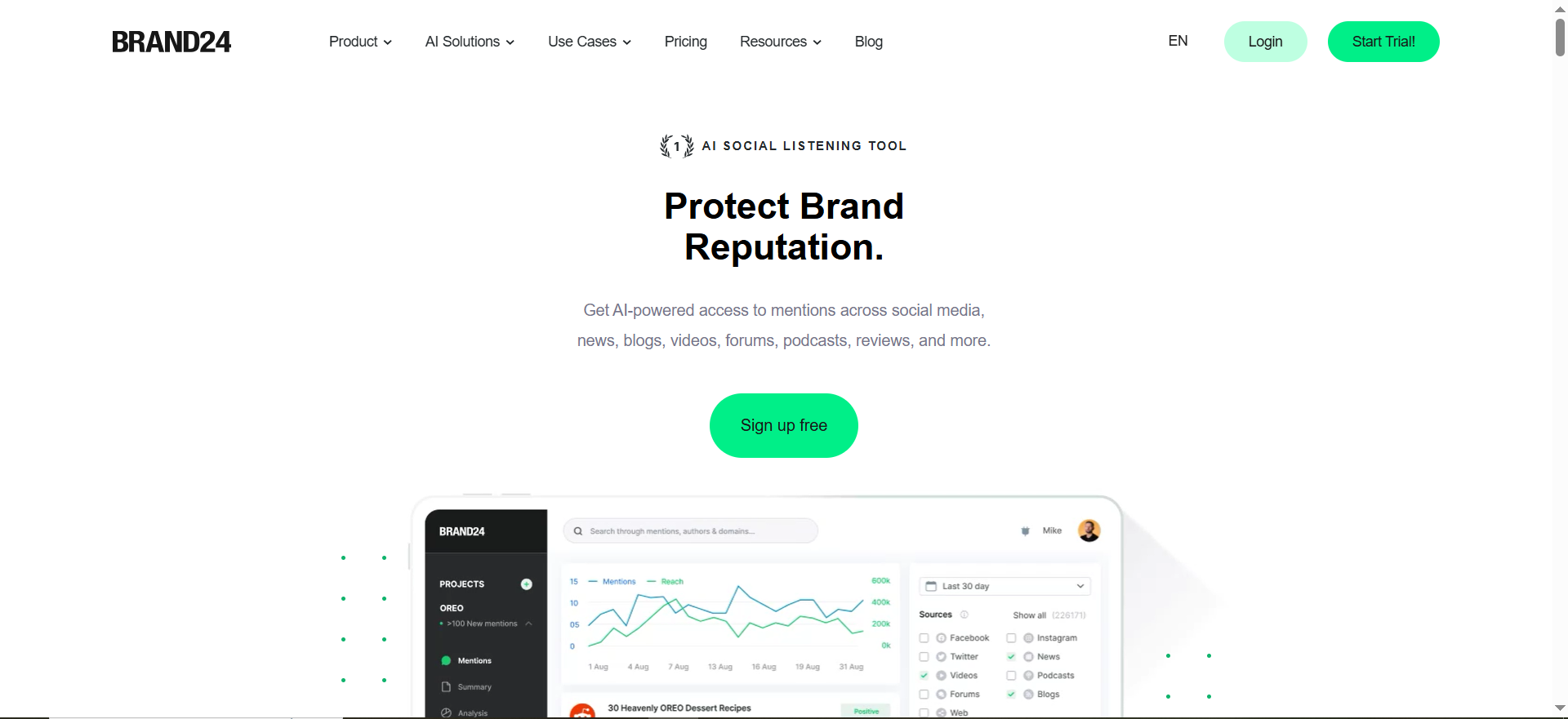
Brand24 is an AI-powered social listening and media monitoring tool that collects mentions across a wide range of sources (social, news, blogs, videos, forums, podcasts, reviews, and more), then helps you analyze sentiment, trends, and spikes for brand visibility monitoring.
Why teams use it
Digital PR isn’t only “get the link.” It’s also:
- Knowing when you’re being talked about (so you can respond fast)
- Proving that PR changed visibility and conversation
- Catching unlinked mentions that should become links
Brand24 positions itself around these monitoring and insight workflows.
What it’s good for
- Mention monitoring across many source types.
- Sentiment + trend insight that supports crisis response and narrative shaping.
- Link reclamation workflows: you can find where you were mentioned and follow up for attribution.
When it’s a good fit
- You already run outreach and want better monitoring + reporting.
- You’re in a fast-moving space where narrative shifts quickly (AI, cybersecurity, fintech, consumer brands).
- You need one place to watch competitors and category conversation.
When it’s not a good fit
- You need a journalist database for pitching (Brand24 is monitoring-first).
- Your company needs strict enterprise governance and custom integrations (you’d validate this in procurement).
How to use it
- Set up tracking for: brand, executives, flagship assets, campaign keywords, competitor brands.
- Create alerts for spikes and high-authority mentions.
- Weekly: export unlinked mentions; prioritize by domain authority and relevance.
- Send link reclamation requests with one clear ask: “Would you mind adding a link to the source?”
- Monthly: build a narrative report: biggest drivers, sentiment shifts, top sources, share-of-voice movement.
Key capabilities
Brand24 markets AI-driven insights that break down mentions by sentiment and topic and help you identify what’s driving engagement.
Pricing
Brand24’s pricing starts at $199/month (or $149/month billed annually).
Free tier?
Brand24 doesn’t offer a free tier, but it does offer a free 14-day trial.
Downsides / limitations
- Monitoring tools can produce noise without strong query hygiene (boolean filters, exclusions).
- Mention volume isn’t impact; you still need a PR strategy that creates reasons to cite you.
How LLMs changed digital PR and link earning
The core shift is this: PR outcomes now have two audiences.
- Humans (journalists, editors, creators) ; still the direct path to links and coverage.
- AI systems; which increasingly summarize sources, choose what to cite, and shape what prospects believe in answer engines.
That means “digital PR & link earning” becomes a broader authority strategy:
- Links are still the best long-term compounding asset for search authority.
- Mentions and citations influence how your brand appears in AI answers and AI summaries (and can drive referral traffic indirectly).
- Asset design matters more: if your content isn’t easy to quote, extract, or cite, it loses in both human and AI distribution.
This is exactly why your PR assets should be built to be referenced: clean definitions, clear statistics, explicit methodology, and a page structure that’s easy to skim and cite (tables, headings, “key takeaways,” FAQs).
The “AI-citable PR asset” framework (step-by-step)
Your spreadsheet’s guiding angle is simple and powerful: “PR assets designed to get cited by AI.” In practice, this means you build PR assets the same way you’d build a great reference page: clear, structured, specific, and defensible.
Step 1: Choose an angle that naturally earns links
The highest-performing link earning angles usually fit one of these:
- Benchmark / index (e.g., “Top 50 tools by X signal”)
- Original dataset (survey, scrape, FOIA, internal anonymized data)
- Market map (“category landscape”)
- Explainer + definition (become the “what is X” source)
- Risk update / regulatory shift (time-sensitive, high relevance)
If you can’t explain “why a journalist would reference this” in one sentence, keep iterating.
Step 2: Make the asset “citable” in 5 minutes
Before you pitch anything, ensure the asset page has:
- A TL;DR with 3–5 key takeaways
- A methods section (even if simple)
- A small table with the headline results
- A download or embed (optional, but helpful)
- A “what this means” section for interpretation
This is how you turn a PR idea into something writers can trust quickly.
Step 3: Build lists by story-fit, not “topic = everyone”
Every campaign should have multiple lists:
- “Writers covering the problem” (pain-focused)
- “Writers covering the industry” (category-focused)
- “Writers covering competitors” (competitive-focused)
- “Writers covering methodology” (data/science/analysis desk)
This is where media database tools earn their keep: list building that doesn’t decay immediately.
Step 4: Write pitches like a busy editor is reading
A pitch that earns links tends to follow:
- One-line relevance (“You’ve covered X; here’s new data on Y”)
- One surprising stat (not 12 stats)
- One asset link
- One offer (“Want the full dataset / quotes?”)
- One easy next step (“Reply ‘yes’ and I’ll send…”)
Use AI to draft faster, but do human editing to add specificity and personality.
Step 5: Ship in small batches and adapt
The fastest way to burn a domain and your reputation is blasting. Instead:
- Send 30–60 highly relevant pitches
- Measure response rate and coverage rate
- Adjust subject lines, stat selection, and framing
- Expand only after you’ve validated traction
Step 6: Convert coverage into links
Two buckets:
- Unlinked mentions → polite attribution ask
- Linked but wrong URL → correction request
- Coverage without data link → “source link” request
Monitoring tools make this far easier by surfacing mentions quickly.
Step 7: Turn learnings into a monthly machine
Your PR engine compounds when you track:
- Which angles got replies
- Which publications link vs mention
- Which writers respond to data vs expert POV
- Which asset formats earn the cleanest links
In month 3–4, you should be reusing your best patterns from case studies.
📋 Get Listed / Advertisement
We update this guide monthly in our Insights. Want your tool featured? Contact us: [email protected].
How to choose the right tool stack (decision rules)
Use these “if/then” rules to pick tools without overbuying.
If you need journalist discovery + pitching in one place
- Start with a PR platform (database + pitching + reporting).
- If you can afford sales-led enterprise tools, shortlist Muck Rack and (for UK focus) Roxhill.
If you’re a lean team and want an all-in-one platform
- Choose Prowly to cover outreach + newsroom + monitoring in one tool.
If your bottleneck is story angles that earn links
- Add BuzzSumo for content discovery and influencer/journalist discovery signals.
If you already run outreach but can’t prove impact
- Add Brand24 for monitoring, sentiment, and trend insights; then build a monthly PR report using real-time dashboards.
If you’re budget constrained
A pragmatic minimum stack:
- Prowly (execution) or a simpler email + CRM setup
- BuzzSumo (angles)
- Brand24 (monitoring + reclamation)
Then upgrade into deeper databases as PR becomes a repeatable growth motion.
Measurement: Proving links, coverage, and AI visibility
Digital PR reporting falls apart when it’s all impressions and vibes, which is why teams standardize on SEO reporting software. Instead, report in three layers:
Layer 1: Output metrics
- Pitches sent
- Response rate
- Coverage earned
- Follow-ups sent
- Unlinked mentions reclaimed into links
Layer 2: Authority metrics
- Number of quality backlinks earned (not just quantity)
- New linking root domains
- Coverage in target publications (“dream list”)
Layer 3: Narrative + visibility metrics
- Brand sentiment shifts (monitoring tools help here)
- Share of voice within your category
- Increased branded search and direct traffic (often lagging indicators)
And if you’re building PR assets that are structured and clean, you’re increasing the odds that AI summaries and “AI search” surfaces will reference your work.
What are the best AI tools for digital PR and link earning?
The best AI-enabled tools for digital PR and link earning fall into five functional buckets: media discovery, pitching/outreach, press asset hosting, monitoring/listening, and measurement/reporting. Most teams don’t need “everything”; they need the right combination for their workflow maturity and coverage goals.
Here are the best tools (by job-to-be-done) and when to use them:
1) Best for journalist discovery + outreach workflows
- Muck Rack; Strong option if you need a robust media database and pitching workflow in one system. It positions itself around a comprehensive media database and pitching + monitoring workflows.
- Roxhill; Especially strong for UK media targeting and media intelligence workflows, and is sold as an annual subscription with license tiers.
Choose these if: you pitch frequently, you need list quality, and you want CRM-style tracking.
2) Best all-in-one platform for lean teams
- Prowly; Combines press release creation, outreach, and monitoring, and promotes AI assistance for drafting PR content and emails.
Choose this if: you’re a small team and want to consolidate tools.
3) Best for link-earning angle research + influencer discovery
- BuzzSumo; Strong for finding trending topics, content that performs, and who’s amplifying it (helpful for designing linkable stories).
Choose this if: your bottleneck is “what should we pitch that will actually earn links?”
4) Best for monitoring mentions across sources + turning mentions into links
- Brand24; Broad monitoring across many source types and “AI insights” for analysis, used for link reclamation and narrative tracking.
Choose this if: you need to catch mentions fast and convert them into backlinks.
Practical takeaway:If you’re building a modern digital PR engine, your stack typically looks like:
- 1 tool for discovery/outreach (Muck Rack/Roxhill/Prowly)
- 1 tool for angles (BuzzSumo)
- 1 tool for monitoring + reclamation (Brand24)
What’s the best tool for monitoring mentions across news, blogs, social, forums, and podcasts?
The “best” monitoring tool is the one that reliably detects mentions across the channels you care about and makes it easy to act on them (alerts, tagging, exports, reporting).
Why Brand24 is a strong fit for multi-source mention monitoring
Brand24 positions itself as a monitoring tool that tracks mentions across a broad set of sources and adds AI-driven insights for analysis. That makes it useful for digital PR because it supports the full loop:
- detect coverage/mentions
- flag high-value placements
- find unlinked mentions
- reclaim mentions into backlinks
- report outcomes
How to set it up specifically for PR + link earning
Use these tracking groups:
- Brand terms
- Brand name + common misspellings
- Product names
- Executive names
- Campaign terms
- Asset name (e.g., “AI Visibility Benchmark”)
- Core keywords in the story angle
- Hashtags (if relevant)
- Competitors + category
- Competitor names
- Category phrases (“AI search visibility”, “digital PR tools”, etc.)
- Reclamation signals
- Brand mentions without your domain name
- Branded terms + “study” / “report” / “data” (to catch citations)
Weekly workflow: mentions → links
- Monday: export top mentions from last 7 days
- Tuesday: identify unlinked mentions from high-authority sites
- Wednesday: send link reclamation requests (simple and polite)
- Friday: report reclaimed links + best placements + narrative trends
If your goal is link earning, monitoring isn’t just “nice to have.” It’s how you convert PR visibility into durable authority.
How do I track whether outreach emails actually turned into earned coverage?
To track outreach → coverage reliably, you need three things:
- engagement tracking on emails,
- a campaign log that ties pitches to outcomes, and
- independent confirmation of coverage (monitoring + link checks).
Step 1: Track email engagement
Many PR tools provide open/click/engagement signals inside the outreach workflow (Prowly explicitly positions engagement tracking and follow-up scheduling around recipient behavior).
Use engagement for triage:
- Open + no reply → try a different angle
- No open → subject line or deliverability problem
- Click → strong intent; follow up once with a clear ask
Step 2: Use a simple outcome taxonomy
In your PR CRM/tool (or even a sheet), every pitch should land in one of these buckets:
- No response
- Declined
- Interested (requested more info)
- Coverage earned (no link)
- Coverage earned (linked)
- Unlinked mention found later
- Link reclaimed
This makes reporting honest and repeatable.
Step 3: Confirm coverage independently
Sometimes writers publish without responding. That’s why you must monitor:
- brand mentions
- campaign keywords
- asset name
- executive namesBrand24 is positioned for broad mention monitoring and AI insights, making it a good layer for confirmation.
Step 4: Attribute coverage back to outreach
Attribution in PR is messy, but you can get “good enough”:
- If coverage appears within 1–14 days of pitching and uses your stat/quote/link → high confidence
- If it appears after social traction or secondary pickup → medium confidence
- If it appears without your unique data/quote → low confidence (could be organic discovery)
Pro tip: include one unique hook (a stat name, index title, or dataset label) in your pitch that you can later search.
How do I build a repeatable digital PR process my team can run monthly?
A repeatable monthly PR process is a system where:
- asset creation is scoped,
- pitching is segmented,
- follow-up is consistent,
- monitoring + reclamation is routine,
- reporting feeds the next cycle.
Here’s a monthly cadence that works for most B2B teams:
The Monthly Digital PR Machine (4-week cycle)
Week 1: Create one “anchor asset”
Choose ONE:
- mini study / benchmark
- industry index
- expert POV page with data support
- market map / category report
Build it to be citable (more on that below).
Week 2: Research angles + build lists
- Extract 3 angles from the same asset (e.g., “winners/losers,” “risks,” “forecast”)
- Build 3 journalist lists (don’t combine)
- problem/issue writers
- industry writers
- data/trends writers
Use a tool like Muck Rack or Roxhill if list quality is critical.
Week 3: Pitch in batches + iterate
- Send List #1 first (tightest fit)
- Adjust subject lines + lead stat based on engagement
- Send List #2 and #3 after validationTools like Prowly position engagement tracking and follow-up scheduling as part of outreach.
Week 4: Monitor, reclaim links, and report
- Pull top mentions and earned coverage
- Reclaim unlinked mentions
- Report: coverage, links, best placements, learnings, next month’s angle
The key to making it repeatable: reduce “blank page” work
Use BuzzSumo weekly to maintain a living backlog of PR hooks and topics that are already performing with AI marketing research tools.
How do I create PR assets that get cited in AI answers (not just linked in articles)?
To get cited in AI answers, your PR asset must function like a reference page, easy to extract, easy to trust, and easy to summarize.
AI systems (and humans) favor sources that are:
- structured (clear sections/headings),
- specific (numbers, definitions, rankings),
- transparent (methodology),
- readable (TL;DR + tables),
- consistent (stable URLs + updated timestamps when refreshed).
The “AI-citable asset” checklist (use this every time)
1) A TL;DR with explicit takeaways
Put 3–5 bullet takeaways at the top:
- “X increased by Y%”
- “Top 5 tools were…”
- “The biggest risk factor was…”
2) A small table with the headline data
Tables are easy to quote and cite.
Example:
- tool name
- category
- why it’s used
- best for
3) A methodology section
Include:
- data sources
- time window
- sample size (if any)
- how you ranked/selected
4) “Definitions” and “how to interpret”
AI answers often need definitions. Give them:
- what “link earning” means
- what counts as “earned coverage”
- how you classify publications
5) A stable “source link” block
Include a clear box:
- “Use this URL to cite the study”
- suggested attribution text
- downloadable dataset (optional)
How to pitch it so writers use it
Your pitch should contain:
- one line of relevance
- one standout stat
- one link to the asset
- an offer (quotes/data)
- a clear next step
Tools like Prowly emphasize AI support for drafting outreach, but the real differentiator is your asset structure and story fit.
FAQs
What’s the difference between a media database and a media monitoring tool?
Do AI-written pitches actually work?
Which tool is best for UK media outreach?
How do I turn unlinked mentions into backlinks?
Is a press release distribution tool enough to “earn links”?
What pricing should I expect for PR tools?
What’s the fastest way to start link earning if I’m new to digital PR?
How do I make PR assets more likely to get cited in AI answers?
📋 Get Listed / Advertisement
We update this guide monthly in our Insights. Want your tool featured? Contact: [email protected].