
If you want search engines and AI assistants to understand your brand, you need more than “keyword optimization. You need a clear entity model (who/what you are), content that consistently reinforces that model, and structured data + references that make it easy to verify that make it easy to verify. For most teams, the fastest path is: use InLinks for entity-based on-page optimization and internal linking, Schema App for scalable schema and a reusable content knowledge graph, Semrush to expand entity coverage and prioritize what to build next, Wikidata tools for canonical IDs and disambiguation, and AlsoAsked for question graphs that reveal the entities users expect you to cover.
📋 Get Listed / Advertisement
We update this guide monthly. Want your tool featured? Contact: [email protected].
Best 5 Tools for Entity SEO & Knowledge Graph Building (Quick Comparison)
| Tool | Best for | Entity/KG superpower | Pricing / free tier |
|---|---|---|---|
| InLinks | Entity-based on-page + internal linking | Uses entity analysis + a knowledge graph approach to recommend entities and structure internal links | Paid plans; free tools exist |
| Schema App | Enterprise schema + content knowledge graph | Builds semantic schema markup at scale and develops a reusable content knowledge graph | Paid platform (demo); resources/plugins exist |
| Semrush | Coverage planning + competitive research | Entity-based SEO strategy + topic/keyword workflows to plan clusters and find gaps | Freemium + paid tiers |
| Wikidata tools | Canonical IDs + external reference layer | Public entity identifiers + relationships + SPARQL querying via WDQS | Free/open |
| AlsoAsked | Question graphs for entity coverage | Live “People Also Ask” trees + topic connections to shape entity coverage | Paid; plans vary |
📋 Get Listed / Advertisement
We update this guide monthly. Want your tool featured? Contact: [email protected].
1. InLinks
What it does
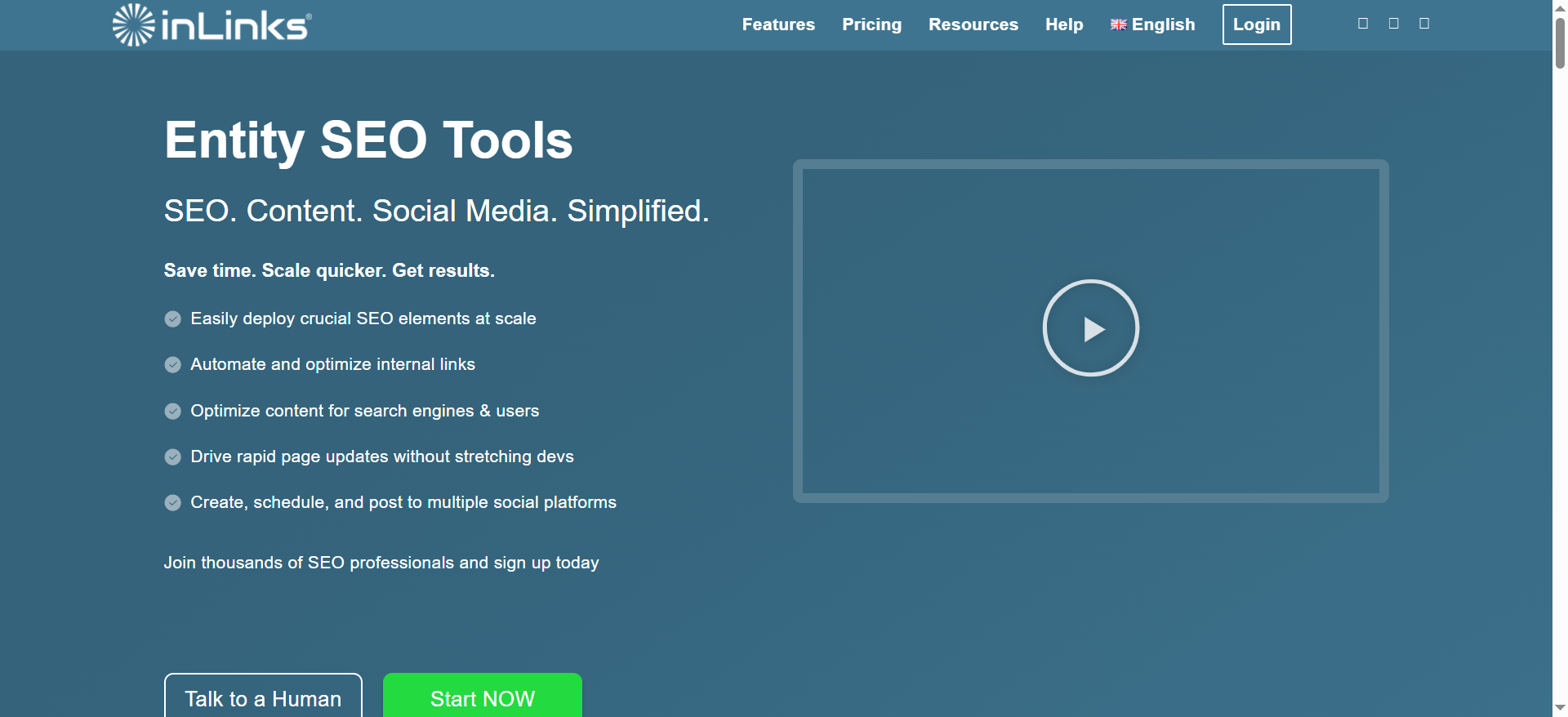
InLinks positions itself as an entity-based semantic SEO tool that uses semantic analysis and knowledge graph optimization and internal linking.
Why teams use it
Because it translates “entity SEO theory” into concrete actions: identify missing related entities, strengthen topical relevance, and wire pages together with internal links based on topics/entities, not just exact-match anchor text.
What it’s good for
- Finding “entity gaps” in an article (related concepts you should mention to make the page’s “aboutness” unambiguous).
- Building topic clusters that map to entity relationships (pillar → supporting pages → subtopics).
- Automating internal linking at scale based on semantic matching.
- Adding schema support as part of a content optimization workflow.
When it’s a good fit
- You publish a lot of content and internal linking is inconsistent.
- Your team wants a repeatable workflow for semantic optimization (entity coverage → link structure → iteration).
- You’re trying to win in AI search/AI Overviews where clarity and “aboutness” matter.
When it’s not a good fit
- You only have a handful of pages and can manually manage internal linking.
- Your primary challenge is enterprise-level structured data governance across many templates (Schema App is usually stronger).
- You need deep competitive datasets, reporting and rank/visibility tooling across large keyword sets (Semrush is usually stronger).
How to use it
- Start with one pillar topic and audit your existing pages: which pages already align with the entity set for that topic?
- Optimize your top 3–5 revenue pages first: add missing entities, improve definitions, and clean up sections so the page’s intent is obvious.
- Deploy internal linking automation rules conservatively (relevance and UX > link volume).
- Re-run optimization after updates and put it on a monthly maintenance loop.
Key capabilities
- Entity-based content optimization recommendations.
- Internal linking features built around topics/entities.
Pricing
InLinks’ paid plans start at $49/month, with pricing based on how many pages you add.
Free tier?
InLinks offers a free plan, and it also offers a free trial.
Downsides / limitations
- Recommendations can feel abstract if your team isn’t used to thinking in entities and relationships.
- Internal linking automation still needs QA (over-linking and irrelevant links can hurt UX and dilute topical focus).
- You may want tighter editorial workflow integration than a standalone tool provides.
2. Schema App
What it does
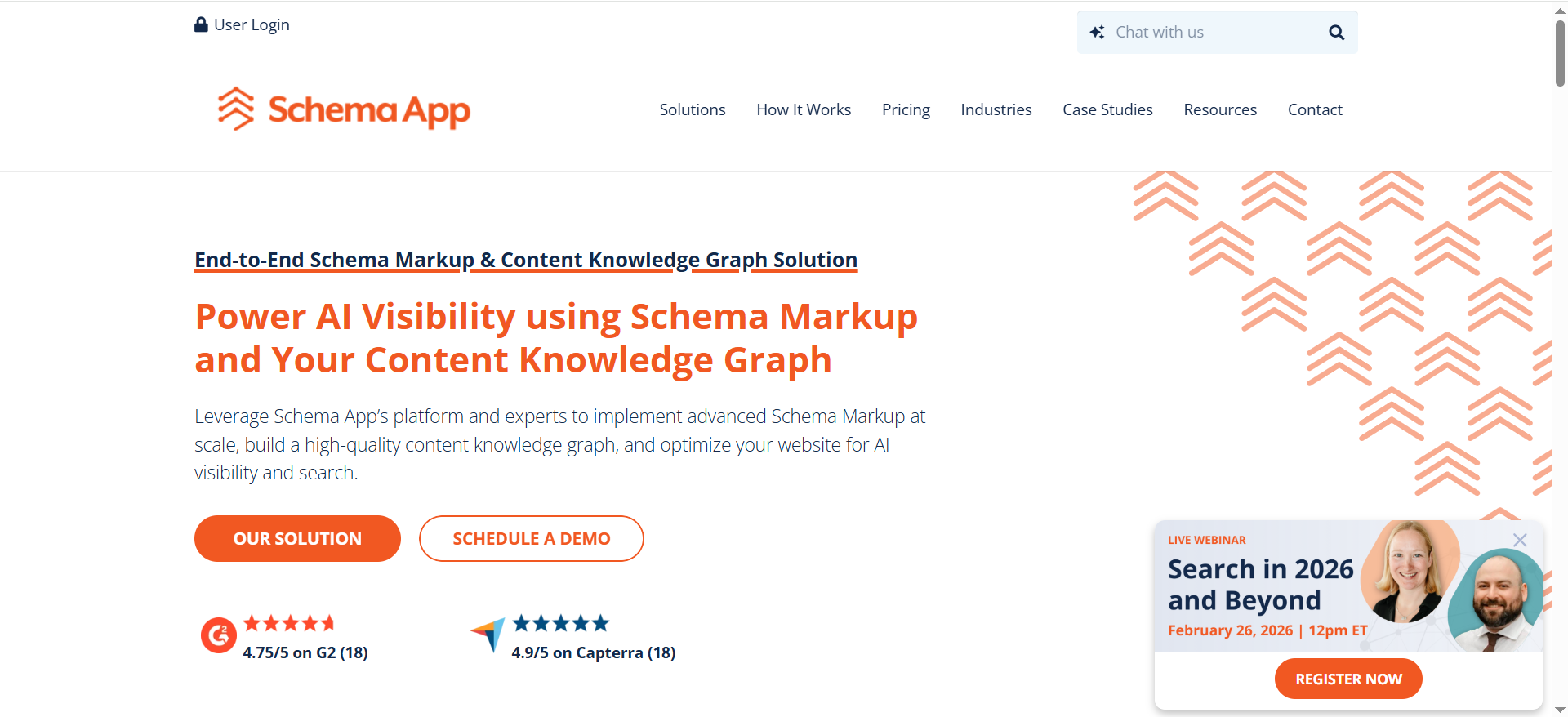
Schema App is positioned as an end-to-end schema markup solution and a platform for developing a content knowledge graph from your website’s content through semantic schema markup.
Why teams use it
Because schema work breaks in the real world: multiple page types, inconsistent templates, CMS limitations, and scattered ownership. Schema App’s value is making schema modeling, deployment, and governance repeatable, so structured data stays accurate as the site evolves.
What it’s good for
- Enterprise-scale structured data across many templates and content types.
- A coherent schema model for Organization, Product/Service, Person, and content pages.
- Building reusable entity nodes and relationships that persist across your site.
- Avoiding “random JSON-LD snippets” that drift or conflict over time.
When it’s a good fit
- You have hundreds/thousands of pages and multiple templates.
- You need QA/governance (who owns the model, how changes get tested and deployed).
- AI visibility is a priority and you want consistent machine-readable facts across the site.
When it’s not a good fit
- You’re early-stage and just need a minimum viable schema setup for key pages.
- You can’t justify a dedicated platform and prefer a lightweight plugin/manual approach.
How to use it
- Inventory your entity pages (About, product/service pages, docs, team/leadership, locations, case studies).
- Decide your core schema types and attributes (Organization/Person/Product/Service/Article/FAQPage, etc.).
- Build a mapping layer so each page type emits consistent JSON-LD aligned to the same model.
- Validate and iterate (treat schema as a governed system, not a one-time task).
Key capabilities
- End-to-end schema markup implementation and governance.
- Building a reusable content knowledge graph using schema.org vocabulary.
Pricing
Schema App’s pricing is not publicly listed; it’s available by custom quote.
Free tier?
Schema App doesn’t offer a free tier or free trial, but it does offer a demo.
Downsides / limitations
- Implementation effort is real; it’s not “install and forget.”
- Overkill if you only need basic markup on a small site.
- Requires someone to own schema quality and the underlying entity model.
3. Semrush
What it does
Semrush is a broad SEO suite, but it’s especially useful for entity SEO because it helps you expand topical/entity coverage, identify competitive gaps, and turn that into a prioritized content plan. Semrush also publishes guidance on entity-based SEO strategy (helpful for stakeholder alignment).
Why teams use it
Entity SEO still needs classic SEO inputs: demand discovery, intent modifiers, SERP features, and competitor overlap. Semrush is strong at converting competitive research into “what should we publish and update next?” workflows.
What it’s good for
- Building a roadmap that covers entities and subtopics systematically.
- Discovering competitor pages that “own” entity clusters you’re missing.
- Clustering terms into intent-driven groups (often good proxies for entity clusters).
- Reporting and prioritization for ongoing content programs.
When it’s a good fit
- You want an integrated view of keywords, competitors, and content opportunities.
- You’re building topical authority and need a plan, not just a page-level optimizer.
- You need repeatable reporting for leadership/stakeholders.
When it’s not a good fit
- You need schema governance at scale (Schema App).
- You want entity-first internal linking automation (InLinks).
- You need canonical IDs and external entity reconciliation (Wikidata tooling).
How to use it
- Pick one high-value entity cluster (e.g., “entity SEO”, “knowledge graph building”, “structured data”).
- Build a topic plan (pillar page + supporting pages + FAQs).
- Use competitor overlap/gap insights to identify missing subtopics and sections.
- Translate the output into an entity map: which entities must appear on which pages, and how those pages should link; then sanity-check your stack with this AI SEO tools comparison
Key capabilities
- Keyword research toolkits and topic discovery.
- Topic research and content planning workflows.
- Entity-based strategy guidance (useful for team alignment).
Pricing
Semrush’s pricing starts at $165.17/month for its Starter plan (billed monthly).
Free tier?
Semrush offers a free account with limited daily usage, and it also offers a 7-day free trial for most plans.
Downsides / limitations
- It’s not a knowledge graph builder by itself; it’s a coverage and planning engine.
- Teams that still think “keywords only” will need a translation layer from keyword clusters → entity clusters.
4. Wikidata tools
What it does
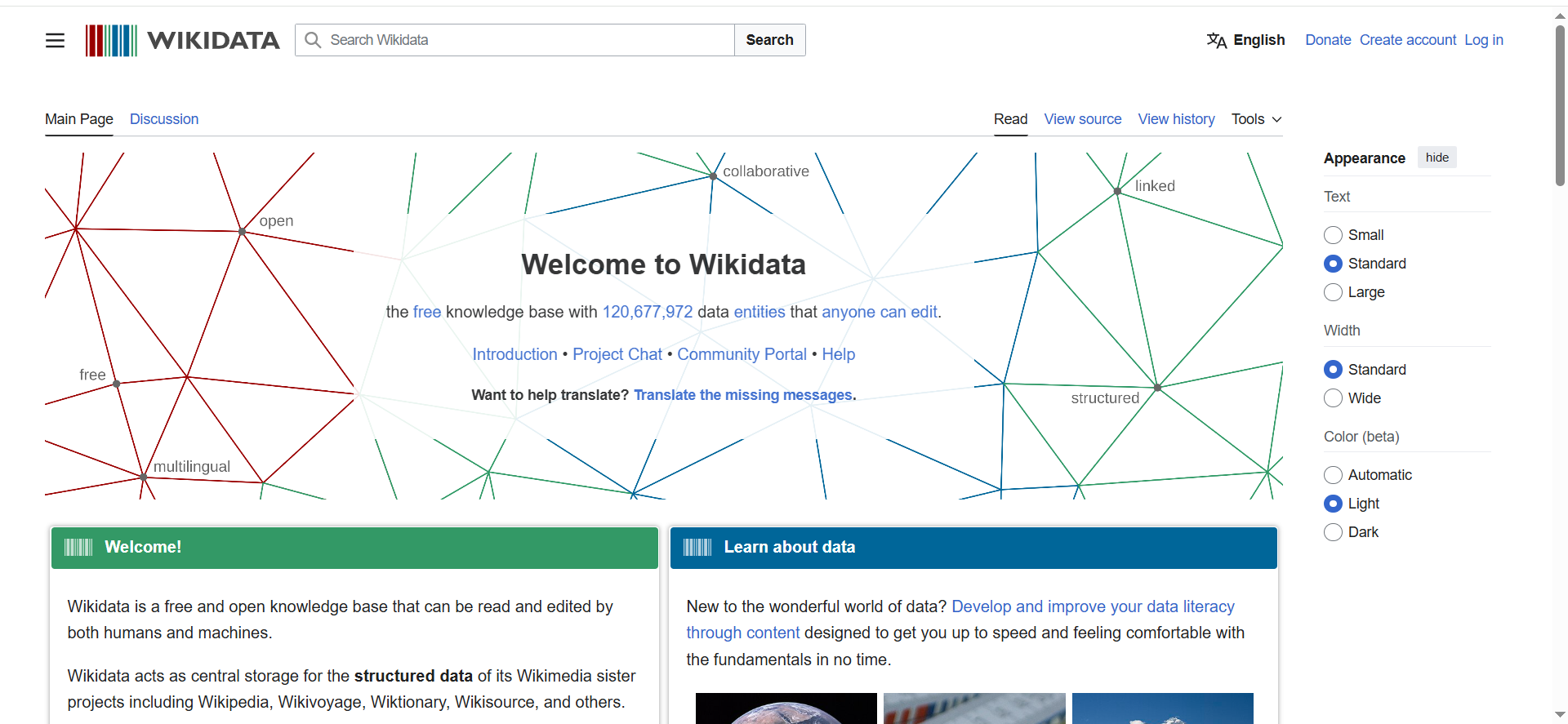
Wikidata is a public knowledge base with stable identifiers for entities (people, organizations, places, concepts) and their relationships. The Wikidata Query Service (WDQS) lets you query that graph with SPARQL via a public endpoint and GUI.
Why teams use it
Entity SEO often fails due to ambiguity: similar names, multiple locations, subsidiaries, product lines, or unclear “same thing” references. Wikidata IDs (and related tooling) provide a canonical reference layer for disambiguation, research, and “sameAs” alignment.
What it’s good for
- Finding and validating entity IDs and attributes.
- Disambiguating similar names (brand vs person, product vs concept, etc.).
- Researching related entities and “missing relationships.”
- Exporting datasets to seed your internal knowledge graph.
When it’s a good fit
- You have entity ambiguity problems (especially across regions).
- You want a transparent reference layer for your entity model.
- You have a technical resource who can run SPARQL or use query tools.
When it’s not a good fit
- You want a plug-and-play marketing tool (this is a knowledge base + query system).
- Your entity work must remain private (Wikidata is public).
How to use it
- Search for your brand, products, and key concepts; confirm accuracy and disambiguation.
- Capture IDs (Q-numbers) for core entities and competitors.
- Use WDQS to explore relationships (industry, founders, parent orgs, locations).
- Use these outputs to guide your site’s entity pages and structured data (consistent naming, sameAs links, better citations).
Key capabilities
- Stable entity IDs and relationship claims.
- SPARQL endpoint + GUI for querying.
Pricing
Wikidata is free to use.
Free tier?
Wikidata is fully free/open with no paid tier; the public Query Service is free to use (with usage constraints for heavy querying).
Downsides / limitations
- Learning curve (especially if you’ve never used SPARQL).
- Public KB governance and notability policies matter if you want to create/edit entries.
- Public data can be incomplete; you still need first-party truth on your website.
5. AlsoAsked
What it does
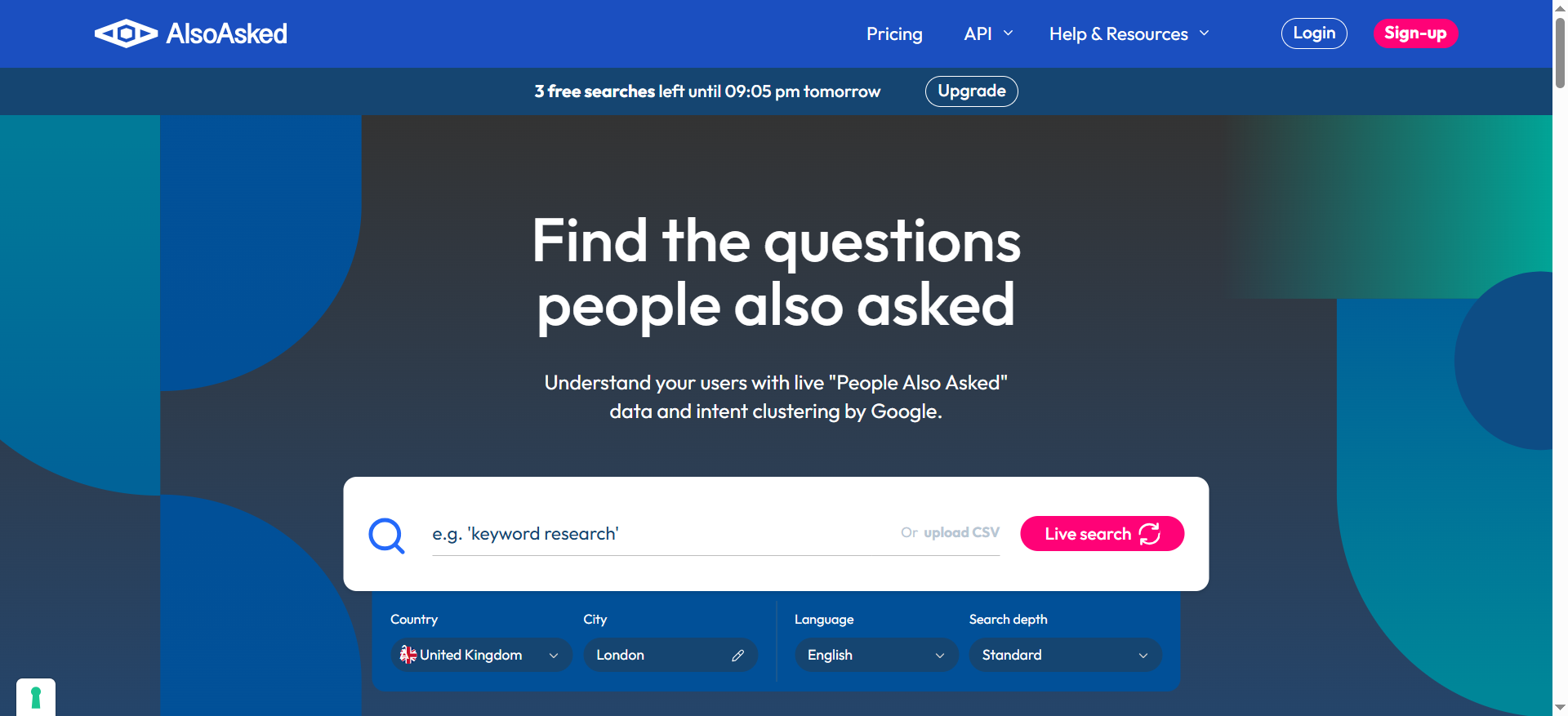
AlsoAsked visualizes Google’s “People Also Ask” questions and maps connections between topics. For entity SEO, this matters because question graphs are one of the fastest ways to discover the entities and relationships people expect you to cover.
Why teams use it
Because it turns a single topic into a structured coverage plan: definitions, comparisons, “how to,” and troubleshooting branches that translate cleanly into headings and supporting pages.
What it’s good for
- Building an FAQ + subtopic map quickly.
- Discovering “vs” and comparison intentions.
- Turning real query structures into scannable H3s that help snippet extraction.
- Generating a query fan-out list grounded in Google PAA behavior.
When it’s a good fit
- You build topic clusters and want real-user question data quickly.
- You want your content structured in question-style headings (useful for extraction).
- You need briefs that are intent-first (not just keyword lists).
When it’s not a good fit
- You need schema governance or knowledge graph modeling (this is research, not implementation).
- You want competitive intelligence, backlinks, or technical audits (Semrush is better).
How to use it
- Enter your core topic/entity.
- Export or map the question tree into: definitions → comparisons → implementation → objections.
- Turn each cluster into either a section (H3/H4) or a supporting page.
- Use the output to populate your FAQ module and validate your query fan-out coverage.
Key capabilities
- Live People Also Ask data and topic connection mapping.
Pricing
AlsoAsked’s pricing starts at $12/month (Basic plan), with higher tiers available.
Free tier?
AlsoAsked offers a free tier with 3 search credits per day for visitors.
Downsides / limitations
- PAA shifts over time; treat it as directional (update quarterly).
- Still requires translation from questions → entities → content architecture.
Entity SEO & knowledge graphs
What “entities” mean in SEO
An entity is a “thing” with a stable identity, like a company, product, person, place, or concept, that can be referenced consistently across systems. Schema.org explicitly exists to describe entities and relationships (and can be expressed in JSON-LD), and search engines use structured data (often based on schema.org) to interpret content and enable richer experiences.
In practical terms, entity SEO is about making your site the clearest, most consistent source of truth for:
- Your brand entity (Organization) and your offerings (Product/Service/Application/Software/SoftwareApplication where appropriate).
- The topical entities you want to be associated with (your “semantic neighborhood”).
- The relationships between those entities (what you do, for whom, how it works, proof).
The three layers of a knowledge graph strategy
Think of knowledge graph building for SEO as three nested layers:
- First-party entity model (content + architecture)
- Your pages clearly define entities, attributes, and relationships in human-readable language (copy), structure (headings), and internal linking.
- Machine-readable layer (structured data)
- You encode the entity model in structured data using schema.org vocabulary, following Google’s structured data guidance for what matters and how to implement/test.
- External reference layer (verification signals)
- Your entities are corroborated by credible third-party sources (directories, profiles, Wikidata where appropriate), reducing ambiguity and improving trust.
How this connects to AI search visibility and citations
AI systems summarize and cite what they can confidently extract and cross-verify. When your brand entity is fuzzy, unclear naming, inconsistent descriptions, missing proof, AI answers become unstable: wrong descriptions, missing mentions, or competitor substitutions.
This is why TRM’s angle is powerful: entity work isn’t “knowledge panel vanity.” It’s how you increase accuracy, citations, and consistent recommendations across both classic search and AI answers.
The entity-building playbook (tools per step)
This is the “do the work” workflow behind the tool stack, organized so you can assign owners and ship outcomes.
Step 1 — Define your entity set and “aboutness”
Goal: Decide which entities you must own.
Start with:
- Brand entity: name variants, legal name, HQ, leadership, official URLs, verified social profiles.
- Offer entities: products/services, categories, and 10–30 core attributes that customers care about.
- Topic entities: the concepts you want to be associated with (the semantic neighborhood around your brand).
Tools: Semrush (discovery + competition), AlsoAsked (questions), Wikidata tools (IDs/disambiguation).
Deliverable: An entity dictionary (your internal source of truth) with names, short definitions, canonical URLs, and IDs where applicable.
Step 2 — Build an entity map and coverage plan
Goal: Turn entity research into content architecture.
Build:
- A pillar page for each major concept.
- Supporting pages for sub-entities, comparisons, and objections.
- An FAQ module aligned to People Also Ask.
- A linking plan: which pages reinforce which relationships.
Tools: InLinks (entity gaps + internal linking), AlsoAsked (clusters), Semrush (prioritization).
Deliverable: A one-page map: entity → defining page(s) → supporting pages/sections → internal links.
Step 3 — Publish the entity system (content + internal links)
Goal: Make your site’s entity story unmistakable.
Tactics:
- Use question-style H3s (“What is X?”, “X vs Y”, “How does X work?”) to improve extraction.
- Add definition blocks, comparisons, and proof sections (benchmarks, case studies, third-party references).
- Link between pages with descriptive anchors (don’t hide the entity name in vague anchors like “click here”).
Tools: InLinks (internal linking + entity coverage), Semrush (competitive examples + planning).
Deliverable: Updated pillar pages and supporting pages with consistent entity language and intentional linking.
Step 4 — Add structured data that matches your model
Goal: Encode your entity truth in JSON-LD and schema.org.
Start with what you can keep accurate:
- Organization (brand facts), Person (leadership), Product/Service/SoftwareApplication (offerings), Article (content), BreadcrumbList, and FAQPage where appropriate.
- Validate using Google’s tools and documentation.
Tools: Schema App (scale + governance), Google structured data guidance (testing + rules), and sometimes InLinks for schema suggestions.
Deliverable: A structured data model deployed consistently across templates.
Step 5 — Create / strengthen external reference signals
Goal: Reduce ambiguity and improve verifiability.
Actions:
- Standardize official facts across your ecosystem (profiles, directories, partner pages).
- Use consistent “sameAs” references (official profiles) in schema where appropriate.
- Use Wikidata responsibly for disambiguation and research (and only make public edits where legitimate, cited, and policy-compliant).
- Use the Google Knowledge Graph Search API to look up entities and understand how they’re represented in Google’s KG.
Deliverable: A reference list per core entity (what external sources corroborate it).
Step 6 — Monitor, iterate, and protect your entity
Goal: Keep the entity graph healthy.
Track:
- y queries (brand + product + category).
- Schema errors/template drift.
- Whether AI answers cite you correctly and consistently.
- New content that introduces inconsistent naming or claims.
Tools: Semrush (tracking + reporting), InLinks (ongoing optimization loops), Schema App (schema governance/monitoring).
Deliverable: A monthly entity maintenance routine (content + schema + references).
How to choose the right stack (decision framework)
If you’re an SMB or early-stage team
Start lean:
- AlsoAsked for coverage and FAQs.
- Semrush (optional) if you need competitor-driven prioritization.
- InLinks if internal linking + on-page semantic coverage are bottlenecks.Use lightweight schema plugins/manual JSON-LD for a small set of key pages, and keep it accurate.
If you’re growth-stage and scaling content
Add repeatability:
- InLinks + Semrush as your “coverage + structure” core.
- AlsoAsked for briefs, FAQs, and section planning.Invest in schema QA and template consistency even before a full enterprise platform.
If you’re enterprise with complex schema + governance
Prioritize governance:
- Schema App as the structured data foundation and content knowledge graph system.
- Semrush for planning and reporting at scale.
- InLinks for editorial teams that need entity coverage + internal links.Use Wikidata tools for disambiguation and “sameAs” alignment where appropriate.
Quick-start checklist
- Choose 5–10 core entities you must own (brand + offers + key concepts).
- Build an entity dictionary (names, descriptions, IDs, URLs).
- Map each entity to a page that defines it (or create one).
- Use AlsoAsked to generate question clusters; turn them into H3s + FAQs.
- Use Semrush to find competitor gaps and prioritize supporting pages.
- Use InLinks to fix entity gaps and deploy internal links (with QA).
- Implement Organization/Product/Service/FAQ structured data; validate using Google tools.
- Add “sameAs” to official profiles; ensure off-site consistency.
- Create a monthly entity maintenance loop (content + schema + references) to protect evergreen content visibility in AI search.
How do you build a knowledge graph for SEO?
Building a knowledge graph for SEO is less about “software” and more about creating a repeatable entity system: clear definitions, consistent relationships, and machine-readable facts that match what your site already says.
1) Start with an entity inventory (your “source of truth”)
Create an internal sheet that lists:
- Brand entity (Organization): name variants, legal name, HQ, founders/leadership, social profiles, logo, customer support URL, etc.
- Offer entities: Product/Service/SoftwareApplication (choose what fits), core features, target audience, integrations, pricing page URL, category.
- Proof entities: customers, partners, awards, benchmarks, case studies.
- Topic entities: the concepts you want to own (e.g., “entity SEO”, “knowledge graph building”, “structured data”).
Output: an entity dictionary with canonical names + canonical URLs for each entity page.
2) Design your entity model (relationships matter)
Entities don’t help unless they connect. Map relationships like:
- Organization → offers → Product/Service
- Product/Service → solves → Problem/Use case
- Product/Service → integrates with → Integration entities
- Organization → hasPerson → leadership (Person)
- Organization → hasLocation → Place/LocalBusiness (if relevant)
Output: a simple graph map (even a diagram) showing how your entities relate.
3) Create (or improve) entity pages that “define the thing”
For each core entity, you need a page that clearly answers:
- What is it?
- Who is it for?
- What are its attributes (features, specs, pricing model)?
- How does it relate to other entities (integrations, competitors, categories)?
Output: entity pages that act as definitive sources (not vague marketing copy).
4) Build internal linking that reflects the graph
Knowledge graphs aren’t only schema—they’re also how your pages connect.
- Link from pillar pages → supporting pages
- Link from features → integrations → docs
- Link from “best X tools” pages → each tool entity page
Output: entity-driven internal link structure (topic clusters that match relationships).
5) Add structured data (schema) aligned to your model
This is the machine-readable layer:
- Organization / Person
- Product / Service / SoftwareApplication
- Article
- BreadcrumbList
- FAQPage (only if real FAQs exist)
Output: JSON-LD that matches what the page states (no “markup theater”).
6) Strengthen external references (verification layer)
Google/AI systems trust what they can verify:
- Keep your brand facts consistent across official profiles
- Use stable IDs (Wikidata / sameAs where appropriate)
- Earn citations (press, partner pages, credible directories)
Output: a reference list for each entity.
7) Maintain it (knowledge graphs decay)
Entity facts drift as people leave, products change, sites redesign.Run a monthly loop:
- new content reviewed for naming consistency
- schema checked for errors/coverage
- entity pages updated as offerings evolve
Do entities matter more than keywords in 2026?
They’re not “more important” in a zero-sum way. Keywords still express how people search, but entities determine what search engines understand.
Here’s the reality in 2026
- Keywords = demand signals (what people type, ask, compare)
- Entities = meaning + identity (who/what the query refers to)
- Relationships = relevance (how your page connects to what the user meant)
If you only do keyword optimization, you can rank for terms but still be:
- misclassified (wrong category)
- not cited (AI doesn’t trust your facts)
- outcompeted by brands with clearer entity profiles
Why entities feel “more important” now
Because Google and AI assistants increasingly:
- summarize instead of listing ten links
- rely on entity recognition to avoid ambiguity
- cite sources that define entities clearly (and consistently)
What to do with this insight
- Use keyword research to find what matters.
- Use entity research to define how to cover it.
- Use schema + internal links to reinforce meaning.
How do I find my brand’s entity IDs (Wikidata, Google KG)?
Think of entity IDs like “primary keys” for identity systems. They help resolve ambiguity and connect references across the web.
A) Find your entity in Wikidata
- Search your brand on Wikidata.
- If a result exists, it will have a Q-number (e.g., Q123456).
- Validate: does it match your brand (location, website, industry, founders)?
What to capture:
- Q-number
- official website property
- social profile IDs
- parent/subsidiary relationships (if applicable)
If no entry exists:
- Don’t rush to create one unless your brand meets notability and you have strong citations. Use Wikidata mainly for research + disambiguation, and treat edits as a governance process.
B) Use Google’s Knowledge Graph Search API (if you have dev support)
This can help you:
- search for entities by name/type
- see candidate entities and IDs returned by Google’s KG system
Practical use case:
- If your brand name is shared with another company/person, KG Search API can reveal what Google thinks the likely entity is.
C) Use “sameAs” alignment (practical outcome)
Once you have stable references:
- Add sameAs links in Organization schema to official profiles (LinkedIn, X, YouTube, Crunchbase/other credible profiles depending on your niche)
- Keep brand facts consistent everywhere
The goal isn’t “collect IDs”, it’s to reduce identity confusion.
How do I do entity research for a topic cluster?
Entity research for a cluster answers: what “things” must be included for Google/AI to believe you thoroughly covered the topic.
Step 1: Define the cluster’s “core entity”
Example: “Entity SEO” or “Knowledge Graph building.”
Write a one-sentence definition you’d be comfortable publishing.
Step 2: Build the “required entities” list
For any topic cluster, you’ll typically need:
- Primary entity (topic)
- Sub-entities (methods, frameworks, components)
- Adjacent entities (related concepts Google expects)
- Comparison entities (“X vs Y” alternatives)
- Tool entities (software/platforms)
- Measurement entities (KPIs, metrics, validation tools)
Step 3: Extract question-based entities (fastest method)
Use People Also Ask style questions to reveal what users consider part of the topic:
- “What is X?”
- “How does X work?”
- “X vs Y?”
- “Is X worth it?”
- “How to implement X?”
Each question implies entities (process steps, tools, standards, definitions).
Step 4: Validate with SERP competitive patterns
Open the top-ranking pages and note:
- what subtopics appear repeatedly
- which tools/standards are mentioned across competitors
- what definitions they use (and what’s missing)
The overlap reveals “table stakes” entities.
Step 5: Create an entity-to-page coverage map
For each entity, decide:
- Does it need a standalone page?
- Or can it live as a section under a pillar page?
- Which pages should link to it?
Output: a coverage plan like:
- Pillar: Entity SEO
- Supporting: Entity research, schema, internal linking, disambiguation, knowledge panels
- Pillar: Knowledge graphs
- Supporting: schema.org, Wikidata, Google KG, sameAs, organization schema, entity pages
How do I connect entity SEO to AI citations / AI Overviews?
AI citations happen when a system can:
- extract a claim cleanly
- verify it against other sources
- attribute it to a trustworthy page
Entity SEO helps all three.
What AI systems tend to cite
- Clear definitions (“X is…”)
- Structured lists / steps / comparisons
- Stat-backed claims with sources
- Canonical “about” pages (brand, product)
- Pages that resolve ambiguity quickly
How entities improve your citation odds
1) Clear aboutness = clean extraction
If the page is clearly about a specific entity, AI systems can confidently summarize it.
2) Consistent naming = less confusion
Same entity name, same description, same attributes across the site.
3) Structured data = machine-readable facts
Schema doesn’t guarantee citations, but it reduces friction for systems that parse pages at scale.
4) Reference signals = verification
If your brand facts match credible third-party sources, you’re safer to cite.
A practical “AI citations” checklist
- Add a definition block near the top of entity pages.
- Use question-style headings for key queries.
- Add “proof” sections: examples, case studies, benchmarks, clear methodology.
- Ensure Organization/Product schema matches the page’s actual content.
- Keep one canonical page per entity (avoid duplicates).
- Build internal links so AI crawlers find the “best” page first for AI search visibility.
How do I avoid duplicate entities and disambiguation issues?
Duplicate entities are one of the fastest ways to sabotage entity SEO, especially for brands with similar names, multiple products, or international presence, which is why you need AI search visibility audit tools.
Common causes of duplicate entities
- Multiple “About” pages (brand story vs company page vs press page)
- Separate product pages that describe the same thing with different names
- Location pages that compete with the main brand page
- Multiple authorship profiles (Person entity duplication)
The fix: establish canonical entities
For each important entity:
- One canonical URL
- One canonical name
- One canonical short description
- Consistent schema (same @id pattern, sameAs links)
Use @id to unify structured data
In JSON-LD, using stable @id values helps declare that multiple mentions refer to the same entity.
Example outcomes:
- Your Organization entity appears across many pages but uses the same @id
- Product entities are referenced consistently across docs/blog/pricing pages
Handle ambiguous names explicitly
If your brand name overlaps with others:
- Include disambiguating descriptors early (industry, location, tagline, category), especially when your brand messaging affects AI visibility.
- Strengthen your “About” page and Knowledge Graph references, start with your About page.
- Use external citations that clearly identify you
Keep “thin duplicates” from indexing
If two pages exist for functional reasons:
- consider canonical tags
- consolidate content into one authoritative page
- redirect where possible
What’s the minimum viable entity + schema setup?
If you’re trying to ship fast (without doing enterprise-scale KG work), here’s the minimum setup that produces real outcomes.
Minimum viable entity system
You need:
- One strong About/Company page (defines your Organization entity)
- One page per product/service (defines your offering entities)
- A topical pillar page for your main category + 3–10 supporting pages
- Clean internal linking between these pages
Minimum viable structured data
Implement:
- Organization schema (with name, logo, URL, sameAs official profiles)
- Product / Service / SoftwareApplication schema (match your offering)
- Article schema on blog posts
- BreadcrumbList sitewide (helps structure)
- FAQPage only where FAQs are real (not spam)
Minimum viable verification signals
- Consistent brand facts across your website and official profiles
- At least a few credible third-party references (press, partner pages, directory profiles appropriate to your niche)
If you do only this well, you’ve already created a foundation most sites never build.
How do I handle multiple locations / international entities?
Multiple locations and international markets often create entity duplication and confusion unless you plan the structure deliberately.
Decide what the “primary entity” is
Are you:
- one brand with multiple offices?
- a franchise model?
- separate legal entities per country?
- one product sold globally with local distributors?
This affects both site architecture and schema.
Recommended site architecture patterns
Pattern A: One brand, multiple offices
- One primary Organization page
- Location pages under /locations/ or /contact/
- Internal links from Organization → each location
- Schema: Organization + Place/LocalBusiness for each location as appropriate
Pattern B: Country-specific business units
- Country subfolders/subdomains (/uk/, /ae/, etc.) if truly localized
- Separate localized entity pages if offerings/legal entities differ
- Strong hreflang and canonical controls
Pattern C: Global product, localized content
- Keep one canonical product definition
- Localize supporting pages (pricing, compliance, documentation)
- Maintain consistent naming and entity definitions across locales
Structured data tips for international setups
- Use consistent @id for the global Organization entity (if it’s truly one)
- Use distinct location entities for addresses, with clear relationships to the parent Organization
- Maintain consistent “sameAs” references (global profiles and, if necessary, local equivalents)
- Avoid having multiple pages each claiming to be the “main” homepage for the same entity
Operational best practice
Create an “entity governance” rule:
- every new locale page must reference the canonical entity page
- content must use approved naming
- schema must reference the same Organization @id
FAQs
What is entity SEO, in one sentence?
No, keywords are still how users express intent. Entities are the underlying meaning. Use keyword research to find demand, then use an entity map to cover the concepts comprehensively and consistently.
What’s the difference between schema markup and a knowledge graph?
How do I find my brand’s entity ID?
Does adding schema guarantee a Knowledge Panel?
What structured data matters most for B2B SaaS?
How do I measure entity coverage?
Is Wikidata safe to use for marketing?
📋 Get Listed / Advertisement
We update this guide monthly. Want your tool featured? Contact: [email protected].