Earned media accounts for 84% of all AI citations, while paid and advertorial content accounts for just 0.3%, according to Muck Rack's May 2026 Generative Pulse analysis of more than 25 million links cited by ChatGPT, Claude, and Gemini across 17 industries.
Digital PR is no longer an optional line item for growth-stage brands. It is the primary mechanism through which companies earn the third-party editorial coverage that both search engines and AI answer engines trust, cite, and surface to buyers.
The agencies on this list do not simply pitch press releases and hope for impressions. They build campaigns that generate high-authority backlinks, earn brand mentions in the publications AI models rely on, and connect media wins to measurable SEO and revenue outcomes.
Whether you need data-led campaigns, reactive newsjacking, thought leadership placements, or full-service earned media programs, the ten services below represent the strongest options available in 2026 for teams that want digital PR to drive authority, rankings, and pipeline, not just clippings.
▶️ If your ranked pages are not showing up in AI answers and you want a content system that fixes that, book a SaaS content strategy call.
How We Selected and Ranked These Digital PR Services
The ten agencies below were evaluated against five criteria designed to surface partners that deliver durable, measurable outcomes rather than vanity metrics.
The selection methodology prioritizes agencies with a documented track record of earning editorial placements in publications that both Google and AI engines trust, because coverage quality determines long-term authority more than placement volume.
| Evaluation Criterion | What It Measures | Weight |
|---|---|---|
| Earned media quality | Average domain rating of placements, tier of publications secured, editorial versus contributed | High |
| SEO and link building integration | Whether campaigns connect PR wins to ranking improvements, backlink profiles, and organic traffic growth | High |
| AI visibility awareness | Whether the agency accounts for how AI answer engines cite sources, namely earned editorial over paid content | Medium |
| Campaign methodology transparency | Published process, case studies with verifiable metrics, and clarity on deliverables versus hours | Medium |
| Client fit and specialization | Whether the agency serves your industry, stage, and budget range with relevant case studies | Medium |
The agencies listed are unranked. The best fit depends on your campaign goals, budget, vertical, and whether you need full-service execution, a specialist in one PR discipline, or a hybrid SEO and PR partner. Each option below follows a consistent template so you can compare on equal terms.
Comparison Table of Top Digital PR Services
| Agency | Best For | Core Strength | Pricing (2026) | Notable Clients |
|---|---|---|---|---|
| Siege Media | Content-driven digital PR and GEO | Data journalism, product-led DPR, AI citation strategies | Custom retainer | Instacart, Zapier, HubSpot, Asana |
| Go Fish Digital | Full-service earned media campaigns | Survey-based campaigns, creative content, end-to-end outreach | Custom retainer | Marriott, Adobe, The New York Times, Airbnb |
| Fractl | Data-driven storytelling at scale | Original research, data studies, large-scale media outreach | Custom retainer | McAfee, Velotric, Alcohol.org |
| Omniscient Digital | Revenue-first B2B digital PR | Growth pods integrating SEO, GEO, and off-page distribution | Starting ~$10,000/mo | Jasper, SAP, Loom |
| Linkifi | High-authority editorial link earning | Real-time journalist query monitoring, DR70+ placements | Custom retainer | Enterprise SaaS and fintech brands |
1. Siege Media
Best for: Brands that want content-driven digital PR, GEO, and AI visibility through data journalism and authority-building campaigns.
Siege Media is a full-service GEO and digital PR agency that has spent more than 13 years building content programs designed to surface brands across Google, ChatGPT, Perplexity, and the high-authority publishers that AI models trust most. The agency operates at the intersection of content marketing and digital PR, creating assets, namely data studies, interactive tools, original research, and product-led campaigns, that earn links and citations at scale.
Siege's proprietary tools, BlueprintIQ and DataFlywheel, audit content against live AI engine results and refresh 20 to 60 assets per quarter to maintain freshness and authority.
Key Features:
- Media partner network: Over 7,500 media partners for earned outreach and link placement
- GEO playbook: Proprietary methodology for earning citations from AI answer engines through authoritative, entity-rich content
- Campaign types: Data journalism, interactive content, product-led digital PR, thought leadership, and affiliate-driven authority building
- AI audit tooling: BlueprintIQ flags topical and entity gaps versus live ChatGPT, Gemini, and Perplexity results
Pricing: Custom retainer based on campaign scope. Siege positions as a premium, full-service partner for brands investing in long-term organic authority.
Pros:
- Industry-leading content quality with measurable traffic and link outcomes
- Dedicated GEO strategy backed by proprietary auditing tools
- Deep experience across SaaS, fintech, and e-commerce verticals
Cons:
- Premium positioning may not fit early-stage budgets under $5,000 per month
- Best suited for brands ready to commit to ongoing content and PR programs rather than one-off campaigns
When to choose Siege Media: Choose Siege when content and authority are your primary growth levers and you want a partner that builds both traditional search visibility and AI citation pipelines simultaneously.
2. Go Fish Digital
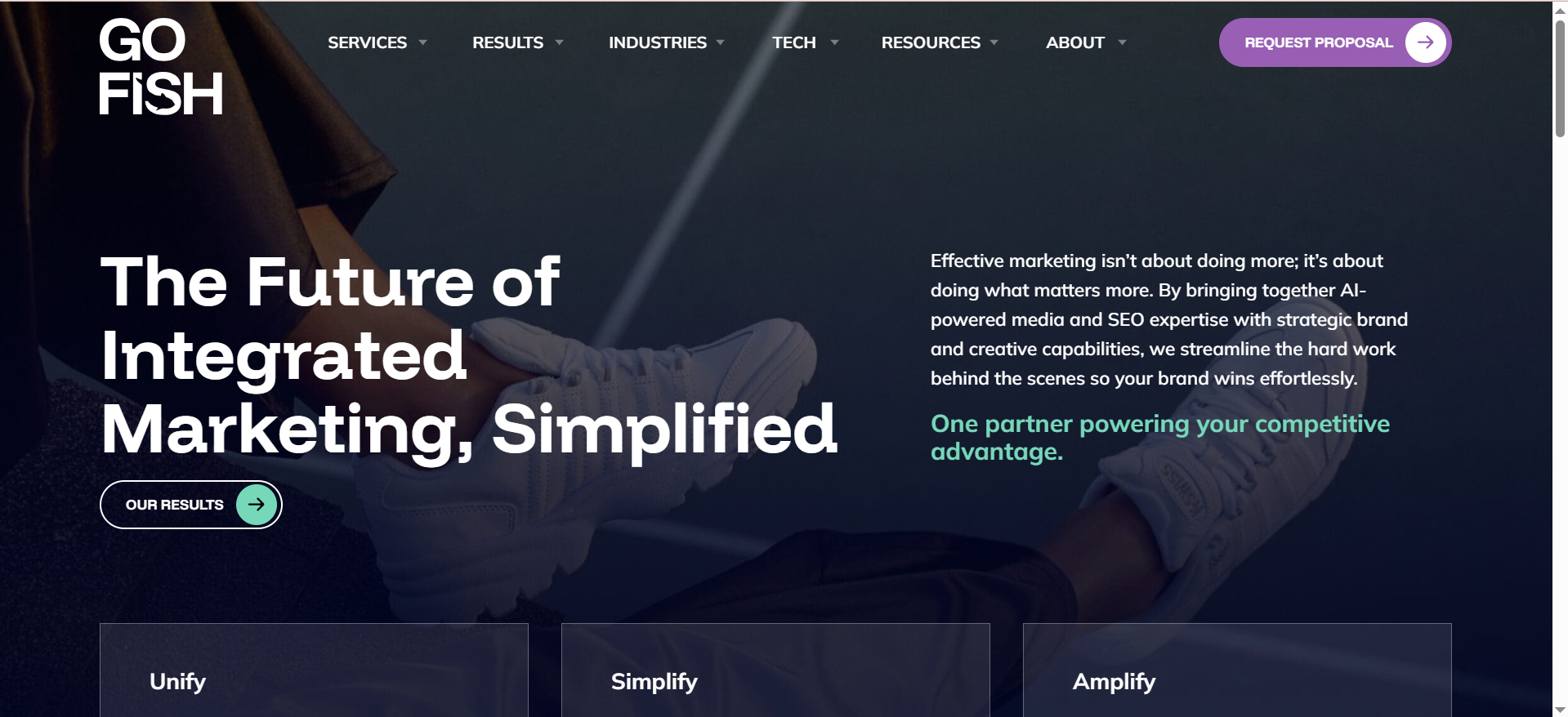
Best for: Brands that need end-to-end digital PR campaigns combining creative content with high-impact media outreach.
Go Fish Digital is a full-service, award-winning digital marketing agency that combines smart SEO with high-impact digital PR. The team builds campaigns around custom surveys, data studies, infographics, and multimedia assets, then executes expert-level media outreach to secure coverage in outlets like The New York Times, CNN, and Business Insider.
With over 15 years of experience, the agency has built a reputation for creating eye-catching content that connects brands to the current news cycle.
Key Features:
- Creative campaign production: Custom surveys, data studies, interactive content, and visual assets designed for media pickup
- High-authority placements: Consistent coverage in tier-one outlets including NYT, ESPN, Adobe, and CNN
- SEO integration: Link building and digital PR campaigns tied directly to ranking and traffic improvements
- End-to-end execution: Ideation, data research, content creation, outreach, and promotion managed in-house
Pricing: Custom retainer. Go Fish Digital serves mid-market to enterprise clients with campaign scopes typically starting at $5,000 per month.
Pros:
- Proven track record of landing placements in the highest-authority publications
- Methodical, data-driven campaign design that produces repeatable results
- Full-service execution reduces the need for multiple vendor relationships
Cons:
- Primarily US-focused, which may limit reach for brands with international PR needs
- Creative campaigns require adequate lead time for research, production, and outreach cycles
When to choose Go Fish Digital: Choose Go Fish when you need creative, data-rich campaigns that land in tier-one publications and you want a single partner managing ideation through reporting.
3. Fractl
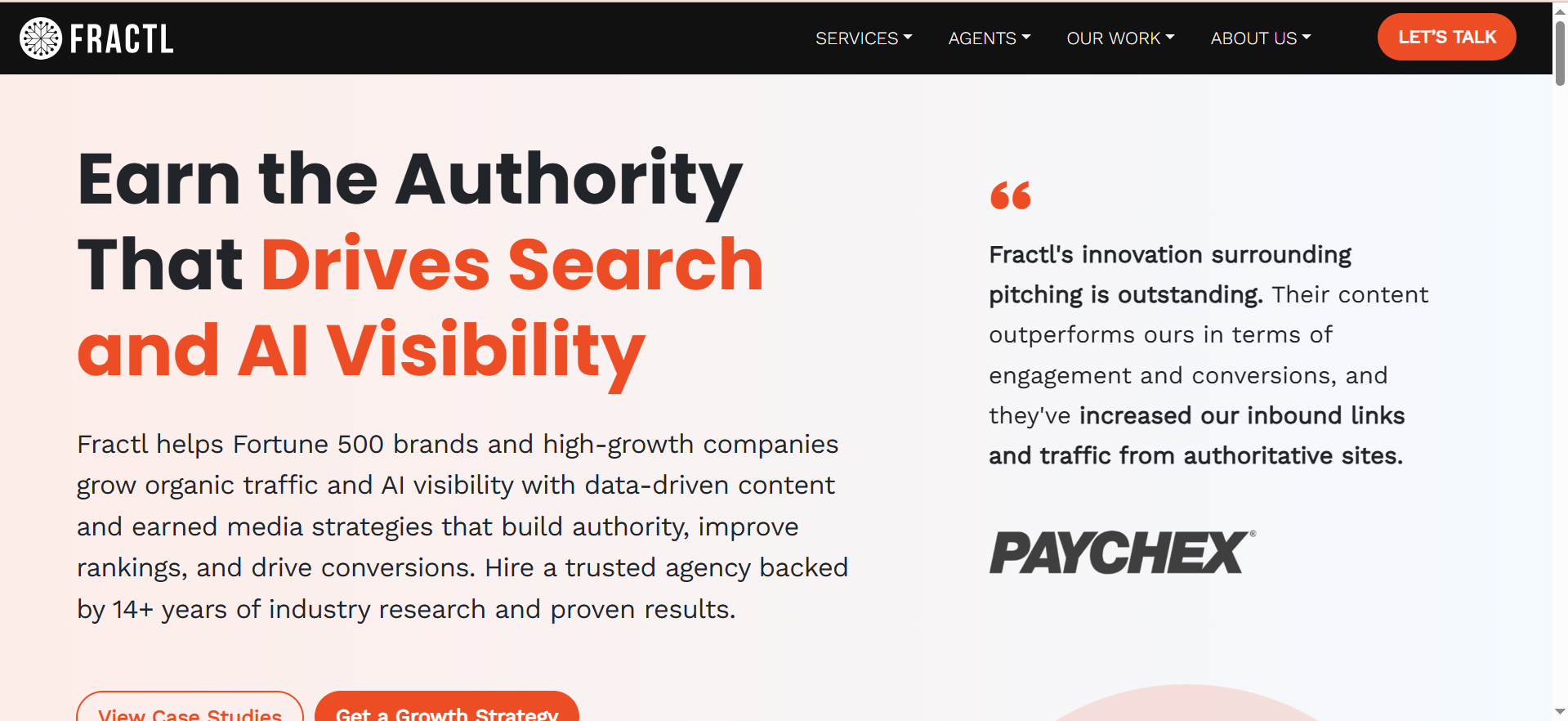
Best for: Mid-market brands that need data-driven storytelling tied to measurable organic growth and brand awareness.
Fractl is a Florida-based digital PR and content marketing agency recognized for data-driven storytelling and strategic media outreach. The agency combines original research, large-scale surveys, and data visualization with expert-level outreach to earn placements in outlets like TIME, Forbes, and Harvard Business Review.
Fractl has also invested heavily in AI-powered tools and agentic products across SEO, GEO, social media, and content, positioning itself as an innovative team on the cutting edge of AI-enabled PR.
Key Features:
- Data journalism: Original research and data-driven campaigns that generate newsworthy insights journalists want to cover
- Scalable outreach: Experienced outreach team with deep relationships across industries
- Flexible campaign structures: Campaigns adapted to different verticals, from health and fintech to higher education and B2B
- AI and automation: Early adopter of AI agents across SEO, GEO, and content workflows
Pricing: Custom retainer. Case studies indicate multi-month engagements producing measurable organic traffic and domain authority growth.
Fractl Case Study Metric
Result
Organic traffic increase (financial services, 2 years)
119.5%
Domain authority gain (financial services, 2 years)
+14.1 points
Referring domain growth (financial services, 2 years)
+421%
Pros:
- Exceptional track record of securing placements in top-tier publications
- Strong emphasis on data journalism creates highly shareable, link-worthy campaigns
- Flexible structures that adapt to different industries and campaign goals
Cons:
- Data-driven campaigns require significant research timelines, typically 4 to 8 weeks before outreach begins
- Less focused on reactive or newsjacking PR compared to agencies like Rise at Seven
When to choose Fractl: Choose Fractl when your primary objective is earning coverage through original data and research, and you need a partner with deep journalist relationships across multiple verticals.
4. Omniscient Digital
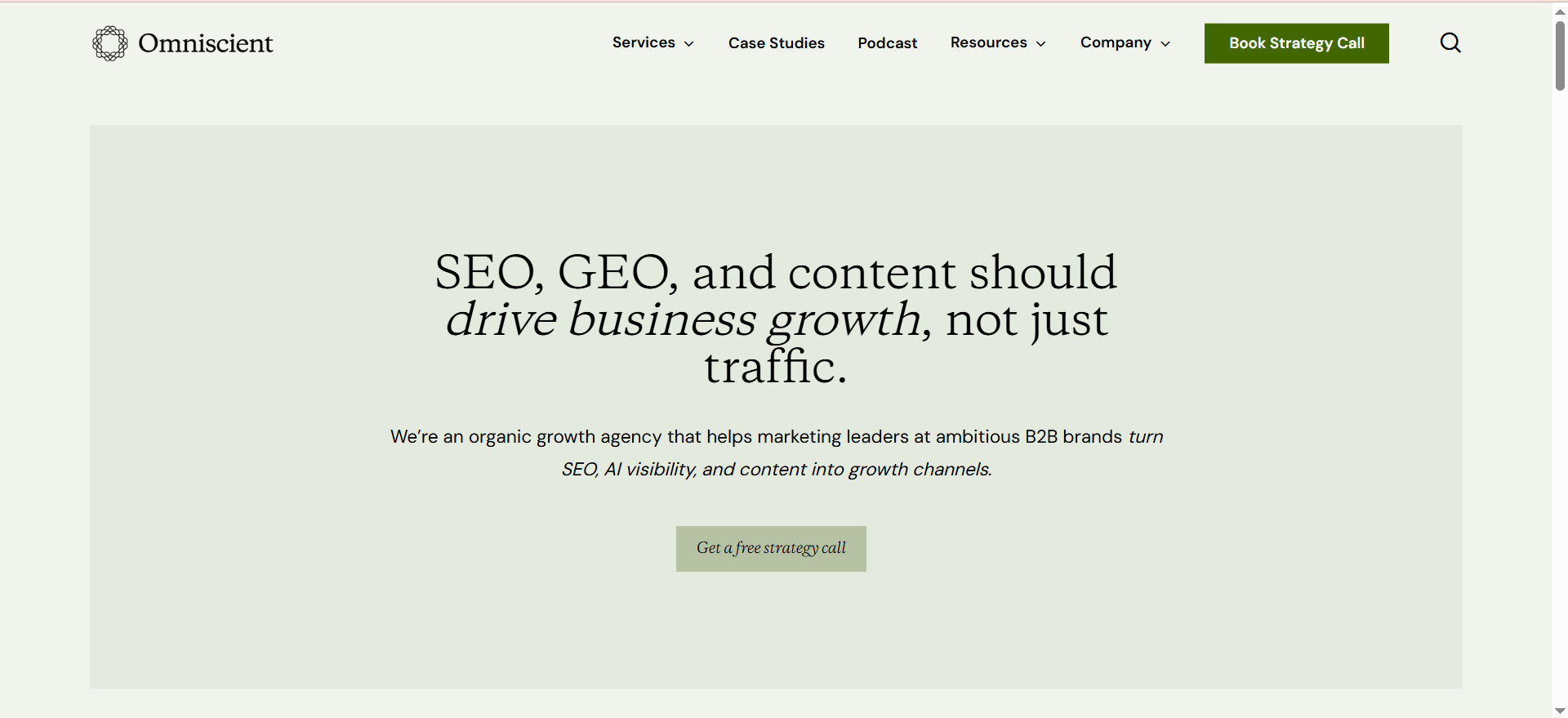
Best for: B2B companies that want digital PR integrated with a revenue-first organic growth strategy.
Omniscient Digital takes a revenue-first approach to digital PR, focusing on securing coverage that drives authority, AI visibility, and growth rather than chasing vanity metrics or shallow mentions.
The team works in cross-functional growth pods that integrate organic growth strategy with a high-octane editorial team and distribute stories, experiences, and data-driven research through off-page digital PR campaigns.
Their process combines data-driven storytelling with relationships across high-authority publications to earn placements that move the needle for B2B companies.
Key Features:
- Cross-functional growth pods: SEO, GEO, content, and PR specialists working as an integrated team
- Revenue attribution: PR outcomes tied to authority, pipeline, and revenue rather than impressions alone
- AI visibility strategy: Digital PR designed to increase brand visibility in AI answer engines
- Off-page distribution: Data studies, original research, and expert commentary placed across authoritative third-party publications
Pricing: Full-service engagements starting from approximately $10,000 per month, according to publicly available pricing data.
Pros:
- Uniquely integrated model that connects PR to organic growth and revenue metrics
- Strong B2B SaaS focus with case studies in the technology sector
- AEO and GEO awareness embedded into campaign strategy from the start
Cons:
- Minimum investment level may exclude early-stage startups with budgets under $10,000 monthly
- Best suited for B2B and technology brands rather than consumer or e-commerce verticals
When to choose Omniscient Digital: Choose Omniscient when you want a partner that treats digital PR as one gear in a broader revenue growth engine, not as a standalone tactic.
5. Linkifi
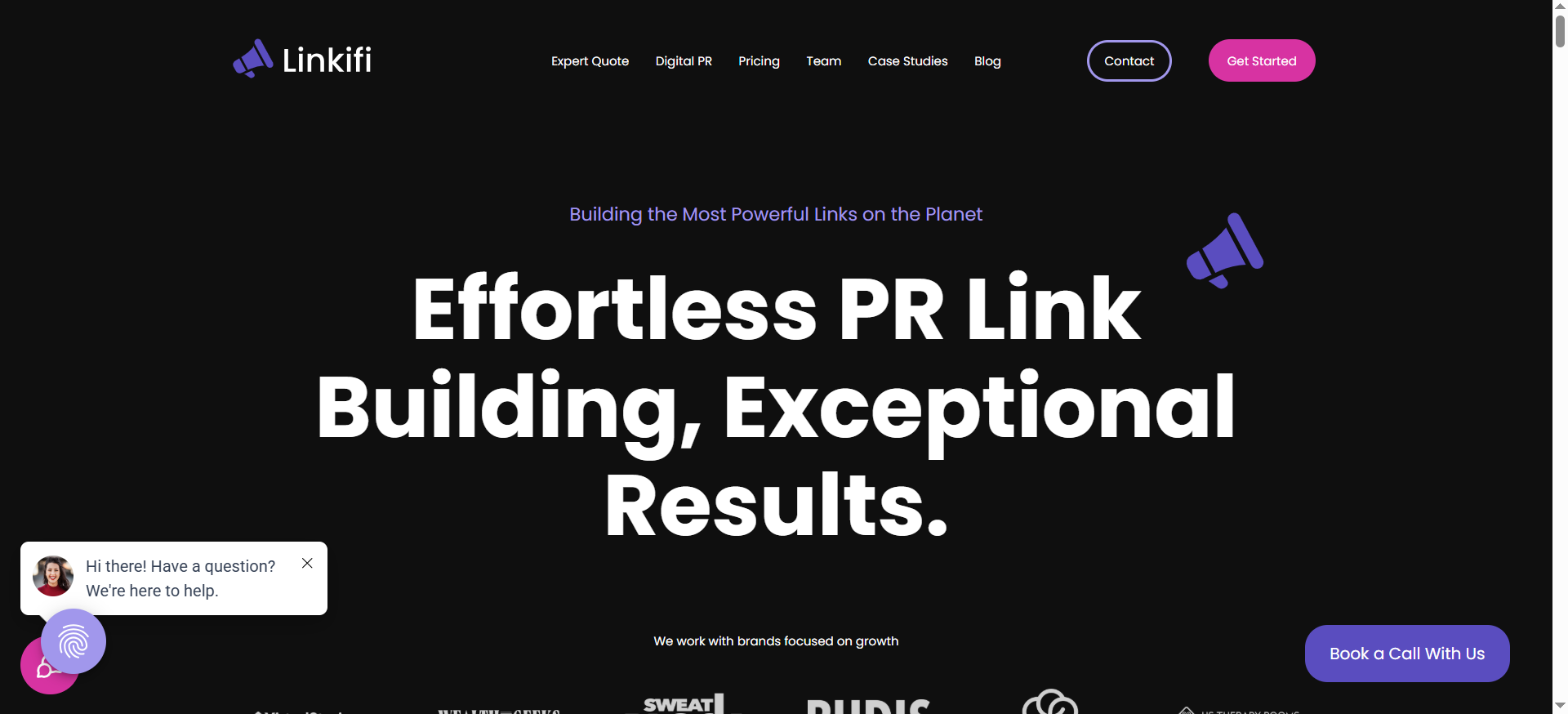
Best for: Brands that need high-authority editorial links from DR70+ publications through real-time journalist query matching.
Linkifi specializes in securing top-tier editorial coverage that positions brands as category authorities. Their core model is built around real-time inbound journalist pitching, monitoring journalist queries 24/7 and responding within minutes.
Rather than relying solely on cold outreach or viral-style campaigns, Linkifi prioritizes narrative positioning and strategic alignment between founder expertise, media demand, and publication standards.
Key Features:
- Real-time journalist monitoring: 24/7 monitoring of journalist queries with rapid response times
- High-authority focus: Targets DR70+ publications for editorial, not contributed, placements
- Authority ecosystem approach: Treats digital PR as part of a broader system designed to compound visibility over time
- Narrative positioning: Aligns founder and executive expertise with media demand
Pricing: Custom retainer. Linkifi positions as a specialist focused on quality over volume, with pricing reflecting the authority level of targeted publications.
Pros:
- Consistently lands placements in publications most agencies struggle to access
- Deep existing relationships with high-authority editors and journalists
- Focus on editorial placements, not contributed or sponsored content
Cons:
- Specialist model means fewer campaign types compared to full-service agencies
- Volume of placements may be lower than agencies running mass outreach campaigns
When to choose Linkifi: Choose Linkifi when editorial credibility and publication authority matter more than placement volume, particularly for brands in industries where trust and reputation drive conversions.
What Does a Digital PR Agency Actually Do
A digital PR agency earns media coverage, backlinks, and brand mentions through editorial outreach, data-driven campaigns, and journalist relationship management, not through paid placements or advertising.
The core function is creating newsworthy assets, namely original research, data studies, expert commentary, surveys, and interactive content, and then distributing those assets to journalists, editors, and publishers who cover relevant beats.
The outcome is editorial coverage on third-party websites that builds domain authority, strengthens backlink profiles, and generates the kind of earned mentions that both Google and AI answer engines prioritize.
The distinction from traditional PR matters for digital marketing teams. Traditional PR historically measured success through impressions, broadcast mentions, and sentiment. Digital PR measures success through acquired backlinks, referring domain growth, organic traffic improvements, and, increasingly, AI citation rates.
According to the BuzzStream State of Digital PR 2025 report, 89.6% of professionals now rate digital PR as the most effective strategy for building backlinks, and data-led campaigns are used by roughly 95% of practitioners.
| Digital PR Function | What It Produces | How It Connects to SEO |
|---|---|---|
| Data-led campaigns | Original research, surveys, indexes, benchmarks | Earns high-DR backlinks from publications covering the data |
| Expert commentary and thought leadership | Bylines, podcast appearances, journalist quotes | Builds entity authority and topical relevance signals |
| Reactive and newsjacking campaigns | Rapid-turnaround commentary tied to trending news | Generates timely backlinks and brand mentions |
| Creative content campaigns | Infographics, interactive tools, visual assets | Earns links through media pickup and social sharing |
| Press release distribution | Structured announcements on newswires | Catalyzes downstream earned coverage, though direct citation rates are low |
For teams evaluating tools to support digital PR operations, the guide to the best AI tools for digital PR and link earning covers the platforms that handle journalist discovery, pitching, monitoring, and analytics.
Digital PR Vs. Traditional PR
Digital PR focuses on earning online coverage, backlinks, and brand mentions that directly improve search visibility and AI citation rates, while traditional PR prioritizes broadcast media, print placements, and impression-based metrics.
The budget trajectory reflects this divergence. According to DemandSage's 2026 digital PR statistics, the digital PR services market is projected to reach $25.4 billion by 2032, up from $12.3 billion in 2023, while over 60% of PR teams now allocate a portion of their traditional PR budget to digital channels.
| Dimension | Traditional PR | Digital PR |
|---|---|---|
| Primary output | Broadcast mentions, print placements, event coverage | Backlinks, online coverage, brand mentions, AI citations |
| Success metrics | Impressions, ad value equivalency, sentiment | Referring domains, DR of placements, organic traffic lift, AI citation rate |
| Pricing structure | Monthly retainer, $7,500 to $50,000+ per month | Monthly retainer, $3,000 to $15,000+ per month, or performance-based |
| Speed of measurement | Weeks to months for sentiment and impression reports | Real-time link tracking, weekly ranking and traffic monitoring |
| AI search impact | Indirect, through downstream editorial coverage | Direct, earned editorial coverage accounts for 84% of AI citations |
| Typical billing rate | $278/hr average, according to the PR Council's 2025 U.S. Labor Billing Rate Report | Included in retainer or billed per placement |
The cost gap is significant.
Traditional PR retainers at established firms start at $7,500 to $50,000 per month according to O'Dwyer's annual agency survey, while digital PR retainers average $5,000 to $10,000 per month.
The critical difference is measurement. Digital PR teams can track every placement, every link, and every ranking improvement, while traditional PR often reports on estimated impressions and qualitative sentiment.
How Much Do Digital PR Services Cost in 2026
Most digital PR programs cost between $3,000 and $10,000 per month, with a market-average monthly contract of $5,458 across all respondents, according to BuzzStream's dedicated digital PR cost survey. Agencies charge approximately 50% more than freelancers on average, with agencies at $6,357 versus $4,200 for freelance consultants, reflecting the added investment in creative production, team depth, and reporting infrastructure.
| Digital PR Pricing Model | Typical Range (2026) | What You Get |
|---|---|---|
| Monthly retainer (agency) | $5,000 to $15,000/mo | Ongoing campaigns, journalist relationships, creative production, reporting |
| Monthly retainer (freelancer) | $3,000 to $6,000/mo | Outreach, pitching, and relationship management with leaner creative |
| Performance-based or pay-per-link | $400 to $800 per secured placement | Payment tied to delivered links, with authority thresholds varying by provider |
| Project-based campaigns | $5,000 to $25,000 per project | One-time campaigns for product launches, data studies, or seasonal pushes |
| Enterprise retainer | $15,000 to $50,000+/mo | Global coordination, proprietary research, crisis management, and executive positioning |
Budget allocation patterns are shifting upward. BuzzStream's 2026 data shows that budgets above $20,000 per month more than doubled year over year, growing from 4% to 8.8%, while sub-$5,000 budgets shrank from 34.1% to 25.7%.
According to Editorial.link's 2026 survey, the average acceptable price for acquiring one high-quality backlink is $508.95, and 80.9% of SEO specialists believe link-building costs will continue rising over the next two to three years.
The pricing model you select affects incentives. Retainer models provide stability and allow agencies to invest in relationship building, creative ideation, and long-term authority campaigns. Performance-based models align payment with outcomes, but can incentivize agencies to prioritize scalable, lower-authority placements over strategic, high-authority editorial wins. Understanding these tradeoffs is essential before signing any engagement.
For teams building their SEO and PR budgets, the B2B SaaS content benchmarks provide data on how long organic investments take to compound and what performance to expect at each stage.
How Digital PR Drives AI Search Visibility
Digital PR is the only link-building strategy that simultaneously builds the two signals AI search engines use to decide which brands to cite, namely backlinks and brand mentions.
Muck Rack's longitudinal Generative Pulse study found that earned media has consistently accounted for 82% to 89% of AI citations across three editions from July 2025 to May 2026, with journalism alone making up 25% to 27% of cited sources. Paid and advertorial content accounts for 0.3%.
| AI Citation Pattern | Finding | Source |
|---|---|---|
| Share of citations from earned media | 84% (May 2026 edition) | Muck Rack Generative Pulse, May 2026 |
| Share from paid and advertorial content | 0.3% | Muck Rack Generative Pulse, May 2026 |
| Journalism share of all cited sources | 27% (stable across three editions) | Muck Rack Generative Pulse, May 2026 |
| Brand mention correlation with AI visibility | 3x stronger than backlinks (0.664 vs. 0.218) | Ahrefs, 75,000-brand study, 2025 |
| Content recency and citation rate | Highest citation rate within 7 days of publication | Muck Rack, December 2025 |
| AI citations from top 10 organic SERP results | Only 12%, meaning 88% come from outside the traditional top 10 | Moz, 2026 analysis of 40,000 queries |
The Ahrefs study of 75,000 brands found that brand web mentions correlate approximately 3x more strongly with AI Overview visibility than backlinks alone. This means that digital PR campaigns generating branded editorial coverage, not just links, have outsized impact on whether AI engines recommend your brand.
Executing this well is exactly the gap The Rank Masters closes for B2B SaaS teams, building an ICP-led content system that maps each topic cluster to a money page and to pipeline, rather than publishing posts that never convert.
The AI search visibility audit tools guide covers how to measure your current AI citation baseline and identify where coverage gaps exist.
How to Choose a Digital PR Agency
The right digital PR agency depends on whether you need creative campaigns, editorial authority, technical SEO integration, or a full-service growth partner. Start by defining your primary objective, whether that is link acquisition, brand awareness, AI visibility, or a combination, and then match agencies to that goal rather than evaluating on pricing alone.
| Decision Factor | What to Evaluate | Red Flags |
|---|---|---|
| Campaign methodology | Does the agency explain how it generates ideas, builds assets, and earns coverage? | Vague claims about "proprietary outreach" without specifics |
| Placement quality | What is the average domain rating of earned placements? What publications appear in case studies? | Heavy reliance on contributed or sponsored content rather than earned editorial |
| Measurement and reporting | Does the agency connect PR activity to SEO metrics, namely backlinks, traffic, rankings, and AI citations? | Reporting limited to impressions, estimated ad value, or coverage volume |
| Link guarantees | Does the agency guarantee a specific number of links? If so, what quality thresholds apply? | Guarantees without authority thresholds or with heavy reliance on guest posts |
| Vertical expertise | Has the agency delivered results in your industry with comparable brands? | Generic case studies without verifiable metrics or named clients |
| AI visibility awareness | Does the agency account for how AI answer engines cite sources? | No awareness of GEO, AI citations, or the earned media dynamics shaping AI search |
According to Bright Valley Marketing's 2025 survey of 500 business leaders, the top priorities when choosing a digital PR partner are results at 42%, clear communication at 31%, reporting and analytics at 16%, and industry expertise at 11%. That ordering suggests buyers value demonstrated outcomes and transparent communication over credentials and specialization, though the best agencies deliver on all four.
For teams building the complementary internal toolkit for managing outreach, link tracking, and media monitoring, the right software stack amplifies whatever agency you select.
Digital PR Campaign Types and When to Use Each
The most effective digital PR programs combine multiple campaign types rather than relying on a single approach. Data-led campaigns dominate the industry, used by approximately 95% of practitioners according to the Reporter Outreach State of Link Building 2026 report, but the strongest agencies layer reactive PR, thought leadership, and creative content alongside data-driven work.
| Campaign Type | How It Works | Best For | Typical Timeline |
|---|---|---|---|
| Data-led campaigns | Original surveys, benchmarks, or data analysis packaged for journalist outreach | Earning tier-one placements and high-DR links | 4 to 8 weeks |
| Expert commentary | Executive or expert quotes provided to journalists covering relevant beats | Building entity authority and thought leadership signals | Ongoing, opportunistic |
| Reactive and newsjacking | Rapid-response commentary or data tied to breaking news or trending topics | Timely coverage and fast link acquisition | Hours to 48 hours |
| Hero content campaigns | Large-scale interactive tools, infographics, or visual assets designed for mass outreach | Generating volume of links and social shares | 6 to 12 weeks |
| Product-led digital PR | Campaigns built around proprietary product data, features, or user insights | SaaS and technology brands with unique first-party data | 4 to 6 weeks |
The balance between campaign types should match your brand's stage and objectives. Early-stage companies often benefit most from reactive PR and expert commentary, which require lower production budgets and can generate quick wins. Established brands with larger budgets can invest in hero content and data-led campaigns that produce higher volumes of high-authority links.
For brands still building internal content foundations, the best tools for media monitoring and brand mentions help teams track where coverage lands and identify unlinked mentions that can be converted to backlinks.
How to Measure Digital PR ROI in 2026
Digital PR ROI should be measured through backlink quality, organic traffic improvements, ranking changes, and increasingly, AI citation rates, not through impression estimates or ad value equivalency. The industry is moving toward measurement maturity, but gaps remain. According to BuzzStream's 2026 data, 39.2% of professionals still do not track their cost per link, down from 51.4% a year earlier but still a significant blind spot.
| ROI Metric | What It Measures | How to Track It |
|---|---|---|
| Cost per link (CPL) | Average spend per earned backlink, benchmarked at $597 per the BuzzStream 2025 survey | Total campaign spend divided by total earned links meeting quality thresholds |
| Average domain rating of placements | Authority quality of publications where coverage lands, benchmarked at DR 61 per Reboot Online data | Ahrefs or Semrush backlink reports filtered by campaign period |
| Organic traffic lift | Incremental sessions driven by improved rankings after PR-earned links | GA4 segmented by landing pages targeted in campaigns |
| AI citation rate | Frequency of brand mentions in AI engine responses for target queries | AI visibility monitoring tools, such as those in the GEO prompt monitoring tools guide |
| Branded search lift | Increase in searches for your brand name following media coverage | Google Search Console filtered by branded queries |
| Referring domain growth | Net new referring domains added during campaign period | Ahrefs or Semrush domain-level backlink reports |
The most credible measurement connects PR activity to commercial outcomes. Earned editorial placements produced a 31% lead-to-close rate versus 12% for paid advertising and 8% for wire distribution, according to the Baden Bower 2026 Report.
That 31% close rate reflects the trust premium that editorial coverage carries, namely readers who arrive through earned media coverage already believe the source is credible, which accelerates conversion.
For teams tracking AI visibility specifically, the AI visibility tools for competitor benchmarking guide covers how to monitor share of voice across ChatGPT, Perplexity, and Google AI Overviews.
Digital PR for B2B SaaS Brands
B2B SaaS companies face a specific challenge with digital PR. Their products are complex, their buying cycles are long, and their target audience, namely founders, CMOs, and heads of growth, researches extensively across Google, AI answer engines, and comparison workflows before engaging with a vendor. Digital PR for SaaS must connect media coverage to the discovery pathways these buyers actually use.
The most effective SaaS digital PR agencies build campaigns that earn coverage in the publications, review sites, and industry outlets that both Google and AI models trust. This means targeting placement in publications like TechCrunch, VentureBeat, and vertical-specific trade media, rather than generalized consumer outlets that carry less weight in B2B buyer
| SaaS Digital PR Priority | Why It Matters | Agencies That Excel |
|---|---|---|
| Category authority | SaaS buyers research categories before they research vendors, so appearing in "best [X]" and comparison content is critical | Omniscient Digital, Siege Media, Grizzle |
| AI citation in buyer queries | 94% of B2B buyers now use AI in their purchasing process, making AI citation a direct revenue variable | Siege Media, Omniscient Digital |
| Thought leadership | Executive visibility builds trust and shortens sales cycles when prospects already recognize founders | Linkifi, Edelman |
| BOFU comparison coverage | Bottom-of-funnel content that includes your brand in category comparisons drives qualified traffic | Grizzle, Fractl |
Executing this well across content, SEO, and PR requires a system-level approach rather than isolated campaign bursts. The Rank Masters builds exactly this kind of ICP-led content system for B2B SaaS teams, connecting topic clusters to money pages and pipeline so that digital PR wins compound rather than evaporate after a single coverage cycle.
The enterprise SEO agencies guide provides additional context on how to evaluate partners that combine content, PR, and technical SEO.
Common Mistakes When Hiring a Digital PR Agency
The biggest mistakes brands make when hiring a digital PR agency are prioritizing cost over quality, ignoring measurement gaps, and treating PR as a one-time campaign rather than an ongoing authority-building function. Avoiding these errors starts with asking the right questions during evaluation.
- Choosing based on link volume guarantees without authority thresholds: An agency promising 50 links per month at $3,000 is almost certainly delivering low-authority, contributed, or syndicated placements that carry minimal SEO or AI citation value
- Ignoring AI visibility entirely: According to Muck Rack's State of AI in PR 2026, 76% of PR professionals now use generative AI in their work, and 66.2% of practitioners track AI citations as a KPI. Agencies that do not account for AI search dynamics are building on an incomplete strategy
- Treating digital PR as separate from content and SEO: The most effective programs integrate PR with content strategy, technical SEO, and conversion optimization. Isolated PR campaigns produce links that decay if the underlying content and site structure are not maintained
- Failing to verify case study claims: Ask for named clients, verifiable metrics, and specific publications. Generic claims of "hundreds of placements" without domain ratings, traffic data, or named outlets should raise questions
- Expecting overnight results: According to the Reporter Outreach survey, 85.2% of digital PR campaigns produce measurable results within 3 to 6 months. Meaningful authority building is a compounding investment, not a quick fix