

TL;DR
When you run an agency, brand monitoring is not optional — it is the infrastructure that lets you protect client reputations, catch negative press before it spirals, and prove the value of your work with real data. The problem is that most brand monitoring tools were built for in-house teams managing one brand, not agencies juggling ten or twenty client accounts at once. That changes the math on everything from pricing and seat limits to dashboard flexibility and reporting.
After researching and comparing the leading platforms, the five tools worth shortlisting in 2026 are Brand24 for mid-market agencies that need strong AI analysis without enterprise pricing, Mention for smaller teams that prioritize real-time alerts and speed, Sprout Social for agencies that want social management and monitoring unified in one platform, Meltwater for agencies that need traditional media coverage alongside digital monitoring, and Brandwatch for large agencies running deep consumer intelligence at scale. This guide breaks down each tool's features, pricing, strengths, and limitations so you can match the right platform to your agency's actual workflow.
Best Brand Monitoring Tools for Agencies (Quick Comparison)
| Tool | Best For | Starting Price | Key Strength |
|---|---|---|---|
| Brand24 | Mid-market agencies wanting AI-driven insights | $79/mo (Individual) | AI-powered anomaly detection and sentiment analysis |
| Mention | Teams needing real-time alerts and media monitoring | $599/mo (Company) | Fastest real-time mention alerts with Boolean search |
| Sprout Social | Agencies unifying social management and monitoring | Agencies unifying social management and monitoring | All-in-one social management with built-in listening |
| Meltwater | Agencies tracking traditional and digital media | Custom (~$25K/yr median) | Strongest traditional media coverage (TV, radio, print) |
| Brandwatch | Large agencies running consumer intelligence at scale | Custom (~$800+/mo basic) | 100M+ sources with image and logo recognition |
Tool #1: Brand24
What It Does
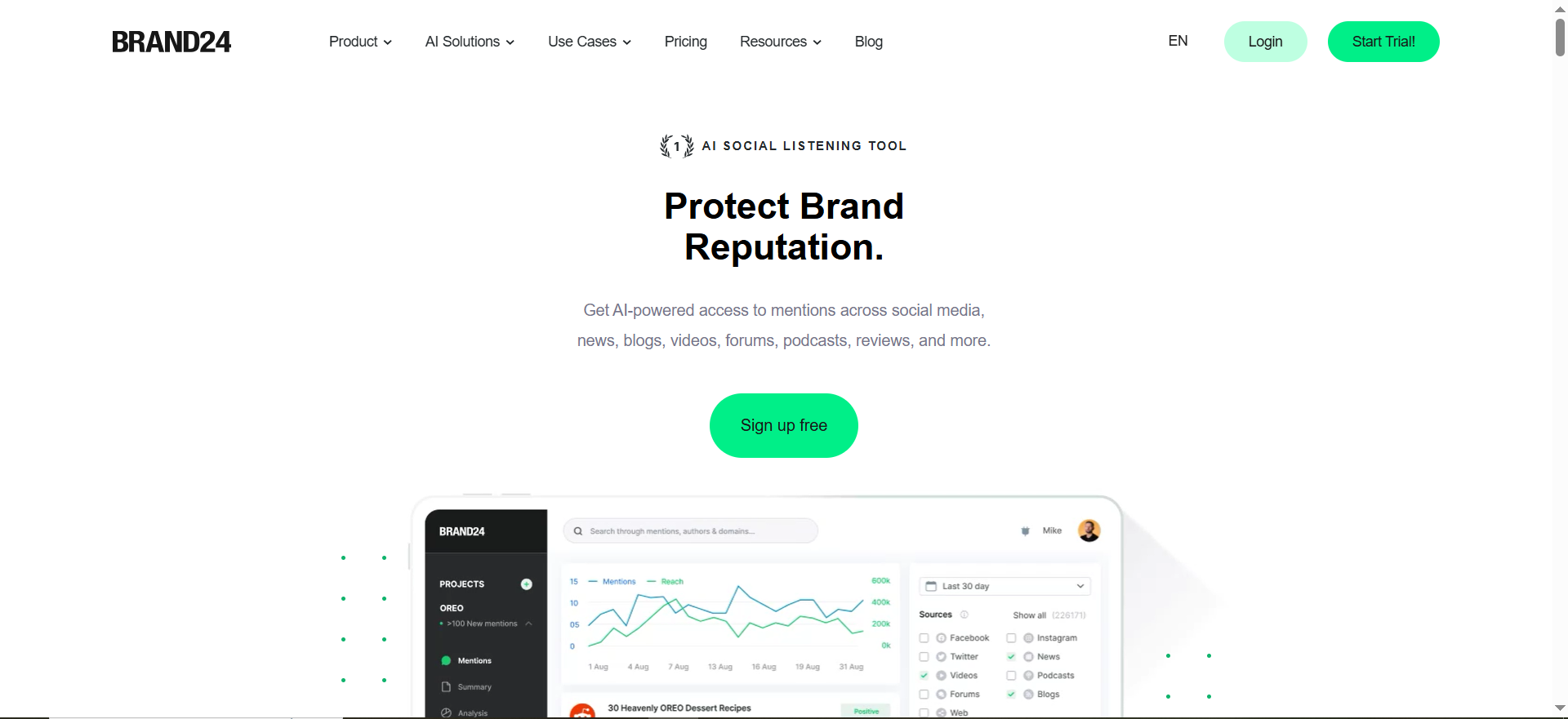
Brand24 is a social listening and brand monitoring platform that tracks mentions of your brand, competitors, or any keyword across social media, news sites, blogs, forums, podcasts, and review platforms. It uses AI to analyze sentiment, detect anomalies in mention volume, and generate summaries that save hours of manual analysis. In 2026, Brand24 also tracks how AI chatbots like ChatGPT, Claude, Gemini, Perplexity, and Grok mention and recommend brands — a capability that is becoming increasingly relevant as consumers shift research behavior toward AI tools.
Why Teams Use It
Agencies choose Brand24 because it hits a balance between depth and accessibility. The platform provides enterprise-grade features like AI-driven topic analysis and anomaly detection without requiring enterprise-grade budgets or dedicated analysts to run it. The learning curve is manageable, which matters when you are onboarding junior team members who need to monitor client accounts without weeks of training.
What It Is Good For
Brand24 excels at real-time mention tracking with instant alerts via email or Slack, AI-powered sentiment analysis that categorizes mentions as positive, negative, or neutral automatically, automated PDF reporting that can be scheduled and sent directly to client stakeholders, competitive benchmarking to show clients how their share of voice compares to competitors, and influencer identification to surface high-reach accounts that are already talking about a client's brand.
When It Is a Good Fit
Brand24 works best for mid-market agencies managing five to twenty client accounts that need solid monitoring without the budget for enterprise platforms. If your agency serves clients in B2B SaaS, e-commerce, or professional services — and your clients care about online reputation and social sentiment — Brand24 delivers the data you need at a price point that makes the engagement profitable.
When It Is Not a Good Fit
Brand24 falls short if your agency needs deep traditional media monitoring (TV, radio, print) — that is not its strength. It also lacks the data volume and historical depth that enterprise platforms like Brandwatch or Meltwater provide. If you manage Fortune 500 accounts that require analysis across hundreds of millions of data points with years of historical context, Brand24 will feel limiting.
How to Use It
Set up projects for each client with relevant keywords including brand name, product names, key executives, and competitor names. Configure Boolean queries to filter out irrelevant mentions, such as common word overlaps. Set up automated alerts through Slack or email so your team catches spikes in negative sentiment within minutes. Schedule weekly or monthly PDF reports to go directly to client contacts, reducing the manual reporting burden on your team. Use the AI summary feature to generate quick executive briefings before client calls.
Key Capabilities
Brand24 covers mentions across social media platforms (Facebook, Instagram, X, LinkedIn, TikTok, YouTube, Reddit, Telegram, Twitch), news sites, blogs, forums, podcasts, review sites, and AI chatbot responses. AI features include sentiment analysis, anomaly detection, topic analysis, and AI-generated summaries. The platform offers geolocation and language filters, which are particularly useful for agencies with clients operating in multiple markets. Native integrations include Slack and Zapier, plus an API for custom workflows.
Pricing
Brand24 uses per-keyword pricing billed monthly or annually. The Individual plan starts at $79 per month and covers basic monitoring with limited keywords. The Team plan runs $249 per month, adding unlimited mentions, more keywords, and features like white-label reports. The Professional plan costs $599 per month with full AI features and expanded keyword slots. Enterprise pricing is custom for agencies with high-volume needs. All plans come with a 14-day free trial.
Free Tier?
No free plan. Brand24 offers a 14-day free trial with full access to test the platform before committing.
Downsides and Limitations
Brand24 does not cover traditional media like TV, radio, or print publications. Historical data depth is limited compared to enterprise platforms — you typically get data from the point you start tracking, not years of backfilled history. The per-keyword pricing model can get expensive quickly for agencies monitoring dozens of client brands and competitors. White-label reporting is only available on higher tiers, which adds cost for agencies that want to present reports under their own brand.
Tool #2: Mention
What It Does
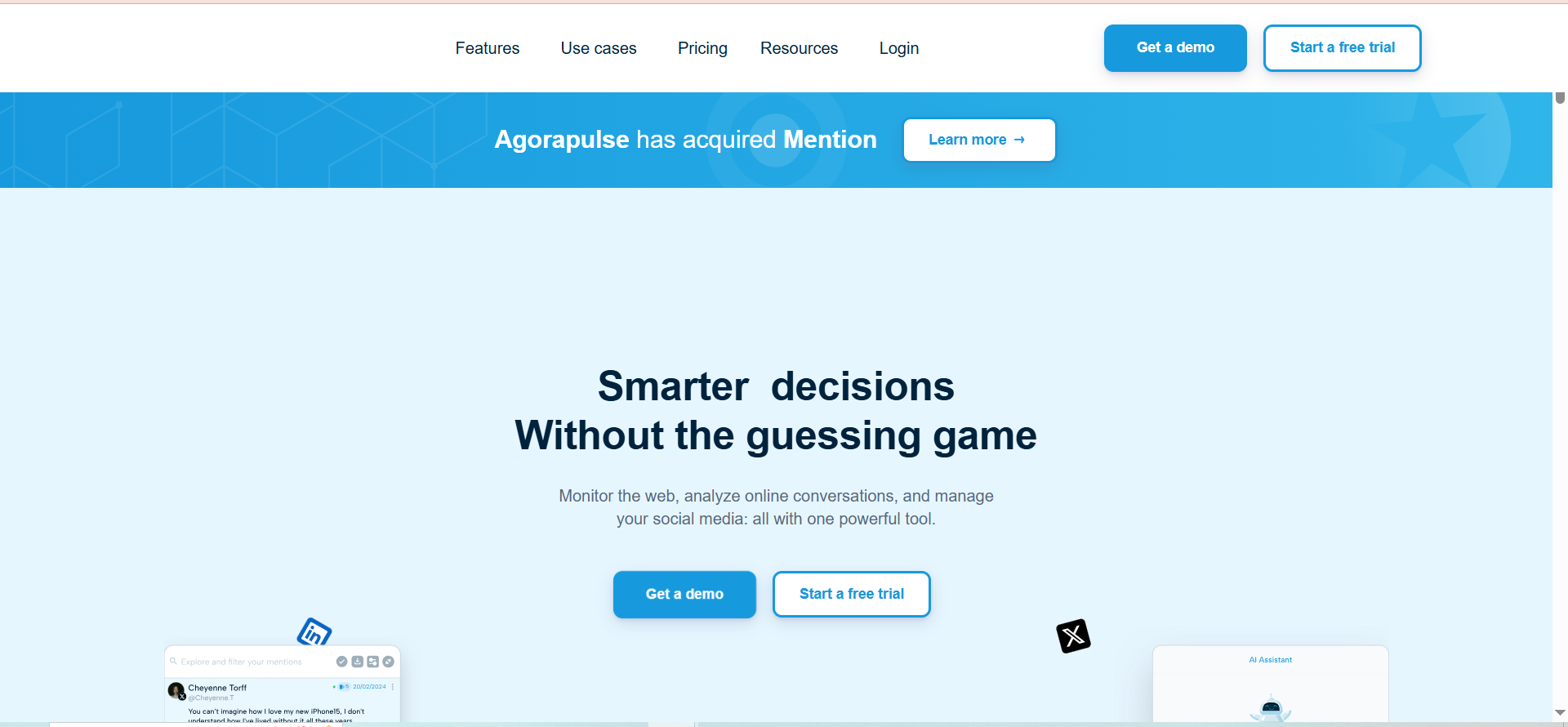
Mention is a real-time media monitoring tool that tracks brand mentions across the web, social media, forums, blogs, and news sources. The platform is built for speed — alerts arrive within minutes of publication, making it one of the fastest monitoring tools available. Mention also includes competitive tracking, influencer identification, and Boolean search operators for precise query building.
Why Teams Use It
Agencies pick Mention when real-time responsiveness is the priority. If your clients operate in fast-moving industries where a negative review, a viral complaint, or a competitor announcement needs to be caught and addressed within minutes rather than hours, Mention's alert speed is its biggest selling point. The interface is clean and straightforward, which means less training time for account managers who need to monitor client brands daily.
What It Is Good For
Mention is strong at instant alert delivery so your team knows about brand mentions within minutes of publication, Boolean search operators that let you build highly specific queries to filter out noise and surface only relevant mentions, side-by-side competitive monitoring that lets you benchmark client brands against competitors, and influencer identification that automatically flags high-influence sources mentioning client brands.
When It Is a Good Fit
Mention works well for small to mid-sized agencies managing three to ten client accounts where real-time responsiveness matters more than deep historical analysis. It is particularly effective for agencies in PR, crisis communications, or social media management where the speed of response directly affects client outcomes. At $599 per month for the Company plan, Mention is positioned as a mid-market option for agencies with established monitoring budgets.
When It Is Not a Good Fit
Mention is not ideal for agencies that need deep analytics, historical trend analysis, or AI-driven consumer intelligence. The platform prioritizes speed and simplicity over analytical depth. If your agency's value proposition centers on strategic insights derived from months or years of conversation data, Mention will not provide the analytical horsepower you need. It also lacks robust traditional media monitoring.
How to Use It
Create separate alerts for each client brand, including variations in spelling, common misspellings, and competitor names. Use Boolean operators (AND, OR, NOT) to refine queries and reduce noise — for example, excluding mentions of a brand name that overlaps with a common word. Set up real-time notifications via email or Slack for each account manager responsible for a client. Use the competitive tracking dashboard to prepare monthly competitive landscape reports. Export data or connect through Zapier to feed mention data into client-facing dashboards or CRM systems.
Key Capabilities
Mention monitors web pages, social media (Facebook, X, Instagram, LinkedIn, Reddit), news sites, blogs, forums, and review platforms. The platform supports monitoring in multiple languages, which is valuable for agencies with international clients. Features include real-time alerts, Boolean search, competitive tracking, sentiment analysis, influencer scoring, and data export. API access is available for custom integrations.
Pricing
As of mid-2025, Mention consolidated its pricing around a single Company plan starting at $599 per month on an annual contract. The legacy Solo ($41 per month), Pro, and Pro Plus tiers are no longer available to new customers. The Company plan is built for businesses that need advanced listening capabilities with high mention volume, custom alerts, and dedicated support. Custom pricing is available for agencies with specific data volume and feature requirements.
Free Tier?
No free plan is currently available for new customers. Mention previously offered a free tier and lower-cost Solo plan, but these have been discontinued for new signups as of mid-2025. Contact Mention directly to inquire about trial access for the Company plan.
Downsides and Limitations
Mention's analytics are relatively shallow compared to platforms like Brandwatch or Meltwater. The platform does not offer deep AI-driven consumer intelligence or image recognition. With the consolidation to a single Company plan at $599 per month, Mention no longer offers an accessible entry point for smaller agencies — the legacy Solo and Pro tiers have been discontinued for new customers. The platform does not cover traditional media (TV, radio, print). Historical data access is limited compared to enterprise platforms.
Tool #3: Sprout Social
What It Does
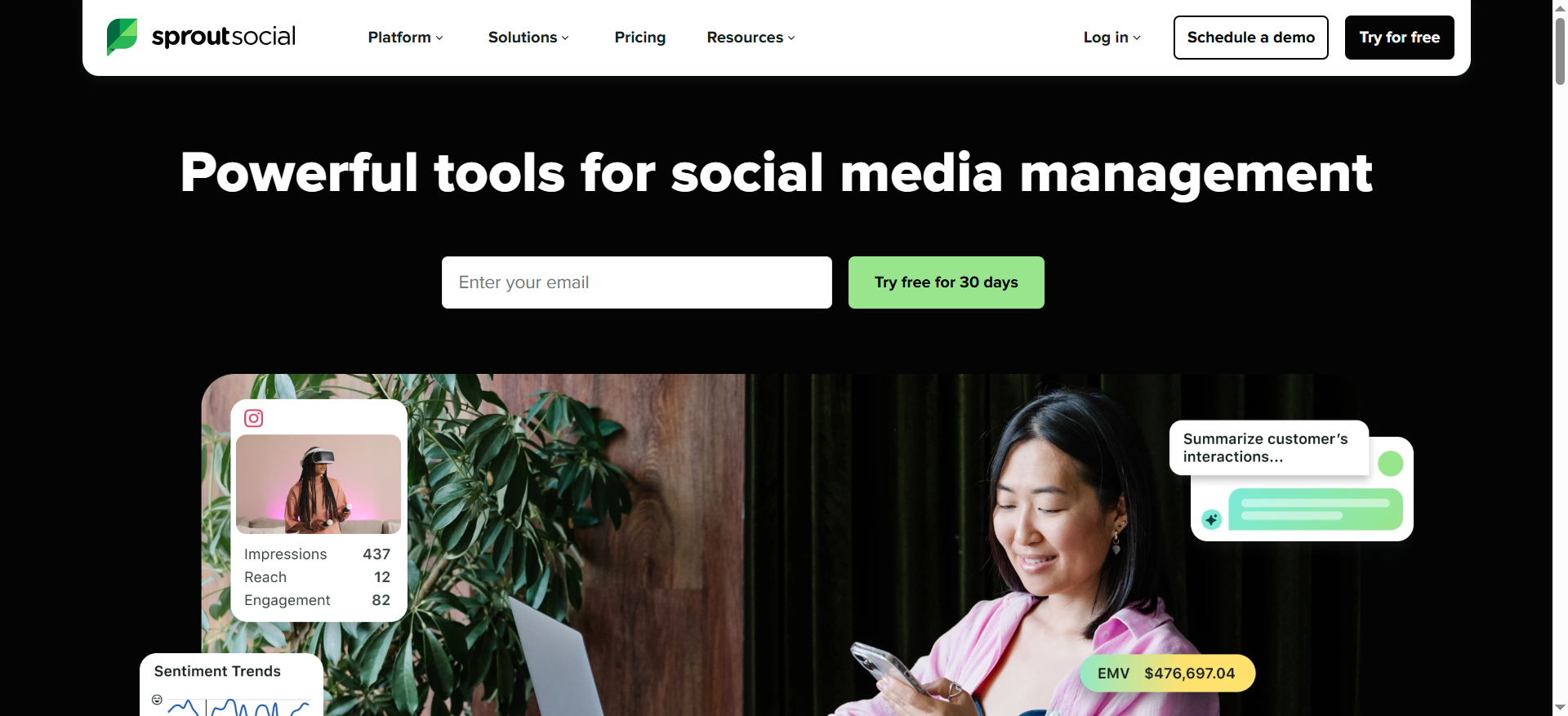
Sprout Social is a comprehensive social media management platform that includes publishing, engagement, analytics, and social listening capabilities in a single tool. For agencies, this means you can schedule posts, respond to comments and DMs, run competitive reports, and monitor brand mentions — all from one dashboard. The social listening add-on extends monitoring beyond owned channels to track broader conversations, sentiment trends, and industry topics across social and web sources.
Why Teams Use It
Agencies choose Sprout Social because it eliminates the need to juggle separate tools for social publishing and brand monitoring. When your team is already using Sprout to schedule content and manage engagement, adding the listening module means brand monitoring data sits right next to the content calendar and inbox. This workflow integration reduces context switching, speeds up response times, and makes it easier to connect monitoring insights to content strategy in a single report.
What It Is Good For
Sprout Social excels at unified social management where publishing, engagement, and monitoring live in one platform, Smart Inbox that consolidates messages, mentions, and comments from every connected profile into a single stream, competitive reporting that benchmarks client performance against competitors with ready-to-share reports, team collaboration features including approval workflows, task assignments, and user roles designed for agency structures, and multi-platform support covering Facebook, Instagram, X, LinkedIn, Pinterest, YouTube, TikTok, and Google Business Profile.
When It Is a Good Fit
Sprout Social is the right choice for agencies that already use or plan to use a social media management tool and want monitoring integrated into the same workflow. It works particularly well for agencies managing five to fifteen client accounts where the per-user pricing model still makes economic sense. If your agency's deliverables include monthly social performance reports alongside brand sentiment analysis, Sprout Social lets you pull both from one source.
When It Is Not a Good Fit
Sprout Social becomes expensive quickly for larger agencies because of its per-user pricing model. If you have fifteen account managers, each needing access, the monthly cost adds up fast. The social listening add-on is priced separately and can add $2,000 to $8,000 per year depending on topic volume. Sprout Social also does not cover traditional media — it is focused on social and web sources. Agencies that need deep, enterprise-grade consumer intelligence or media monitoring across TV, radio, and print should look elsewhere.
How to Use It
Connect all client social profiles to Sprout Social and organize them into client groups. Use the Smart Inbox to monitor and respond to client mentions in real time. Set up the social listening module with brand keywords, competitor names, and industry topics for each client. Build custom reporting templates for each client that combine publishing metrics, engagement data, and listening insights into a single deliverable. Use the approval workflow feature to route client-facing responses through a review step before they go live.
Key Capabilities
Sprout Social covers all major social platforms plus Google Business Profile. The Smart Inbox aggregates messages, mentions, and comments across all connected profiles. Social listening tracks brand mentions, sentiment, and trends across social and web sources. Reporting includes competitive analysis, audience demographics, and engagement metrics. The platform supports team roles, approval workflows, content calendars, and asset libraries. AI Assist helps with content drafting and tone adjustment.
Pricing
Sprout Social uses per-user monthly pricing billed annually. The Standard plan costs $199 per user per month with 5 social profiles, unlimited scheduling, Smart Inbox, keyword monitoring, and basic reporting. The Professional plan runs $299 per user per month, unlocking unlimited social profiles, competitive reports, paid social insights, and AI Assist. The Advanced plan costs $399 per user per month, adding sentiment analysis, automated chatbots, and customizable reporting. Social listening is an add-on priced at $2,000 to $8,000 per year depending on topic volume. Annual billing is required for all plans.
Free Tier?
No free plan. Sprout Social offers a 30-day free trial to test the platform.
Downsides and Limitations
Per-user pricing makes Sprout Social one of the most expensive options for larger agency teams. Social listening is a separate add-on cost on top of the base subscription. The platform does not cover traditional media. Data depth and historical analysis are more limited compared to dedicated monitoring platforms like Brandwatch or Meltwater. The listening module's source coverage is narrower than standalone social listening tools.
Tool #4: Meltwater
What It Does
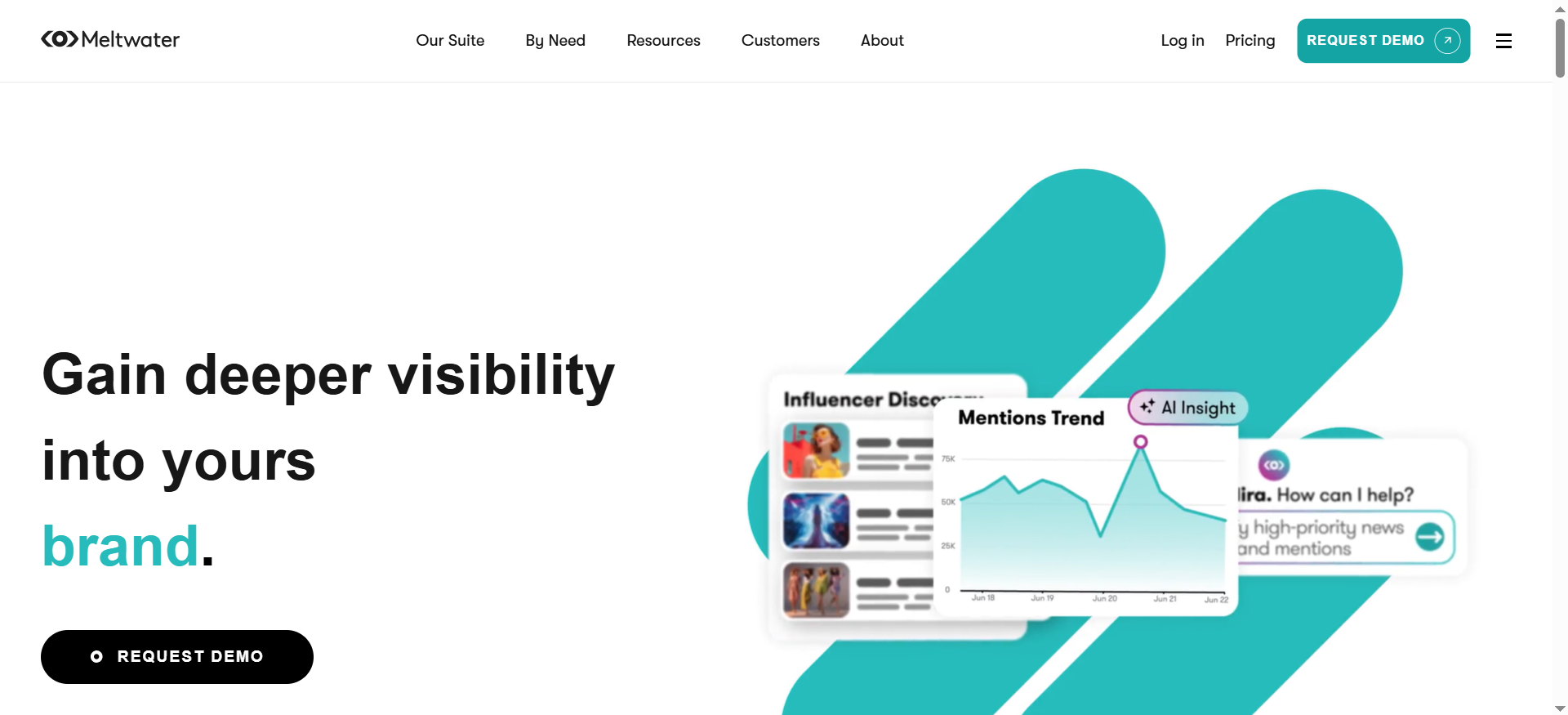
Meltwater is an enterprise media intelligence platform that combines social listening, traditional media monitoring, and PR analytics in a single system. It monitors over 6 million media sources including news outlets, social media platforms, blogs, forums, podcasts, TV broadcasts, radio, and print publications. Meltwater is one of the few platforms that bridges the gap between digital monitoring and traditional media tracking, making it the go-to choice for agencies that need a complete view of client coverage across every channel.
Why Teams Use It
Agencies use Meltwater when clients care about traditional media coverage as much as social mentions. If your client gets coverage in Bloomberg, the Wall Street Journal, or industry trade publications — and they need that tracked alongside their social media presence — Meltwater is the platform that does both without requiring a second tool. The Mira Studio AI assistant adds conversational analytics that let account managers ask questions about client data in plain language rather than building complex queries.
What It Is Good For
Meltwater stands out for its traditional media monitoring that covers TV, radio, and print alongside digital sources, access to premium paywalled news content from outlets like Bloomberg and Dow Jones, journalist and influencer identification with a media contacts database for PR outreach, Mira Studio AI assistant for conversational analysis and prompt-driven reporting, predictive analytics that forecast mention volumes and sentiment shifts, and unified reporting that combines social, digital, and traditional media data in one dashboard.
When It Is a Good Fit
Meltwater is built for agencies managing mid-market to enterprise clients where traditional media coverage matters — think clients in finance, healthcare, technology, government, or consumer brands with significant PR programs. It works well for agencies with ten or more client accounts and dedicated analysts who can leverage the platform's depth. If your agency's deliverables include media coverage reports that span broadcast, print, and digital, Meltwater is the most complete single-platform option.
When It Is Not a Good Fit
Meltwater's pricing puts it out of reach for smaller agencies. The custom pricing model means you need to engage sales and negotiate contracts, which is a slower buying process. The platform's depth also means a steeper learning curve — you will need team members who can invest time in learning the system. If your agency only needs social media monitoring without traditional media tracking, Meltwater is more platform than you need, and you are paying for capabilities you will not use.
How to Use It
Work with your Meltwater account representative to set up monitoring dashboards for each client, including keywords, competitor names, and industry topics. Configure alerts for real-time notifications when client brands appear in major publications or experience sentiment spikes. Use the media contacts database to identify relevant journalists for client PR campaigns. Leverage Mira Studio to generate quick briefings and reports by asking questions about client data in plain language. Build automated reports that combine traditional and digital media metrics and schedule them for client delivery.
Key Capabilities
Meltwater monitors 6 million-plus media sources spanning social media, online news, blogs, forums, podcasts, TV, radio, and print. The platform includes unlimited keyword searches, real-time alerts, journalist and influencer identification, competitive benchmarking, sentiment analysis, and predictive analytics. Mira Studio provides AI-powered conversational analysis and automated reporting. The platform supports multiple languages and geographic markets.
Pricing
Meltwater uses custom pricing based on the number of users, modules selected, media sources monitored, geographic coverage, and contract length. The median annual cost is approximately $25,000, with typical ranges between $6,000 and $100,000 or more per year depending on the scope of features, users, and media coverage required. When social listening is added, expect incremental costs of $10,000 to $30,000 annually. Pricing requires a discovery call and sales engagement — there are no self-serve plans.
Free Tier?
No free plan and no self-serve free trial. Meltwater offers personalized demos upon request.
Downsides and Limitations
Custom pricing with no transparency makes it difficult to budget without engaging sales. Annual contracts are standard, with limited flexibility for month-to-month arrangements. The platform has a steeper learning curve than mid-market tools. Smaller agencies may find the minimum investment too high relative to the number of client accounts they manage. The sales-driven buying process can be slow for agencies that need to get up and running quickly.
Tool #5: Brandwatch
What It Does
Brandwatch is an enterprise-grade consumer intelligence platform that monitors and analyzes conversations across more than 100 million online sources worldwide. Beyond standard mention tracking, Brandwatch offers deep analytical capabilities including image and logo recognition, audience segmentation, historical data analysis, and custom dashboard building. The platform is designed for organizations that need to go beyond tracking what people are saying to understanding why they are saying it and what it means for strategy.
Why Teams Use It
Large agencies choose Brandwatch when their clients need consumer intelligence, not just mention monitoring. The difference matters — monitoring tells you that people are talking about a brand, while intelligence tells you who those people are, what drives their sentiment, how conversations cluster into themes, and how audience segments differ in their perception of a brand. For agencies serving Fortune 500 or large consumer brands, this level of analytical depth is what justifies the engagement.
What It Is Good For
Brandwatch delivers exceptional performance in massive-scale data analysis across 100 million-plus sources, image and logo recognition that catches brand appearances in photos even when the brand is not mentioned in text, audience segmentation that breaks down demographics, interests, and behavior patterns of people engaging with a brand, flexible dashboard builder that lets you create custom views for different stakeholders from executive summaries to detailed analyst dashboards, historical data access that allows trend analysis over months and years, and automated scheduled reports delivered via email.
When It Is a Good Fit
Brandwatch is the right platform for large agencies with enterprise clients who need deep consumer insights. If your agency serves brands in consumer packaged goods, retail, automotive, entertainment, or any industry where understanding consumer perception at scale drives strategy, Brandwatch provides the analytical depth to support that work. It works best when your team includes analysts who can build custom queries, design dashboards, and translate data into strategic recommendations.
When It Is Not a Good Fit
Brandwatch is not designed for small or mid-sized agencies with limited budgets. The custom pricing typically starts at $800 per month for basic access and scales well above $5,000 per month for professional and enterprise tiers. The platform's analytical depth is wasted if your agency's monitoring needs are limited to real-time alerts and basic sentiment tracking. Brandwatch also does not cover traditional media (TV, radio, print) as comprehensively as Meltwater. There is no free trial, so you cannot test the platform before committing.
How to Use It
Set up queries for each client brand, including brand names, product lines, competitor names, and industry topics. Use Boolean operators and filters to refine results and reduce noise. Build custom dashboards for each client — create an executive summary view for monthly client presentations and a detailed monitoring view for your team's daily use. Leverage the image recognition feature for clients with strong visual brand identities to catch logo appearances in social media photos. Use the audience segmentation tools to add demographic and psychographic context to sentiment reports. Schedule automated report delivery to client contacts.
Key Capabilities
Brandwatch covers 100 million-plus online sources including social media, news, blogs, forums, review sites, and video platforms. AI-powered features include sentiment analysis, image and logo recognition, topic clustering, and trend detection. The dashboard builder supports unlimited custom views with drag-and-drop configuration. Audience insights provide demographic, interest, and behavioral data. The platform supports historical data analysis, competitive benchmarking, and custom alerts. API access is available for integration with other tools and workflows.
Pricing
Brandwatch uses custom pricing with no published rates. Based on user reports, the basic tier runs $800 to $2,000 per month for 3 to 5 users with limited historical data. The professional tier costs $2,000 to $5,000 per month for 10 or more users with one year of data history. Enterprise pricing runs $5,000 to $15,000 or more per month with unlimited users and full feature access. Pricing depends on the number of active queries, data sources, user seats, and contract term. Annual contracts are standard.
Free Tier?
No free plan and no free trial. Brandwatch offers personalized demos upon request.
Downsides and Limitations
No pricing transparency — you must engage sales for a quote. No free trial makes it difficult to evaluate the platform before committing budget. The platform requires analytical expertise to get full value from its features. Traditional media coverage is more limited compared to Meltwater. The cost of entry puts it out of reach for smaller agencies. Annual contracts reduce flexibility for agencies with variable client rosters.
What Is Brand Monitoring and Why Do Agencies Need It?
Brand monitoring is the practice of tracking mentions of a brand, product, person, or keyword across online and offline media sources. For agencies, it serves a fundamentally different purpose than it does for in-house teams. An in-house brand manager monitors one brand to protect reputation and inform strategy. An agency monitors dozens of brands simultaneously, often across different industries, with different reporting cadences and different stakeholder expectations.
Agencies need brand monitoring for several reasons. First, it provides the raw data that proves the value of PR, social media, and content campaigns — without monitoring, you are asking clients to trust your instincts instead of showing them measurable results. Second, it enables proactive reputation management, catching negative coverage or sentiment shifts before they reach the client's CEO inbox. Third, competitive monitoring gives agencies strategic ammunition for client pitches and campaign planning. And fourth, monitoring data feeds directly into content strategy, helping agencies identify topics, trends, and conversations that clients should be participating in.
The agency use case also introduces unique requirements around multi-account management, client-facing reporting, and team collaboration. A tool that works well for a single brand may fail when scaled to fifteen client accounts with different keywords, different reporting templates, and different team members responsible for each account.
Social Listening vs Brand Monitoring: What Is the Difference?
These terms are often used interchangeably, but they describe different levels of analysis. Brand monitoring is the process of tracking and alerting — you set up keywords, and the tool tells you when and where those keywords appear. The output is an alert, a notification, or a mention log. It answers the question "what are people saying?"
Social listening goes deeper. It takes the mentions captured through monitoring and analyzes them for patterns, sentiment trends, topic clusters, audience demographics, and strategic implications. The output is not an alert — it is an insight that informs a decision about content strategy, product positioning, campaign messaging, or competitive response. It answers the question "why are people saying this, and what should we do about it?"
For agencies, the practical implication is that monitoring is table stakes — every tool in this guide does it. Listening is where tools diverge in value. Brand24 and Mention provide solid monitoring with basic sentiment analysis. Sprout Social adds listening as an add-on that integrates with social management. Meltwater and Brandwatch offer the deepest listening capabilities with audience intelligence, trend forecasting, and strategic analytics.
The right level depends on what your agency sells. If you deliver monthly coverage reports and real-time alerts, monitoring-focused tools are sufficient. If you deliver strategic recommendations based on conversation analysis and audience insights, you need a platform with genuine listening capabilities.
How to Choose a Brand Monitoring Tool for Your Agency
Choosing the right tool starts with understanding your agency's actual workflow, not aspirational feature lists. Here are the factors that matter most.
Start with the number of client accounts you manage. Tools with per-keyword or per-project pricing (like Brand24) become expensive as you scale. Per-user pricing (like Sprout Social) becomes expensive as your team grows. Custom pricing (like Meltwater and Brandwatch) may offer better per-client economics at scale but requires larger upfront commitments.
Next, consider your reporting requirements. If clients expect branded reports with your agency's logo, you need white-label capabilities — and not every tool offers them, or they may be locked behind higher tiers. If clients want real-time dashboards they can access themselves, look for tools with shareable dashboard links or client portal features.
Evaluate the sources that matter for your clients. If your clients are B2B SaaS companies, social media and web monitoring may be sufficient. If your clients are consumer brands with PR programs targeting broadcast and print media, you need Meltwater's traditional media coverage. If your clients care about visual brand presence, Brandwatch's image recognition matters.
Consider your team's analytical capacity. Enterprise platforms like Brandwatch deliver enormous analytical depth, but only if you have team members who can build queries, design dashboards, and interpret complex data sets. If your team is three to five people managing everything from content to monitoring, a simpler tool like Mention or Brand24 will deliver more value per hour invested.
Finally, factor in integration with your existing stack. If your agency already uses Sprout Social for social management, adding their listening module is a natural extension. If you run client data through a BI tool or CRM, check for API access and Zapier compatibility.
How Much Do Brand Monitoring Tools Cost for Agencies?
Brand monitoring tool costs vary dramatically depending on the platform tier and agency size. Here is a realistic breakdown.
At the entry level, Brand24 (Individual at $79 per month) provides basic monitoring for agencies just starting to offer brand monitoring as a service. This plan is typically limited to a small number of keywords and mentions, making it suitable for one to three client accounts.
Mid-market pricing ranges from $199 to $599 per month. Mention's Company plan ($599 per month), Brand24's Team and Professional plans ($249 to $599 per month), and Sprout Social's Standard plan ($199 per user per month) fall into this range. For an agency with five team members on Sprout Social, the base cost alone is nearly $1,000 per month before adding the social listening module.
Enterprise pricing starts at approximately $15,000 per year and can exceed $100,000 annually. Meltwater's median cost is around $25,000 per year, while Brandwatch ranges from roughly $10,000 to over $180,000 per year depending on feature set and user count.
When budgeting, agencies should also account for the cost of team time spent learning and operating the platform, the cost of add-ons like social listening modules or premium analytics, and the potential savings from consolidating multiple tools into one platform.
What Metrics Should Agencies Track with Brand Monitoring Tools?
The metrics that matter depend on what your agency promises to deliver, but several are universally relevant.
Share of voice measures how much of the total conversation in a category or against specific competitors belongs to your client's brand. It is one of the clearest indicators of brand visibility and is particularly useful for showing month-over-month progress.
Sentiment ratio tracks the balance of positive, negative, and neutral mentions over time. A sudden shift in sentiment — especially toward negative — is an early warning signal that requires investigation and potentially a response plan.
Mention volume and velocity show how many times a brand is being mentioned and how quickly those mentions are accumulating. Spikes in volume often correlate with PR coverage, product launches, viral content, or crises.
Source distribution reveals where conversations are happening — social media, news outlets, forums, review sites, blogs, or podcasts. This helps agencies advise clients on where to invest engagement effort and where coverage gaps exist.
Influencer and reach metrics identify which mentions carry the most weight based on the reach and authority of the source. A mention from a journalist at a major publication or an influencer with a large following has different strategic value than a mention on a low-traffic blog.
For agencies tracking AI visibility, newer metrics include AI mention frequency — how often AI chatbots reference or recommend a client's brand in their responses. Brand24 now tracks this, and it is becoming a differentiating data point for agencies that can offer it.
Can Brand Monitoring Tools Track AI Mentions?
This is one of the most significant developments in brand monitoring for 2026. As consumers increasingly use AI tools like ChatGPT, Claude, Gemini, and Perplexity to research products, compare tools, and get recommendations, whether a brand is mentioned in AI responses has become a meaningful signal.
Brand24 has been one of the first mid-market platforms to add AI mention tracking, monitoring how AI chatbots mention, describe, and recommend brands in their responses. This lets agencies show clients not only how they appear in traditional search and social conversations but also how they show up when someone asks an AI tool for recommendations in their category.
Meltwater and Brandwatch have also been developing AI monitoring capabilities as part of their broader intelligence offerings, though the depth of coverage varies. Dedicated AI monitoring tools have emerged specifically to address this niche, but for most agencies, having AI mention tracking integrated into an existing monitoring platform is more practical than adding another standalone tool.
For agencies, AI mention tracking is becoming a differentiator in pitches and proposals. Being able to report on a client's AI visibility alongside traditional media and social monitoring demonstrates a forward-looking approach that many competing agencies cannot yet offer.
How to Set Up Brand Monitoring for Multiple Clients
Managing brand monitoring across multiple client accounts requires structure from the start. Here is a practical framework.
Begin by creating a standardized onboarding template for each new client. This template should capture the client's primary brand name (including variations and common misspellings), product and service names, key executive names, competitor names (typically three to five), industry keywords and topics, and geographic and language filters.
Set up each client as a separate project or workspace within your monitoring tool. Resist the temptation to combine client keywords into a single project — keeping them separate ensures clean data, prevents cross-contamination, and makes it easy to generate client-specific reports.
Assign clear ownership for each client account. One team member should be responsible for monitoring alerts, responding to urgent mentions, and preparing periodic reports for each client. Document who owns what in a shared sheet or project management tool.
Standardize your reporting cadence and template. Create a base report template that you customize for each client. Most agencies report monthly, with real-time escalation for negative sentiment spikes or crisis events. Tools like Brand24 and Sprout Social let you schedule automated reports, which reduces the manual burden significantly.
Set up escalation protocols for negative mentions or crisis events. Define what constitutes a crisis-level mention for each client (for example, a mention in a major publication with negative sentiment, a viral social media complaint, or a sudden spike in negative mentions), and establish a clear chain of communication for rapid response.
Free vs Paid Brand Monitoring Tools for Agencies
Free brand monitoring tools exist, but they are not viable for agency use beyond the most basic level. Google Alerts is free and tracks web mentions, but it misses social media entirely, has significant delays, and offers no analytics or reporting. Talkwalker Alerts (free tier) provides slightly better coverage but still lacks the depth, customization, and reporting agencies need.
The reality is that agency-grade brand monitoring requires paid tools for several reasons. Clients expect professional reporting, which free tools cannot generate. Multi-client management requires separate projects, configurable alerts, and team collaboration — features that only exist in paid plans. The speed and coverage of paid tools is fundamentally different from free alternatives — paid platforms monitor millions of sources in real time, while free tools check a limited set of sources on a delayed basis.
That said, free trials are valuable for evaluating paid tools before committing. Brand24 offers 14 days, Sprout Social offers 30 days, and Mention offers 14 days. Use these trials to test the tool with actual client data and workflows before making a purchasing decision.
For agencies starting out with limited budgets, Brand24's Individual plan at $79 per month represents the lowest viable entry point for professional-grade monitoring. Mention's Company plan at $599 per month is the next step up for agencies that need real-time alerts with higher mention volume.
What Sources Do Brand Monitoring Tools Track?
The source coverage of brand monitoring tools is one of the biggest differentiators between platforms. Here is what each tool covers.
Social media platforms including Facebook, Instagram, X (formerly Twitter), LinkedIn, TikTok, YouTube, Reddit, Pinterest, and Telegram are covered by most tools in this guide. The depth of coverage varies — some tools track only public posts, while others also capture comments, replies, and stories.
News and online media coverage spans websites, online news outlets, press releases, and digital publications. All five tools in this guide cover online news, though Meltwater's access to premium, paywalled content from outlets like Bloomberg and Dow Jones gives it a unique advantage.
Blogs, forums, and review sites are tracked by most monitoring platforms. This includes WordPress blogs, Medium, industry forums, Reddit, Quora, G2, Capterra, Trustpilot, and similar review platforms.
Podcasts and video content are increasingly tracked by platforms like Brand24, which monitors podcast transcripts and video descriptions for brand mentions.
Traditional media including TV broadcasts, radio, and print publications is only comprehensively covered by Meltwater. This is a critical distinction for agencies with clients that have significant PR programs targeting broadcast and print media.
AI chatbot responses are an emerging source that Brand24 tracks — monitoring how AI tools like ChatGPT, Claude, and Perplexity mention and recommend brands.
How to Report Brand Monitoring Results to Clients
Client reporting is where brand monitoring becomes tangible business value for agencies. The report is the deliverable that justifies the monitoring investment and demonstrates your agency's contribution to the client's brand health.
Structure reports around outcomes, not data dumps. Lead with the key takeaway — what happened this period that matters, what changed, and what action is recommended. Follow with supporting metrics like sentiment trends, share of voice, mention volume, and notable coverage. End with recommendations for the next period.
Use visualizations over text wherever possible. Charts showing sentiment trends over time, share of voice comparisons, and source distribution breakdowns communicate faster than paragraphs of analysis. Most monitoring tools include built-in chart generation in their reporting features.
Customize the depth to the audience. A CMO wants a one-page executive summary with three to five key insights and recommended actions. A marketing manager wants detailed data with source-level breakdowns. Build report templates at both levels so you can serve different stakeholders from the same data set.
Automate what you can. Brand24, Sprout Social, and Meltwater all support scheduled automated reports that deliver directly to client email addresses. This reduces your team's manual reporting time and ensures consistent delivery cadence. Reserve manual analysis for the strategic insights layer that automated reports cannot provide.
Include competitive context in every report. Clients do not just want to know how their brand is performing — they want to know how it compares to competitors. Share of voice benchmarks and competitive sentiment comparisons transform a monitoring report from a data summary into a strategic asset.