
Braze, Iterable and MoEngage are the three customer engagement platforms most mid-size teams should demo first, and the right one depends less on features than on your team. Braze suits teams with engineers on hand, Iterable suits lifecycle marketers who want to own journeys themselves, and MoEngage suits B2C teams that want no-code orchestration.
This holds for teams sending email, push, SMS and in-app messages from one platform. Teams whose messaging already runs inside a CRM suite should price Salesforce Marketing Cloud Next before anything else.
Braze, Iterable and MoEngage all sell through sales conversations without public prices, and the per-vendor fit verdicts come from vendor-published comparisons. Plans, prices and channels below are the ones each vendor's own pages show for 2026. Confirm cost and fit in a demo before you commit.
When a buyer asks ChatGPT or Perplexity which platform to shortlist, the answer is pulled from pages like this one. If you sell in this category and want your product named, see how our Generative Engine Optimization work gets SaaS products into those answers.
📋 Get Listed / Advertise
We update this guide monthly. Want your tool featured? Contact: [email protected].
Customer Engagement Platforms At A Glance
Four platforms make this shortlist, and the single criterion that separates them is your team's engineering capacity. Salesforce is the only one of the four whose pricing page shows dollar figures in 2026. The engineering load ratings in the table are TRM's own judgement, drawn from the vendors' plan descriptions.
| Platform | Best For | Channels | Pricing Model | Entry Price | Engineering Load | Main Trade-Off |
|---|---|---|---|---|---|---|
| Braze | Large teams with engineering support | Confirm in demo | Edition, monthly active users and credits | Pricing on request | High | Sales-led pricing and heavy set-up |
| Iterable | Mid-sized lifecycle teams | Confirm in demo | Sales-led quote | Pricing on request | Medium | No public plans, prices or channel list |
| MoEngage | B2C teams wanting no-code orchestration | Mobile push, web push, email, SMS, in-app, on-site | Growth and Enterprise plans, sales-led | Pricing on request | Low to medium | Extra channels sold as add-ons |
| Salesforce Marketing Cloud Next | Teams already on Salesforce | Email, SMS, web | Per user and per organisation | $25 per user per month (Starter) | Depends on Salesforce admin skills | No mobile push or in-app listed |
1. Braze: Best For Large Teams With Engineering Support
Braze is a cross-channel engagement platform that sends messages triggered by customer behaviour, and it sits at the heavy end of the omnichannel marketing platform tier. Braze's pricing page lists four plans, Go, Select, Pro and Enterprise, and each one adds capability to the one below.
Braze suits large teams with a real budget and engineers who can own the integration. If your lifecycle team has no developer time to give, it will feel like a lot of platform to carry. A mid-size team with one engineer can run it, but the set-up work lands on that person.
| Plan | Price | Billing Basis | What It Includes |
|---|---|---|---|
| Go | Pricing on request | Monthly active users, edition and credits | Core features for early-stage growth teams |
| Select | Pricing on request | Monthly active users, edition and credits | Adds orchestration, security and user provisioning |
| Pro | Pricing on request | Monthly active users, edition and credits | Adds predictive AI, AI personalized recommendations and message prioritization |
| Enterprise | Pricing on request | Monthly active users, edition and credits | Adds enterprise orchestration, infrastructure, governance and advanced experimentation |
The pricing page names the four plans and sends buyers to sales. Braze describes its model as value-based pricing across edition, monthly active users and credits, with no seat licensing, so adding teammates does not raise the price by itself. Ask in the demo whether a trial or pilot is available.
Strengths:
- Clear plan ladder: Teams can start on Go and move up to Select, Pro or Enterprise as needs grow.
- Predictive tools on Pro: Predictive AI, recommendations and message prioritization sit on the Pro plan and above.
- No seat licensing: Cost follows audience and edition, so a growing team does not pay more per head.
- Governance at the top end: Enterprise adds infrastructure and governance controls that large organisations ask for.
Trade-offs:
- Sales-led pricing: You cannot see a price until you are in a sales conversation.
- Engineering load: The platform rewards teams that can give it developer time and punishes teams that cannot.
- Cost tracks audience: Because billing follows monthly active users, a large audience raises the bill even when the team stays small.
- Predictive features cost more: The tools that most teams buy Braze for start at the third plan.
Key capabilities:
- Cross-channel messaging triggered by customer behaviour
- Orchestration of journeys from Select upward
- Predictive AI and personalized recommendations from Pro upward
- Advanced experimentation on Enterprise
Good fit:
- A large B2C or subscription business with a platform engineering team
- A lifecycle team that wants one system for many channels and can fund it
- A company that expects its audience to grow and wants pricing that follows usage
Not a fit:
- A small team with no engineer to spare
- A team that needs a published price to get budget approved
- A business that only sends email
The limitation that matters most is the combination of sales-led pricing and engineering load, which together make Braze slow to evaluate and expensive to be wrong about.
2. Iterable: Best For Mid-Sized Lifecycle Teams
Iterable is a cross-channel messaging platform aimed at lifecycle marketers, positioned in MoEngage's comparison for teams that want an approachable journey builder. It suits a mid-sized lifecycle team that wants an approachable journey builder. Iterable's pricing page lists no plan names, prices or billing basis and sends buyers to book a demo or contact sales. Channels are described here at category level only, as cross-channel messaging, because the exact channel list should come from Iterable in writing during your demo.
| Plan | Price | Billing Basis | What It Includes |
|---|---|---|---|
| Sales-led quote | Pricing on request | Agreed with sales | Scope and channels set in the demo and contract |
Ask for the quote at your audience size, with your channels and with every add-on, and ask what happens to the price in year two and year three.
Strengths:
- Approachable journey builder: MoEngage's comparison positions Iterable for mid-sized lifecycle teams that want an approachable journey builder.
- Negotiable scope: A sales-led quote lets you trade channels and volume against price.
Trade-offs:
- No public plans or prices: You cannot compare it with other platforms until you have a quote.
- Channel list to confirm: This guide cannot list channels for Iterable, so you must get them in writing.
- Predictive minimums: Predictive features carry an audience-size minimum, covered in the decision rule below.
Key capabilities to check in the demo:
- Cross-channel messaging across the channels you need
- A journey builder your marketers can change without engineering
- Segmentation and personalization on live customer data
- Reporting that ties messages to outcomes
Good fit:
- A mid-sized lifecycle team with a few marketers and limited developer time
- A team that wants to build and edit journeys itself
- A buyer comfortable negotiating a custom quote
Not a fit:
- A buyer who needs published prices before talking to sales
- A team with a small audience that expects predictive features to work on day one
- A team that needs a confirmed channel list before booking a demo
The limitation that matters most is that nothing about price or channels can be checked from public pages, so the demo carries all the weight.
3. MoEngage: Best For B2C Teams Wanting No-Code Omnichannel Orchestration
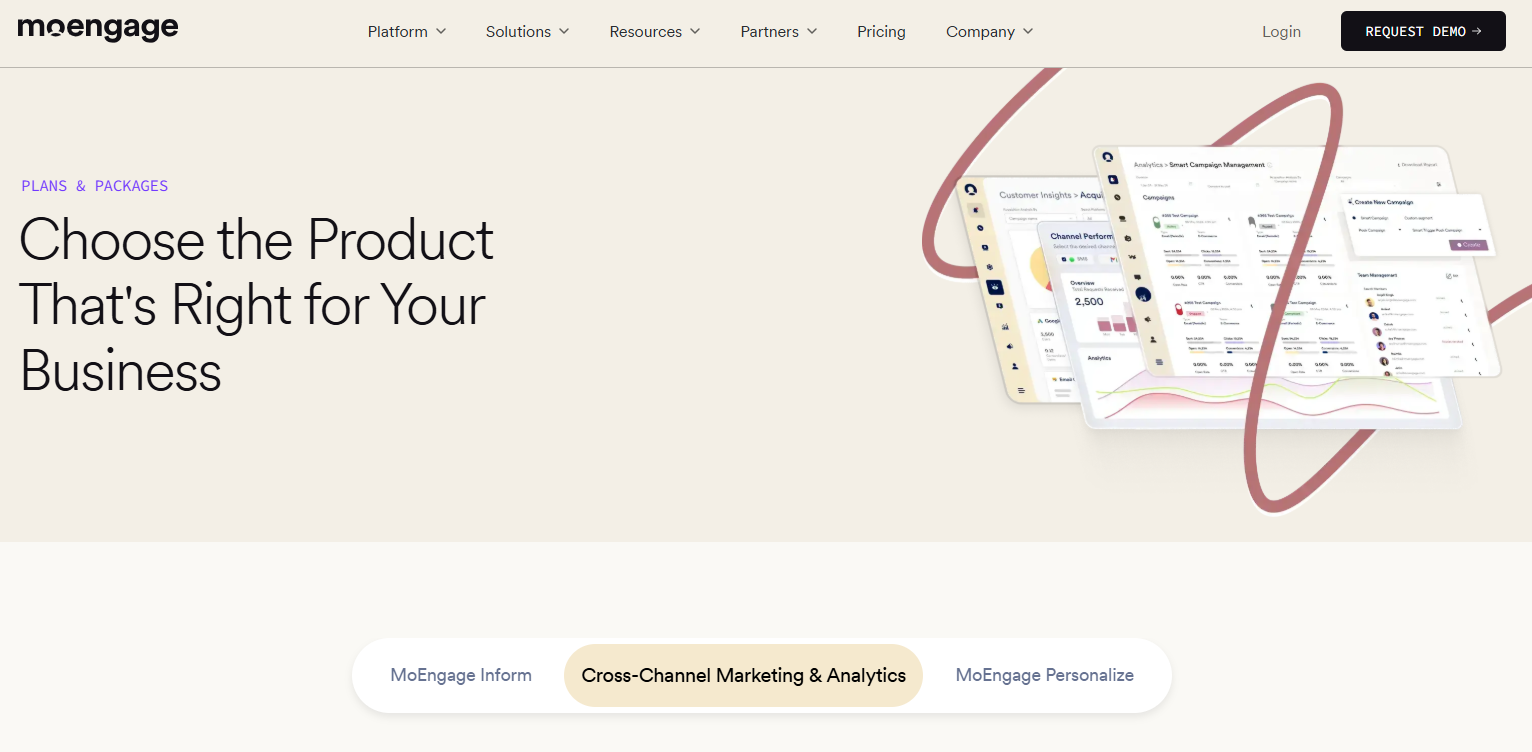
MoEngage is built for B2C mid-market and enterprise teams that want no-code, AI-driven engagement. Its pricing page lists mobile push, web push, email, SMS, in-app and on-site messages as channels, with WhatsApp, RCS, Line, Viber and Telegram as add-ons. Its platform page lists an App Marketplace with 300+ integrations and real-time transactional alerts through a single API.
One thing to weigh plainly. MoEngage published the comparison of the three platforms that supplies the fit verdicts for Braze, Iterable and MoEngage in this article. It positions Braze as best for large enterprises with big budgets and technical resources, Iterable as best for mid-sized lifecycle teams wanting an approachable journey builder, and MoEngage as best for B2C mid-market and enterprise teams wanting no-code, AI-driven engagement. The author is a competitor of the other two, so read it that way.
| Plan | Price | Billing Basis | What It Includes |
|---|---|---|---|
| Growth | Pricing on request | Sales-led quote | Behavior-based personalization, a visual omnichannel journey builder, AI and ML timing and content optimization, improved push delivery |
| Enterprise | Pricing on request | Sales-led quote | Everything in Growth plus catalog sync for recommendations, automatic routing to best-performing journeys, access controls, local data servers with IP whitelisting, quarterly business reviews |
MoEngage's pricing page names the two plans and publishes no prices. Budget for the WhatsApp, RCS, Line, Viber and Telegram add-ons separately if you need them.
Strengths:
- Widest confirmed channel list: Six core channels are listed on the vendor's own pricing page, and five more are available as add-ons.
- Visual journey builder: The Growth plan includes a visual omnichannel journey builder, so marketers can orchestrate without code.
- AI timing and content: Growth includes AI and ML optimization of send timing and content.
- Large integration marketplace: 300+ integrations reduce custom connector work.
Trade-offs:
- No public prices: You need a sales conversation to get a number.
- Add-on channels cost extra: The messaging apps and regional channels are not in the base plan.
- Enterprise-only controls: Access controls, local data servers and catalog sync require the higher plan.
- Vendor-authored evidence: The comparison that supports its fit verdict is its own.
Key capabilities:
- Mobile push, web push, email, SMS, in-app and on-site messaging
- Behavior-based personalization
- A visual omnichannel journey builder
- An App Marketplace with 300+ integrations
Good fit:
- A B2C team that wants marketers, not engineers, building cross-channel journeys
- A business that sends across more than three channels
- A team that needs messaging apps such as WhatsApp and is willing to pay for the add-on
Not a fit:
- A team that needs published pricing for budget sign-off
- A B2B team whose engagement runs mostly through sales and account management
- A buyer who wants independent proof before the demo
The limitation that matters most is that the only fit evidence for MoEngage comes from MoEngage, so your proof of concept has to do the verifying.
4. Salesforce Marketing Cloud Next: Best For Teams Already On Salesforce
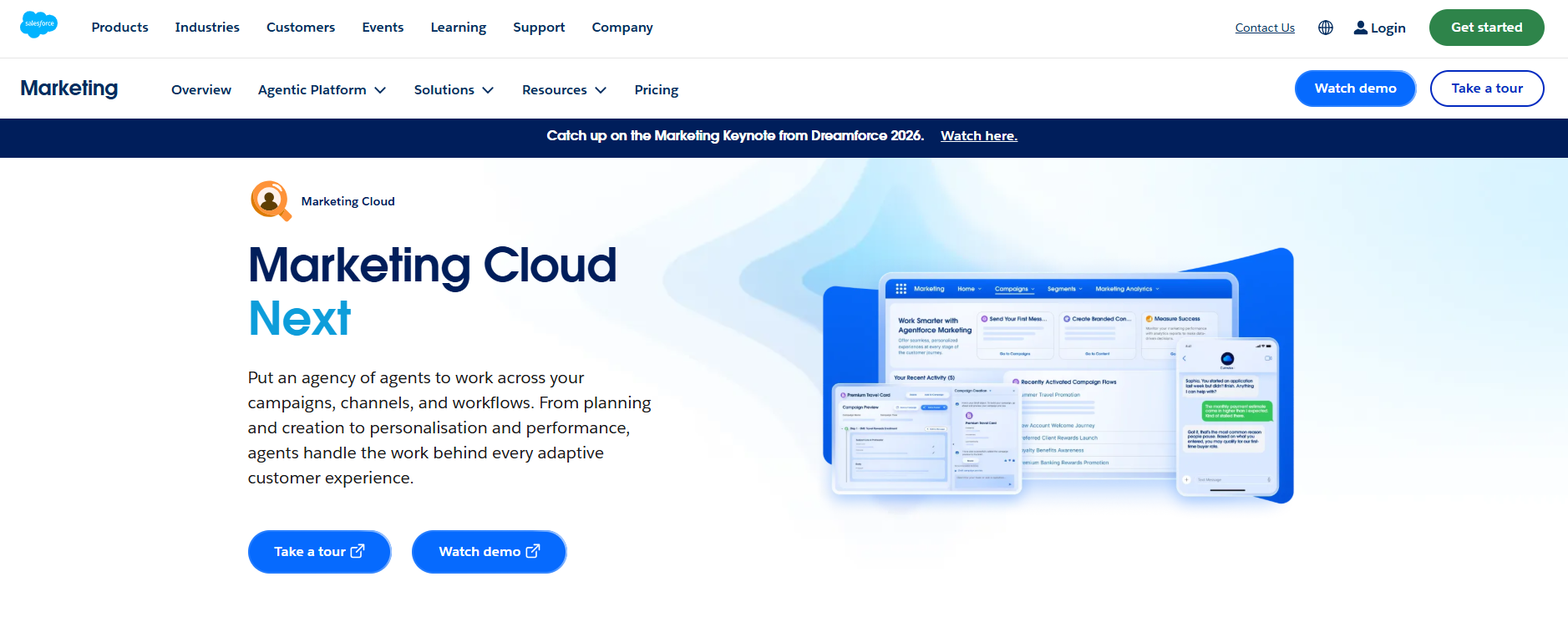
Salesforce Marketing Cloud Next is a fit-specific option rather than a main recommendation, and it is the one platform here with public prices. The Starter plan costs $25 per user per month, and the choice makes most sense when your customer and service data already live in Salesforce. Public prices reflect a different buying model. Salesforce sells editions and add-ons by user and by organisation, where the other three quote against your audience.
Salesforce's marketing page lists email (including two-way), SMS (including two-way) and web as channels. It also lists Data 360 CDP, a native Service Cloud connection, and pre-built connectors and APIs for non-Salesforce tools. It does not list mobile push or in-app messaging. Advanced Edition adds path experimentation and two-way SMS and WhatsApp conversations.
| Plan | Price | Billing Basis | What It Includes |
|---|---|---|---|
| Starter | $25 per user per month | Monthly or annual billing, transaction fees apply | Per-user entry plan |
| Growth Edition | $1,500 per org per month | Billed annually | Organisation-wide edition |
| Advanced Edition | $3,250 per org per month | Billed annually | Adds path experimentation, two-way SMS and WhatsApp conversations |
| Salesforce Personalization add-on | $8,000 per org per month | Billed annually | Add-on for personalization |
All four prices come from Salesforce's pricing page. Transaction fees apply on Starter, so the headline figure is a floor.
Strengths:
- Published prices: You can model the cost before you talk to anyone.
- Native Salesforce data: A native Service Cloud connection and Data 360 CDP keep customer and service records close to the messaging.
- Connectors for other tools: Pre-built connectors and APIs cover non-Salesforce systems.
- Entry point for small teams: A $25 per-user plan is the cheapest published starting point in this list.
Trade-offs:
- Channel gaps: Mobile push and in-app are not listed on the marketing page.
- Add-on pricing: Personalization costs $8,000 per org per month on top of the edition.
- Per-user growth: Starter's seat pricing rises with every marketer you add.
- Salesforce dependency: The value falls if your data does not live in Salesforce.
Key capabilities:
- Email and SMS, including two-way
- Web messaging
- Data 360 CDP and a native Service Cloud connection
- Path experimentation and WhatsApp conversations on Advanced
Good fit:
- A team already running Salesforce CRM and Service Cloud
- A business that sends mainly email and SMS
- A buyer who needs a published price for budget approval
Not a fit:
- A mobile-first business that depends on push and in-app messaging
- A team with no Salesforce footprint
- A lifecycle team that wants a purpose-built journey tool outside a CRM suite
The limitation that matters most is the missing push and in-app channels, which rule it out for any product that lives on a phone.
📋 Get Listed / Advertise
We update this guide monthly. Want your tool featured? Contact: [email protected].
What Is A Customer Engagement Platform?
A customer engagement platform is software that sends messages across email, SMS, push and in-app channels, triggered by what customers do. It collects behavioural data, groups customers into segments, runs automated journeys and measures what each message achieved.
The working loop has five parts. Data flows in from your app, site and CRM. Segments and profiles are built from that data. A journey decides who gets which message and when. The platform sends it on the right channel. Reporting shows what changed, and the next journey learns from it.
People use "omnichannel marketing platform" for the same idea, and the terms overlap heavily. Omnichannel describes the goal, one consistent experience across channels. Customer engagement platform describes the software built to deliver it. If your needs are mostly about linking channels, look at tools that link email and phone touchpoints. If you only send email, step down to one of the email marketing platforms by list size, which will cost less and do the job.
The table below separates the four categories that vendors blur together.
| Category | Main Job | Typical Data | Where It Overlaps |
|---|---|---|---|
| Customer engagement platform | Sends behaviour-triggered messages across channels | Events, profiles, segments | Often includes light CDP and automation features |
| CRM | Stores customer records and sales or service interactions | Contacts, accounts, deals, tickets | Supplies contact data to the platform |
| CDP | Unifies customer data from many sources | Profiles from every system | Feeds the platform; some platforms bundle it |
| Marketing automation | Runs scheduled and triggered campaigns | Lists, forms, lead scores | Often covers fewer channels than a full platform |
The categories overlap and vendors blur them, so judge a product by what it sends and what data it needs, not by the label on its website.
Key Features To Look For In A Customer Engagement Platform
Seven features separate one platform from another, and each one can be tested in a demo. Benefits such as higher retention and fewer wasted sends come out of these features, so test the feature and the benefit follows.
- Channels: Ask which channels are included in the base plan and which are add-ons. Then ask for the list in writing, because MoEngage's own pricing page shows how a base channel list and an add-on list can differ.
- Journey builder: Ask a marketer on your team to build a three-step journey in the demo with no help. Journey and workflow depth is also where email automation tools built to scale are judged, so use the same test.
- Segmentation and real-time data: Ask how quickly a customer action changes a segment, and whether the segment updates before the next message is sent.
- Personalization and AI: Ask which AI features are in the plan you are quoted and which need a higher edition. Braze's own buying guide cites a survey in which 93% of marketing leaders say AI helps them understand customers better while 53% of consumers say brands predict their needs accurately. It is a vendor's survey, so read it as a direction and test the AI on your own data. For writing support inside the tool, see AI email writing tools.
- Analytics: Ask to see a report that ties one message to one outcome, such as a purchase, and ask how attribution is calculated.
- Integrations: Ask for native connectors to your CDP, warehouse and analytics tools, and what each one costs to maintain.
- Compliance and security: Ask for the vendor's current security documentation and how it handles consent and data location. Do this before the proof of concept, not after.
How To Choose: A Decision Rule By Team Size, Channels And Engineering Capacity
Most shortlists go wrong because they start with features. Start with people instead. Work through these five steps in order and stop when two platforms are left.
- Count the engineers you can give the platform. If you can give it one or more engineers through the first quarter, Braze stays on the list. If you cannot, favour Iterable or MoEngage. MoEngage's comparison puts Braze with large enterprises that have big budgets and technical resources, and that page is written by a competitor.
- Count the channels you must send on in the next twelve months. If you need email, push, SMS and in-app from the start, choose MoEngage or get Braze and Iterable's channel lists in writing. If you need WhatsApp, RCS, Line, Viber or Telegram, price MoEngage's add-ons. If email and SMS are enough and you run Salesforce, go to step 4.
- Check audience size against the predictive minimums. MoEngage's comparison says Braze's predictive churn needs at least 30,000 customers and Iterable's predictive goals and frequency optimization need 100K+ customers. If you have fewer than 30,000 customers, expect to run without predictive features on either platform. The source is a competitor, so confirm both figures with each vendor.
- Check whether your CRM suite already covers email and SMS. If your customer and service data live in Salesforce and you send mainly email and SMS, price Salesforce Marketing Cloud Next first. If you also need mobile push or in-app, the Salesforce marketing page does not list them, so keep a dedicated platform on the list.
- Demo the two that survive, with real data. Load a real segment and build one live journey on your two most important channels. Score both against the same weighted criteria you wrote before the demos.
Here is a worked example. The inputs are invented and the result is only an illustration.
- Team: 12-person lifecycle team with one engineer.
- Channels needed: Email, push and SMS within twelve months.
- Audience: 400,000 customers.
- CRM: A CRM that is not Salesforce.
Step 1 leaves one engineer, which is thin for a heavy Braze integration, so Braze drops to third place. Step 2 favours MoEngage because it lists all three channels, while Iterable's list has to be confirmed. Step 3 passes for both platforms, because 400,000 customers clears the 30,000 and 100K+ minimums. Step 4 removes Salesforce because the team has no Salesforce footprint. Step 5 sends MoEngage and Iterable to a proof of concept. Braze only returns if the demos show the team can find more engineering time.
Cost works the same way. Seat-based pricing grows with the team, and usage-based pricing grows with the audience. The Salesforce Starter plan costs $25 per user per month, so those 12 people would cost $300 per month in seats alone, while a usage-based plan would rise as the 400,000 customers grow. If you run a small Shopify store and none of this fits, start with email marketing tools for Shopify stores instead.
The rule cannot tell you the price at your volume, how usable the builder feels to your marketers, or whether your data is clean enough to use. Only a quote, a trial and your own data answer those.
If you run a product in this category, comparison pages and listicles like this one are where shortlists get made. Our SaaS content marketing team builds them from verified vendor facts, not recycled claims.
What Customer Engagement Platforms Cost And How Pricing Works
Of the four platforms here, only Salesforce publishes dollar prices. Braze, Iterable and MoEngage each ask you to talk to sales. Pricing models fall into five types, and knowing which one a vendor uses tells you what makes the bill grow.
| Platform | Pricing Basis | Published Prices |
|---|---|---|
| Braze | Edition, monthly active users and credits | Pricing on request |
| Iterable | Sales-led quote | Pricing on request |
| MoEngage | Growth and Enterprise plans, sales-led quote | Pricing on request |
| Salesforce Marketing Cloud Next | Per user (Starter) and per organisation (Growth, Advanced, add-on) | $25 per user per month to $8,000 per org per month |
The five pricing types are usage-based on monthly active users or audience, edition-based, credit-based, per seat and per organisation. Per-seat pricing grows when you add marketers. Per-organisation pricing stays flat as the team grows but steps up with each edition. Usage-based pricing grows with your audience, even when the team stays the same.
Pricing that scales per seat or per database size can become costly as the team or audience grows. Mid-size teams should weigh team size, technical resources and customer volume before they compare quotes.
To get a comparable quote, send every vendor the same brief.
- Audience size: The number of customers or monthly active users today and in three years.
- Channels: Every channel you will send on, including add-ons.
- Add-ons: Predictive tools, extra data storage and any messaging apps.
- Term: A three-year figure, with the price in each year.
Reporting and ongoing programme costs sit outside the platform bill. If you are budgeting those as well, the GEO and SEO growth programme page shows how we scope them.
Integrations And Data Stack Fit
A platform is only as good as the data it can reach. Before the demo, list where your customer data lives now, such as a CDP, a warehouse, an analytics tool and a CRM. Then check how each platform connects to each one.
MoEngage's platform page lists an App Marketplace with 300+ integrations, and Salesforce's marketing page lists a Data 360 CDP and pre-built connectors for non-Salesforce tools. For Braze and Iterable, ask for the connector list in writing rather than relying on a number you read elsewhere. The analysis layer that sits beside the platform matters too, and customer insights tools for email data show what to measure once the data is flowing.
Ask each vendor these four questions.
- Native or API-only: Is there a native connector for each system in our stack, or do we build against an API?
- Direction of flow: Does data move both ways, so the platform can send results back to the warehouse and CRM?
- Speed: How long does an event take to reach the platform and change a segment?
- Ownership: Who maintains each connector when a source system changes?
If your data already sits in a warehouse or a CRM and the platform has a native connector to it, a separate CDP adds cost without much gain. A CDP earns its place when data is scattered and no single source can feed the platform.
Implementation And Measuring Return
Implementation is mostly data work. Mapping events, setting up channels, warming sender domains and capturing consent cause most of the delays, and none of them depend on which platform you buy. Sender and domain reputation is a common cause of delay, so read about email deliverability tools before you send at volume.
Plan the first ninety days in three blocks.
- Days 1 to 30: Name an owner, map your events and connect your data sources. Set up sender domains and consent capture.
- Days 31 to 60: Build and test the first journey on one channel. Send to a small segment and check delivery and data accuracy.
- Days 61 to 90: Add the second channel, set up reporting and write down what to change. Retire the old tool only after the new one has run a full cycle.
Return comes from one formula. Return equals incremental revenue from lifecycle messages minus platform cost minus team time. Incremental means revenue you would not have had without the messages, so compare against a holdout group that did not receive them. Choose your email tracking tools so that the numbers you need are captured from the first send.
Here is a worked example with invented inputs. Replace them with your own.
- Incremental revenue per month: $18,000
- Platform cost per month: $6,000
- Team time per month: 60 hours at $50 per hour, which is $3,000
- Net return per month: $18,000 minus $6,000 minus $3,000, which is $9,000
- Return on spend: $9,000 divided by $9,000 of cost, which is 100%
State your assumptions beside the result, especially how you measured incremental revenue, so the number holds up when someone challenges it.
FAQs
Is A Customer Engagement Platform The Same As A CRM?
Are CDPs Customer Engagement Platforms?
Is An Omnichannel Marketing Platform The Same As A Customer Engagement Platform?
Do I Need A CDP Alongside A Customer Engagement Platform?
Which Platform Suits A Small Lifecycle Team?
Why Do Braze, Iterable And MoEngage Not Publish Prices?
How Many Customers Do I Need Before Predictive Features Work?
How Long Does It Take To Implement A Customer Engagement Platform?
How Should I Run A Proof Of Concept Before Buying?
When Does Salesforce Marketing Cloud Make More Sense Than A Dedicated Platform?
If you would rather have someone who has done this before look at how your product shows up in these shortlists, book a thirty-minute call. One of the founders takes it, and you leave knowing what we would fix first.