

TL;DR
Email marketing still drives the highest ROI of any channel for Shopify stores, returning an average of $36–$79 for every dollar spent. But picking the right platform matters more than most store owners realize. The wrong tool either bleeds money through inflated contact-based pricing or holds back growth with shallow automation and weak Shopify data sync.
This guide compares the five email marketing tools that dominate the Shopify ecosystem in 2026: Klaviyo, Omnisend, Mailchimp, Brevo, and ActiveCampaign. Each one is evaluated on Shopify integration depth, automation capabilities, pricing transparency, and real-world fit for different store sizes and stages. If you run a Shopify store and need email marketing that actually moves revenue, this is where to start.
Best Email Marketing Tools for Shopify (Quick Comparison)
| Feature | Klaviyo | Omnisend | Mailchimp | Brevo | ActiveCampaign |
|---|---|---|---|---|---|
| Free Plan | 250 contacts, 500 emails/mo | 250 contacts, 500 emails/mo | 250 contacts, 500 emails/mo | 100,000 contacts, 300 emails/day | 14-day trial only |
| Paid Starting Price | $20/mo (251–500 contacts) | $16/mo (500 contacts) | $13/mo (500 contacts) | $9/mo (5,000 emails) | $15/mo (1,000 contacts) |
| Pricing Model | Per contact | Per contact | Per contact | Per email sent | Per contact |
| Shopify Integration | Native, real-time sync | Native, deep sync | Official app, standard sync | Plugin-based sync | Official app, standard sync |
| SMS Included | Add-on (150 free credits) | Included in Pro plan | Add-on (application required) | Add-on | Add-on |
| Automation Depth | Advanced (predictive analytics, AI segments) | Strong (pre-built ecommerce workflows) | Moderate (Marketing Automation Flows) | Moderate (unlimited workflows on paid) | Advanced (visual builder, AI-powered) |
| Best For | Scaling stores ($50K+/mo revenue) | Mid-size stores wanting email + SMS | Beginners and smaller stores | Budget-conscious stores with large lists | Stores needing CRM + deep automation |
1. Klaviyo
What It Does
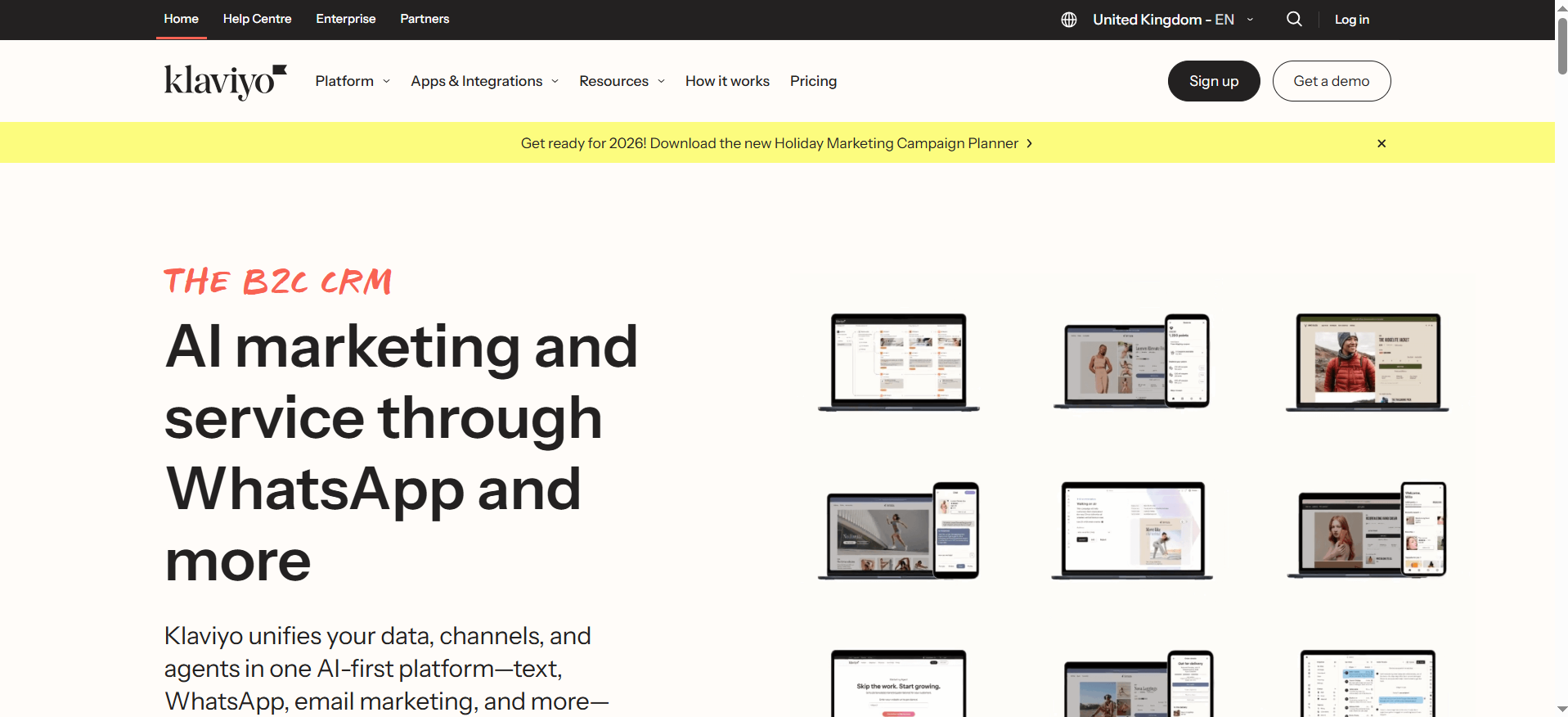
Klaviyo is an email and SMS marketing platform built specifically for ecommerce. It connects directly with Shopify to pull in customer data, purchase history, and browsing behavior in real time, then lets you build campaigns, automated flows, and segments based on that data. The platform now spans four product areas: Klaviyo Marketing, Klaviyo Analytics, Klaviyo Service, and Klaviyo Data.
Why Teams Use It
Klaviyo is the default choice for Shopify stores that have outgrown basic email tools and need data-driven retention marketing. Its predictive analytics can identify which customers are about to churn, which are likely to purchase again, and what their predicted lifetime value is. For brands with a data team or a dedicated email marketer who can act on those signals, this is where Klaviyo separates itself from cheaper alternatives.
The flow builder is considered best-in-category, and 60+ pre-built templates mean you can launch a complete retention program in days rather than months. The Marketing Agent feature uses AI to help create campaigns and flows, reducing the time from idea to live send.
What It Is Good For
Klaviyo excels at behavioral segmentation, predictive analytics, and revenue attribution. If you need to know exactly how much revenue each email flow generates, which customer segments are most profitable, and what product recommendations to serve based on browsing history, Klaviyo handles all of this natively. It also supports 350+ integrations and syncs Shopify data in milliseconds, so every message reflects what is happening in your store right now.
When It Is a Good Fit
Klaviyo is the right choice for Shopify stores doing $50K or more per month in revenue, stores with dedicated email marketing staff, brands that want advanced segmentation and predictive analytics, and Shopify Plus stores that need enterprise-grade data sync and custom integrations.
When It Is Not a Good Fit
Klaviyo is not ideal for stores just starting out with small lists (under 1,000 contacts), brands on tight budgets where cost per contact matters most, teams without technical capacity to use its advanced features, and stores that only need basic newsletter sends without complex automation.
How to Use It
Install the Klaviyo app from the Shopify App Store. The integration syncs your product catalog, customer profiles, and order history automatically. From there, start with Klaviyo's pre-built flow templates for abandoned cart, welcome series, post-purchase, and win-back sequences. Customize segments using purchase behavior, browsing data, and predictive metrics. Layer in SMS for high-intent moments like cart abandonment and shipping updates.
Key Capabilities
Klaviyo offers real-time Shopify data sync with millisecond latency, predictive analytics including expected date of next order, churn risk score, and predicted lifetime value. It includes an AI-powered Marketing Agent for campaign and flow creation, advanced segmentation with behavioral, demographic, and predictive filters, A/B testing for subject lines, content, and send times, revenue attribution per campaign and per flow, 350+ platform integrations, and native SMS and push notification support.
Pricing
Klaviyo's free plan covers up to 250 active profiles and 500 email sends per month. Paid email plans start at $20 per month for 251–500 profiles. At 5,000 contacts, expect to pay around $100 per month. At 10,000 contacts, pricing reaches approximately $150 per month for email only, or around $240 per month for email and SMS combined. Above 250,000 profiles, Klaviyo moves to custom enterprise pricing.
Free Tier
Yes. The free plan includes up to 250 active profiles, 500 email sends per month, 150 SMS/MMS credits per month, and access to most features including flows, segmentation, and basic analytics. It is limited by list size, not by feature access.
Downsides and Limitations
Klaviyo's pricing scales aggressively as your list grows, making it one of the more expensive options at scale. The platform has a steep learning curve, and most small to mid-size Shopify stores end up paying for features they never fully use. Contact-based pricing means you pay for all profiles in your account, not just those you actively email. There is no phone support on lower-tier plans.
2. Omnisend
What It Does
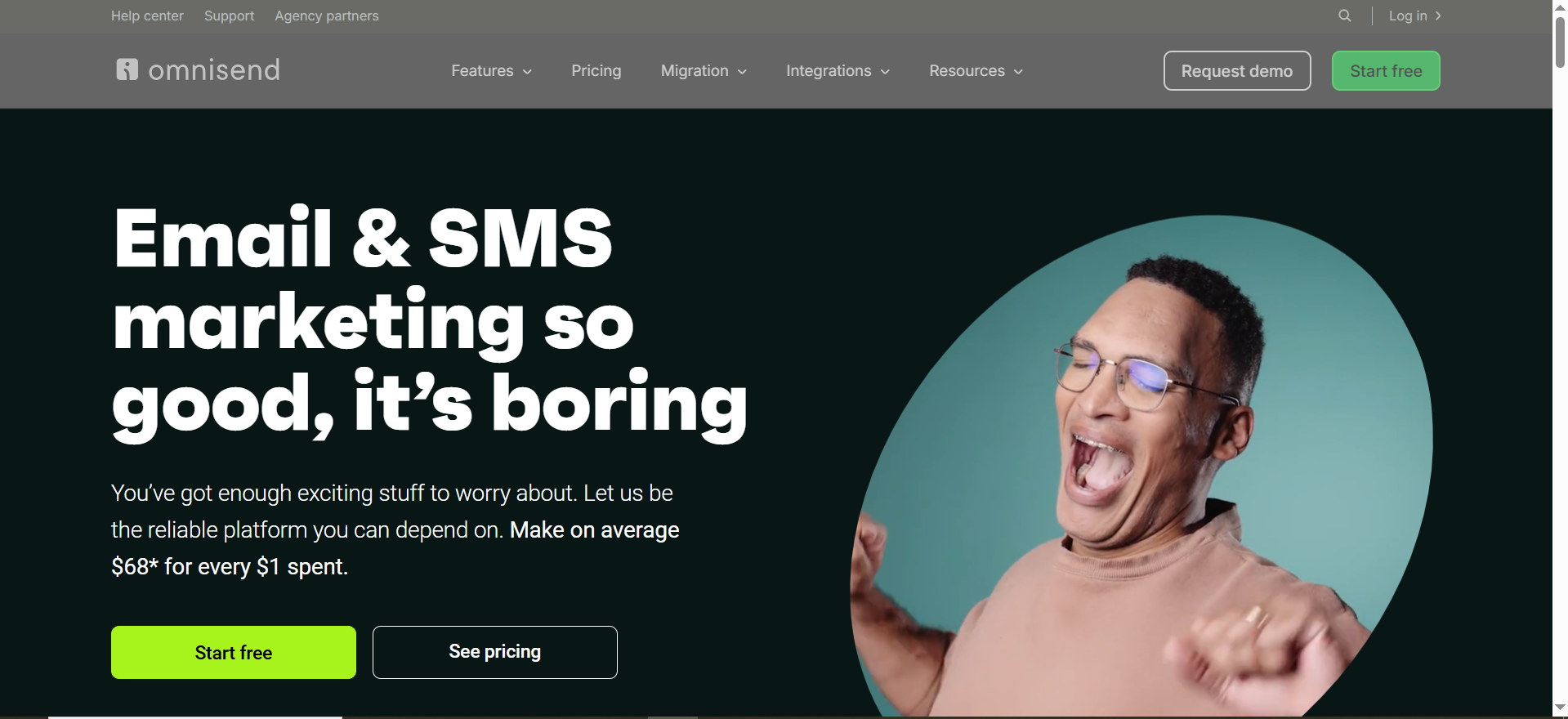
Omnisend is an email and SMS marketing platform designed specifically for ecommerce merchants. It provides tools to grow your email list with popups and forms, create emails using hundreds of templates, and send personalized messages using AI-powered product recommendations and segmentation. The platform combines email, SMS, and web push notifications in a single dashboard.
Why Teams Use It
Omnisend sits in the sweet spot between Klaviyo's premium pricing and Mailchimp's limited ecommerce depth. It is built for ecommerce from the ground up, which means pre-built automations for abandoned cart, welcome series, order confirmation, and shipping updates come ready to launch out of the box. Teams choose Omnisend because it delivers strong multichannel automation at a price point that makes sense for stores that are not yet at the scale where Klaviyo's advanced analytics justify the cost.
What It Is Good For
Omnisend is strong at combining email, SMS, and push notifications into unified automated workflows. Its pre-built ecommerce automation workflows are among the fastest to deploy, and its drag-and-drop email editor includes a product picker that pulls items directly from your Shopify catalog. The platform also released predictive analytics updates in 2026, assigning likely-to-buy scores to individual subscriber profiles based on browsing frequency and historical purchase data.
When It Is a Good Fit
Omnisend is a good fit for Shopify stores doing $10K–$200K per month in revenue, brands that want email and SMS in one platform without paying Klaviyo prices, teams that need quick-to-deploy automation without heavy customization, and stores looking for strong Shopify integration at a mid-range price point.
When It Is Not a Good Fit
Omnisend may not be ideal for enterprise stores needing deep CRM functionality, brands requiring advanced predictive analytics comparable to Klaviyo, teams that need highly custom API integrations, and stores focused primarily on B2B where ecommerce-specific features are less relevant.
How to Use It
Install Omnisend from the Shopify App Store. The app syncs your customer data, products, and orders automatically. Start with the pre-built automation workflows. The platform walks you through setting up abandoned cart recovery, welcome sequences, and post-purchase flows with minimal configuration. Use the drag-and-drop editor to customize templates and add products directly from your store.
Key Capabilities
Omnisend offers deep native Shopify integration with automatic data sync, pre-built ecommerce automation workflows for abandoned cart, welcome series, order follow-up, and browse abandonment. It includes a drag-and-drop email editor with Shopify product picker, combined email, SMS, and web push notification campaigns, AI-powered product recommendations and segmentation, popups, forms, and landing pages for list growth, 200+ integrations, and 24/7 email and live chat support for all plans including free.
Pricing
The free plan includes up to 250 contacts and 500 emails per month. The Standard plan starts at $16 per month for 500 contacts and 6,000 emails per month. The Pro plan starts at $59 per month and includes unlimited emails, included SMS credits matching your monthly plan cost, and advanced reporting. At 10,000 contacts, Omnisend costs around $132 per month, compared to Klaviyo's approximately $150 per month for email only.
Free Tier
Yes. The free plan includes up to 250 contacts, 500 emails per month, all features including automation workflows, popups, segmentation, and 24/7 support. Omnisend is one of the few platforms that gives free users access to live chat support.
Downsides and Limitations
Omnisend's analytics and reporting are less granular than Klaviyo's, particularly around predictive metrics and revenue attribution at the segment level. The platform has fewer advanced customization options for teams that want to build highly bespoke workflows. Template design options, while functional, are not as extensive as Mailchimp's library. SMS pricing outside of the Pro plan can add up quickly.
3. Mailchimp
What It Does
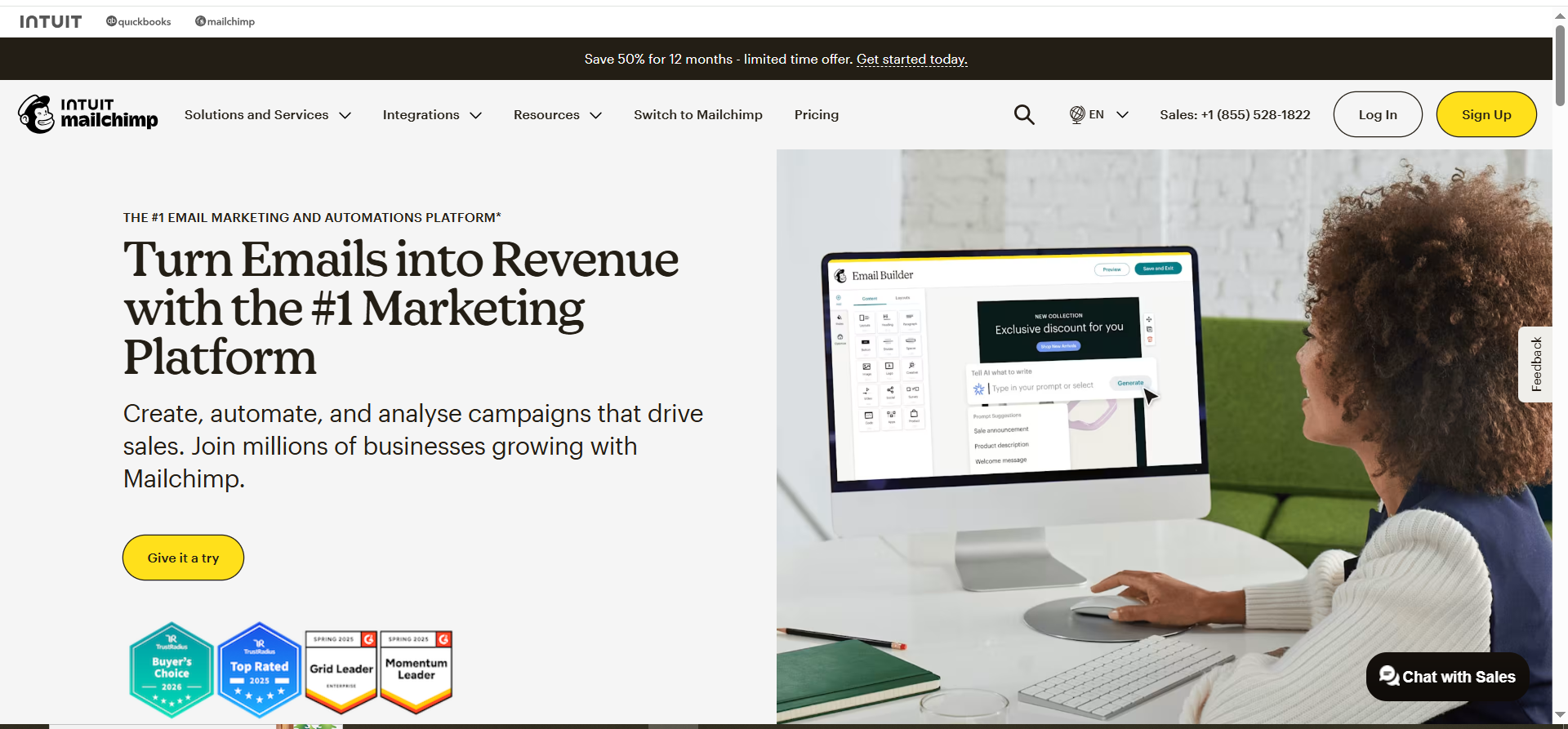
Mailchimp is a broad marketing platform that covers email, SMS, landing pages, and social ads. For Shopify stores, it syncs customer, product, and order data to enable newsletter campaigns, automated abandoned cart emails, re-engagement sequences, and social retargeting across Facebook, Instagram, TikTok, and Snapchat. The platform includes 260+ mobile-responsive templates, a visual automation builder (now called Marketing Automation Flows), and 300+ integrations.
Why Teams Use It
Mailchimp is the most recognizable name in email marketing and the default starting point for many Shopify store owners. Its interface is designed for people who have never used email marketing software before, and its free plan provides enough room for very small stores to get started without paying anything. Teams use Mailchimp because it is familiar, well-documented, and provides a single dashboard for email, social ads, and basic marketing automation.
What It Is Good For
Mailchimp is strong at campaign creation with its intuitive drag-and-drop editor and large template library. The Creative Assistant generates branded templates automatically, and the Content Optimizer provides copy improvement suggestions. For stores that also run social ads, Mailchimp's built-in Facebook, Instagram, and TikTok ad management is convenient. The platform also offers basic ecommerce automations including abandoned cart recovery and post-purchase follow-ups.
When It Is a Good Fit
Mailchimp is a good fit for new Shopify stores just getting started with email marketing, small stores with lists under 2,500 contacts, teams that want email and social ads in one dashboard, and brands that prioritize ease of use and a gentle learning curve over advanced features.
When It Is Not a Good Fit
Mailchimp is not ideal for stores doing heavy segmentation and behavioral targeting, brands that need deep ecommerce-specific automation workflows, stores looking for included SMS capabilities (SMS requires a separate application and approval), and growing stores where Mailchimp's per-contact pricing becomes expensive quickly.
How to Use It
Install the Mailchimp app from the Shopify App Store. It syncs your customer data, products, and order history. Set up your first campaign using the drag-and-drop editor and one of the 260+ templates. Enable abandoned cart automation through Marketing Automation Flows. Use the audience dashboard to segment contacts by purchase behavior, engagement, and demographics.
Key Capabilities
Mailchimp offers 260+ mobile-responsive email templates, a drag-and-drop campaign editor with Creative Assistant and Content Optimizer, Marketing Automation Flows for automated sequences, audience segmentation with behavioral and demographic filters, social ad management for Facebook, Instagram, TikTok, and Snapchat, landing page builder, A/B and multivariate testing, 300+ integrations including Shopify and WooCommerce, and revenue tracking tied to campaigns.
Pricing
Mailchimp's free plan covers up to 250 contacts and 500 emails per month (reduced from 500 contacts and 1,000 emails in January 2026). The Essentials plan starts at approximately $13 per month for 500 contacts. The Standard plan starts at approximately $20 per month for 500 contacts. Pricing increases significantly as contacts grow: on the Essentials plan, 5,000 contacts costs approximately $75 per month, while the Standard plan costs approximately $100 per month at the same tier. At 10,000 contacts, the Standard plan costs approximately $135 per month. SMS is available as an add-on in select markets and requires an application.
Free Tier
Yes, but limited. As of January 2026, the free plan includes up to 250 contacts and 500 emails per month with a daily send limit of 250 emails. It includes basic templates and basic reporting. Automation workflows are no longer available on the free plan, and Mailchimp branding appears on all free plan emails.
Downsides and Limitations
Mailchimp was not originally built for ecommerce, and its Shopify integration is not as deep or real-time as Klaviyo or Omnisend. Pricing scales sharply as your list grows, and the platform charges for unsubscribed contacts on some plans. Advanced ecommerce automations are limited compared to purpose-built platforms. SMS is not natively integrated and requires a separate application process. The recent rebranding of Customer Journey Builder to Marketing Automation Flows has caused some confusion among existing users.
4. Brevo
What It Does
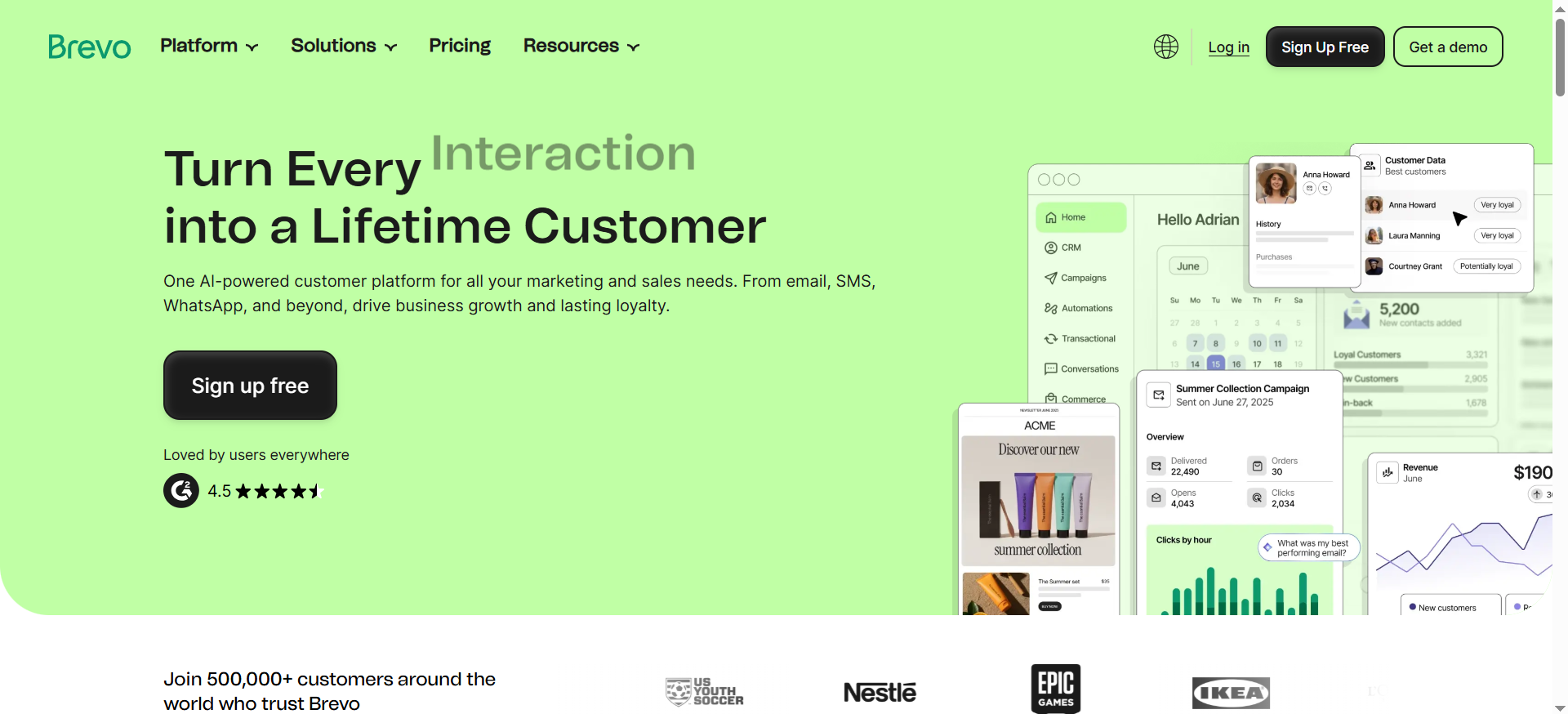
Brevo (formerly Sendinblue) is a marketing platform that includes email, SMS, WhatsApp, and CRM tools. Unlike most competitors, Brevo uses per-email pricing instead of per-contact, charging based on the number of emails you send rather than the number of contacts in your database. The free plan supports up to 100,000 contacts. This makes it particularly attractive for stores with large contact lists but moderate email frequency.
Why Teams Use It
Brevo is the budget option that does not feel like a budget option. Teams choose it when they have a large contact list but do not send emails every day, which means per-email pricing saves them significant money compared to per-contact platforms like Klaviyo or Mailchimp. The platform also includes a built-in CRM, transactional email capabilities, and WhatsApp messaging, making it a versatile all-in-one solution for stores that want to consolidate tools.
What It Is Good For
Brevo handles email automation, transactional emails, SMS, and WhatsApp from a single platform. Its advanced segmentation allows you to filter contacts by demographics, website activity, campaign engagement, and custom events, with unlimited segments on all plans. The platform includes A/B testing, click heatmaps, geography reports, and an AI content generator. For Shopify stores, Brevo triggers automated emails and SMS for abandoned carts, post-purchase follow-ups, and browse abandonment.
When It Is a Good Fit
Brevo is a good fit for Shopify stores with large contact lists but moderate send frequency, budget-conscious brands that want up to 100,000 contacts without paying per-head, stores that need transactional emails alongside marketing emails, and teams that want email, SMS, WhatsApp, and CRM in a single platform.
When It Is Not a Good Fit
Brevo may not be ideal for stores that need the deepest possible Shopify integration with real-time behavioral data, brands requiring advanced predictive analytics and AI-driven segmentation at the level Klaviyo provides, high-frequency senders who email their entire list daily (where per-email pricing can add up), and teams that want the most polished drag-and-drop editor and template library.
How to Use It
Install the Brevo app from the Shopify App Store. The integration syncs your customer data, order history, and product catalog. Set up automation workflows for abandoned cart recovery, welcome sequences, and post-purchase follow-ups. Use the segmentation builder to create targeted lists based on purchase behavior and engagement. Add SMS or WhatsApp as additional channels within your automated flows.
Key Capabilities
Brevo offers unlimited contacts on all plans including free, per-email pricing model, email, SMS, and WhatsApp marketing from one platform, built-in CRM with contact management, marketing automation with unlimited workflows on paid plans, advanced segmentation with demographic, behavioral, and engagement filters, A/B testing for subject lines and content, click heatmaps and geography reports, AI content generator, transactional email support, and 150+ integrations.
Pricing
Brevo's free plan includes 300 emails per day (approximately 9,000 per month) with up to 100,000 contacts. The Starter plan begins at $9 per month for 5,000 emails. The Business plan starts at $18 per month for 5,000 emails and adds advanced features including marketing automation, A/B testing, and advanced statistics. Enterprise pricing is custom. Annual billing saves up to 10 percent.
Free Tier
Yes. Brevo's free plan is one of the most generous available: up to 100,000 contacts, 300 emails per day, a built-in CRM, and basic automation. The main limitation is the daily send cap rather than a monthly contact cap, which is a meaningful difference for stores with large lists.
Downsides and Limitations
Brevo's Shopify integration is plugin-based rather than native, which means data sync is not as immediate or granular as Klaviyo or Omnisend. The email editor and template library are functional but not as polished as Mailchimp's. The platform's ecommerce-specific features are less developed than purpose-built tools like Klaviyo and Omnisend. Per-email pricing can become expensive for high-frequency senders. Customer support response times have received mixed reviews.
5. ActiveCampaign
What It Does
ActiveCampaign combines email marketing with CRM, sales automation, and advanced workflow building. For Shopify stores, it sends real-time store data to ActiveCampaign, enabling automated abandoned cart emails, post-purchase sequences, and personalized messages based on purchase history. The platform is known for its visual automation builder, which supports multi-step workflows with branching paths based on opens, clicks, purchases, and custom events.
Why Teams Use It
ActiveCampaign is the choice for Shopify stores that need more than just email marketing. Teams use it when they want a CRM integrated directly with their email platform, when they need complex multi-step automations that go beyond simple drip sequences, and when they want to combine email, SMS, and WhatsApp messaging into unified customer journeys. The visual automation builder is one of the most powerful available, and the AI-powered builder lets you describe a goal in plain English and generates the workflow for you.
What It Is Good For
ActiveCampaign excels at complex automation workflows, lead scoring, and CRM-integrated email marketing. It supports multi-step journeys with branching paths, conditional logic, and goal tracking. The platform also offers advanced segmentation, site tracking, event tracking, and attribution reporting. For Shopify stores that also sell B2B or have a sales team, the built-in CRM and pipeline management add significant value.
When It Is a Good Fit
ActiveCampaign is a good fit for Shopify stores that also have a B2B or wholesale component, brands that want CRM and email marketing in one platform, teams building complex multi-step automations with conditional branching, and stores that need lead scoring and sales pipeline management alongside email.
When It Is Not a Good Fit
ActiveCampaign is not ideal for small stores that only need basic email campaigns and simple automations, budget-sensitive brands (pricing scales sharply with contact count and add-ons typically add 30–50 percent to the base price), teams looking for the simplest possible setup and fastest time-to-value, and stores that want deep native Shopify integration comparable to Klaviyo or Omnisend.
How to Use It
Install the ActiveCampaign app from the Shopify App Store. The integration syncs customer data, order history, and product information. Start with pre-built automation recipes for abandoned cart, welcome series, and post-purchase flows. Use the visual automation builder to create custom workflows with conditional logic. Set up lead scoring to identify your most engaged customers and trigger targeted campaigns.
Key Capabilities
ActiveCampaign offers a visual automation builder with branching paths, conditional logic, and AI-powered workflow generation. It includes a built-in CRM with sales pipeline management, lead scoring and contact scoring, email, SMS, and WhatsApp messaging (SMS and WhatsApp as add-ons), advanced segmentation with behavioral and event-based filters, site tracking and event tracking, revenue and attribution reporting, A/B testing for emails and automations, and 1,000+ integrations including Shopify, Salesforce, and Google Ads.
Pricing
ActiveCampaign's Starter plan begins at $15 per month for 1,000 contacts. The Plus plan is $49 per month, Pro is $79 per month, and Enterprise starts at $145 per month, all for 1,000 contacts on annual billing. Pricing scales sharply: the Starter plan alone jumps from $15 per month at 1,000 contacts to $149 per month at 10,000 contacts. Annual billing saves 20 percent. There is a 14-day free trial limited to 100 subscribers and 100 emails. Important note: since November 2025, ActiveCampaign charges for all contacts, including unsubscribed, bounced, and unconfirmed.
Free Tier
No permanent free plan. ActiveCampaign offers a 14-day free trial limited to 100 contacts and 100 emails. This is the only tool in this comparison without a lasting free tier.
Downsides and Limitations
ActiveCampaign's pricing is among the highest in this comparison when factoring in add-ons, which typically increase costs by 30–50 percent above the base price. The platform charges for all contacts including unsubscribed and bounced, which inflates costs. Its Shopify integration is standard rather than native, meaning data sync is not as immediate as Klaviyo or Omnisend. The learning curve is steep due to the breadth of CRM and automation features. SMS and WhatsApp require paid add-ons. There is no free plan, only a limited trial.
What Is the Best Email Marketing Platform for Shopify Stores
The best email marketing platform for Shopify depends on your store's size, budget, and what you need beyond basic email sends. For most Shopify stores doing under $50K per month in revenue, Omnisend provides the best balance of features, ecommerce-specific automation, and pricing. It is built for ecommerce, includes SMS in its Pro plan, and costs significantly less than Klaviyo at every contact tier.
For stores doing $50K or more per month with dedicated marketing staff, Klaviyo's predictive analytics, real-time data sync, and advanced segmentation justify the premium. Mailchimp works for stores that are just getting started and want the easiest onboarding experience. Brevo is the smart pick for stores with large lists that do not email frequently. ActiveCampaign is best for stores that also need CRM and sales pipeline functionality.
How Much Does Email Marketing Cost for Shopify
Email marketing costs for Shopify vary widely depending on the platform and your contact list size. At the entry level, several platforms offer functional free plans: Brevo gives you up to 100,000 contacts with 300 emails per day, while Omnisend, Klaviyo, and Mailchimp each cover up to 250 contacts on their free plans.
On paid plans for 1,000 contacts, expect to pay between $9 per month (Brevo) and $20 per month (Klaviyo). At 10,000 contacts, costs range from approximately $50 per month (Brevo, depending on send volume) to $150 per month (Klaviyo email only). The pricing model matters: Brevo charges per email sent, which benefits stores with large lists and moderate frequency, while Klaviyo, Omnisend, Mailchimp, and ActiveCampaign charge per contact, which benefits stores with smaller lists that email frequently.
Factor in add-ons for SMS, WhatsApp, and advanced features. ActiveCampaign users should budget 30–50 percent above the base price for add-ons. Klaviyo's SMS is a paid add-on beyond 150 free credits per month.
Klaviyo vs Omnisend for Shopify Which Is Better
Klaviyo and Omnisend are the two most popular email marketing platforms among Shopify stores, and the choice between them comes down to scale and budget. Klaviyo offers superior predictive analytics, deeper data granularity, and more advanced segmentation options. Its real-time Shopify sync is the fastest available, and its revenue attribution is the most detailed.
Omnisend, however, delivers 85 percent of Klaviyo's functionality at roughly 60–70 percent of the cost. At 10,000 contacts, Omnisend costs around $132 per month compared to Klaviyo's $150 per month for email only (or $240 with SMS). Omnisend includes SMS in its Pro plan, while Klaviyo charges separately. Omnisend's pre-built ecommerce workflows are faster to deploy, and its interface is more approachable for teams without a dedicated email marketer.
For stores under $50K per month in revenue, Omnisend is typically the better choice. For stores above that threshold with staff to leverage advanced analytics, Klaviyo earns its premium.
How to Set Up Abandoned Cart Emails on Shopify
Abandoned cart emails are the highest-ROI automation for Shopify stores, with multi-email sequences making customers 2.4 times more likely to complete their purchase compared to single follow-ups. Here is how to set them up effectively.
First, choose your email marketing platform and install the Shopify integration. All five tools in this guide support abandoned cart automation. Klaviyo and Omnisend offer the deepest cart data sync, pulling in product images, quantities, prices, and discount codes automatically.
Second, build a multi-email sequence rather than sending a single reminder. A proven structure is: Email 1 sent 1 hour after abandonment (simple reminder with cart contents), Email 2 sent 24 hours later (address common objections, add social proof), and Email 3 sent 48–72 hours later (final reminder, optional incentive). Advanced platforms like Klaviyo use logic to decide whether a discount is necessary based on product demand, stock levels, and customer history.
Third, add SMS as a secondary channel. Combining email and SMS recovers more carts than email alone. Omnisend and Klaviyo both support SMS within their automation workflows.
Aim for a 10–15 percent recovery rate as your benchmark.
Does Mailchimp Work With Shopify in 2026
Yes, Mailchimp works with Shopify in 2026 through an official integration available on the Shopify App Store. The app syncs customer data, product catalogs, and order history, enabling ecommerce-specific campaigns including abandoned cart emails, post-purchase follow-ups, and product recommendation emails.
However, Mailchimp's Shopify integration is not as deep as Klaviyo's or Omnisend's. Data sync is standard rather than real-time, and some behavioral tracking features (like browse abandonment based on specific product pages) are less granular. Mailchimp also was not originally built for ecommerce, so its automation templates and segmentation options are more general-purpose compared to platforms designed specifically for online stores.
For basic Shopify email marketing needs, including newsletters, abandoned cart recovery, and post-purchase emails, Mailchimp works well and offers a familiar interface. For stores that need deeper product-level behavioral data and more sophisticated ecommerce automations, Klaviyo or Omnisend are stronger choices.
What Is the Best Free Email Marketing Tool for Shopify
For free email marketing on Shopify, the answer depends on what matters most. Brevo offers the most generous free plan with up to 100,000 contacts and 300 emails per day, making it the best choice for stores with large lists that send infrequently. Mailchimp's free plan now covers 250 contacts and 500 emails per month, matching Klaviyo and Omnisend in contact allowance after a January 2026 reduction.
Omnisend's free plan is the strongest for ecommerce-specific features. It includes access to all automation workflows, popups, segmentation, and 24/7 live chat support, even for free users. Klaviyo's free plan gives you 250 contacts with access to most features including flows and predictive analytics.
ActiveCampaign does not offer a free plan, only a 14-day trial. For most Shopify stores getting started, Omnisend's free plan offers the best combination of ecommerce features and support.
How to Choose an Email Marketing Tool for Your Shopify Store
Choosing an email marketing tool for your Shopify store comes down to five factors: your current list size, your monthly revenue, your team's technical capacity, which channels you want to use (email only vs email plus SMS), and your budget.
Start by assessing your list size. If you have under 500 contacts, every platform in this guide either has a free plan or an affordable entry tier. The differences become meaningful above 5,000 contacts, where pricing models diverge significantly.
Next, consider your revenue and growth stage. Stores doing under $10K per month should prioritize affordability and ease of use, which points to Omnisend or Mailchimp. Stores doing $10K–$50K per month benefit from Omnisend's balance of features and price. Stores above $50K per month can justify Klaviyo's premium for its analytics and segmentation depth.
Evaluate your team. If you have a dedicated email marketer, Klaviyo or ActiveCampaign provide the depth they need. If email is managed by the founder or a generalist, Omnisend or Mailchimp's simpler interfaces save time.
Finally, check the pricing model. If you have a large list but send emails weekly rather than daily, Brevo's per-email pricing can save you 50 percent or more compared to per-contact platforms.
Is Klaviyo Worth It for Small Shopify Stores
For most small Shopify stores, Klaviyo is more tool than you need. Its free plan covers 250 contacts with access to advanced features, but the moment you cross that threshold, you are paying $20 per month or more. The platform's real value is in its predictive analytics, advanced segmentation, and deep data sync, features that require both a meaningful amount of customer data and someone with the skills to act on the insights.
If your store has fewer than 1,000 contacts and you are handling marketing yourself, Omnisend or Mailchimp will do everything you need at a lower cost. Omnisend's free plan gives you access to all automation workflows and live chat support. Mailchimp's free plan offers 250 contacts and a gentle learning curve.
Klaviyo becomes worth it when you have enough customer data to feed its predictive models (typically 5,000+ contacts with purchase history) and the staff or agency support to use its segmentation and flow-building capabilities. At that point, the revenue lift from better-targeted campaigns can more than offset the higher cost.
Best Email Marketing Tool for Shopify Dropshipping
Dropshipping stores have specific email marketing needs: longer shipping times mean more customer anxiety, margins are thinner, and supplier reliability varies. The best email marketing tool for Shopify dropshipping balances automation depth with cost efficiency.
Omnisend is the strongest choice for most dropshipping stores. Its pre-built automation workflows cover the critical touchpoints: abandoned cart recovery, order confirmation with expected delivery windows, shipping updates, and review request sequences. The Pro plan includes SMS, which is valuable for proactive shipping delay notifications. Pricing starts at $16 per month.
Brevo is a strong alternative for dropshipping stores watching costs closely. Its per-email pricing and unlimited contacts mean you pay only for what you send, and its transactional email support handles order confirmations and shipping updates alongside marketing emails.
Klaviyo's advanced features are usually overkill for dropshipping unless you are running a multi-brand store with complex product catalogs and high customer lifetime value.
How to Integrate Email Marketing With Shopify
Integrating email marketing with Shopify follows a similar process across all platforms. Install your chosen email marketing app from the Shopify App Store. Once installed, authorize the connection, and the app will sync your existing customer data, product catalog, and order history.
Klaviyo and Omnisend offer the deepest native integrations. Data syncs in real time (or near-real time), including browsing behavior, cart activity, checkout events, and post-purchase actions. This means your segments and automations always reflect current customer behavior.
Mailchimp, Brevo, and ActiveCampaign sync through standard Shopify app integrations. Data flows are reliable but may not be as immediate. Product images, customer tags, discount codes, and order details sync across, enabling ecommerce automations like abandoned cart and post-purchase sequences.
After connecting, start with these three automations: a welcome series for new subscribers, an abandoned cart sequence (1-hour, 24-hour, and 72-hour emails), and a post-purchase follow-up requesting a review or offering a related product. These three flows typically account for 25–40 percent of email-attributed revenue for Shopify stores.