

Outbound prospecting is having a moment again, mostly because AI finally makes the hardest parts less painful, including running consistent follow-up without living in spreadsheets especially when paired with a solid AI marketing stack.
But “AI for outbound” is also a messy category, which is why it helps to start with real AI marketing use cases before you buy tools. Some tools are basically data platforms with AI features. Others are sequencing tools that use AI to optimize sending and copying, which overlaps with the best AI marketing tools for email marketing. A newer wave are “AI SDR” products that try to orchestrate research, messaging, and multi-step outreach, and many teams pair that with AI tools for marketing automation to keep follow-ups consistent.
This guide is built for commercial intent: you want a shortlist now, and you want to understand tradeoffs quickly, so if you want help choosing, you can book a call. The five tools below come from the topic brief you provided (Clay, Apollo, Regie.ai, Lavender, Instantly). I’ll show where each one fits, what it’s best for, where it falls down, and how to actually use it in a real outbound workflow.
- If you want the most flexible way to build highly targeted lists and personalize at scale, start with Clay (best “data + workflow” engine).
- If you want an all-in-one prospecting database + outreach foundation that’s easy to adopt, Apollo is the default starting point for many teams.
- If you’re evaluating AI SDR automation (sequencing agents, dialer, orchestration) for a more mature org, look at Regie.ai.
- If your bottleneck is email quality and rep effectiveness, Lavender is a strong “AI email coach” layer, and the same principle shows up in CRO and product-led content.
- If you need to send cold email at scale with deliverability features and simple pricing, Instantly is a common pick.
📋 Get Listed / Advertisement
We update this guide monthly, and if you want your tool featured you can reach us via Contact Us: [email protected].
Best AI Tools for Outbound Prospecting (Quick Comparison)
| Tool | Best for | Key AI strengths | Pricing (starting) |
|---|---|---|---|
| Clay | List building + enrichment + personalization workflows | Enrichment “waterfalls,” AI-based research + message drafting inside workflows | Free plan available; paid plans vary by credits ([Clay][1]) |
| Apollo | Prospecting database + sequences in one place | AI assistance across prospecting + outreach; credit-based database access | Free plan; paid from $49/user/mo (annual) ([Apollo][2]) |
| Regie.ai | AI SDR-style orchestration for outbound teams | Sequencing agents, messaging + analytics, dialer + enrichment in one platform | From $180/user/mo (AI SEP) ([Regie.ai][3]) |
| Lavender | Better cold emails (coaching + personalization) | Real-time coaching, personalization assistant, team analytics | Free plan; paid tiers vary by plan ([Lavender][4]) |
| Instantly | Cold email scale + warmup + sending infrastructure | AI-assisted outreach + scaling mechanics (warmup, inbox rotation) | From about $37/mo (annual) / $47/mo monthly ([Instantly][5]) |
A quick note on pricing: outbound tool pricing changes often and can depend on billing terms, usage/credits, and add-ons, so it’s worth checking your overall pricing model before you scale volume. Treat “starting price” as a baseline, then sanity-check based on your expected volume.
1. Clay
What it does
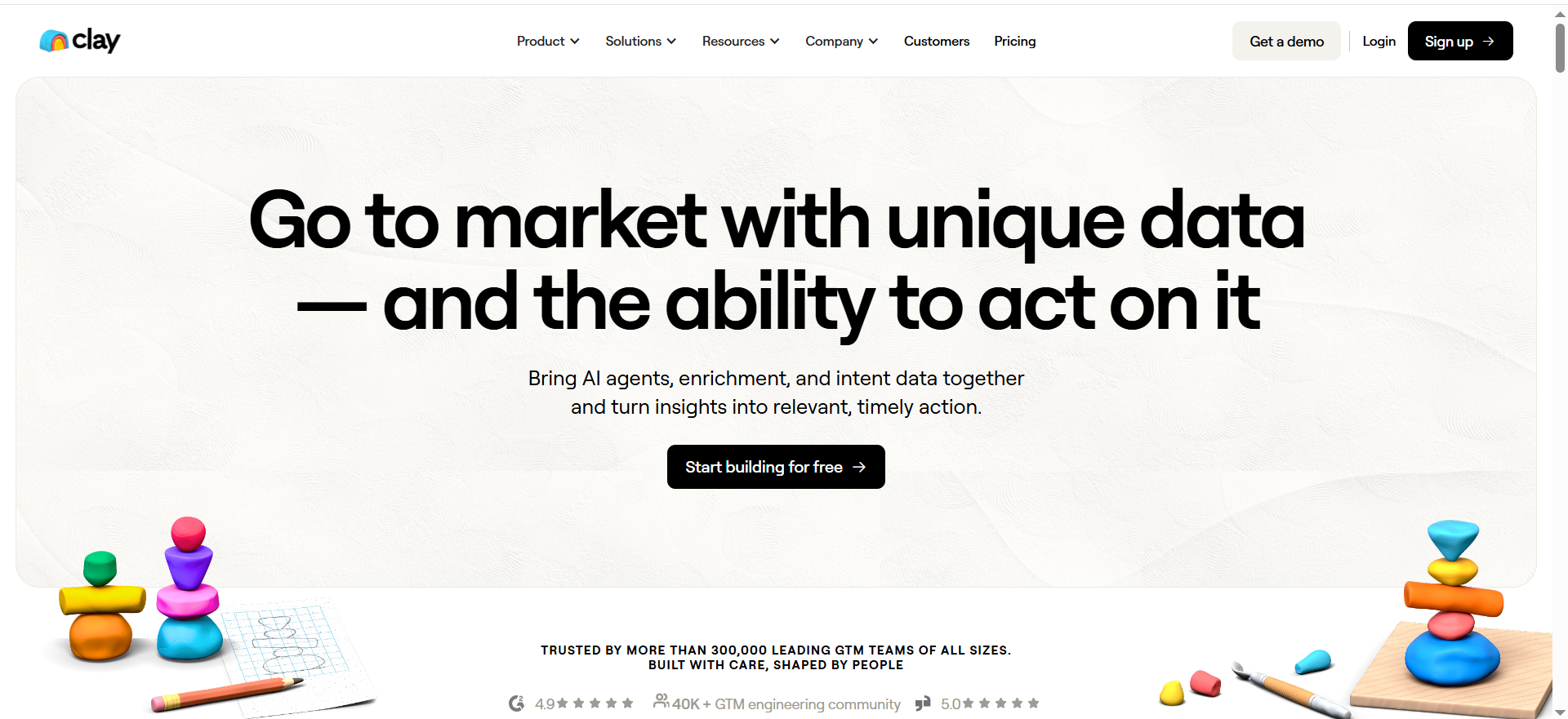
Clay is best understood as a prospecting workflow engine. You build tables of accounts/contacts and run “recipes” (automations) that can enrich data from many providers, scrape signals, and generate personalized outputs like first lines or snippets you can drop into sequences, which pairs well with an agile AI workflow playbook. Clay’s own pricing language emphasizes paying via credits for data provider actions, rather than a simple “all you can eat” subscription.
Why teams use it
Outbound teams adopt Clay when they’re tired of one-size-fits-all lists and generic personalization. Clay helps you:
- Start with a rough list (from your CRM, Apollo export, LinkedIn list, or a scraped set of companies)
- Add richer attributes (tech stack, hiring signals, funding events, job titles, intent signals, etc.)
- Produce usable personalization at scale (relevant opener, use-case angle, subject line variants)
- Route the output into your sequencing tool or CRM
It’s especially powerful when your ICP is narrow and your messaging needs to be specific, like security, data infra, or regulated industries where spray-and-pray fails fast.
What it’s good for
- List building that doesn’t embarrass you: You can create a high-quality list with fewer “wrong persona” contacts.
- Enrichment and data cleaning workflows: Great for de-duplication, formatting, verifying fields, and filling gaps.
- Personalization at scale: When you want to do more than just “{{first_name}}”.
- Segmenting by signals: For example, “companies hiring RevOps,” “recently raised,” “using competitor tech”, etc.
When it’s a good fit
Clay is a strong fit if:
- You have a clear ICP, and the problem is execution (data + research + personalization)
- You’re willing to invest in building and maintaining workflows
- You want flexibility: swapping data providers, trying new signals, changing criteria weekly
This is common in growth-stage SaaS teams where outbound is strategic and you can’t afford to burn domain reputation on bad targeting.
When it’s not a good fit
Clay can be the wrong first purchase if:
- You don’t yet know your ICP or offer (automation won’t fix messaging-market mismatch)
- Your team won’t maintain workflows (Clay rewards iteration)
- You really just need a basic prospecting database + sequences with minimal setup
Also: if your org is highly compliance-restricted, you’ll want to verify enrichment sources and processes carefully before scaling.
How to use it
Here’s a practical Clay workflow that maps to how outbound actually works:
- Start with accounts, not contacts
- Build an account list first (companies). It’s easier to validate ICP fit at the company level.
- Add qualifying signals
- Add fields like employee count range, industry tags, tech stack, hiring signals, funding stage, or geography. The goal is to create a “yes/no” filter before you ever pull contacts.
- Pull the right personas
- For each account, find contacts by role (titles) and department. Define 1–2 primary personas and 1 secondary persona. Don’t try to message everyone.
- Run an enrichment waterfall
- Use multiple sources in sequence (provider A, then provider B if missing). This improves coverage and can reduce the “unknown email” problem, but it’s also where credit costs can grow.
- Generate personalization artifacts
- Create fields like:
- “Why them” (company signal)
- “Why now” (timing signal)
- “Angle” (use case)
- “Opener line” (1–2 sentences)
- Keep artifacts short, because long AI paragraphs are a deliverability and relevance risk, so it helps to stick to safe AI writing practices when you scale.
- Create fields like:
- Export to sequencing
- Export clean, segmented lists with personalization fields that map directly into your sequences.
Key capabilities
- Multi-source enrichment and workflow automation
- Table-based prospecting ops (think “spreadsheet that does things”)
- AI-assisted research and message generation inside the workflow
- Integrations and exports into downstream systems (varies based on your setup)
Pricing
Clay’s pricing starts at $134/month for the Starter plan (billed annually). Enterprise pricing is custom and available by quote.
Free tier?
Clay offers a free tier ($0/month). It also offers a 14-day free trial.
Downsides / limitations
- Workflow overhead: you’ll need someone to own it (RevOps, growth ops, or a technical SDR)
- Costs can be opaque: credit usage depends on how often you enrich and which providers you hit
- Garbage in, garbage out: if your ICP criteria is wrong, Clay helps you scale the wrong thing faster
2. Apollo
What it does
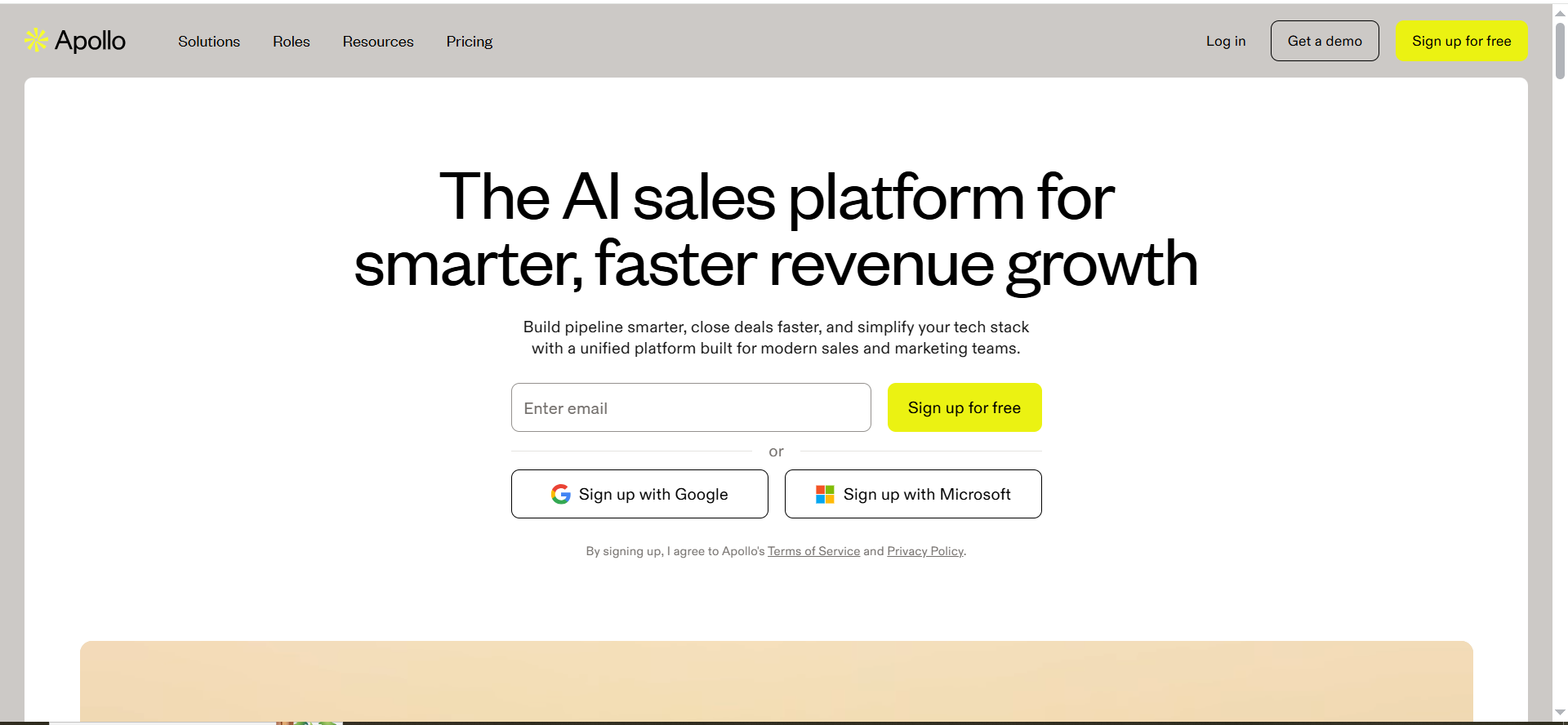
Apollo is a sales intelligence platform that combines a B2B contact database with outbound execution: prospecting, lists, sequences, and supporting workflows. It’s often used as the “single pane of glass” for early outbound because it reduces the number of tools you need on day one. Apollo publishes pricing tiers including a free plan and paid plans (for example, Basic from $49/user/month billed annually, based on their pricing page).
Why teams use it
Teams pick Apollo because it’s a practical default:
- You can get contacts quickly
- You can run sequences without wiring up a complex stack
- You can test outbound messaging with less setup time
For many B2B SaaS teams, Apollo is the fastest way to go from ‘we should do outbound’ to ‘we sent 1,000 emails this week,’ and the same speed tradeoff shows up in enterprise SaaS marketing tool choices. That can be good or bad, depending on how disciplined you are.
What it’s good for
- Prospecting at speed: filters, lists, exports, and immediate outreach
- Entry-level outbound stack: database + sequences + basic workflows
- Testing ICP hypotheses: run small experiments across segments
- Teams that need adoption: easier to standardize than a “build your own stack” approach
When it’s a good fit
Apollo is a good fit if:
- You’re building outbound muscle for the first time
- You want one tool to cover list building and initial outreach
- You need something your team will actually use without heavy ops support
When it’s not a good fit
Apollo may not be ideal if:
- You need highly specialized enrichment signals or custom workflows (Clay may be stronger)
- You’re running very high-volume deliverability-sensitive campaigns and want dedicated sending infrastructure (Instantly may be simpler for that)
- You require enterprise-grade governance and complex orchestration beyond “database + sequences”
How to use it
A simple Apollo setup that works:
- Define tight search filters
- Use firmographics and role filters to stay focused. The goal is fewer, better leads.
- Create persona-based lists
- Separate lists by persona and use-case so your messaging stays relevant.
- Write sequences by segment
- Avoid one mega-sequence, and instead align your outreach like a lifecycle content strategy with clear persona and use-case paths. Create 2–4 sequences aligned to your top segments.
- Use AI carefully
- AI can help draft variants, but don’t let it create “padded” emails. Short, specific, human-sounding outreach wins.
- Measure the right things
- Reply rate is not the KPI, so track meetings and qualified pipeline with the right marketing analytics tools. Meetings and qualified pipelines are.
Key capabilities
- Contact and company database
- Sequencing / outreach workflows
- Credits model for exports/contact data (varies by plan)
Pricing
Apollo’s pricing starts at $49 per user per month (billed annually) on the Basic plan.
Free tier?
Apollo offers a free tier (Starter is free forever). It also offers a free trial of paid plans.
Downsides / limitations
- Database limitations: coverage and accuracy vary by region/industry; you still need verification and list hygiene
- Temptation to over-send: easy access to contacts can lead to volume-before-quality behavior
- Differentiation: many competitors are using the same base database, so your edge comes from segmentation and messaging, which is why strong SEO copywriting best practices translate surprisingly well to outbound.
3. Regie.ai
What it does
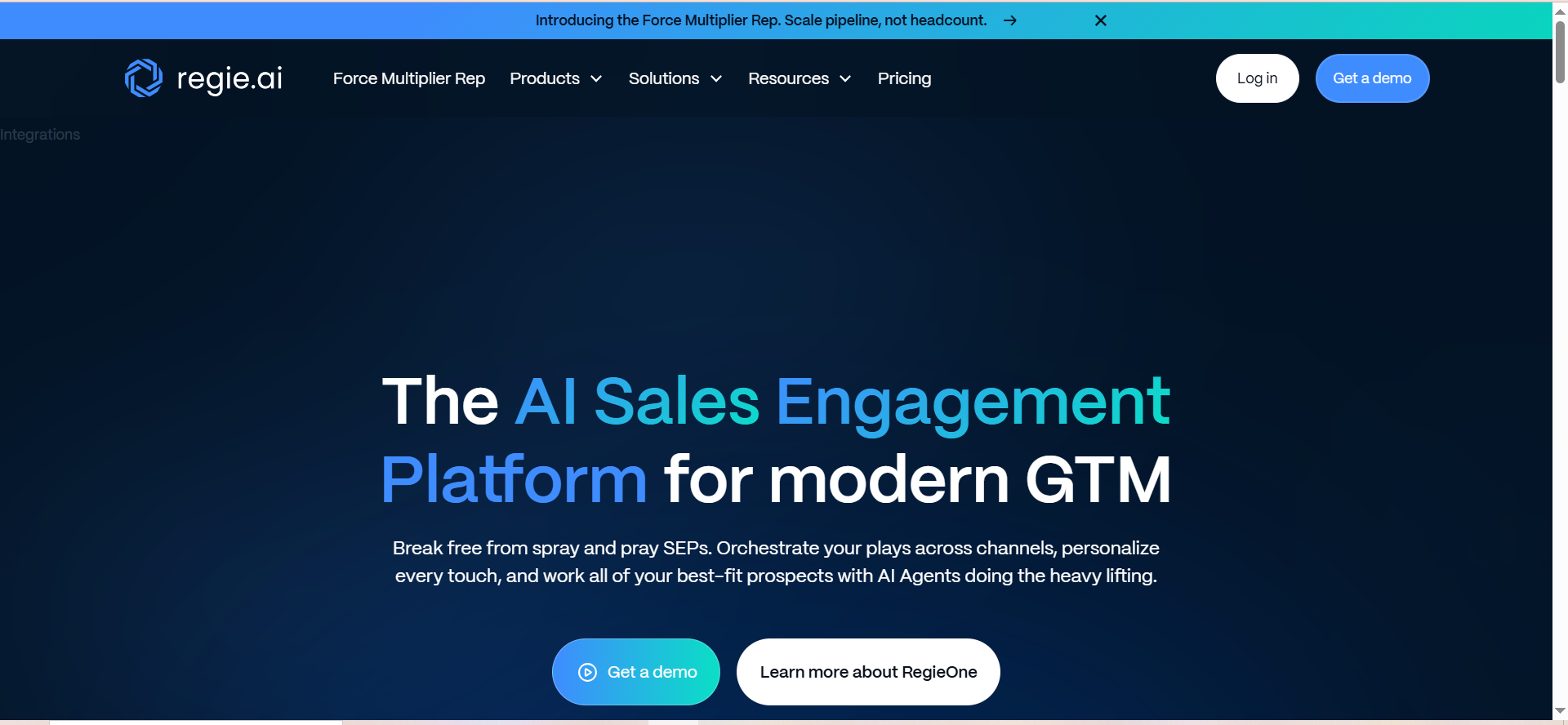
Regie.ai is positioned as an AI-powered outbound platform with sequencing agents, messaging, and execution features (including dialer elements and analytics depending on the package). Their pricing page describes plan options including AI SEP at $180/user/month and a higher tier at $499/user/month with expanded capabilities.
Why teams use it
Regie.ai is attractive when the question shifts from “Can we do outbound?” to “How do we scale outbound without scaling headcount linearly?”
In other words: you’re trying to increase coverage and speed, and you want more of the workflow orchestrated:
- selecting who to contact next (prioritization)
- generating on-message variants
- coordinating steps across channels (depending on setup)
- tracking which messaging actually contributes to outcomes
What it’s good for
- Outbound teams that already have baseline process
- Scaling coverage across larger account sets
- Standardizing messaging while still creating variants
- Operationalizing analytics around what’s working (content + sequences + outcomes) gets easier when you treat it like competitor benchmarking.
When it’s a good fit
Regie.ai tends to fit when:
- You have SDRs/AEs running outbound, and you need more leverage
- You already know your ICP and offer, and you want to industrialize execution
- You want more automation than a “normal sequencing tool” provides
When it’s not a good fit
It may not fit if:
- You’re early-stage and still discovering ICP (you’ll pay to automate confusion)
- Your biggest issue is data quality (start with data foundations first)
- You only need better emails (Lavender might deliver faster ROI at lower complexity)
How to use it
A practical rollout approach:
- Start with one segment + one play
- Pick a segment where you already have wins, and validate the payoff with a clear SaaS blog ROI timeline. Don’t start with your hardest niche.
- Define your messaging constraints
- AI tools work better when you give boundaries: value props, proof points, disqualifiers, tone.
- Instrument outcomes
- Align on what “success” means: meeting booked, SQL created, pipeline value, cycle time.
- Scale coverage incrementally
- Expand to additional segments only after you can show consistent performance, just like dialing in SaaS blog SEO publishing frequency before scaling output.
Key capabilities
Regie.ai’s pricing page highlights:
- sequencing agents (static and dynamic)
- intent prioritization
- dialer and “sales floor”
- AI messaging, coaching/voicemails
- analytics and integrations
Pricing
Regie.ai’s pricing starts at $180 per user per month for AI SEP (10-seat minimum). Higher tiers start at $499 per user per month.
Free tier?
Regie.ai doesn’t list a free tier. It offers a demo via “Talk to sales.”
Downsides / limitations
- You still need a strong ICP + offer: automation doesn’t create demand
- Change management: reps may resist “agent-driven” workflows if it feels prescriptive
- Implementation: you’ll want a clean CRM and clear routing rules to get full value
4. Lavender
What it does
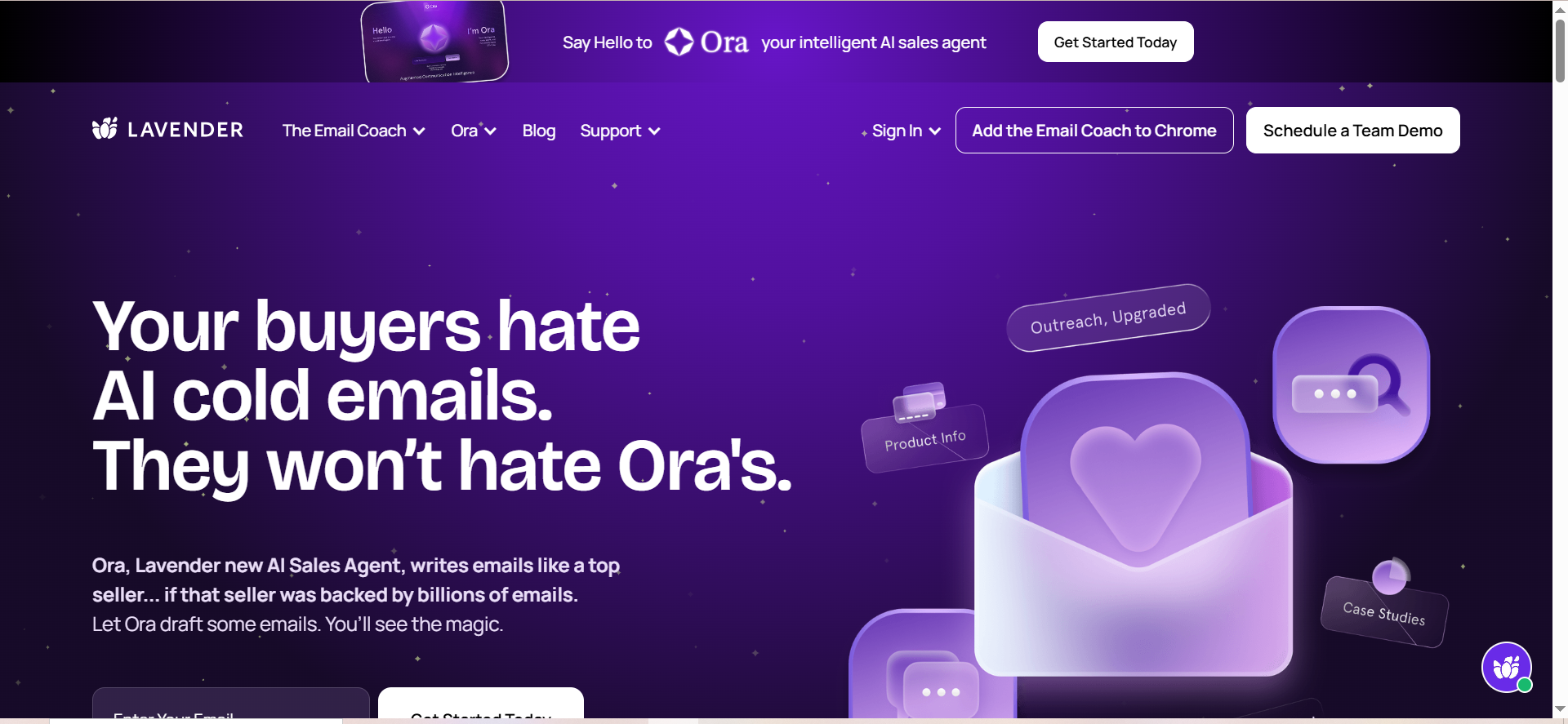
Lavender is an AI sales email coach. It focuses on improving the quality and effectiveness of outbound emails through real-time guidance, personalization assistance, and team-level insights.
Lavender’s help docs describe a Basic (free) plan with benefits like analyzing five emails per month and using the personalization assistant a limited number of times.
Third-party pricing listings also commonly show tiers from free up to paid levels (for example, G2 lists pricing editions and ranges).
Why teams use it
Most outbound programs don’t fail because they didn’t send enough emails. They fail because the emails weren’t good enough for the segment, or reps didn’t have the skill to write tight, relevant messages consistently.
Lavender is a “quality layer”:
- helps reps write better emails faster
- enforces good habits (clarity, structure, mobile-friendly formatting)
- reduces the gap between top performers and the rest of the team
What it’s good for
- SDRs and AEs who write a lot of 1:1 outbound
- Teams trying to improve reply rates without scaling volume
- Coaching and enablement (especially when you want consistent standards)
When it’s a good fit
Lavender is a good fit if:
- You already have decent targeting, but copy quality is inconsistent
- Your team struggles with personalization that sounds natural
- You want better emails without ripping out your whole stack
When it’s not a good fit
Lavender won’t fix:
- bad lists
- wrong personas
- weak offer positioning
- deliverability problems caused by sending infrastructure
If those are your issues, start with data hygiene and sending practices first, then add coaching.
How to use it
- Define your house style
- Decide what “good outbound” looks like for your org (length, tone, proof points).
- Create templates per segment
- Keep a few core structures, then personalize the first 1–2 lines.
- Coach with examples
- Use winning emails as internal benchmarks, and if you want a reference point for what “good” looks like, compared against B2B SaaS content benchmarks. The point is consistency, not novelty.
- Measure improvements
- Look for: positive reply rate, meeting rate per send, and time-to-first-draft.
Key capabilities
- Real-time email coaching
- Personalization assistant
- Integrations depend on plan and workflow; confirm based on your setup
Pricing
Lavender’s pricing starts at $29/month on the Starter plan. The Pro plan is $49/month, and Teams pricing starts at $8,500.
Free tier?
Lavender offers a free tier (Basic) with limited usage.
Downsides / limitations
- Not a data tool: it won’t improve list quality
- Not a sequencing engine: you still need a platform to run campaigns
- Requires behavior change: coaching only works if reps actually use it
5. Instantly
What it does
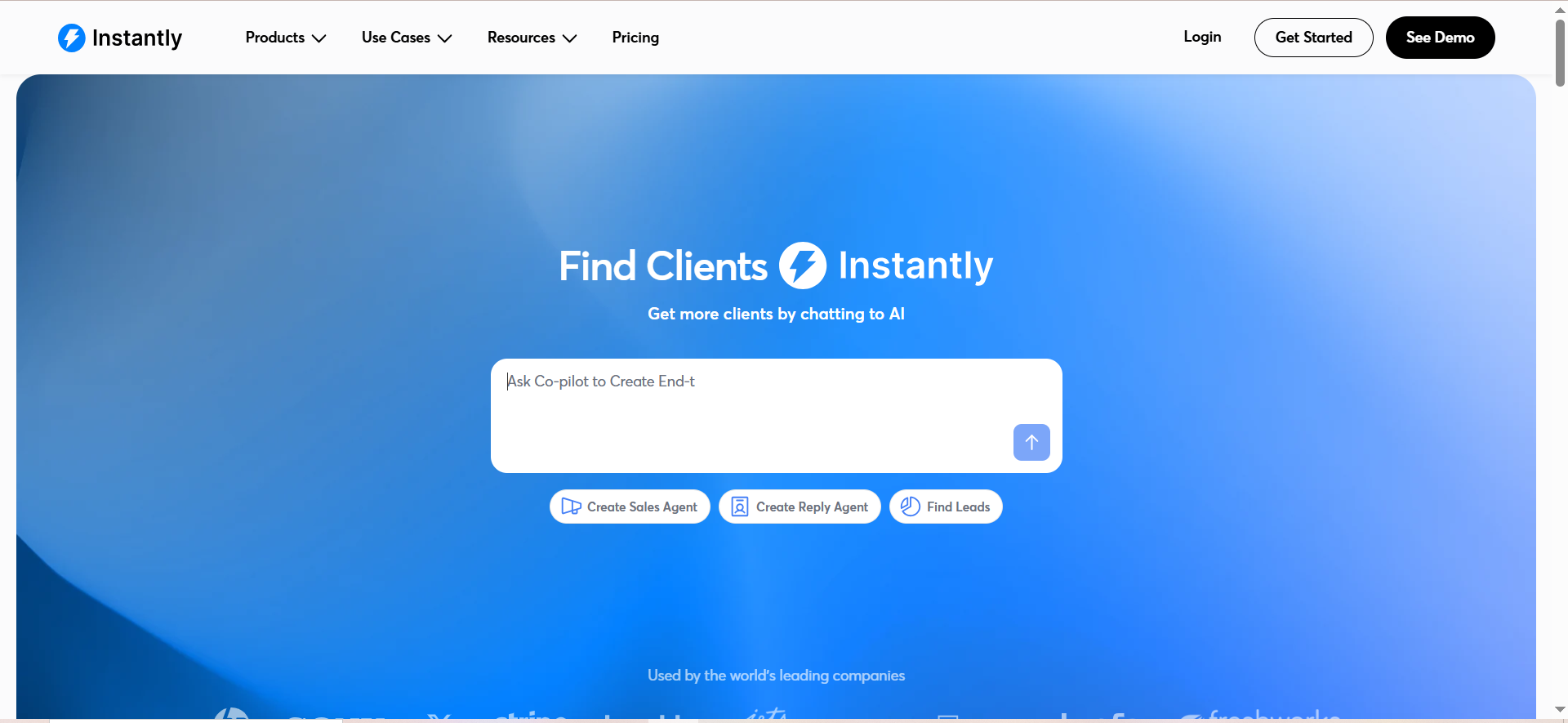
Instantly is best known for cold email at scale: sending infrastructure features (warmup, multiple inboxes), campaign execution, and simple pricing tiers. Their pricing page lists plans (for example, Growth and Hypergrowth) and encourages starting free.
Why teams use it
Instantly is popular when:
- you want to send meaningful volume
- you want built-in warmup and deliverability mechanics
- you don’t want per-seat pricing to explode as you add inboxes/users
It tends to be chosen by outbound-focused teams and agencies who care about throughput and deliverability, which is also why many teams look at AI marketing tools for agencies.
What it’s good for
- High-volume cold email with multiple inboxes
- Teams that want sending simplicity
- Outbound programs where deliverability is a first-class concern
When it’s a good fit
Instantly is a strong fit if:
- Cold email is a core channel
- You want to scale sending while managing warmup and rotation
- You have (or can produce) good lists and personalization fields to feed it
When it’s not a good fit
Instantly may not be your first choice if:
- You need a built-in prospecting database as the primary feature (Apollo leads here)
- Your team needs heavy coaching and enablement (Lavender layer)
- You want highly custom enrichment workflows (Clay layer)
How to use it
- Set up sending properly first
- Configure domains and inboxes carefully, and don’t rush setup, especially if you’re also planning SEO automation across your growth stack.
- Start with low volume
- Gradually ramp. The goal is steady performance, not a spike.
- Segment campaigns
- Separate by persona and use-case.
- Use personalization fields
- AI can help draft, but you still need strong inputs.
- Watch deliverability signals
- Monitor bounce rates, spam complaints, and sudden drops in open/reply trends, and treat it like ongoing visibility tracking rather than a one-time setup task.
Key capabilities
Instantly’s pricing page highlights:
- unlimited email accounts (plan-dependent)
- email warmup
- volume limits by tier (emails/month, leads uploaded)
Pricing
Instantly’s Email Outreach pricing starts at $47/month on the Growth plan. Higher tiers (like Hyper Growth and Light Speed) start at $97/month and $358/month.
Free tier?
Instantly doesn’t list a free tier for Email Outreach, but it does offer a free trial.
Downsides / limitations
- You still need data: Instantly doesn’t magically solve “who should we email?”
- Bad targeting scales badly: it’s easy to hurt reputation if you scale too fast
- Add-ons can matter: depending on plan and volume, you may need add-ons for capacity
How to Choose the Right AI Outbound Stack
If you only remember one idea from this guide, make it this: your outbound stack should reflect your bottleneck, and that’s the same mindset behind a good SaaS content audit and fix sprint.
- If the bottleneck is finding and qualifying the right people, start with data + enrichment (Clay or Apollo).
- If the bottleneck is running consistent outreach, start with sequencing + sending infrastructure (Apollo or Instantly).
- If the bottleneck is quality of emails and rep execution, add coaching (Lavender).
- If the bottleneck is scaling coverage and orchestration, evaluate AI SDR orchestration (Regie.ai).
Pick your “source of truth”
Decide where your canonical customer and activity records live:
- CRM as source of truth (common in mature orgs)
- SEP/engagement platform as source of truth (sales-led orgs)
- Prospecting system as source of truth (early stage, fast iteration)
If you don’t choose, your stack will choose for you, and you’ll end up with duplicates, messy attribution, and confused reporting, which is why AI visibility reporting needs a clear source of truth.
A simple decision tree
Use this as a quick heuristic:
- Do we already have a reliable way to source leads?
- No → Start with Apollo (fast) or Clay (flexible + powerful).
- Yes → Go to #2.
- Is our main problem “we can’t send enough”?
- Yes → Instantly (scale sending) + your data source.
- No → Go to #3.
- Is our main problem “emails aren’t converting”?
- Yes → Add Lavender for coaching and consistency.
- No → Go to #4.
- Are we trying to scale coverage without scaling headcount linearly?
- Yes → Evaluate Regie.ai style orchestration.
- No → Keep stack lean and focus on process.
Budgeting: where costs really show up
Tool subscription price is rarely the true cost, so plan to spend the way a Series A SaaS content marketing budget does. The real costs are:
- Data credits (enrichment, exports, intent signals)
- Verification (bounces are expensive)
- People time (workflow maintenance, copy iteration, QA)) is a real cost, so it helps to keep a handle on it with time tracking.
- Deliverability failures (domain burn is a tax you pay later), and the same kind of downside shows up when Google SGE impacts SaaS blog traffic.
A low-cost tool that causes deliverability issues is often more expensive than a pricier tool used carefully, which is why teams invest in a repeatable SaaS content marketing system instead of one-off fixes.
📋 Get Listed / Advertisement
We update this guide monthly, and if you want your tool featured you can reach us via Contact Us: [email protected].
What tool is best for cold email sequencing at scale?
If your goal is to run cold email at meaningful volume (multiple inboxes, consistent sending, easy campaign management), Instantly is usually the most straightforward pick from the tools in this guide because it’s built around scaling outbound sends and managing the mechanics that come with it (warmup, inbox rotation, campaign execution).
That said, “best” depends on what you mean by sequencing:
If you mean “send a lot of cold email reliably”
Best fit: Instantly
- Designed for high-volume cold email execution
- Emphasizes warmup + sending infrastructure, not just sequence steps
- Works well when you already have lists and personalization fields coming from somewhere else (Clay/Apollo/your CRM)
Why teams choose it: It reduces friction around the operational parts of scaling (multiple inboxes, warmup, sending limits) so you can focus on segmentation and messaging.
If you mean “sequencing + built-in prospecting database”
Best fit: Apollo
- Good option if you want prospecting + sequences in one platform
- Faster to get started if you don’t want a separate sending tool right away
Why teams choose it: It’s convenient. You can source leads and run sequences without stitching multiple tools together, which is great early on.
If you mean “advanced orchestration (AI SDR-style workflows)”
Best fit: Regie.ai
- More suitable when you have a defined outbound motion and want agent-driven sequencing, standardization, and analytics layers on top
Why teams choose it: Scaling coverage across segments and teams, with more automation and coordination than a typical sequencer.
A practical recommendation (most teams)
- Early stage / lean team: Apollo first (speed), then add Instantly when volume and deliverability matter more.
- Outbound is a core growth lever: Data + personalization (Clay) → Sending at scale (Instantly) is a common combo.
- Mature SDR org: Consider Regie.ai if you’ve already nailed ICP and want orchestration.
How do I avoid deliverability issues when using AI to scale outbound?
The uncomfortable truth: AI makes it easier to send more, but deliverability is earned slowly and lost quickly. The safest approach is to use AI to increase relevance and targeting precision, not just volume, which is why tighter marketing research matters before you scale sends. Here’s a practical playbook that keeps you out of trouble.
1) Ramp volume slowly (even if AI can write 1,000 emails in a minute)
Deliverability systems reward consistent behavior, so avoid sudden spikes and follow a durable AI search visibility strategy mindset as you scale. Sudden spikes are risky.
- Start low, ramp gradually week over week
- Keep a steady cadence per inbox
- Avoid launching multiple new campaigns at once
Tools built for scaled cold email often highlight warmup and infrastructure features that support this approach.
2) Keep emails short, specific, and human
AI-generated emails get flagged when they look like “marketing copy” or when they’re overly long and templated, so use AI proofreading tools to keep them tight.
- Aim for 60–120 words
- One clear idea, one CTA
- Avoid heavy formatting, links, and attachments in early touches
- Don’t over-personalize with creepy details (that triggers spam reports)
If your issue is email quality, an AI coaching tool like Lavender helps reps write tighter emails that read more naturally, which also supports CRO-focused improvements across the funnel.
3) Segment harder than you think you need to
Most deliverability problems start with poor targeting, so build segments by persona, use case, and trigger using a clear keyword research framework for how you define each segment. If people don’t recognize your relevance, they ignore you or mark you as spam.
- Build segments by persona + use case + trigger
- Write separate sequences per segment (don’t force one generic sequence across everyone)
- Cut segments that produce low engagement quickly, using the same mindset as a disciplined content pruning process.
This is where Clay can help: it’s strong for creating enriched, signal-based segments and generating controlled personalization fields.
4) Use AI for research and first lines, not full “autopilot” blasting
A good pattern:
- AI generates: 1–2 line opener, a relevant angle, and a proof point
- You control: the core message structure and CTA
This keeps your emails consistent and reduces the “AI voice” that hurts replies and can increase spam complaints, which is why teams focus on getting cited in AI answers instead of chasing volume.
5) Verify and clean your data before you scale
Bad emails (bounces) will wreck deliverability fast.
- Verify email addresses (especially if enriched from multiple sources)
- Deduplicate contacts across tools
- Remove role accounts (info@, support@) and risky domains
If you’re using a prospecting database tool, remember coverage and accuracy vary. “Database says it exists” isn’t the same as “deliverable inbox.”
6) Watch the right early warning metrics
Don’t wait for things to crash, and monitor bounce rate, spam complaints, and reply quality like you would in a brand visibility audit. Track:
- Bounce rate (hard bounces are a red flag)
- Spam complaint rate (even small numbers matter)
- Reply quality (positive vs negative replies)
- Sudden drops in opens/replies (trend matters more than a single day)
7) Make opt-out easy and honor it
This is both a compliance and reputation move.
- Include a simple opt-out line
- Maintain suppression lists across tools
- Don’t re-import suppressed leads into new campaigns
8) Use the right tools for the right layer
- Instantly helps with scaling sends and warmup mechanics.
- Clay helps improve targeting and personalization inputs.
- Lavender helps improve email quality and consistency.
A safe “AI scaling” checklist (copy/paste)
- Segments are tight (persona + use case + trigger)
- Emails are short, specific, and sound human
- Verified emails, cleaned list, deduped contacts
- Gradual ramp with stable daily volumes per inbox
- One campaign launch at a time
- Monitor bounces/complaints/reply quality daily
- Opt-out and suppression handled correctly
FAQs
What are “AI SDR tools” and do they replace SDRs?
What’s the safest way to use AI for outbound travel without hurting deliverability?
Should I start with Clay or Apollo?
Is Instantly only for agencies?
When does it make sense to buy Regie.ai (or similar orchestration platforms)?
What metrics should I track to judge whether these tools rate (list health)?
📋 Get Listed / Advertisement
We update this guide monthly, and if you want your tool featured you can reach us via Contact Us: [email protected].