

The best demand generation tools for B2B teams depend on your biggest funnel need. HubSpot is the best all-in-one option for most growth-stage B2B SaaS teams, while Marketo is better for enterprise companies with more complex automation needs. Clearbit helps improve lead quality and form conversion, 6sense is ideal for ABM and intent-driven targeting, and LinkedIn Ads is one of the best paid channels for reaching B2B buyers. For most teams, the best stack is not the biggest one. It is the one that helps you generate demand, qualify leads, and drive pipeline efficiently.
If you run B2B demand generation, the right tool stack does not just help you send more campaigns, and for teams building a scalable engine, a stronger SaaS content marketing foundation often supports everything that follows. It helps you identify the right accounts, capture intent earlier, reduce friction in your funnel, route leads faster, and prove which programs are actually creating pipeline.
The best demand generation tools for B2B teams in 2026 are HubSpot for all in one campaign execution, Adobe Marketo Engage for enterprise marketing automation, Clearbit for enrichment and form conversion, 6sense for ABM and intent driven orchestration, and LinkedIn Ads for paid reach into professional buying committees, and the right AI marketing stack depends on whether your biggest problem is automation, enrichment, targeting, orchestration, or distribution. The right choice depends on whether your biggest problem is automation, enrichment, targeting, orchestration, or distribution.
📋 Get Listed / Advertisement
We update this guide monthly. Want your tool featured? Contact: [email protected].
Best Demand Generation Tools for B2B Teams
| Tool | Best for | Core strength | Pricing visibility |
|---|---|---|---|
| HubSpot | Growth stage teams that want an all in one system | Marketing automation, landing pages, forms, reporting, CRM alignment | Public pricing available |
| Adobe Marketo Engage | Enterprise B2B teams with complex lifecycle marketing | Advanced automation, nurture, segmentation, analytics | Custom quote |
| Clearbit | Teams that need better data and higher form conversion | Enrichment, visitor identification, form shortening, routing | Custom / evolving under HubSpot |
| 6sense | ABM heavy teams focused on buying signals and account prioritization | Intent, predictive scoring, audience orchestration, AI driven workflows | Custom quote |
| LinkedIn Ads | Teams that need paid distribution to the right professional audience | Precise B2B targeting, lead gen forms, content distribution | Auction based |
This ranking is less about which platform has the longest feature list and more about where each tool creates leverage in a modern B2B funnel.
- Choose HubSpot if you want one platform to manage campaigns, forms, landing pages, email, and core reporting without stitching together a huge stack.
- Choose Marketo if you already operate at enterprise scale and need more sophisticated lifecycle orchestration and segmentation.
- Choose Clearbit if lead quality, enrichment, and conversion friction are bigger problems than campaign execution.
- Choose 6sense if your team runs ABM and needs intent based account selection, prioritization, and multi channel activation.
- Choose LinkedIn Ads if your strongest bottleneck is reaching the right buyers, especially for high value B2B offers.
📋 Get Listed / Advertisement
We update this guide monthly. Want your tool featured? Contact: [email protected].
1. HubSpot
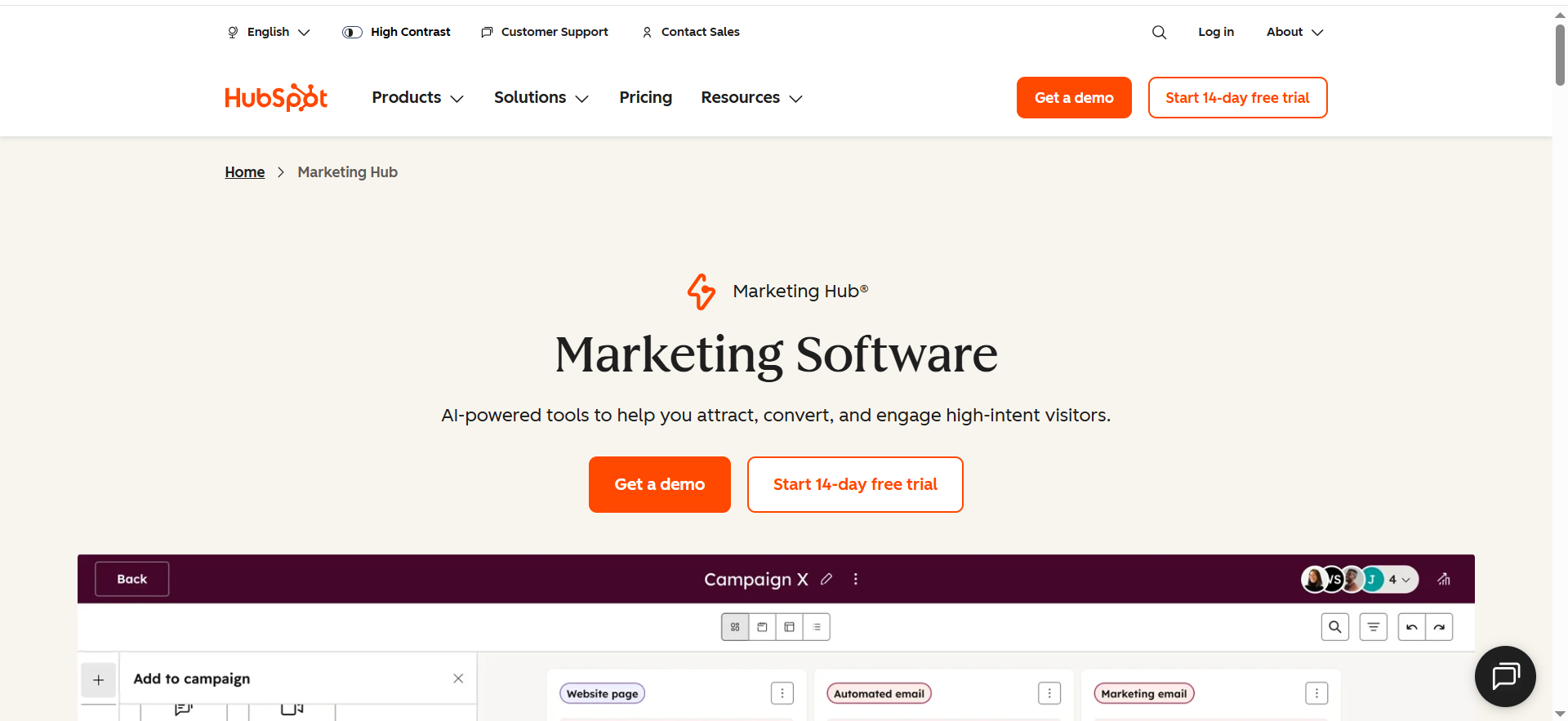
What it does
HubSpot Marketing Hub is an all in one marketing platform built around campaign execution, lead capture, automation, reporting, and CRM connectivity. HubSpot’s official pricing guide positions it as a platform for generating leads, automating campaigns, and measuring marketing performance, with tiers from free tools up through enterprise.
Why teams use it
B2B teams use HubSpot because it reduces stack sprawl, which is a common challenge for teams building a more efficient B2B SaaS SEO workflow. Instead of bolting together separate tools for landing pages, forms, email, basic automation, and analytics, they can run a meaningful share of demand gen in one place, which also supports better SEO copywriting. That matters for growth teams that need speed, clean handoffs to sales, and better visibility without enterprise implementation overhead, which is also why many teams care about a stronger agile workflow.
What it’s good for
HubSpot is especially strong for:
- inbound and lead capture
- campaign automation
- landing pages and forms
- email nurture
- early to mid stage reporting
- close alignment between marketing and sales
It is a strong fit when a team wants operational simplicity as much as raw capability, especially if they are still comparing their broader tool stack.
When it’s a good fit
HubSpot is a good fit when:
- you are a growth stage B2B SaaS company
- your team wants an all in one operating layer
- marketing and sales already work closely
- you care about speed to launch
- you need a system non technical marketers can actually use
When it’s not a good fit
It is less ideal when:
- your lifecycle design is highly complex
- you need very deep enterprise governance and segmentation
- you already have a large, mature Adobe or Salesforce environment
- your team needs advanced ABM intelligence more than campaign execution
How to use it
A practical HubSpot demand gen motion looks like this: run LinkedIn or search campaigns into a gated landing page, capture leads with native forms, enrich or score them, route based on lifecycle stage, then trigger email marketing nurture and sales alerts. For many growth teams, that is enough to cover most of the funnel without adding much operational drag.
Key capabilities
HubSpot’s current public materials point to forms, email marketing, automation, ads, landing pages, social tools, analytics, and lead scoring across tiers, with more advanced reporting and omni-channel automation higher up the stack.
Pricing
HubSpot’s Marketing Hub starts at $15/month per seat on Starter, while higher tiers start at $800/month for Professional and $3,600/month for Enterprise.
Free tier?
HubSpot does offer a free tier. It also offers free marketing tools with no credit card required.
Downsides / limitations
HubSpot can become expensive as contacts, seats, and add ons grow. Its own pricing guide calls out onboarding fees for higher tiers and extra costs tied to contact volume and usage based add ons. It is also not the strongest option here for high maturity ABM programs compared with 6sense, or for enterprise lifecycle complexity compared with Marketo.
2. Adobe Marketo Engage
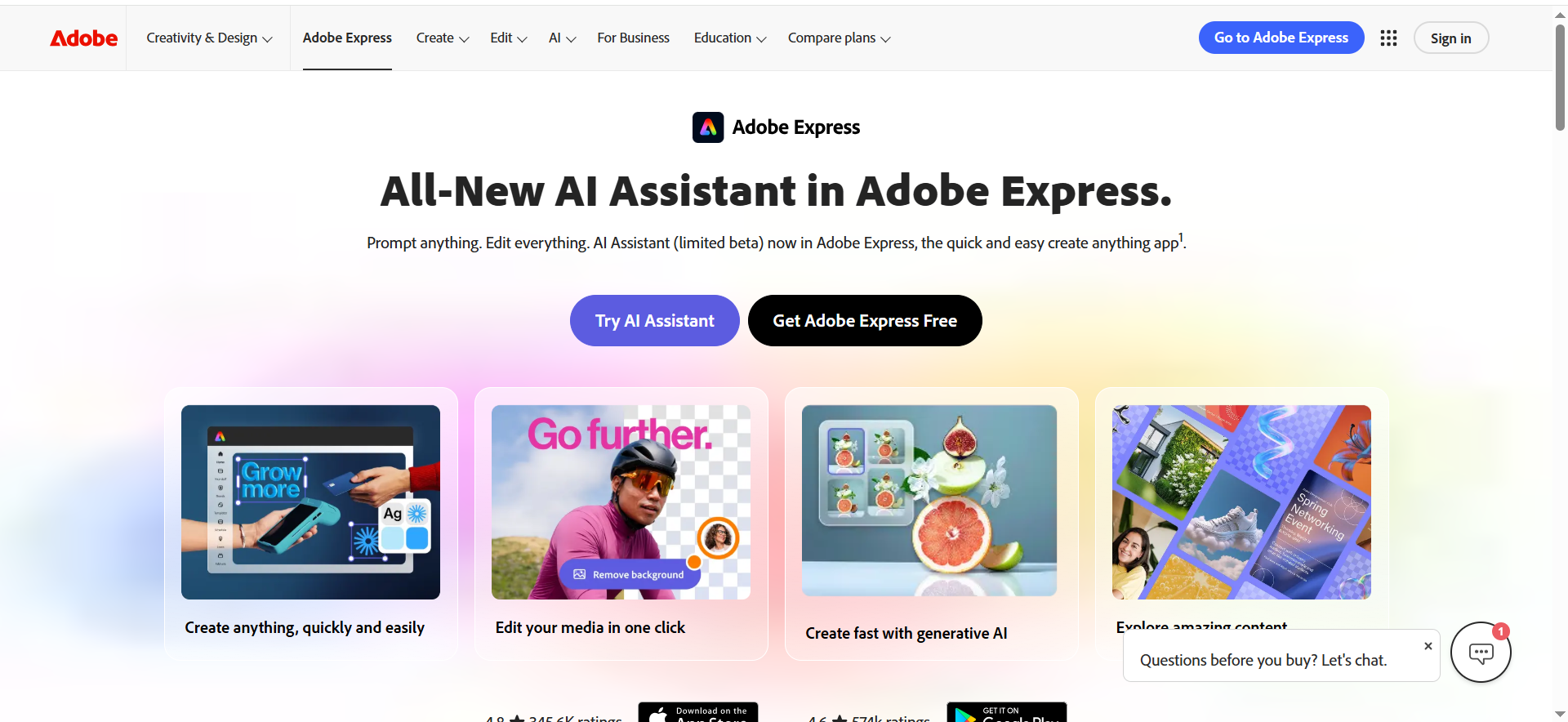
What it does
Adobe Marketo Engage is an enterprise marketing automation platform for orchestrating buyer journeys across channels, nurturing leads, syncing with sales, and measuring marketing impact. Adobe describes it as an AI powered platform built to scale personalized buyer engagement and predictable pipeline.
Why teams use it
Teams use Marketo when lifecycle marketing gets complicated, which is why it often comes up in broader evaluations of marketing automation tools.
What it’s good for
Marketo is good for:
- enterprise B2B lifecycle orchestration
- multi step nurture design
- complex audience segmentation
- marketing operations at scale
- close sales and marketing alignment
- attribution support through Marketo Measure
Adobe explicitly highlights audience building, omnichannel engagement, personalized content, campaign operations, sales alignment, and marketing impact measurement.
When it’s a good fit
Marketo is a strong fit when:
- you run a large B2B database
- you have multiple personas, products, regions, or lifecycle paths
- your marketing ops team is experienced
- you need enterprise controls and compliance support
- you want a system that can sit at the center of a more complex GTM architecture
When it’s not a good fit
It is not the best fit when:
- your team is small
- you need quick deployment with minimal admin overhead
- you want transparent self serve pricing
- your priority is easier usability over enterprise flexibility
How to use it
A common Marketo motion is to acquire traffic from paid and partner channels, score or segment leads by fit and behavior, move them into nurture streams, sync qualified records into CRM, and measure influence across the pipeline, which also supports stronger search visibility strategy. It works best when paired with a clear lifecycle framework and strong ops ownership, especially for teams that already rely on content benchmarks to guide planning.
Key capabilities
Adobe’s product page highlights targeted audiences, profile enrichment, native CRM integration, omnichannel campaigns, sales and marketing alignment, and measurement of marketing impact on pipeline and revenue. Adobe also separately positions Marketo Measure as a multi touch attribution tool for understanding campaign and channel impact.
Pricing
Marketo’s pricing is not publicly listed in dollars; it’s available by quote. Adobe offers four plans: Growth, Select, Prime, and Ultimate.
Free tier?
Marketo doesn’t offer a free tier. Adobe directs buyers to request pricing or a demo.
Downsides / limitations
Marketo’s main tradeoff is complexity. It usually requires more implementation discipline, stronger ops support, and a clearer systems design than HubSpot. It is powerful, but it is rarely the easiest tool to stand up fast.
3. Clearbit
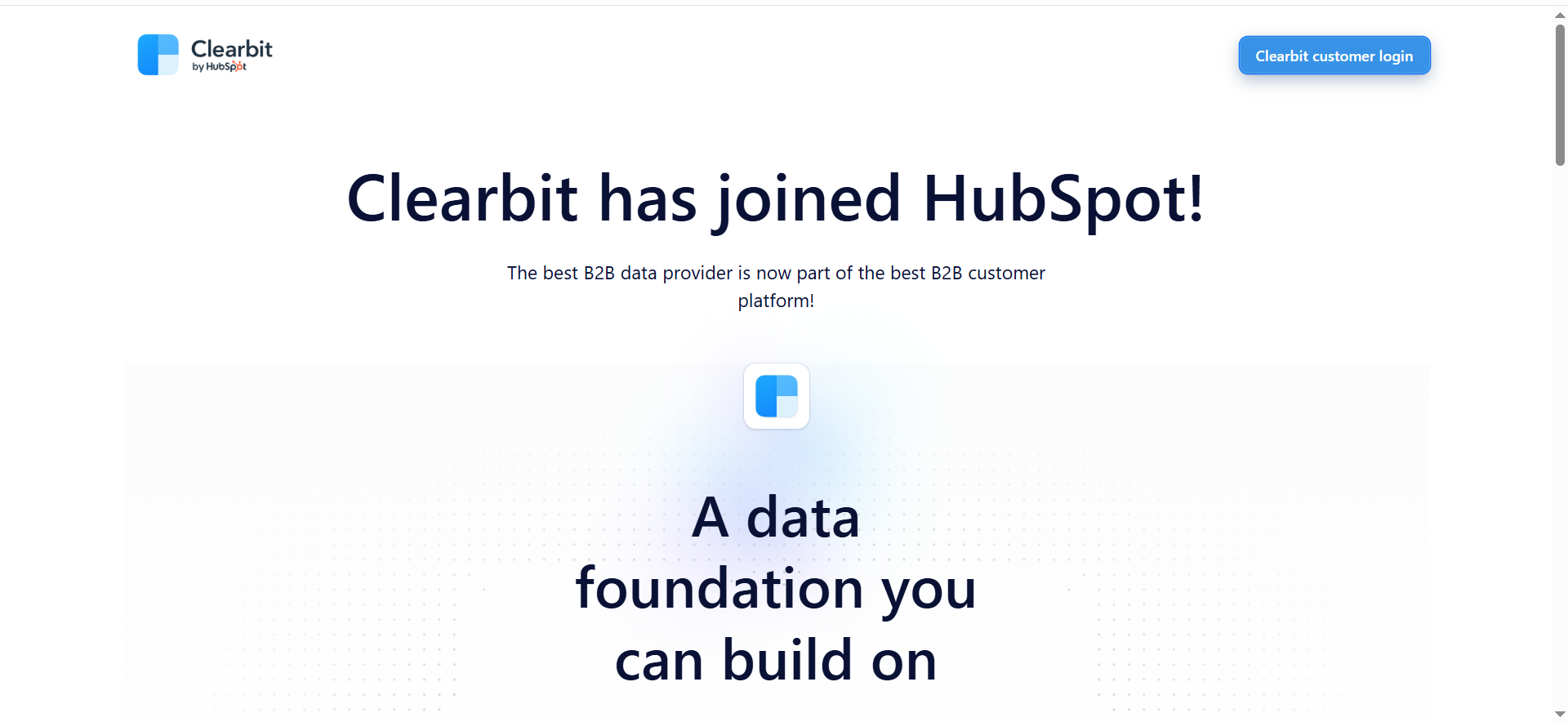
What it does
Clearbit is a B2B data and enrichment platform now folded into HubSpot’s ecosystem. Its current site positions it around record enrichment, lead scoring and routing, visitor identification, and form shortening, while HubSpot confirmed it completed the Clearbit acquisition in December 2023.
Why teams use it
Demand gen teams use Clearbit because bad data quietly wrecks performance, especially for teams trying to improve lead generation efficiency. If your targeting is weak, your forms are too long, or your routing is inconsistent, campaign efficiency falls apart before automation even matters, which is also why CRO for product-led content becomes important.
What it’s good for
Clearbit is good for:
- enriching leads, contacts, and accounts
- shortening forms without losing coverage
- identifying anonymous website visitors
- routing based on firmographic fit
- improving downstream lead quality
Clearbit’s site specifically highlights global company and contact data, role normalization, corporate hierarchy support, buying intent signals from visitor identification, and dynamic form shortening.
When it’s a good fit
It is a good fit when:
- paid and inbound campaigns produce lots of partial or messy leads
- your forms convert poorly because they ask for too much
- SDRs complain that MQL quality is inconsistent
- you want to route faster based on fit and intent signals
When it’s not a good fit
It is less useful as a standalone investment if:
- you do not have enough traffic or lead volume to benefit from enrichment
- your primary issue is campaign orchestration, not data quality
- you need a full marketing automation platform rather than a data layer
How to use it
A strong use case is simple: reduce your form to email plus one key field, enrich the rest, score by fit, route instantly, then push high value leads into SDR or lifecycle workflows, which also supports stronger CRO. That kind of setup often improves conversion rate and speed to lead at the same time.
Key capabilities
Clearbit’s site says it can enrich every record, score and route leads in real time, reveal buying intent from anonymous traffic, and shorten forms by hiding fields it can already enrich from an email address.
Pricing
Clearbit’s pricing is not publicly listed. Its current product site describes the product, but does not publish standard self-serve pricing.
Free tier?
Clearbit doesn’t clearly offer a public free tier for its main platform. It does have some free resources or APIs, but the core product’s free-tier details are not publicly stated on the main product page.
Downsides / limitations
The biggest limitation is that Clearbit is not a complete demand gen system on its own, and that kind of dependency is easier to evaluate with a stronger content audit process. It is a force multiplier. It works best when paired with a CRM, MAP, or campaign platform. Buyers should also evaluate how its current packaging fits into HubSpot’s post-acquisition roadmap, especially if they are reviewing broader vendor categories.
4. 6sense
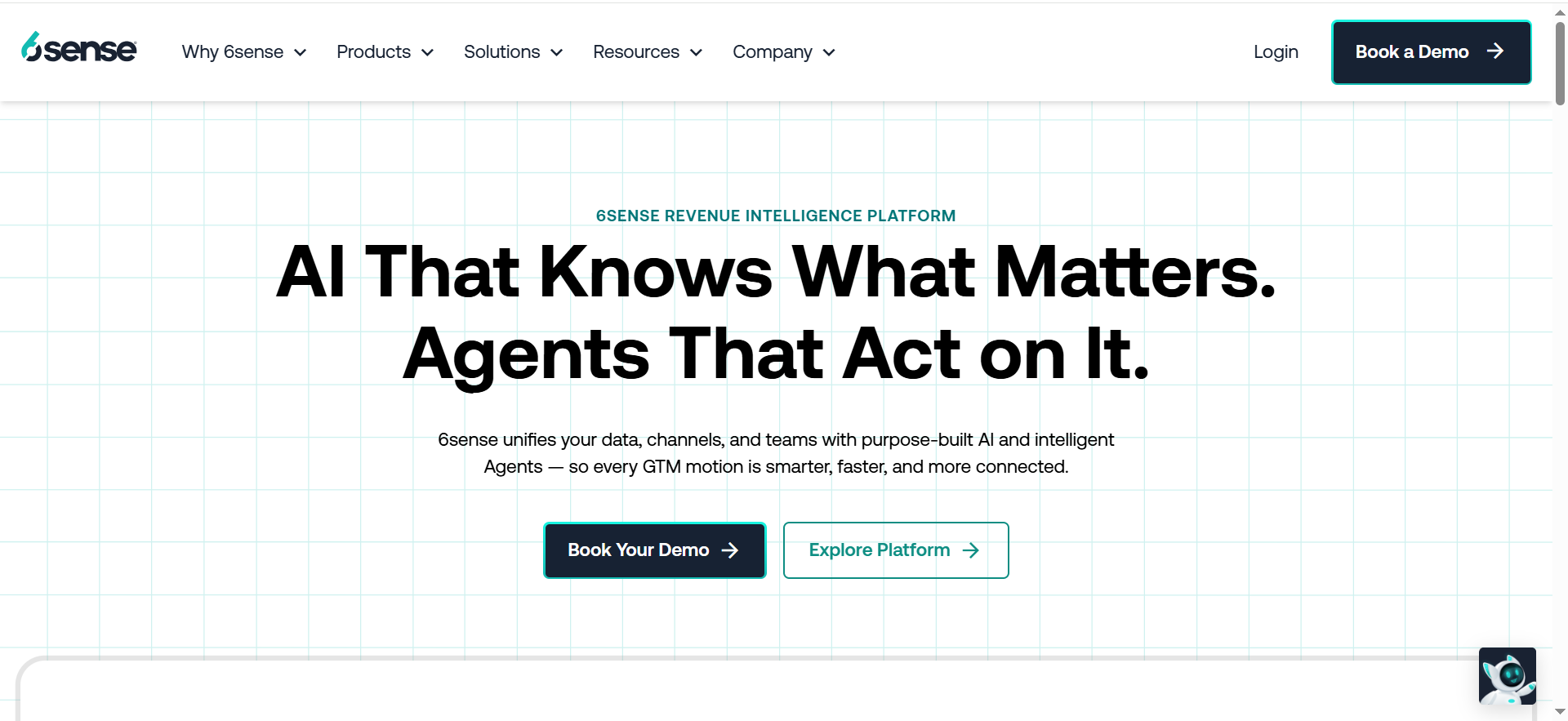
What it does
6sense is a revenue AI and ABM platform focused on account identification, intent, predictive modeling, audience prioritization, and orchestration across inbound, outbound, and advertising. Its current positioning emphasizes unifying data, channels, and teams, then using AI and buyer signals to focus effort on likely buyers.
Why teams use it
Teams use 6sense when traditional lead based demand gen is no longer enough, especially in more advanced AI marketing use cases where signal quality matters. In larger B2B motions, the goal is not just collecting more leads, and teams often need a clearer buyer guide before expanding the stack. It is identifying which accounts are actually in the market, seeing early buying signals, and coordinating marketing and sales around that intelligence.
What it’s good for
6sense is good for:
- ABM program orchestration
- intent driven targeting
- account prioritization
- AI assisted audience selection
- ad and email activation based on buyer behavior
- aligning inbound and outbound around the same account view
Its public materials point to form shortening, inbound follow up, intent scoring, AI driven predictions, omnichannel campaign response to real time activity, and hyper personalized campaigns.
When it’s a good fit
It is a strong fit when:
- you sell into named accounts
- your average contract value is high
- you need to prioritize budget around in market accounts
- marketing and sales both operate on an account based motion
- your funnel needs better signal quality, not just more volume
When it’s not a good fit
It is probably overkill when:
- you are a very early stage team
- your database and traffic volume are still limited
- your team does not yet have a mature ICP and account strategy
- you want simple campaign execution more than intelligence and orchestration
How to use it
A common 6sense motion looks like this: identify in market accounts, build audience segments, activate ads and outbound around those accounts, shorten inbound forms, prioritize handoffs, and measure which accounts progress. It works best when the business already has discipline around ICP, segments, and stage definitions, which is closely tied to having a better keyword research process.
Key capabilities
6sense says its platform helps marketers spot early buying signals, maximize ROI by focusing budget and effort on likely buyers, break down data silos, run omnichannel campaigns tied to buyer activity, and reduce repetitive work through AI supported workflows that fit modern marketing automation.
Pricing
6sense’s paid pricing is not publicly listed for its full platform; it’s available by demo or quote. 6sense does publicly show a Free Sales Intelligence plan, alongside paid Sales Intelligence options.
Free tier?
6sense does offer a free tier for Sales Intelligence, which includes 50 data credits per month. For broader demand gen and ABM use cases, pricing is sales-led.
Downsides / limitations
6sense requires maturity. If your team does not already know its ICP, segmentation logic, and handoff rules, you can buy a lot of sophistication without getting enough business value back. It is most useful when paired with a strong GTM process, not as a shortcut around it.
5. LinkedIn Ads
What it does
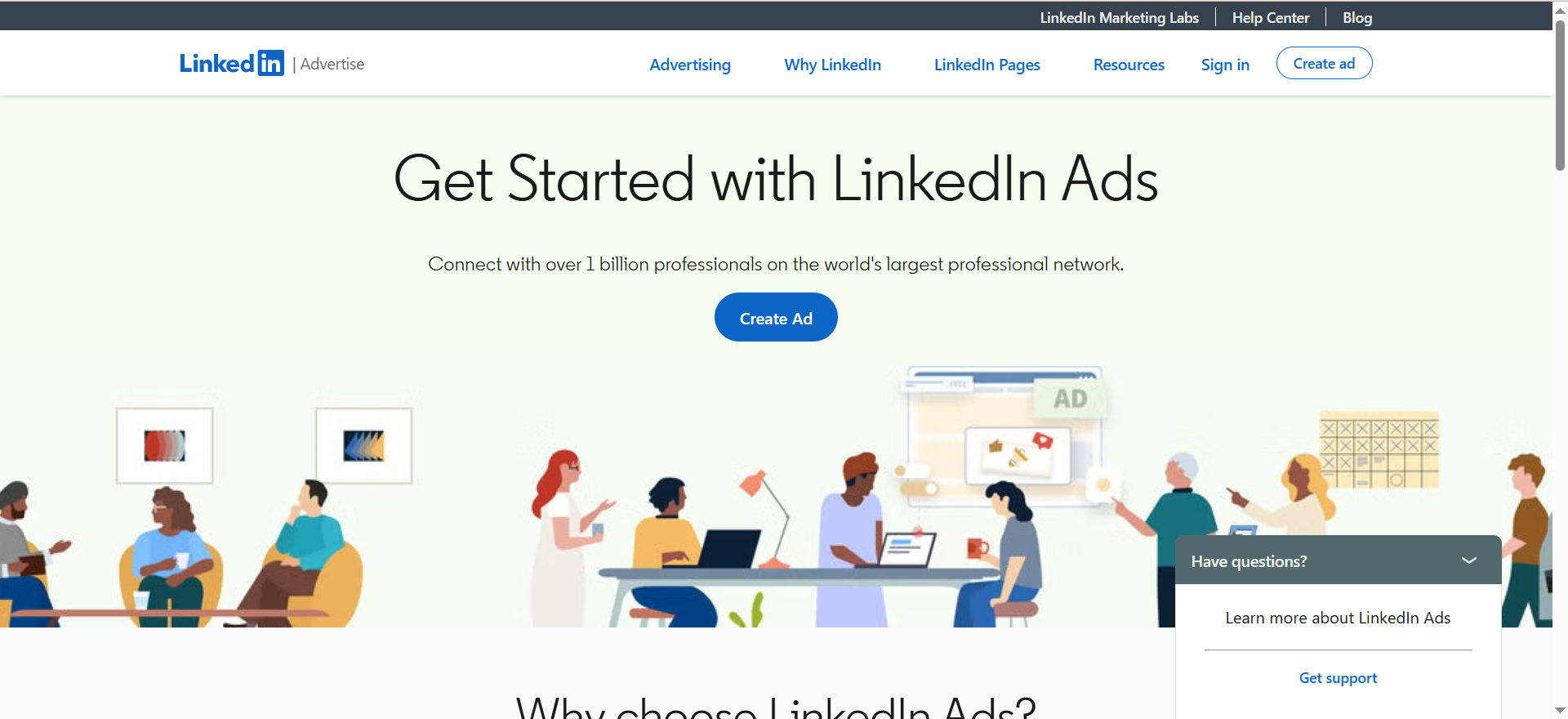
LinkedIn Ads is the paid distribution engine on this list. It helps B2B teams reach specific professional audiences with formats built for awareness, content promotion, event registration, lead generation, and conversation based conversion paths. LinkedIn’s current ads guide explicitly frames the platform around building awareness, generating qualified leads, and driving pipeline.
Why teams use it
B2B marketers use LinkedIn because of the targeting context, which is part of why many teams compare it with other paid growth channels. You can reach people based on company, function, seniority, job title, and other professional signals that matter in B2B buying. That usually makes it one of the most relevant paid channels for high value offers, even if it is rarely the cheapest.
What it’s good for
LinkedIn Ads is good for:
- promoting webinars, reports, and demos
- reaching decision makers by role and company profile
- retargeting engaged professional audiences
- capturing leads with native forms
- amplifying thought leadership and category messaging
LinkedIn’s own materials highlight Single Image Ads, Video Ads, Document Ads, Conversation Ads, Lead Gen Forms, and other formats for different objectives.
When it’s a good fit
It is a good fit when:
- you sell to a definable professional audience
- you have strong content offers
- your sales cycle is complex enough to justify higher CPCs
- you want paid distribution into a named set of titles, functions, or account types
When it’s not a good fit
It is less attractive when:
- your offer has low ACV and thin margins
- you do not yet have good creative or conversion paths
- you cannot follow up quickly on leads
- you expect it to work like cheap direct response social
How to use it
The best use of LinkedIn Ads in B2B demand gen is usually not “send traffic and hope,” and teams comparing paid ads as a SaaS growth channel should match the ad format to the funnel stage: document ads and video for education, lead gen forms for gated offers, conversation or event ads for webinars and demos, and retargeting for hand raisers.
Key capabilities
LinkedIn says Lead Gen Forms are pre filled with LinkedIn profile data, allow tracking of cost per lead and form fill rate, and support download or CRM and marketing automation integrations. Its ads guide also shows document, event, thought leader, and conversation based formats that support different campaign goals.
Pricing
LinkedIn Ads uses auction-based pricing, so there is no fixed starting monthly price. Your costs depend on your bid, target audience, campaign objective, and competition in the ad auction.
Free tier?
LinkedIn Ads doesn’t offer a free tier. It’s a paid advertising platform with flexible spend based on your campaign setup.
Downsides / limitations
The main drawback is cost efficiency. LinkedIn can be highly effective, but weak creative, low intent offers, or poor sales follow up will make it expensive fast. It works best when paired with strong GTM process, not as a shortcut around it, which is the same logic behind a good agency scorecard.
What demand generation tools actually do
A lot of teams buy demand gen tools before they define the job each tool should do. That is where stack bloat starts.
At a practical level, demand generation tools usually fall into five buckets:
- Execution toolsThese run campaigns and automate follow up, and HubSpot and Marketo are the clearest examples for teams also exploring SEO automation tools. HubSpot and Marketo are the clearest examples.
- Data and enrichment toolsThese improve targeting, routing, and conversion quality. Clearbit sits here.
- Intent and orchestration toolsThese identify likely buyers and help coordinate GTM action around those accounts. 6sense is built for that.
- Distribution toolsThese tools get your message in front of the right audience, and LinkedIn Ads is the strongest example in this list for teams researching AI tools for PPC marketing.
- Measurement and attribution layersThese show which programs influence pipeline and revenue, and Marketo Measure and reporting layers in HubSpot or 6sense support that role for teams building better AI visibility metrics.
The mistake is expecting one tool to do all five jobs equally well, and the same principle applies when evaluating your broader tooling and stack. Most strong B2B teams end up with one platform that runs execution, one that improves data quality, and one or two channels that drive qualified attention.
How to choose the right demand gen stack
The fastest way to choose well is to start with your bottleneck, a useful approach for teams also refining their B2B SaaS SEO agency selection criteria.
- If your biggest issue is campaign execution, choose HubSpot or Marketo.
- If your biggest issue is poor lead quality, form friction, or routing delays, prioritize Clearbit.
- If your biggest issue is finding market accounts, prioritize 6sense.
- If your biggest issue is getting your message in front of the right people, prioritize LinkedIn Ads.
Then ask four questions:
1. How complex is your GTM motion?
A startup with one ICP and one funnel path does not need the same tooling as an enterprise team with multiple regions, product lines, and handoff rules, just as it does not need the same SEO tools for small businesses.
2. Is your motion lead based or account based?
Lead based motions can thrive on HubSpot plus paid acquisition and enrichment, while account based motions usually need stronger signal intelligence and orchestration that fits a broader lifecycle content strategy.
3. Do you have ops ownership?
The more powerful the tool, the more operational discipline it usually requires, which is also why teams often start with best free SEO tools before committing to a larger stack.
4. Can you prove revenue impact?
If you cannot connect campaigns to pipeline, the stack will feel expensive no matter how good the features are.
Recommended stacks by team size and maturity
Best stack for early growth B2B teams
- HubSpot
- LinkedIn Ads
- Clearbit
This setup gives you campaign execution, demand capture, paid distribution, and better lead quality without too much complexity, which is also why many teams look for quick fixes for SaaS blog lead generation.
Best stack for growth stage SaaS with real pipeline pressure
- HubSpot or Marketo
- Clearbit
- LinkedIn Ads
- light intent layer or ABM add on
This works when your team needs better qualification and more reliable follow up, but is not fully ABM native yet.
Best stack for enterprise demand gen
- Marketo
- 6sense
- LinkedIn Ads
- enrichment layer such as Clearbit where it fits
This is the strongest model when account prioritization, orchestration, and cross functional alignment matter more than simplicity.
Common mistakes B2B teams make with demand gen tools
Buying tools before defining funnel stages
No software can fix fuzzy lifecycle definitions.
Running paid without fixing conversion friction
If your forms are too long or routing is slow, more spend just creates more waste, and that usually points to the need for a better content audit workflow.
Confusing activity with demand
More emails, more ads, and more workflows do not automatically mean more pipeline, which is why teams often invest in better marketing research tools.
Overbuying enterprise software too early
A smaller team with a weak process often gets more value from a simpler stack used well than a complex stack used halfway, much like the tradeoffs covered in best tools for SEO SaaS.
Ignoring handoff speed
Demand gen fails when follow up is slow. Tools that enrich, score, and route quickly often create more impact than tools with flashy dashboards.
Which demand generation platform is best for B2B SaaS?
The best demand generation platform for B2B SaaS depends on your growth stage, sales motion, and internal team capacity.
For most growth-stage B2B SaaS teams, HubSpot is often the best overall choice because it combines CRM, forms, landing pages, email automation, lead capture, and reporting in one platform. That makes it easier to launch campaigns quickly, keep data clean, and align marketing with sales without building a large, complicated stack.
For enterprise SaaS companies with longer sales cycles, multiple product lines, and more advanced lifecycle marketing needs, Adobe Marketo Engage is usually a stronger fit, much like the broader tradeoffs covered in best enterprise SEO tools. It gives teams more control over segmentation, nurture design, scoring models, and cross-channel orchestration, though it typically requires more operational support.
If your SaaS company runs a strong account-based go-to-market motion, then 6sense becomes highly valuable, especially for teams investing in account-level visibility and optimization. It helps identify in-market accounts, prioritize buying signals, and coordinate campaigns around account intent rather than just lead capture. That is especially useful for companies selling into larger buying committees or targeting high-value accounts.
In practice, the “best” platform is usually tied to the job you need the tool to do:
- If you need an all-in-one platform, choose HubSpot
- If you need enterprise automation depth, choose Marketo
- If you need account intelligence and ABM orchestration, choose 6sense
For many B2B SaaS teams, the smartest starting point is not buying the most advanced platform, a principle that also shows up in the CEO guide to content marketing for SaaS.
Best demand gen software for small B2B marketing teams
Small B2B marketing teams need software that reduces complexity, shortens setup time, and helps one or two marketers do the work of five.
That is why the best demand gen software for small teams is usually software that combines multiple functions in one system. In most cases, HubSpot is the strongest option because it gives small teams access to forms, landing pages, email campaigns, CRM workflows, reporting, and lead management without requiring a large ops function.
Small teams usually do not fail because they lack features, and for teams trying to streamline execution, better digital marketing tools can make the stack easier to manage. A leaner stack helps them move faster and spend more time on messaging, offers, and follow-up instead of maintenance.
For smaller teams, these tools usually make the most sense, and HubSpot is best for all-in-one execution, especially for inbound campaigns, lead capture, and nurture, much like other AI marketing tools for small business.
HubSpot
Best for all-in-one execution, especially for inbound campaigns, lead capture, and nurture.
LinkedIn Ads
Best paid acquisition channel for reaching specific B2B audiences when budgets are focused and targeting matters more than volume.
Clearbit
Best add-on for improving lead data quality, shortening forms, and routing leads faster, especially when the team does not have time to manually clean or enrich records.
A small B2B team usually does not need a huge enterprise stack. What it needs is a practical system that helps it do three things well:
- Capture demand
- Qualify demand
- Hand it off quickly
That is why simple, integrated software often outperforms “powerful” software that takes months to implement.
Best B2B marketing automation platforms
B2B marketing automation platforms help teams manage lead capture, nurture flows, lifecycle progression, segmentation, and campaign reporting, and many teams pair that with stronger content optimization tools. They sit at the center of many demand generation programs because they turn interest into structured follow-up.
The best B2B marketing automation platforms usually come down to two primary choices: HubSpot and Adobe Marketo Engage.
HubSpot
HubSpot is one of the best marketing automation platforms for B2B companies that want speed, usability, and broad functionality in one place. It is ideal for teams that need to launch campaigns quickly and avoid tool sprawl. Its strength is simplicity combined with enough automation power for most growth-stage needs.
HubSpot is especially strong for:
- email nurture
- forms and landing pages
- lifecycle workflows
- lead capture and routing
- CRM visibility
- campaign reporting
It is often the best option for companies that want marketing automation without needing a dedicated marketing ops team.
Adobe Marketo Engage
Marketo is one of the best B2B marketing automation platforms for enterprise teams with more complex needs. It is built for deeper segmentation, sophisticated nurture architecture, and advanced cross-functional lifecycle orchestration.
Marketo is a better fit when:
- the sales cycle is long
- the database is large
- there are multiple personas or product lines
- lifecycle logic is complex
- governance matters
- marketing ops is already mature
The tradeoff is that Marketo typically requires more setup, more ownership, and more technical discipline than HubSpot.
Which is better?
If your team wants an all-in-one engine with easier adoption, HubSpot is usually the better choice.
If your team needs more advanced control and can support the complexity, Marketo is often the better long-term platform.
The best platform is not necessarily the one with the most features, because it is the one that helps your team automate consistently without creating a maintenance burden that slows execution, which is also true when choosing AI marketing tools for content marketing.
Best ABM and intent tools for B2B
The best ABM and intent tools for B2B help teams identify which accounts are most likely to buy, understand where those accounts are in the buying journey, and coordinate marketing and sales around real signals instead of guesswork.
For this job, 6sense is one of the strongest options available.
6sense is designed for B2B teams running account-based marketing at scale. Instead of relying only on form fills or lead scores, it helps teams identify in-market accounts earlier by using intent signals, account intelligence, and predictive modeling. That makes it especially valuable for enterprise or mid-market teams with higher contract values and longer consideration cycles.
6sense is particularly useful for:
- account prioritization
- identifying buying-stage signals
- segmenting target accounts
- coordinating marketing and sales outreach
- launching campaigns based on account activity
- improving ABM focus and efficiency
If your team is trying to answer questions like these, an ABM and intent platform becomes useful:
- Which accounts are actually in market right now?
- Which accounts are showing increased buying interest?
- Which segments deserve budget and SDR attention first?
- How do we align outbound, paid, and nurture around the same account list?
That said, ABM and intent tools are not magic. They work best when your team already has:
- a clearly defined ICP
- named account or segment strategy
- sales and marketing alignment
- strong process for follow-up
For earlier-stage companies, ABM platforms can be too much too soon. For mature B2B teams, they can significantly improve targeting efficiency and help focus effort where revenue is most likely to happen, especially when paired with a stronger competitive analysis process.
Best paid acquisition tools for B2B lead generation
Paid acquisition in B2B is not just about traffic, and teams comparing channel efficiency often look at AI marketing statistics to benchmark performance expectations.
That is why LinkedIn Ads is one of the best paid acquisition tools for B2B lead generation.
LinkedIn is especially effective because of its professional targeting capabilities. B2B marketers can target by job title, function, seniority, company type, industry, and other signals that map closely to business buying decisions. For teams selling SaaS, services, or enterprise solutions, that level of targeting is often more useful than cheaper but broader channels.
LinkedIn Ads works well for:
- webinar promotion
- gated reports and guides
- demo campaigns
- account-based paid campaigns
- retargeting engaged audiences
- thought leadership distribution
It is particularly strong when paired with:
- a well-defined ICP
- high-value offers
- short lead forms or native lead gen forms
- fast SDR or nurture follow-up
The challenge with LinkedIn Ads is cost. It is rarely the cheapest paid channel, which means campaign quality matters more. If the audience is too broad, the message is weak, or the offer is low intent, spend can disappear quickly without enough qualified pipeline in return.
For that reason, the best paid acquisition setup is usually not LinkedIn by itself, and teams often support it with programmatic SEO to balance paid and organic demand capture.
- landing pages or lead gen forms
- CRM integration
- lead routing
- nurture workflows
- reporting and attribution
In B2B lead generation, the best paid tool is not the one with the lowest CPC. It is the one that gets your offer in front of the right buying committee with enough targeting control to create a qualified pipeline.
What tools help with attribution in B2B marketing?
Attribution tools help B2B teams understand which channels, campaigns, and touchpoints influence pipeline and revenue, much like broader website traffic analysis tools help clarify performance. Without attribution, demand generation often turns into a reporting mess where teams can see activity but cannot clearly prove impact.
Several types of tools can support attribution in B2B marketing.
Marketing automation platforms with reporting
Platforms like HubSpot and Marketo provide campaign and lifecycle reporting that helps teams connect marketing activity to pipeline progression. These tools are often the first layer of attribution because they capture source data, form fills, campaign membership, and lifecycle movement.
For many growth-stage teams, this level of reporting is enough to answer practical questions such as:
- Which channels drive qualified leads?
- Which campaigns influence demo requests?
- Which offers convert best by source?
Dedicated attribution solutions
For more advanced reporting, especially in enterprise environments, teams often need more than basic platform analytics, which is why many also compare enterprise SaaS marketing tools. This is where dedicated attribution tooling or deeper revenue measurement becomes more important.
Within the Marketo ecosystem, Marketo Measure is relevant because it is built to help marketers understand multi-touch contributions across pipeline and revenue. This is useful when the buying journey is long, there are multiple stakeholders, and several channels influence conversion before an opportunity is created.
Revenue intelligence and ABM platforms
Platforms like 6sense can also support attribution by showing how account engagement changes across channels and how those signals connect to buying stages, which aligns with stronger personalization in marketing. While this is not the same as classic multi-touch attribution, it gives teams a stronger account-level view of what is working.
Why attribution matters
Attribution matters because B2B buying journeys are rarely linear. A buyer might:
- see a LinkedIn ad
- download a guide
- attend a webinar
- get nurtured by email
- speak with sales weeks later
If the only thing you measure is last-touch conversion, you miss most of the actual demand creation process, which is why many teams also evaluate SEO reporting software alongside their attribution stack.
The best attribution setup for B2B depends on maturity, which is similar to how teams think about SaaS blog ROI timelines before expanding their stack. Simpler teams can often start with native reporting inside HubSpot, while more mature teams usually need deeper measurement across channels, campaigns, and opportunity influence, much like the progression outlined in reporting dashboards for leadership. More mature teams usually need deeper measurement across channels, campaigns, and opportunity influence.
What is the best tech stack for B2B demand generation?
The best B2B demand generation tech stack is not the biggest stack, which is a useful mindset for teams also evaluating Series A SaaS content marketing budget decisions. It is the smallest stack that can reliably help your team create demand, capture demand, qualify it, route it, and measure business impact.
A strong B2B demand gen stack usually includes four layers, and teams comparing broader stack decisions may also find best AI SEO tools useful for the organic side of growth.
1. Campaign execution and automation
This is the core system that runs forms, landing pages, workflows, email nurture, and lifecycle automation.
Best options:
- HubSpot for growth-stage teams
- Marketo for enterprise teams
2. Data enrichment and conversion optimization
This layer improves lead quality, reduces friction, and helps sales receive better data faster.
Best option:
- Clearbit
This is especially useful for shortening forms, enriching records, identifying visitors, and improving routing logic.
3. Audience targeting and demand distribution
This is the layer that gets your message in front of the right people.
Best option:
- LinkedIn Ads
For many B2B companies, LinkedIn is the most relevant paid distribution channel because of its targeting precision.
4. Intent and account intelligence
This layer helps identify which accounts deserve focus and where buying intent is increasing.
Best option:
- 6sense
This is more important for ABM and enterprise motions than for early-stage volume-driven demand gen.
Example stacks by maturity
Lean growth-stage stack
- HubSpot
- LinkedIn Ads
- Clearbit
This is a practical stack for small and mid-sized B2B SaaS teams that need to launch quickly and keep operations manageable.
Mid-market stack
- HubSpot or Marketo
- LinkedIn Ads
- Clearbit
- reporting layer
This works well when lead volume is growing and qualification needs more structure, especially for teams comparing newer AI marketing tools for agencies and service-heavy workflows.
Enterprise stack
- Marketo
- 6sense
- LinkedIn Ads
- enrichment layer such as Clearbit
- advanced attribution/reporting support
This makes sense when teams run large-scale lifecycle programs, named-account strategies, and longer sales cycles.
The best stack is the one that matches your buying motion and team maturity. A simple stack used well will outperform a bloated stack that no one fully owns.
FAQs
What is the best demand generation tool for B2B teams overall?
What is the best demand generation tool for ABM?
Which tool is best for improving B2B form conversion?
Are LinkedIn Ads worth it for B2B demand generation?
HubSpot is usually better for teams that want faster deployment, cleaner usability, and an all in one operating system. Marketo is better for enterprise teams that need deeper automation, segmentation, and governance.
Do B2B teams need both enrichment and automation tools?
📋 Get Listed / Advertisement
We update this guide monthly. Want your tool featured? Contact: [email protected].