

Klaviyo remains the strongest option for ecommerce flows, but its active-profile pricing climbs fast, and many stores pay for automation depth they rarely use. Omnisend matches most of that ecommerce depth at a lower cost per profile. Mailchimp is the easiest switch. Brevo bills by email volume instead of profiles. HubSpot ties email to a CRM. GetResponse suits budget-conscious newsletter senders.
This fits if you're already paying for Klaviyo and the trigger is rising cost at your list size, a missing CRM or B2B workflow, or wanting a simpler tool to run day to day.
None of the five rebuilds your highest-revenue Klaviyo flows automatically, so budget time to recreate them by hand. Confirm your own tier's price on the vendor's page too, since most vendors hide exact figures behind a contact-count slider.
If you're spending hours comparing email tools on your own, that's exactly the research and writing our SaaS Content Marketing service does for SaaS and ecommerce teams, as buying guides and comparison content. See how the programme works.
📋 Get Listed / Advertise
We update this guide monthly. Want your tool featured? Contact: [email protected].
Klaviyo Alternatives At A Glance
Before the profiles, here's how Klaviyo and the five alternatives below stack up on the two numbers that matter most at switching time, entry price and free-plan limit. If you'd rather work from list size and use case than from a reason for leaving, our full platform-selection guide covers the broader framework.
| Platform | Entry Price | Free Plan | Billing Basis | Best For |
|---|---|---|---|---|
| Klaviyo | $20/month (500 profiles, 5,000 emails) | 250 active profiles, 500 emails/month | Active profiles | Ecommerce automation depth |
| Omnisend | $11.20/month (500 contacts, 6,000 emails) | 250 contacts, 500 emails/month | Contacts | Ecommerce and SMS at lower cost |
| Mailchimp | $13/month (Essentials) | Up to 250 contacts | Contacts/sends | Lowest-effort switch |
| Brevo | $9/month (from 5,000 emails/month) | No contact cap, 300 emails/day | Email volume | Transparent volume-based billing |
| HubSpot Marketing Hub | $7/seat/month (1,000 marketing contacts) | Up to 2 users, 2,000 sends/month | Seats and contacts | CRM and B2B pipeline fit |
| GetResponse | $19/month (1,000 contacts) | 14-day trial, then limited free account | Contacts | Budget-conscious newsletters |
1. Omnisend: Best For Ecommerce Automation And SMS At A Lower List-Size Cost
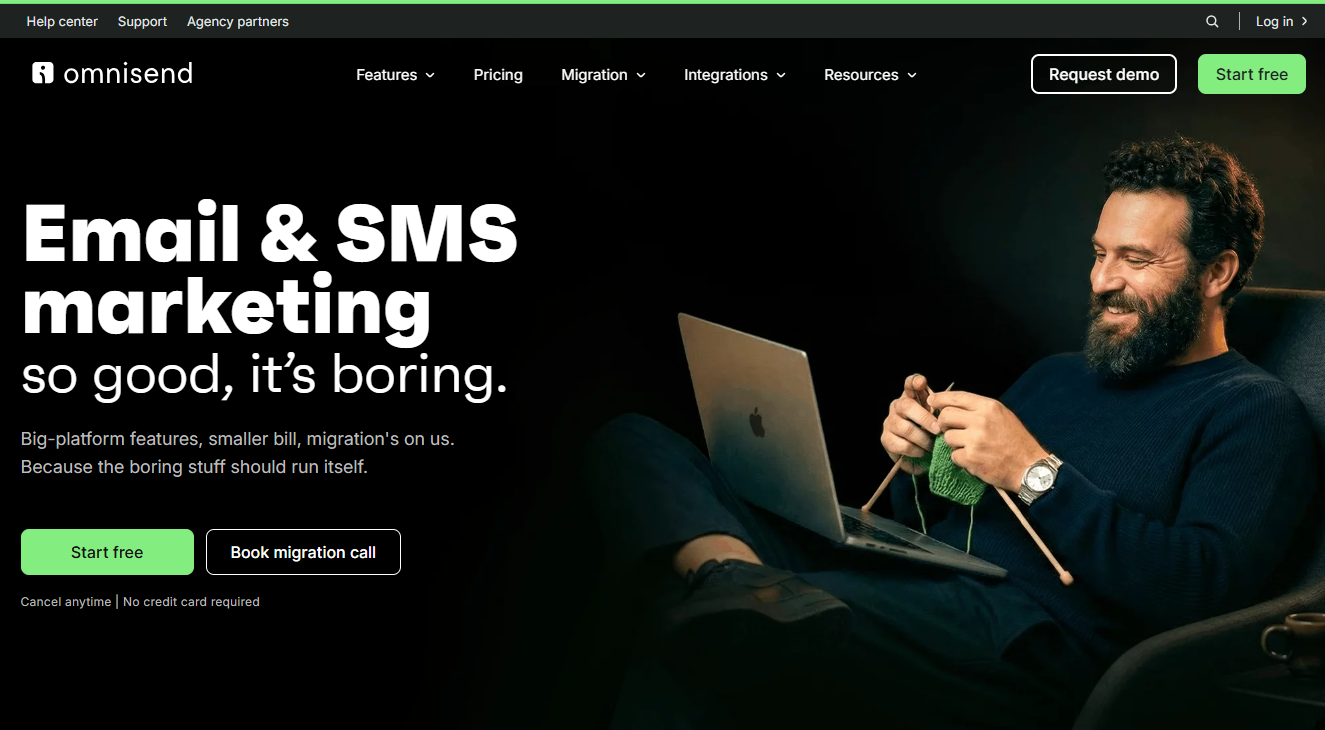
Omnisend is built for the same job Klaviyo does best, ecommerce automation triggered by store events like abandoned carts, back-in-stock alerts and post-purchase flows. It's the closest like-for-like replacement on this list for a Shopify, BigCommerce or WooCommerce store that wants to keep its flow logic and just pay less per profile.
It fits stores running Klaviyo mainly for automated flows rather than for CRM or sales-pipeline features elsewhere. For the best email marketing tool for Shopify stores specifically, see our dedicated Shopify breakdown.
| Plan | Price | Contacts | Emails |
|---|---|---|---|
| Free | $0/month | 250 contacts | 500 emails/month, 500 web push notifications/month |
| Standard | $11.20/month | 500 contacts | 6,000 emails/month |
| Pro | $41.30/month | 2,500 contacts | Unlimited emails |
Full tier details, including overage rates, are on Omnisend's own pricing page. On top of email, Omnisend's SMS add-on for Pro users starts from $0.007 per SMS, with US volume rates stepping down from $0.009 to $0.007 as send volume rises.
Omnisend's own comparison puts its Standard plan at about $20/month against Klaviyo's Email plan at about $30/month, both at 1,000 contacts. That gap narrows to parity by 10,000 contacts, where Omnisend Pro and Klaviyo Email both land around $150/month. The price advantage is real at small list sizes and mostly gone by the time a list reaches five figures.
Strengths:
- Store-event triggers: Abandoned cart, back-in-stock and post-purchase flows mirror Klaviyo's automation logic closely.
- SMS and email in one plan: No separate platform needed for SMS-led sending.
- Lower cost at small list sizes: Meaningfully cheaper than Klaviyo under roughly 5,000 contacts.
Trade-offs:
- Price parity at scale: The cost advantage shrinks to nothing by 10,000 contacts.
- Smaller app ecosystem: Fewer third-party integrations than Klaviyo's marketplace.
- Less granular segmentation: Advanced segment-building isn't as deep as Klaviyo's.
Key capabilities:
- Pre-built ecommerce automation workflows for the major triggers
- SMS and web push alongside email from the same editor
- Native integrations with Shopify, BigCommerce and WooCommerce
Good fit:
- A Shopify or BigCommerce store under about 5,000 contacts
- A team that wants SMS and email billed together
Not a fit:
- A store already past 10,000 contacts, where the cost advantage disappears
- A team needing Klaviyo's deepest custom segmentation logic
The single biggest limitation is that the price gap this profile opens with closes by the time a list reaches 10,000 contacts, so the switch pays off mainly for stores still growing into that range.
2. Mailchimp: Best For A Low-Effort Switch With The Smallest Learning Curve
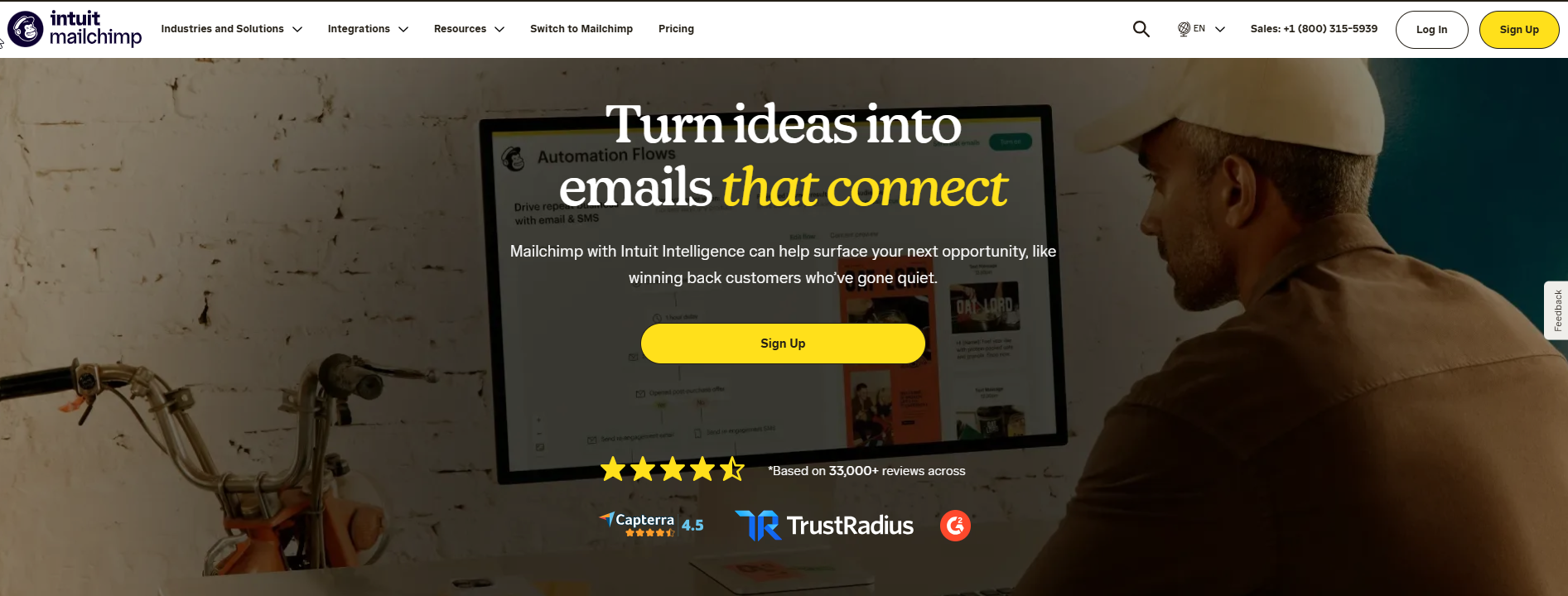
Mailchimp is the alternative most Klaviyo switchers already half-know how to use. It's the default small-business email tool for a reason, with more existing templates, more familiar terminology and a shorter onboarding curve than any ecommerce-specialist platform on this list.
It is not a flow-for-flow Klaviyo replacement. Mailchimp's automation builder is simpler and shallower than Klaviyo's, so a store leaning on complex, multi-branch flows will feel the difference. For the full side-by-side on where each one wins, see our full Klaviyo vs Mailchimp comparison.
| Plan | Price | Limit |
|---|---|---|
| Free | $0/month | Up to 250 contacts, sending pauses past the limit |
| Essentials | $13/month | 14-day free trial available |
| Standard | $20/month | Up to 6,000 emails/month |
| Premium | $350/month | Up to 150,000 emails/month |
See the complete breakdown on Mailchimp's own pricing page.
Strengths:
- Familiar interface: Most marketers have used it before, which shortens onboarding.
- Wide template library: A large base of pre-built templates and landing pages.
- Low entry price: Essentials starts well under most ecommerce-specialist tools.
Trade-offs:
- Shallower automation: Multi-branch, event-triggered flows aren't as deep as Klaviyo's.
- Hard free-plan cap: Sending pauses at 250 contacts with no grace period.
- Ecommerce features feel bolted on: Store-event triggers aren't as native as Omnisend's or Klaviyo's.
Key capabilities:
- Drag-and-drop builder with a large template library
- Basic ecommerce triggers, including abandoned cart and order notifications
- Landing pages and simple contact tagging
Good fit:
- A team wanting the fastest onboarding with the least retraining
- A business sending mostly newsletters and simple campaigns
Not a fit:
- A store running deep, branching automation flows it wants to keep intact
- A team that specifically needs ecommerce-triggered SMS
The limitation that matters most is automation depth. If your Klaviyo flows branch heavily on customer behavior, expect to rebuild and simplify them rather than migrate them as-is.
3. Brevo: Best For Transparent, Volume-Based Pricing Instead Of Profile Billing
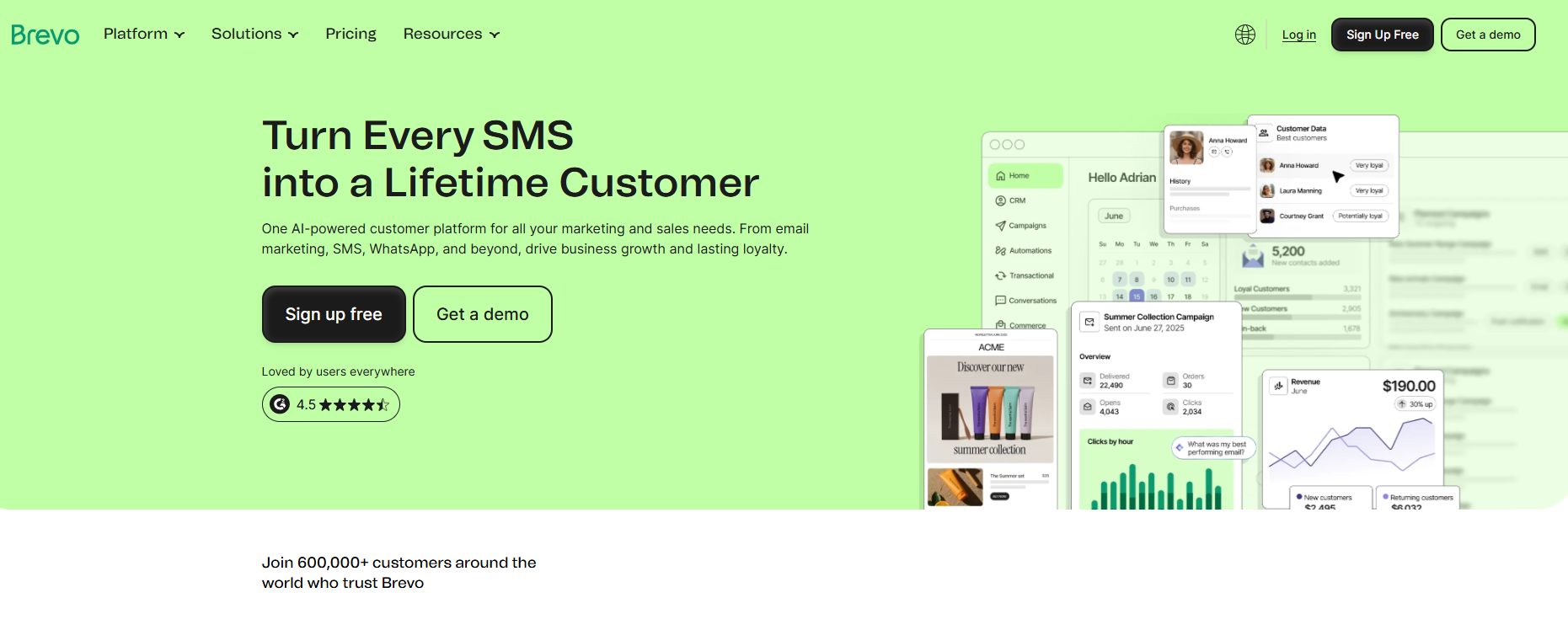
Brevo, formerly Sendinblue, prices by email volume, not by how many contacts sit in your account. That single structural difference is the one a reader leaving Klaviyo over cost most needs to understand, because it changes which number actually drives your bill.
A platform that bills by active or engaged profiles, like Klaviyo, can cost more than one billed by raw send volume, because inactive subscribers can still count toward the price on a profile-based plan. Brevo charges for the emails you actually send each month, so a list with a lot of inactive contacts doesn't inflate the bill the way it can elsewhere.
| Plan | Price | Sending |
|---|---|---|
| Free | $0/month | Up to 300 emails/day after account approval, no contact cap |
| Starter | $9/month ($97/year) | From 5,000 emails/month |
| Standard | $18/month ($194/year) | Higher send volume than Starter |
| Professional | $499/month ($5,389/year) | From 150,000 emails/month |
The full plan breakdown is on Brevo's own pricing page.
Strengths:
- Volume-based billing: You pay for what you send, not for every contact you store.
- No contact cap on Free: Useful for a large but low-frequency list.
- SMS and email on one platform: Brevo sends transactional and marketing SMS alongside email.
Trade-offs:
- Daily send cap on Free: 300 emails/day is restrictive for anything beyond a small list.
- Simpler automation builder: Fewer branching conditions than Klaviyo's flow builder.
- Basic design tools: The template editor is less polished than Omnisend's or Mailchimp's.
Key capabilities:
- Transactional and marketing email on one send infrastructure
- SMS and WhatsApp messaging alongside email
- CRM-lite contact scoring and segmentation
Good fit:
- A large, low-send-frequency list where profile-based billing would cost more
- A team wanting SMS and email billed on the same volume-based logic
Not a fit:
- A high-frequency sender where volume-based pricing climbs faster than profile-based
- A store wanting Klaviyo-depth ecommerce automation out of the box
The volume-based model that makes Brevo cheap for a large, quiet list makes it more expensive than it looks for a small list that sends often, so run your own monthly send count before assuming it's cheaper.
4. HubSpot Marketing Hub: Best For Teams That Need Email Tied To A CRM And Sales Pipeline
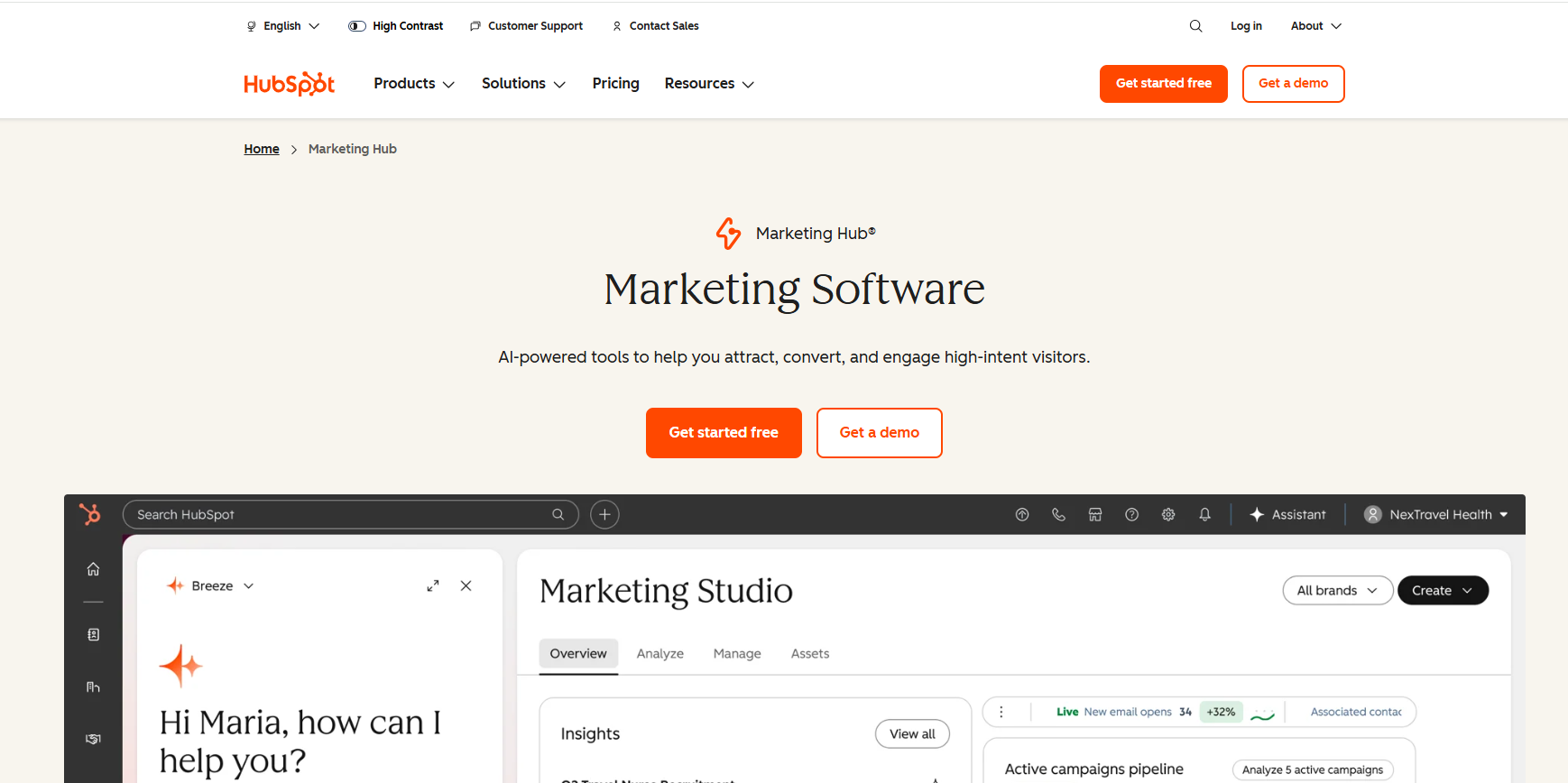
HubSpot Marketing Hub is the pick when the real problem isn't Klaviyo's price. It's that email lives in a different system from your CRM and sales pipeline. For a B2B or hybrid B2B/ecommerce team, that separation means manually syncing lead data between tools Klaviyo was never built to talk to.
The trade-off is cost structure. HubSpot prices per seat rather than per profile, and its higher tiers carry a one-time onboarding fee that doesn't exist on any of the other four alternatives here. Teams also doing outbound B2B outreach alongside email marketing may want to pair this with email outreach tools built for B2B teams.
| Plan | Price | Seats And Contacts | Onboarding Fee |
|---|---|---|---|
| Free | $0/month | Up to 2 users, 2,000 sends/month, 1 automated email action, HubSpot branding | None |
| Starter | $7/seat/month | 1,000 marketing contacts | None |
| Professional | $800/month billed annually ($890/month billed monthly) | 3 core seats, 2,000 marketing contacts | $3,000 one-time |
| Enterprise | $3,600/month | 5 core seats, 10,000 marketing contacts | $7,000 one-time |
Full seat and contact-tier details are on HubSpot's own pricing page.
Strengths:
- Email and CRM in one system: No manual sync between marketing and sales data.
- Seat-based scaling: Costs track team size rather than contact count alone.
- Built-in sales pipeline tools: Deals, pipelines and reporting live alongside email.
Trade-offs:
- Onboarding fees: $3,000 to $7,000 one-time on Professional and Enterprise, on top of monthly cost.
- Steeper jump to Professional: The gap from Starter to Professional is the largest of any tool here.
- HubSpot branding on Free: Outgoing emails carry HubSpot branding until you upgrade.
Key capabilities:
- Native CRM with deal pipelines and contact timelines
- Marketing email tied directly to sales activity and lead scoring
- Seat-based team permissions and reporting
Good fit:
- A B2B or hybrid team that wants marketing and sales data in one system
- A company already running, or planning to run, a sales pipeline alongside email
Not a fit:
- A pure ecommerce store with no B2B sales process to tie email to
- A small team that can't absorb the Professional-tier onboarding fee
The onboarding fee is the detail that catches people off guard. Budget for it separately from the monthly price before you commit to Professional or Enterprise.
5. GetResponse: Best For Budget-Conscious Newsletter And Automation Needs
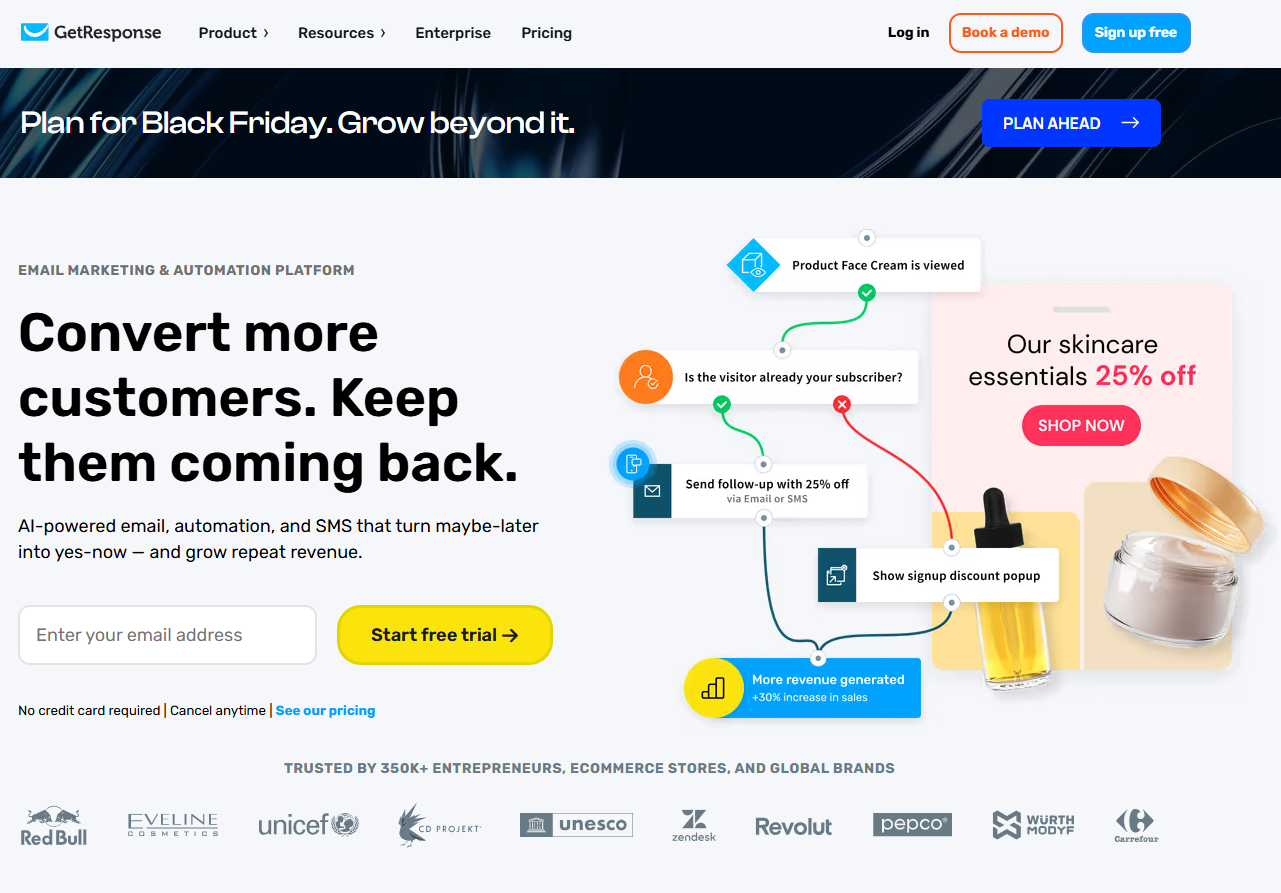
GetResponse is the pick for a newsletter-first sender who still wants automation and basic segmentation without paying for ecommerce-specific flows they won't use. It's priced lower than Klaviyo at comparable contact counts and includes webinar and landing-page tools the ecommerce-specialist tools on this list don't.
The catch is what happens after the trial. GetResponse runs a 14-day free trial rather than a permanent free plan with generous limits, so plan your first two weeks around actually testing automation, not just exploring the interface. For a tool built around one-off sends rather than ongoing automation, see email blast tools for one-off sends.
| Plan | Monthly Price | Annual Price |
|---|---|---|
| Starter | $19/month | $15.58/month |
| Marketer | $59/month | $48.38/month |
| Creator | $69/month | $56.58/month |
Full tier details are on GetResponse's own pricing page. After the 14-day trial ends, a free account limits landing pages to 1,000 visitors/month, webinars to 10 attendees, and shows a GetResponse badge on outgoing messages.
Strengths:
- Lower entry cost: Starter undercuts Klaviyo's Email plan at matching contact counts.
- Webinar and landing-page tools included: Features that are separate add-ons or absent elsewhere.
- Annual-billing discount: Roughly 18% cheaper per month when paid yearly.
Trade-offs:
- No permanent free plan: Only a 14-day trial, then a restricted free account.
- Thinner ecommerce automation: Store-event triggers are less developed than Omnisend's or Klaviyo's.
- Branding on free accounts: A GetResponse badge stays visible until you upgrade.
Key capabilities:
- Newsletter and automation builder with basic behavioral triggers
- Built-in webinar hosting
- Landing pages and simple funnels
Good fit:
- A newsletter-led business wanting automation without ecommerce-specific flows
- A team that also wants webinars in the same platform
Not a fit:
- A store that needs deep, store-event-triggered ecommerce automation
- Anyone who needs a genuinely permanent free tier, not a time-boxed trial
The 14-day trial window is shorter than it looks once you account for list import and automation setup, so start building flows on day one rather than browsing the dashboard first.
📋 Get Listed / Advertise
We update this guide monthly. Want your tool featured? Contact: [email protected].
Why People Actually Leave Klaviyo (And What You'd Still Give Up)
Klaviyo bills on active profiles, meaning anyone it can still market to, on a slider that runs from 500 to 150,000 or more. An active profile isn't the same as a paying customer or even an engaged subscriber. An inactive or non-engaging subscriber can still count toward that active-profile total, and therefore toward the bill, which is the mechanic that makes cost climb even when your actual customer base hasn't grown.
The Email plan's base tier runs $20/month for 500 active profiles and 5,000 emails/month, and the separate Marketing plan runs $25/month, with a limited-time $1 first-month offer for lists up to 5,000 profiles. Those entry numbers look reasonable. The climb is what catches people.
Klaviyo's Email plan costs about $30/month at 1,000 active profiles and about $150/month at 10,000 active profiles, per an independent pricing check from EmailToolTester. A separate worked example from Geekflare puts the jump even more starkly at the next tier up, showing about $110/month at the 5,001 to 5,500 active-profile tier, rising to about $175/month at 10,000 profiles, a roughly 59% increase for roughly doubling your list.
That's the real reason most people leave. It's rarely that Klaviyo stops working. It's that the bill outpaces the business.
What you give up by switching is automation depth, and the cost is mostly your own time. Switching email platforms mid-flow typically means rebuilding your highest-revenue automations, abandoned cart, post-purchase, welcome series, by hand, since most tools don't import a competitor's flow logic. If those flows drive meaningful revenue, budget real hours for recreating them rather than assuming an import button exists. Readers weighing that trade-off against what else is out there may also want AI tools for marketing automation for what's changed outside email specifically.
Switching tools fixes your sending costs, not your visibility when buyers search for "klaviyo alternatives" themselves. The GEO + SEO Growth Programme is built for exactly that gap. See what the programme covers.
What Switching From Klaviyo Actually Costs At Your List Size
Here's the method, not a borrowed number. Look up Klaviyo's own tier price at your current contact count on its pricing page, then look up each alternative's published tier price at that same contact count, and compare the two directly. Anyone quoting a flat dollar savings figure without naming a list size is guessing.
At 1,000 contacts, the anchor point above puts Klaviyo's Email plan at about $30/month. Here's how the five alternatives compare at roughly the same contact count, using each vendor's own published entry tier:
- Brevo: $9/month (Starter, from 5,000 emails/month, no contact cap)
- HubSpot Marketing Hub: $7/seat/month (Starter, 1,000 marketing contacts)
- Omnisend: $11.20/month (Standard, 500 contacts, so roughly double at 1,000)
- Mailchimp: $13/month (Essentials)
- GetResponse: $19/month (Starter, 1,000 contacts exactly)
These aren't apples-to-apples on every dimension. Brevo and HubSpot price on different bases, email volume and seats, not contacts, so the comparison only holds if your sending pattern and team size match the plan you're pricing against. Redo this same lookup at your own contact count before you commit, since several of these alternatives' pricing climbs at different rates than Klaviyo's does. For the fuller picture on cost and capability as a list keeps growing, see email automation tools built to scale.
How We Evaluated These Klaviyo Alternatives
Most roundups for this term tally features and end in a generic verdict without saying how they picked the list. Here's ours, plainly.
- Entry price: What the lowest paid tier actually costs, taken from the vendor's own pricing page.
- Free-plan limit: Where the free tier's cap sits, since that's usually the first wall a growing list hits.
- Billing basis: Whether the tool charges by profile, contact, email volume or seat, because that decides how your bill moves as you grow.
- Automation depth: Whether the tool can actually replace Klaviyo's store-triggered flows, or just sends broadcasts well.
- Switching effort: How much of the migration is a straightforward import versus a manual rebuild.
We excluded tools whose own pricing pages show no usable figures above their lowest tier, because recommending a tool on a number we can't verify isn't a recommendation, it's a guess. Deliverability is the other variable worth checking before you commit either way. See email deliverability tools worth checking for what to look at. This is also roughly how we structure comparison content like this for clients. Criteria stated up front, pricing checked at the source, before any recommendation gets made.
Choosing The Right Klaviyo Alternative For Why You're Leaving
There's no single best Klaviyo alternative, because "best" depends entirely on why you're actually leaving. Match your reason to the fit below.
- If your reason is cost at volume: Omnisend is the fit, because its Standard and Pro plans undercut Klaviyo's Email plan at matching contact counts under roughly 5,000 to 10,000 profiles, where the gap narrows to parity.
- If your reason is ecommerce automation depth: Omnisend is the fit, because its store-triggered flows are the closest match to Klaviyo's own automation logic of any tool on this list.
- If your reason is simplicity: Mailchimp is the fit, because its interface and onboarding curve are the most familiar of the five, even though its automation builder is shallower.
- If your reason is CRM or B2B pipeline fit: HubSpot Marketing Hub is the fit, because it's the only one of the five that puts email and sales pipeline data in the same system, for the price of seat-based billing and an onboarding fee.
- If your reason is SMS-led sending: Omnisend is the fit for ecommerce SMS bundled with automation, and Brevo is the fit if volume-based billing matters more than automation depth.
Budget-conscious newsletter senders who don't fit neatly into any of those five reasons should look at GetResponse instead, since it undercuts Klaviyo on price without forcing a CRM or ecommerce-automation trade-off either way.
None of this solves the separate problem of buyers finding you in the first place. If that's the gap behind the switch, an ongoing SEO and AI-visibility programme is the longer-term fix, not another tool swap.
FAQs
Is Klaviyo Free To Use?
Is Klaviyo Worth The Price?
Who Competes With Klaviyo?
What Is The Cheapest Klaviyo Alternative?
What Is The Best Klaviyo Alternative For Newsletter Creators?
Is Klaviyo Better Than Mailchimp?
Is Shopify Email Better Than Klaviyo?
Is Klaviyo A CDP Or A CRM?
Has Klaviyo's Pricing Changed Recently?
If you'd rather talk through which of these fits your actual list size and automations before you commit, book a free thirty-minute call. One of the founders takes it, and you leave with a shortlist, not a sales pitch. Book a free thirty-minute call.