

TL;DR
A single negative mention can spiral into a full-blown brand crisis within hours. The right crisis monitoring tool catches threats early, tracks sentiment shifts in real time, and gives your team the context needed to respond before the narrative sets. After evaluating the leading platforms on coverage, alert speed, sentiment accuracy, and price, the five tools worth shortlisting in 2026 are Talkwalker (visual listening and early-warning alerts), Meltwater (media intelligence breadth), Brandwatch (deep consumer sentiment analysis), Cision (PR and comms workflows), and Onclusive (accessible earned media measurement). This guide breaks down each tool by what it does, who it fits, pricing, and limitations so you can shortlist faster.
Best Tools for Crisis Monitoring and Brand Protection (Quick Comparison)
| Tool | Best For | Starting Price | Key Strength |
|---|---|---|---|
| Talkwalker | Visual listening and early crisis detection | ~$500/mo (free alerts tier available) | Image, video, and audio brand mention detection across 30+ social networks |
| Meltwater | Enterprise media intelligence and global monitoring | ~$6,000/yr (custom-quoted) | 200B+ social conversations tracked with predictive analytics |
| Brandwatch | Deep consumer sentiment and trend analysis | ~$800/mo | AI-powered emotion detection across 100M+ sources |
| Cision | PR/comms teams and broadcast monitoring | ~$12,677/yr median (custom-quoted) | React Score using 17 NLP models to measure harm and controversy |
| Onclusive | Earned media measurement on a leaner budget | ~$4,999/yr for 5 users | Unified earned, owned, and social monitoring with competitive intelligence |
1. Talkwalker
What it does
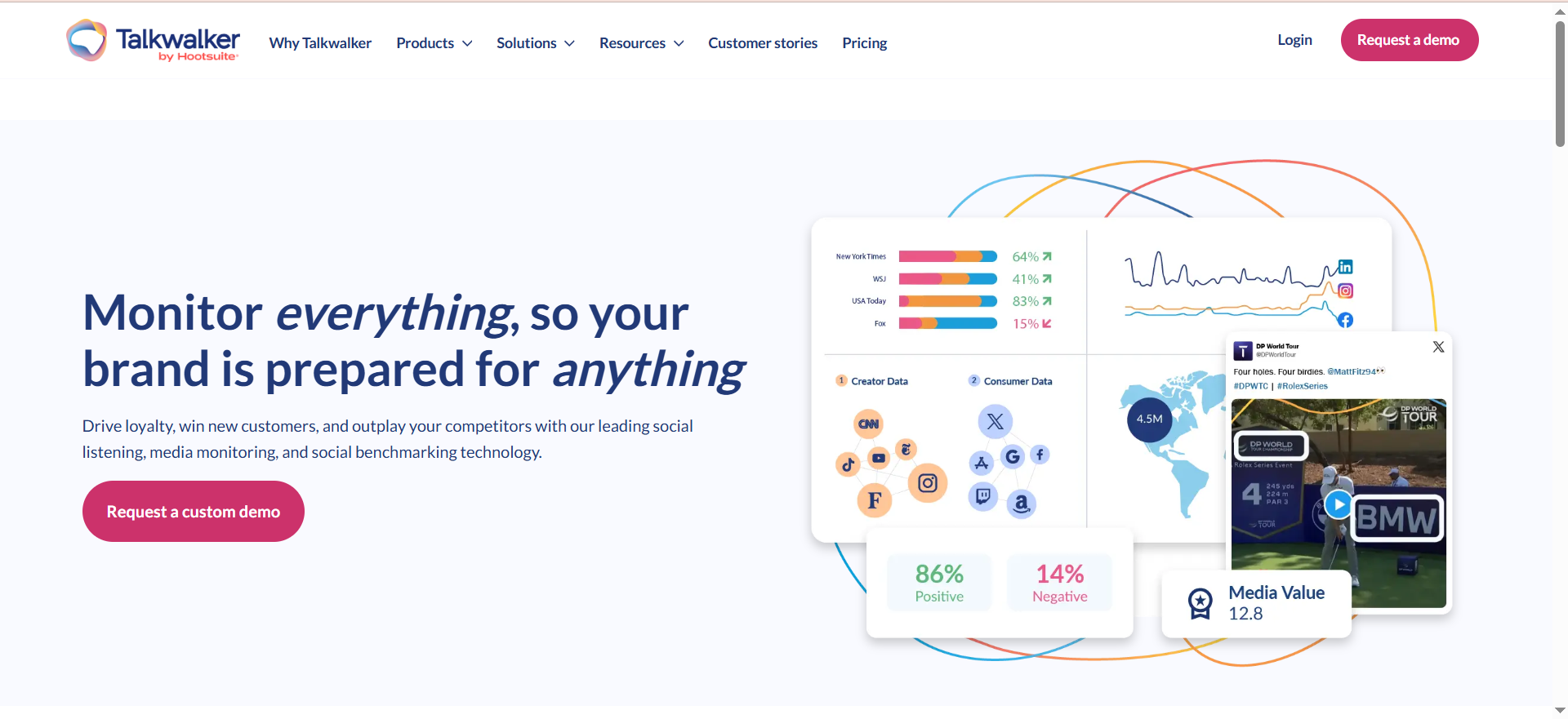
Talkwalker is a social listening and analytics platform that monitors brand mentions across 30+ social networks and 150M+ websites in real time. It covers 187 languages and 196 countries, with a standout visual listening engine that detects brand references in images, videos, and audio. The platform analyzes over 50M videos daily and recognizes 30,000+ visual categories, catching brand exposure that text-only tools miss entirely.
Why teams use it
Brand and comms teams turn to Talkwalker when they need to catch a crisis before it builds momentum. The platform's alert system triggers at the first sign of negative sentiment, giving teams a head start on response. Beyond crisis detection, it provides competitive benchmarking and influencer identification, making it useful for ongoing brand health monitoring as well.
What it's good for
- Early crisis detection with real-time alerts triggered by initial negative mentions
- Visual listening that identifies brand logos and references in images, video, and audio content
- Competitive benchmarking to measure share of voice against rivals
- Influencer identification to find advocates and track influence during a crisis
- Multilingual monitoring spanning 187 languages for global brand protection
When it's a good fit
Talkwalker fits best when your brand has significant visual exposure (products appearing in user-generated content, logo usage in media, video mentions) and you need monitoring that goes beyond text. It works well for mid-market to enterprise teams managing brands across multiple regions and languages, especially those that need competitive context alongside crisis detection.
When it's not a good fit
Teams with smaller budgets or those that only need basic text-based social monitoring may find Talkwalker overpowered and overpriced. The learning curve is steep, and getting full value from the platform requires dedicated setup time. If your primary need is PR-specific media monitoring or journalist outreach, a tool like Cision may be a better match.
How to use it
Set up keyword queries and visual recognition rules for your brand, product names, and key executives. Configure alert thresholds so the system pings your team (via email, Slack, or other channels) the moment negative sentiment spikes. Use the competitive benchmarking dashboard to track how your brand health compares to competitors on an ongoing basis. Combine text and visual monitoring queries for comprehensive coverage.
Key capabilities
- Real-time monitoring across 30+ social networks and 150M+ websites
- Visual listening: image, video, and audio brand detection
- 187-language, 196-country coverage
- Crisis alert system with first-mention triggers
- Competitive benchmarking dashboards
- Influencer identification and tracking
- Sentiment analysis with trend detection
Pricing
Talkwalker offers tiered pricing. Entry-level plans start at approximately $500/mo. The Corporate Plan runs around $1,000/mo ($12,000/yr), and the Enterprise Plan is approximately $2,200/mo ($26,400/yr). Core, Analyze, and Business tiers are custom-quoted. Pricing varies based on query volume, data sources, and contract terms.
Free tier?
Yes. Talkwalker Alerts is a free tool that functions as an alternative to Google Alerts, providing basic brand mention notifications. It does not include the full analytics, visual listening, or dashboard capabilities of the paid platform.
Downsides / limitations
- Steep learning curve, especially for teams without prior social listening experience
- High cost makes it difficult to justify for mid-market teams with tighter budgets
- Initial setup complexity requires significant configuration time to get meaningful results
- Visual listening, while powerful, adds to the overall cost
2. Meltwater
What it does
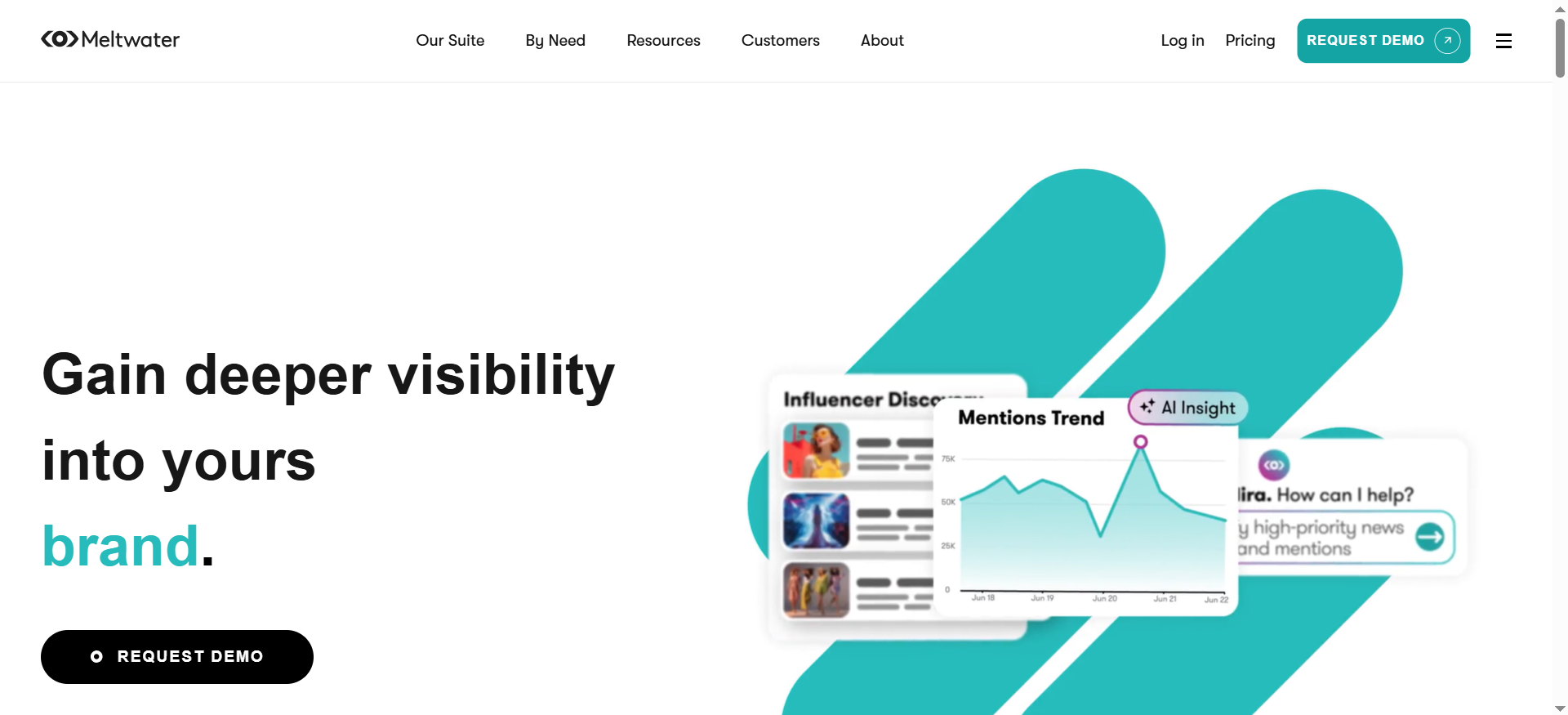
Meltwater combines social media monitoring, media intelligence, and influencer management into a single enterprise platform. It tracks over 200B social conversations and 300M+ social profiles, delivering real-time alerts with custom sentiment thresholds. The platform includes predictive analytics for brand measurement and forecasting, along with AI agents that automate Boolean search creation and query management.
Why teams use it
Enterprise teams choose Meltwater when they need a single platform that covers social monitoring, traditional media intelligence, and influencer tracking without stitching together multiple tools. The predictive analytics capability is particularly valuable for teams that need to forecast brand sentiment trends and measure campaign impact over time, not just react to crises after they start.
What it's good for
- Comprehensive global media monitoring spanning social, print, broadcast, and online sources
- Predictive analytics for forecasting sentiment trends and brand health
- AI-powered Boolean search that simplifies complex query management
- Real-time alerts via email, Slack, or other channels with configurable thresholds
- Influencer identification and management integrated within the monitoring workflow
When it's a good fit
Meltwater is built for enterprise organizations that need combined media intelligence and social monitoring in a single contract. It works best for teams that manage global brands, track media coverage alongside social sentiment, and need AI-assisted search to handle high-volume mention streams. It is well suited for organizations where PR, comms, and social teams share the same monitoring infrastructure.
When it's not a good fit
Smaller teams or companies with budgets under $10,000/yr will find Meltwater difficult to afford. The lack of a free trial means you commit before you experience the product, and the sales process can be lengthy. If your primary need is consumer sentiment analysis rather than media intelligence, Brandwatch may deliver more focused value.
How to use it
Work with your Meltwater account team during onboarding to define monitoring queries, set alert thresholds, and connect notification channels. Use the AI agents to build and refine Boolean searches as your monitoring needs evolve. Set up dashboards that separate crisis signals from routine brand mentions, and configure predictive analytics to flag emerging trends before they become crises.
Key capabilities
- Tracking across 200B+ social conversations and 300M+ social profiles
- Predictive analytics and brand forecasting
- AI agents for Boolean search automation
- Real-time alerts with custom thresholds (email, Slack, other)
- Combined social, media intelligence, and influencer platform
- Sentiment analysis with historical trending
Pricing
Meltwater uses custom pricing. Based on reported purchase data, the median annual cost is approximately $25,000/yr, with a range from $6,000 to $100,000+ depending on features, user seats, and data sources. There is no free trial; Meltwater offers guided demos only.
Free tier?
No. Meltwater does not offer a free tier or a self-service trial. Access requires a guided demo and sales conversation.
Downsides / limitations
- Expensive for smaller teams, with limited pricing transparency
- No free trial to test before committing
- Steep learning curve, particularly around advanced Boolean search and analytics
- Sales process can be lengthy, which slows procurement for teams that need a tool quickly
3. Brandwatch
What it does
Brandwatch is a consumer intelligence platform that tracks brand mentions in real time across 100M+ sources. It uses AI-powered sentiment analysis with emotion detection, going beyond positive/negative classification to identify specific emotions like anger, fear, and joy. The platform includes topic clustering, trend identification, competitive benchmarking dashboards, and crisis detection with real-time alerts, all built on advanced NLP for gauging public sentiment.
Why teams use it
Teams that need to understand not just what people are saying but how they feel about a brand choose Brandwatch. The emotion detection and topic clustering capabilities make it possible to identify the specific drivers behind sentiment shifts, which is critical during a crisis. The large historical data archive also supports post-crisis analysis and long-term trend tracking.
What it's good for
- Deep consumer intelligence with emotion-level sentiment detection
- Topic clustering and trend identification to surface emerging issues automatically
- Competitive benchmarking with side-by-side brand comparison dashboards
- Crisis detection with real-time alerts on sentiment anomalies
- Data visualization that makes complex sentiment data accessible to stakeholders
When it's a good fit
Brandwatch fits teams that prioritize consumer sentiment depth over media intelligence breadth. It works well for brand managers, insights teams, and growth marketers who need to understand the "why" behind public perception shifts. It is especially valuable for companies with large consumer audiences where social conversation volume is high and nuanced sentiment analysis pays off.
When it's not a good fit
If your primary concern is tracking traditional media (print, broadcast, podcasts) alongside social, Meltwater or Cision may provide broader source coverage. Brandwatch's custom pricing model can make budgeting unpredictable, and the platform's depth means it takes time to learn. Teams that need a simpler, lower-cost monitoring solution will find it overkill.
How to use it
Build monitoring queries around your brand, competitor names, product lines, and key crisis keywords. Configure sentiment alerts that trigger when emotion scores deviate from your baseline. Use topic clustering to automatically group related mentions and surface emerging themes. Set up competitive dashboards to compare your brand sentiment against rivals, and use the historical archive to measure recovery after a crisis.
Key capabilities
- Real-time monitoring across 100M+ sources
- AI-powered sentiment analysis with emotion detection
- Topic clustering and automated trend identification
- Competitive benchmarking dashboards
- Crisis detection with configurable real-time alerts
- Advanced NLP for nuanced public sentiment analysis
- Large historical data archive
Pricing
Brandwatch starts at approximately $800/mo for entry-level plans. Enterprise plans range from $3,000 to $10,000+/mo. All pricing is custom-quoted based on query volume, user seats, data sources, and contract term.
Free tier?
No. Brandwatch does not offer a free tier or self-service trial.
Downsides / limitations
- Expensive, particularly at enterprise scale
- Complex for new users who are unfamiliar with social listening platforms
- Custom pricing makes it hard to forecast costs during budget planning
- Source coverage leans heavily toward social; less comprehensive on traditional media than Meltwater or Cision
4. Cision
What it does
Cision (CisionOne) is a media monitoring and PR platform that uses AI to track brand mentions across print, broadcast (TV, radio, podcast), digital, and social media, covering 100M+ sources. Its standout feature is the React Score, which uses 17 NLP models to measure harm, controversy, spam, and emotionality in coverage. The platform also includes a crisis management toolkit with team collaboration features and a media database for journalist outreach.
Why teams use it
PR and communications teams choose Cision because it bridges monitoring and media relations. The React Score gives comms professionals a fast read on how harmful a piece of coverage actually is, cutting through volume to prioritize genuine threats. The built-in journalist database and outreach tools mean teams can move from detecting a crisis to reaching out to media contacts within the same platform.
What it's good for
- PR and comms-centric crisis management with tools built for media relations workflows
- React Score that quantifies harm, controversy, and emotionality using 17 NLP models
- Broadcast monitoring across TV, radio, and podcasts, not just digital and social
- Crisis management toolkit with team collaboration for coordinated response
- Media database for identifying and reaching journalists during a crisis
When it's a good fit
Cision is the right choice for organizations where the PR or corporate communications team owns crisis response. It works best when broadcast media coverage (TV news, radio, podcasts) matters to your brand, and when your crisis workflow includes proactive journalist outreach alongside monitoring. Enterprise organizations with dedicated comms teams will get the most value.
When it's not a good fit
If your primary need is social listening and consumer sentiment analysis, Brandwatch or Talkwalker will deliver deeper insights on that front. Cision's interface can feel dated compared to newer platforms, and the pricing is difficult to predict due to fully custom quoting. Smaller organizations or teams without a PR function may find the media database and outreach tools unnecessary.
How to use it
Set up monitoring queries covering your brand, executive names, and crisis keywords. Use React Score thresholds to filter coverage by harm level, so your team focuses on genuinely threatening mentions first. Activate the crisis management toolkit when a situation escalates, assigning team roles and tracking response tasks collaboratively. Use the media database to identify relevant journalists for proactive outreach during and after a crisis.
Key capabilities
- AI-powered React Score (harm, controversy, spam, emotionality) using 17 NLP models
- Real-time monitoring across print, broadcast, digital, and social (100M+ sources)
- Crisis management toolkit with team collaboration
- Media database for journalist identification and outreach
- Sentiment analysis with historical trending
- Dashboard reporting and automated briefings
Pricing
Cision does not publish pricing. Based on 102 reported real purchases, the median annual cost is approximately $12,677/yr. Smaller programs typically run $15,000 to $30,000/yr, while enterprise deployments can exceed $100,000/yr. All pricing is custom-quoted.
Free tier?
No. Cision does not offer a free tier or self-service trial.
Downsides / limitations
- Expensive for comprehensive coverage, especially at enterprise scale
- Interface can feel dated compared to competitors
- Long contract terms can lock teams in
- Pricing is opaque, making vendor comparison and budget planning harder
5. Onclusive
What it does
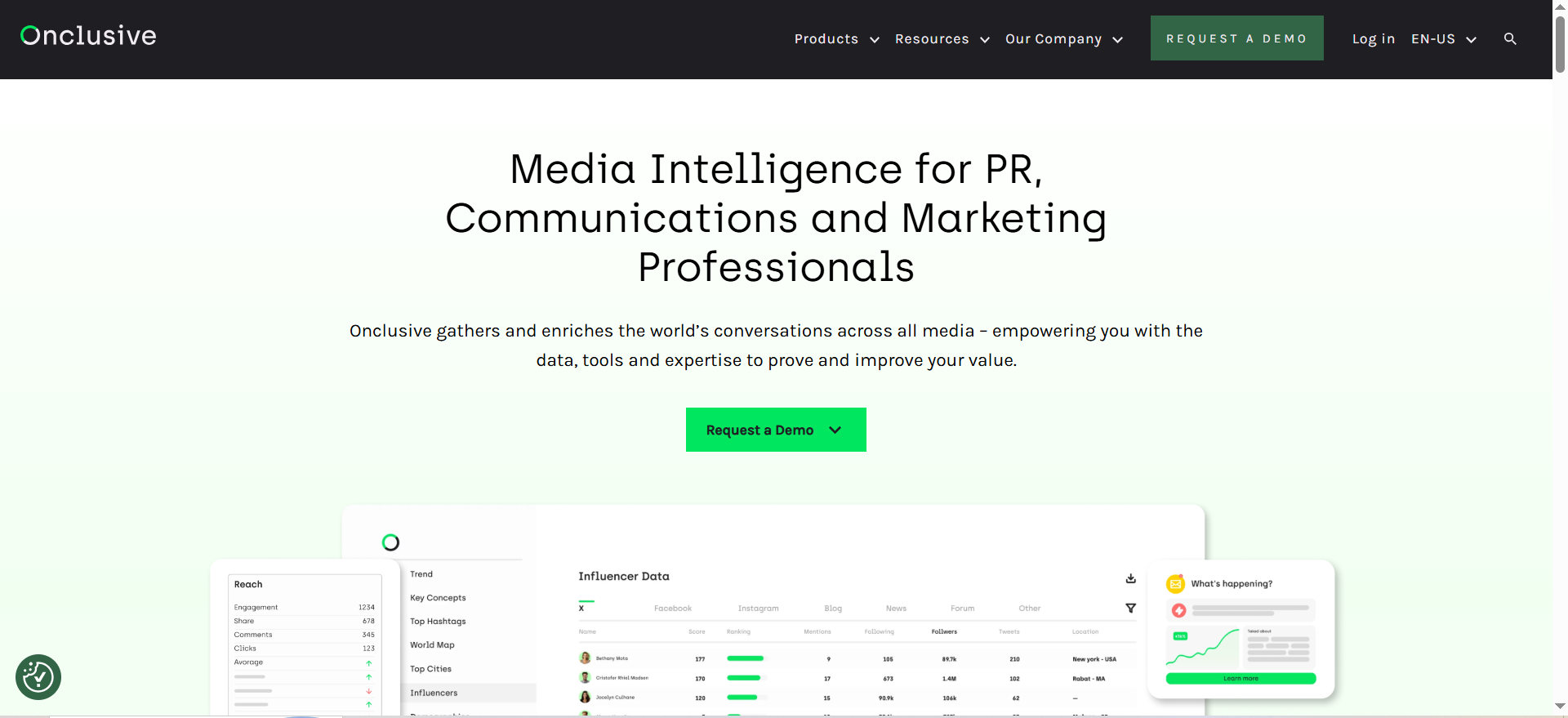
Onclusive provides a unified platform for monitoring earned, owned, and social media. It draws on one of the largest global media content sets, spanning print, online, broadcast, podcasts, and social channels. The platform includes Article Analytics, Competitive Intelligence, and an Author Intelligence media contact database, along with automated sentiment analysis, dashboards, and reporting. Advanced search and filtering help teams surface relevant mentions quickly.
Why teams use it
Teams that prioritize earned media measurement choose Onclusive because it ties monitoring directly to media impact analysis. The platform's competitive intelligence features give comms teams a side-by-side view of how their earned coverage stacks up against competitors. For organizations that find Meltwater or Cision's pricing prohibitive, Onclusive offers a more accessible entry point with a starting price nearly an order of magnitude lower.
What it's good for
- Earned media measurement that connects monitoring to impact analysis
- Unified monitoring across earned, owned, and social channels
- Competitive intelligence with side-by-side brand coverage comparison
- Author Intelligence media contact database for journalist outreach
- Automated reporting and dashboards for stakeholder communication
When it's a good fit
Onclusive works well for teams that need solid earned media monitoring and measurement without the enterprise-tier price tag of Meltwater or Cision. It is a good fit for mid-market brands, growing comms teams, and organizations where earned media is a primary channel. The starting price of approximately $4,999/yr for 5 users makes it accessible for teams that are scaling up their monitoring capabilities.
When it's not a good fit
If deep social listening is your priority, Brandwatch and Talkwalker offer significantly more advanced consumer sentiment and visual listening capabilities. Onclusive's social monitoring is functional but not as granular as dedicated social listening platforms. Teams that need best-in-class dashboards and user experience may find the interface less polished than competitors.
How to use it
Configure monitoring queries for your brand, competitors, and key industry terms. Set up automated sentiment alerts to flag negative coverage early. Use Competitive Intelligence dashboards to benchmark your earned media share against rivals. Leverage Author Intelligence to identify journalists covering your industry, and set up automated reports to keep leadership informed on brand health metrics.
Key capabilities
- Unified earned, owned, and social media monitoring
- Global media content set: print, online, broadcast, podcasts, social
- Article Analytics for earned media measurement
- Competitive Intelligence dashboards
- Author Intelligence media contact database
- Automated sentiment analysis and reporting
- Advanced search and filtering
Pricing
Onclusive uses custom pricing with a published starting point of approximately $4,999/yr for 5 users. Pro and Enterprise tiers are available at higher price points. Contact Onclusive for a current quote based on your team size and feature requirements.
Free tier?
No. Onclusive does not offer a free tier.
Downsides / limitations
- Less well-known than Talkwalker, Meltwater, or Brandwatch, which can mean smaller community and fewer third-party resources
- Social listening depth does not match dedicated platforms like Brandwatch or Talkwalker
- Interface can feel clunky compared to more design-forward competitors
- Smaller market presence may raise concerns about long-term platform investment
How Do Crisis Monitoring Tools Detect Brand Threats in Real Time?
Crisis monitoring tools use a combination of web crawling, API integrations, and artificial intelligence to surface brand threats the moment they emerge. Platforms like Talkwalker and Brandwatch continuously scan social media channels, news outlets, blogs, forums, and review sites, indexing millions of data points every minute. When a spike in negative mentions or an unusual pattern is detected, the system flags it as a potential crisis event.
The detection process typically relies on three core mechanisms. First, keyword and Boolean query matching identifies when your brand name, product names, or key executives appear in public conversations. Second, sentiment analysis algorithms evaluate the tone of each mention, distinguishing routine complaints from escalating threats. Third, anomaly detection compares current mention volumes and sentiment scores against historical baselines, triggering alerts when metrics deviate significantly from the norm.
Meltwater and Cision enhance this detection layer by incorporating media monitoring alongside social listening, ensuring that threats emerging from traditional news sources are caught just as quickly as those on social platforms. Onclusive adds another dimension by tying media mentions to measurable business impact, helping teams prioritize which threats deserve immediate attention versus those that are unlikely to gain traction.
The real-time element is critical because crises escalate exponentially. A negative story that reaches a few hundred people in the first hour can reach millions within six hours if left unaddressed. By combining always-on data collection with intelligent alerting, these tools give communications teams the window they need to respond before a manageable issue becomes a full-blown reputational crisis.
What Is the Difference Between Crisis Monitoring and Social Listening?
Social listening and crisis monitoring are related disciplines, but they serve fundamentally different strategic purposes. Social listening is the ongoing practice of tracking brand mentions, industry conversations, and audience sentiment to inform marketing strategy, product development, and customer experience. Crisis monitoring, by contrast, is specifically designed to detect, escalate, and help manage reputational threats before they spiral out of control.
Think of social listening as the broad radar that tells you what people are saying about your brand on any given day. Tools like Brandwatch and Talkwalker excel at this, offering deep analytics dashboards where marketing teams can explore trends, track campaign performance, and benchmark against competitors. The insights are valuable but typically reviewed on a daily or weekly cadence.
Crisis monitoring operates on a much tighter timeline. It layers urgency-based alerting, threshold triggers, and escalation workflows on top of the same data streams. When Meltwater or Cision detects a sudden volume spike accompanied by a sharp negative sentiment shift, the system does not simply log the data — it pushes an immediate notification to the designated crisis team, often via SMS, email, Slack, or a dedicated mobile app.
Another key distinction is scope. Social listening tends to focus on social media platforms and owned channels. Crisis monitoring casts a wider net that includes broadcast media, print publications, regulatory filings, and even dark web mentions in some enterprise configurations. Onclusive bridges the two by connecting media intelligence to business outcomes, making it easier to determine when a social listening insight has crossed the threshold into crisis territory. In practice, the most resilient brands treat social listening as the foundation and crisis monitoring as the alarm system built on top of it.
How Much Do Crisis Monitoring Tools Cost for Small Businesses?
Pricing for crisis monitoring tools varies widely depending on the depth of coverage, the number of users, and the volume of mentions tracked. For small businesses, the reality is that enterprise-grade platforms like Talkwalker, Meltwater, and Brandwatch are significant investments, with annual contracts typically starting in the range of ten to fifteen thousand dollars and scaling upward based on features and data access.
Talkwalker offers tiered plans that begin with essential social listening capabilities and add crisis-specific features at higher levels. Brandwatch, now part of the Cision ecosystem, positions itself primarily for mid-market and enterprise clients, though smaller teams can sometimes negotiate scaled-down packages. Meltwater similarly operates on a custom-quote model, meaning small businesses need to engage with a sales team to get accurate pricing. Onclusive tends to focus on organizations with established PR functions, which generally places it in the mid-market to enterprise category as well.
For small businesses operating on tighter budgets, the practical approach is to start with a tool that covers the essentials — keyword monitoring, basic sentiment analysis, and real-time alerts — and upgrade as the organization grows. Several of the platforms covered in this article offer starter tiers or can customize a package that excludes features a small team would not use, such as broadcast monitoring or advanced API access.
It is also worth factoring in the cost of not monitoring. A single undetected crisis can result in revenue losses, customer churn, and brand damage that far exceeds an annual software subscription. For small businesses where reputation is often their most valuable asset, the investment in even a basic crisis monitoring setup pays for itself the first time it catches a brewing issue early.
Can Crisis Monitoring Tools Track Mentions in Multiple Languages?
Multilingual monitoring is a core capability of the leading crisis monitoring platforms, and it is increasingly non-negotiable for any brand with an international footprint. Talkwalker stands out in this area with support for over 180 languages, making it one of the most comprehensive options for global brands that need to detect threats regardless of where or in what language they originate.
Brandwatch and Meltwater also offer robust multilingual coverage, with natural language processing models trained across dozens of languages. This goes beyond simple keyword translation. Effective multilingual monitoring requires the tool to understand idioms, slang, sarcasm, and cultural context in each language, because a phrase that reads as neutral in English might carry strongly negative connotations in another market. Cision provides multilingual media monitoring with particularly strong coverage of traditional news outlets across Europe, Asia-Pacific, and Latin America, which is valuable for brands that need to track print and broadcast mentions alongside digital conversations.
Onclusive rounds out the picture by offering media analytics across multiple geographies, helping global communications teams understand not just what is being said but how much impact those mentions are generating in each market.
For organizations operating across borders, the ability to monitor in local languages is essential because crises often start locally before going global. A product safety complaint posted in Portuguese on a Brazilian forum can escalate to international media coverage within hours. Without multilingual monitoring in place, the brand's crisis team would not even know the conversation existed until it had already gained critical mass. When evaluating tools, look for platforms that offer native language sentiment analysis rather than relying solely on machine translation, as translation-based approaches tend to miss nuance and produce unreliable sentiment scores.
What Features Should a Brand Protection Tool Have?
An effective brand protection tool needs to do more than simply track mentions. It should serve as a comprehensive early warning system that combines monitoring, analysis, alerting, and response coordination into a unified workflow. The features that separate adequate tools from genuinely protective ones fall into several categories.
Real-time monitoring across a wide range of sources is the foundation. The tool should cover social media platforms, news outlets, blogs, forums, review sites, podcasts, and ideally broadcast media. Talkwalker and Meltwater both offer this breadth of coverage, ensuring that no channel is a blind spot. Sentiment analysis powered by artificial intelligence is equally important, as it allows the platform to distinguish between a routine customer complaint and a coordinated attack on your brand. Brandwatch is particularly strong in this area, with advanced natural language processing that handles nuance and context.
Customizable alerting is the feature that turns monitoring into protection. You need the ability to set thresholds — for example, triggering an alert when negative mentions exceed a certain volume within a defined time window — and route those alerts to the right people through the right channels. Cision offers sophisticated alerting workflows that integrate with existing PR and communications processes.
Beyond detection, the tool should support competitive benchmarking so you can understand how your brand health compares to peers, and historical analysis so you can identify patterns and predict vulnerabilities. Onclusive contributes here by connecting media mentions to business impact metrics, giving teams a way to prioritize responses based on likely consequence rather than volume alone.
Finally, look for collaboration features that allow your crisis team to coordinate within the platform, assign tasks, track response progress, and maintain an audit trail of actions taken during an incident.
How Do You Set Up Crisis Alerts for Your Brand?
Setting up crisis alerts is one of the most important steps in building a proactive brand protection strategy, and the process is more nuanced than simply entering your company name into a monitoring tool. A well-configured alert system catches genuine threats early while filtering out the noise that leads to alert fatigue.
Start by defining your monitoring scope. This means identifying every term that could signal a crisis: your brand name, product names, executive names, common misspellings, branded hashtags, and key industry terms associated with risk. In platforms like Talkwalker and Brandwatch, you can build complex Boolean queries that combine these terms with negative modifiers to surface only the mentions that warrant attention. For example, you might set a query that tracks your brand name appearing alongside words like "recall," "lawsuit," "data breach," or "boycott."
Next, establish your alert thresholds. Rather than receiving a notification for every negative mention, configure the system to trigger alerts based on anomaly detection. Meltwater and Cision both offer threshold-based alerting where you define what constitutes a significant deviation from your normal mention volume or sentiment baseline. This approach ensures your team is notified when something genuinely unusual is happening rather than being overwhelmed by routine negativity.
Choose your notification channels carefully. Most enterprise platforms support email, SMS, Slack, Microsoft Teams, and mobile push notifications. The best practice is to create a tiered system where low-level alerts go to a monitoring dashboard, moderate alerts trigger an email to the communications team, and high-severity alerts send immediate SMS or phone notifications to senior leadership.
Finally, test your alerts regularly. Run simulated crisis scenarios to verify that notifications reach the right people within acceptable timeframes and that your escalation protocols function as intended.
Which Crisis Monitoring Tools Offer AI-Powered Sentiment Analysis?
All five of the leading crisis monitoring platforms covered in this article now incorporate artificial intelligence into their sentiment analysis capabilities, though the depth and sophistication of their AI implementations vary.
Talkwalker uses AI-powered sentiment analysis that goes beyond simple positive-negative-neutral classification to detect emotions such as anger, fear, joy, and disgust. This granularity is particularly valuable during a crisis because it helps communications teams understand not just that people are upset but exactly how they are upset, which directly informs the appropriate response tone. Talkwalker also applies image and video recognition AI to detect brand logos in visual content, catching mentions that text-based monitoring would miss entirely.
Brandwatch has invested heavily in its AI capabilities, including a conversational intelligence layer that can identify emerging themes, detect irony and sarcasm with reasonable accuracy, and automatically categorize mentions by topic. This makes it easier for crisis teams to quickly understand the narrative taking shape during a developing incident rather than sifting through individual mentions manually.
Meltwater employs machine learning models across its media intelligence platform to score sentiment and relevance, and its AI-generated summaries help teams rapidly digest large volumes of coverage during a fast-moving crisis. Cision integrates AI-powered sentiment analysis across both its social and traditional media monitoring, with the added benefit of tying sentiment data to audience reach estimates so teams can gauge the potential impact of negative coverage.
Onclusive differentiates its approach by focusing its AI on impact prediction, analyzing not just how people feel about a mention but how likely that mention is to influence business outcomes. This impact-oriented analysis helps crisis teams prioritize responses based on potential business consequence rather than treating all negative sentiment equally.
What Is a Crisis Communication Plan and How Do Monitoring Tools Support It?
A crisis communication plan is a documented framework that outlines how an organization will communicate with internal and external stakeholders during a reputational threat, operational disruption, or public relations emergency. It typically includes predefined roles and responsibilities, approved messaging templates, escalation procedures, stakeholder contact lists, and post-crisis evaluation protocols.
Monitoring tools serve as the operational backbone of a crisis communication plan by providing the intelligence layer that triggers and informs every subsequent step. Without real-time monitoring from platforms like Talkwalker or Meltwater, a crisis plan exists only on paper — the team has no mechanism to know when to activate it. These tools provide the situational awareness that turns a static document into a living response system.
During the pre-crisis phase, monitoring tools help organizations identify vulnerabilities and emerging risks. Brandwatch and Cision allow teams to track sentiment trends and media narratives over time, spotting gradual shifts that might indicate a brewing issue. This early intelligence gives communications teams the opportunity to prepare messaging and brief stakeholders before a situation escalates.
Once a crisis is underway, monitoring tools become the command center's primary data feed. They show the team which narratives are gaining traction, which media outlets are covering the story, how sentiment is evolving in real time, and whether the organization's response is being received positively or negatively. Onclusive adds particular value here by quantifying the business impact of media coverage, helping leadership make informed decisions about whether to escalate their response.
In the post-crisis phase, the historical data captured by these tools enables thorough after-action analysis. Teams can review the timeline of the crisis, evaluate response effectiveness, and identify lessons that should be incorporated into an updated crisis communication plan.
How Do Crisis Monitoring Tools Integrate with PR Workflows?
The value of a crisis monitoring tool multiplies when it is embedded directly into existing public relations workflows rather than operating as a standalone alert system. The leading platforms in this space have invested significantly in integration capabilities that connect monitoring data to the tools PR teams already use daily.
Cision offers perhaps the most natural integration with PR workflows because its monitoring capabilities sit alongside a comprehensive PR management suite that includes media database access, press release distribution, and journalist relationship tracking. When a crisis is detected, the PR team can move from alert to response within the same platform, identifying relevant journalists, drafting and distributing statements, and tracking how those statements are received — all without switching tools.
Meltwater follows a similar approach, combining media monitoring with a built-in media contacts database and outreach tools. This integration means that when a crisis alert fires, the team can immediately pull up contact information for key journalists covering the story and begin proactive outreach. Meltwater also integrates with CRM platforms and project management tools, allowing crisis response tasks to flow into existing operational systems.
Talkwalker and Brandwatch both offer robust API access and pre-built integrations with tools like Slack, Microsoft Teams, Salesforce, and various marketing automation platforms. These integrations enable automated workflows where a crisis alert in the monitoring tool can automatically create a task in the project management system, notify the crisis team in their messaging platform, and log the incident in the CRM.
Onclusive supports PR workflow integration through its analytics and reporting capabilities, providing the measurement layer that helps PR teams demonstrate the effectiveness of their crisis response to leadership and stakeholders. This closed-loop reporting is essential for continuously improving crisis response protocols.
Do Crisis Monitoring Tools Work for B2B Brands?
Crisis monitoring is frequently associated with consumer-facing brands, but B2B organizations face their own distinct set of reputational risks that make these tools equally relevant. A negative article about a software vendor's security practices, a viral LinkedIn post from a disgruntled enterprise customer, or a regulatory action against a professional services firm can all inflict serious damage on pipeline and revenue.
The difference for B2B brands is that crises tend to unfold in different channels and at a different pace. While consumer brand crises often explode on platforms like X or TikTok, B2B crises are more likely to surface on LinkedIn, in industry publications, on review platforms like G2 or Trustpilot, or within niche community forums. Meltwater and Cision are particularly well-suited for B2B monitoring because of their deep coverage of trade publications, industry news outlets, and professional media — sources that general social listening tools often underweight.
Talkwalker and Brandwatch offer the flexibility to configure monitoring queries that focus specifically on B2B-relevant channels and conversations. For example, a SaaS company can set up alerts that track mentions in technology publications, software review sites, and investor-focused media while filtering out consumer noise that is irrelevant to their business.
Onclusive provides value for B2B brands through its focus on connecting media mentions to measurable business outcomes. In B2B, where sales cycles are long and purchasing decisions involve multiple stakeholders, understanding whether negative coverage is actually reaching and influencing decision-makers is more important than raw mention volume.
B2B brands should also consider that their crisis exposure often extends to their customers' crises. If a major client experiences a public failure while using your product, the reputational spillover can be significant. Monitoring tools allow you to track these adjacent risks proactively.
What Are the Best Free Crisis Monitoring Tools?
While the platforms featured in this article — Talkwalker, Meltwater, Brandwatch, Cision, and Onclusive — are premium solutions, organizations with limited budgets or those just beginning to build a crisis monitoring practice can start with free or low-cost alternatives to establish a baseline capability.
Google Alerts remains the simplest free option, allowing you to receive email notifications whenever your brand name or specified keywords appear in Google's index. It is limited in speed, lacks sentiment analysis, and does not cover social media, but it provides a basic safety net for catching news coverage. Social media platforms themselves offer native monitoring through features like X's search and notification tools, LinkedIn's mention tracking, and Meta's brand mention alerts within Business Suite.
Talkwalker previously offered a free social search tool that provided limited access to its monitoring capabilities, giving smaller teams a taste of enterprise-grade social listening without the full subscription cost. It is worth checking the current availability of such freemium tiers, as platforms periodically adjust their offerings.
However, free tools come with significant limitations that matter greatly in a crisis context. They typically lack real-time alerting, offer no sentiment analysis, cover a narrow range of sources, and provide no workflow or collaboration features. When a genuine crisis hits, the difference between a fifteen-minute delay and a two-hour delay in detection can determine whether your team controls the narrative or spends days on damage control.
The practical recommendation for budget-conscious organizations is to use free tools for general awareness monitoring while investing in at least one paid platform for crisis-specific alerting. Many of the tools covered in this article offer entry-level packages that provide the most critical crisis features without requiring a full enterprise commitment.
How Do You Measure ROI from Crisis Monitoring Software?
Measuring the return on investment from crisis monitoring software requires a framework that accounts for both the value of crises prevented and the reduced impact of crises that do occur. Unlike marketing tools where ROI can be tied directly to revenue generated, crisis monitoring delivers value primarily through risk reduction — and quantifying avoided losses demands a slightly different approach.
The most straightforward metric is response time improvement. Track how quickly your team identifies and responds to potential crises with the monitoring tool versus without it. Platforms like Meltwater and Talkwalker provide timestamps on alerts and response actions, making it possible to measure the detection-to-response window. Research consistently shows that organizations that respond within the first hour of a crisis experience significantly less reputational and financial damage than those that take longer.
Media impact analysis is another measurable dimension. Onclusive specializes in connecting media coverage to business outcomes, enabling teams to quantify how much negative coverage was mitigated or neutralized through early intervention. Cision provides similar measurement capabilities through its media analytics suite, tracking metrics like share of voice, sentiment trajectory, and audience reach during and after a crisis event.
Brandwatch and Talkwalker offer historical trend analysis that allows you to compare brand health metrics before and after implementing monitoring, establishing a baseline for ongoing performance measurement.
Beyond direct metrics, consider the broader financial implications. Calculate the average cost of past crises to your organization — including revenue impact, customer churn, legal expenses, and remediation costs — and compare that against the annual cost of your monitoring tools. For most organizations, even one crisis detected and managed early enough to prevent escalation will deliver ROI that exceeds several years of software subscription costs.
Crisis Monitoring vs. Media Monitoring: What Is the Difference?
Crisis monitoring and media monitoring share overlapping data sources and technology, but they are designed for different operational objectives and operate at different speeds. Understanding the distinction helps organizations invest in the right capability — or, more commonly, understand how to layer both into a comprehensive communications strategy.
Media monitoring is the systematic tracking of coverage across news outlets, trade publications, broadcast channels, and increasingly social platforms. Its purpose is to provide a comprehensive picture of how your brand, competitors, and industry are being covered over time. Cision and Meltwater are historically rooted in media monitoring, with extensive databases of global publications and broadcast outlets that give communications teams visibility into earned media performance. The cadence is typically daily or weekly reporting, with analysts reviewing coverage trends, calculating share of voice, and identifying opportunities for proactive media engagement.
Crisis monitoring takes the same underlying data streams and applies urgency-oriented logic. Instead of producing retrospective reports, it continuously evaluates incoming data for signals that indicate a developing threat. The emphasis shifts from breadth of coverage to speed of detection and accuracy of threat assessment. Talkwalker and Brandwatch have built their platforms with this real-time orientation, offering anomaly detection and automated escalation that media monitoring alone does not provide.
The practical difference becomes clear during an incident. A media monitoring tool will tell you that your brand appeared in 47 articles yesterday and that sentiment was 30 percent negative. A crisis monitoring tool will tell you at 2:14 AM that negative mentions just spiked 400 percent in the last 30 minutes and that a specific narrative is gaining traction across three media outlets simultaneously. Onclusive bridges these disciplines by adding impact measurement to both, helping teams determine whether a media trend constitutes a genuine business risk or simply elevated chatter.
How Quickly Do Crisis Monitoring Tools Send Alerts?
Alert speed is one of the most critical differentiators among crisis monitoring platforms because the window for effective crisis response is measured in minutes, not hours. The leading tools in this space have made significant investments in reducing the latency between a threat appearing online and the crisis team receiving notification.
Talkwalker and Brandwatch both operate on near-real-time monitoring cycles, with alerts typically delivered within minutes of a qualifying mention being detected. Talkwalker's system continuously indexes social media, news, and blog content, and its alerting engine evaluates new data against configured thresholds as it arrives. Brandwatch offers similar speed, with its platform designed to process high volumes of social data with minimal lag between ingestion and alert delivery.
Meltwater provides real-time alerting across its media and social monitoring coverage, with configurable notification channels including email, mobile push notifications, and integrations with team messaging platforms. The speed of delivery depends partly on the notification channel selected — an SMS or push notification reaches the recipient faster than an email digest, which is why crisis-specific alerts should always be routed through the most immediate channel available.
Cision offers real-time alerts with the added capability of monitoring broadcast media, which is particularly valuable for crises that may surface on television or radio before appearing in digital channels. Onclusive contributes speed in a different dimension by rapidly scoring the potential impact of detected mentions, helping teams avoid wasting precious response time on alerts that are unlikely to escalate.
For organizations evaluating alert speed, the important benchmark is not just how quickly the tool sends the alert but how quickly the entire chain functions — from detection to notification to human acknowledgment to initial response. The best platforms support this end-to-end measurement so teams can identify and eliminate bottlenecks in their response workflow.
What Industries Benefit Most from Brand Protection Tools?
While every organization with a public reputation stands to benefit from brand protection tools, certain industries face heightened risk profiles that make these platforms particularly essential. The combination of regulatory scrutiny, consumer sensitivity, and competitive intensity in these sectors means that reputational threats can translate to material financial consequences faster than in lower-profile industries.
Financial services and banking operate under intense public and regulatory scrutiny, where a single data breach, compliance failure, or executive misconduct allegation can trigger immediate customer attrition and stock price impact. Tools like Meltwater and Cision provide the breadth of traditional media monitoring that these heavily regulated industries require, covering financial publications, regulatory filings, and analyst commentary alongside social channels.
Healthcare and pharmaceuticals face reputational risks tied to patient safety, drug recalls, clinical trial controversies, and pricing debates. Talkwalker's multilingual capabilities are particularly valuable for global pharmaceutical brands that need to monitor patient and healthcare professional conversations across dozens of markets simultaneously.
Technology and SaaS companies are increasingly vulnerable to crises related to data privacy, service outages, security vulnerabilities, and AI ethics concerns. Brandwatch's advanced social analytics help these companies track developer community sentiment and tech media coverage, where reputational damage often begins before reaching mainstream audiences.
Consumer packaged goods and food and beverage companies face product safety and quality risks that can escalate through social media with extraordinary speed. A single consumer video documenting a product defect can generate millions of views before the brand is even aware it exists.
Travel and hospitality, energy and utilities, and government and public sector organizations also derive significant value from crisis monitoring. Onclusive's impact measurement capabilities serve these industries well by helping communications teams demonstrate to leadership exactly how media coverage — positive or negative — is affecting organizational outcomes and public trust.