

TL;DR
Tracking what the world says about your brand is no longer optional — it is a core function of modern PR, comms, and marketing teams. Whether you need to catch a negative press hit before it spirals, measure the reach of a product launch, or keep tabs on competitor coverage, the right media monitoring tool saves hours of manual searching and surfaces insights you would otherwise miss.
The five tools covered in this guide — Meltwater, Cision, Talkwalker, Brandwatch, and Muck Rack — represent the strongest options available in 2026 for teams that need reliable, scalable brand mention tracking across news, social, broadcast, and print. Each serves a slightly different use case: Meltwater leads on breadth of sources, Muck Rack is the go-to for PR teams focused on journalist relationships, Brandwatch excels at deep consumer intelligence, Talkwalker offers strong social listening at a more accessible price point, and Cision bundles media monitoring with press release distribution. Below, you will find a quick comparison table followed by detailed breakdowns covering what each tool does, pricing, strengths, and limitations.
Best Tools for Media Monitoring and Brand Mentions (Quick Comparison)
| Tool | Best For | Starting Price | Free Trial |
|---|---|---|---|
| Meltwater | Enterprise teams needing the widest source coverage | ~$6,000/yr (custom) | No (demo only) |
| Cision | PR teams that also need press release distribution | ~$7,200/yr (custom) | No (demo only) |
| Talkwalker | Mid-market teams focused on social listening and sentiment | ~$500/mo | Yes (limited) |
| Brandwatch | Data-driven teams needing deep consumer intelligence | ~$800/mo (custom) | No (demo only) |
| Muck Rack | PR professionals who need journalist database + monitoring | ~$5,000/yr (custom) | No (demo only) |
1. Meltwater
What It Does
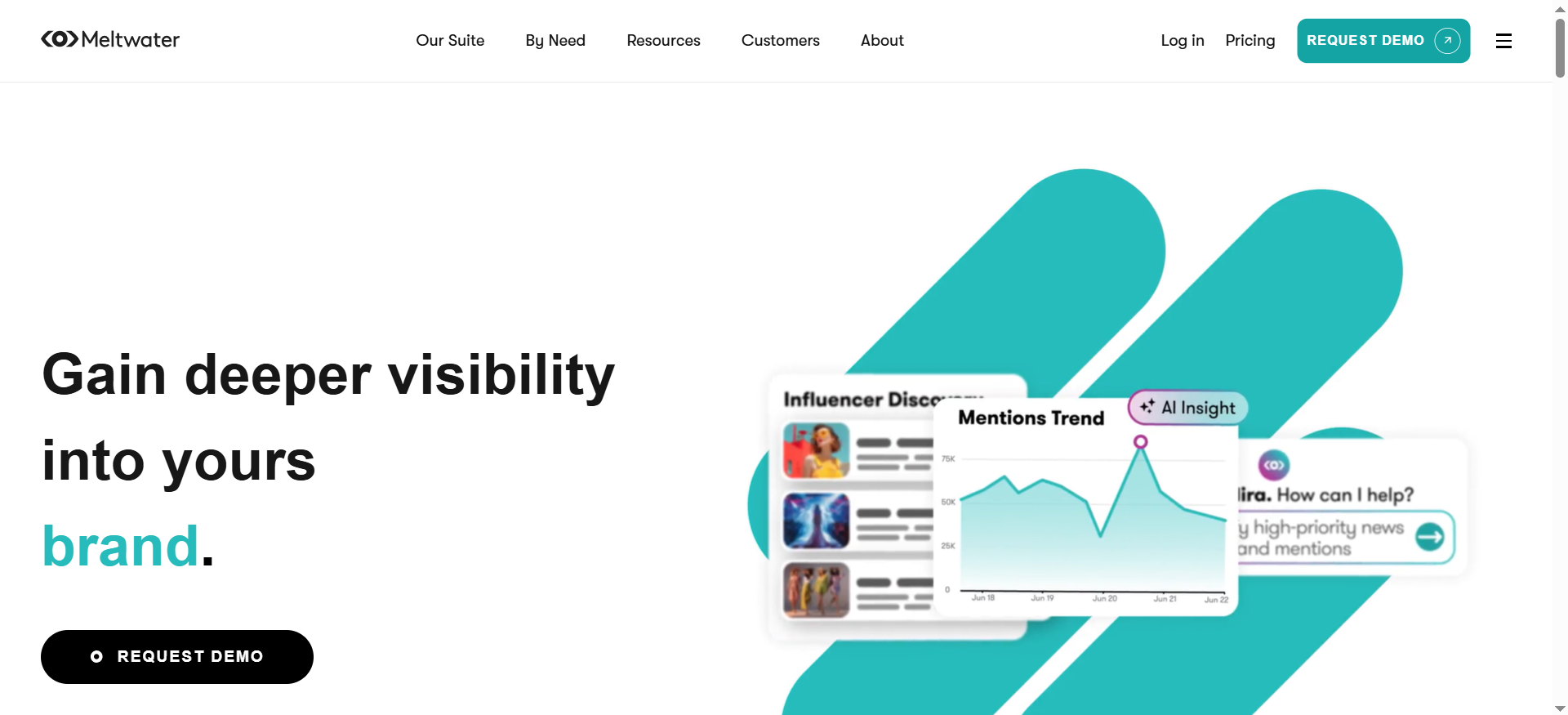
Meltwater is an enterprise-grade media intelligence platform that monitors over 6 million sources across online news, print, broadcast, social media, podcasts, and more. It combines media monitoring with social listening, influencer marketing, and competitive benchmarking in a single platform. Meltwater's AI engine, Mira Studio, converts raw monitoring data into summaries, visuals, and actionable insights through natural language interaction.
Why Teams Use It
Teams choose Meltwater when they need the widest possible net for brand mentions. Its source coverage is among the largest in the industry, spanning news outlets, blogs, forums, social platforms, podcasts, and broadcast media across regions and languages. For global brands that operate across multiple markets, this breadth is difficult to match. The platform also bundles competitive benchmarking, so teams can track share of voice against competitors without needing a separate tool.
What It Is Good For
Meltwater excels at comprehensive, cross-channel media monitoring for brands that need to track coverage in real time across dozens of countries and languages. Its AI-powered sentiment analysis provides brand-level sentiment scoring, and its unified reporting dashboards make it straightforward to share coverage reports with stakeholders. The GenAI Lens feature tracks how your brand appears in LLM-generated content, which is increasingly relevant as AI search grows.
When It Is a Good Fit
Meltwater fits best for mid-market to enterprise companies with dedicated PR or comms teams, multi-region operations that need monitoring in multiple languages, and organizations that want media monitoring, social listening, and influencer marketing consolidated into one platform. It is especially strong when the priority is breadth of coverage rather than depth in a single channel.
When It Is Not a Good Fit
Smaller teams or startups with limited budgets will find Meltwater's pricing prohibitive — contracts typically start at $6,000 per year and can easily exceed $25,000. The platform can also feel overwhelming for teams that only need basic mention tracking without the full suite of analytics, social listening, and influencer tools. If your primary need is journalist outreach rather than monitoring, a more PR-focused tool may be a better fit.
How to Use It
After onboarding with a Meltwater account manager, you set up keyword searches for your brand, competitors, and industry terms. The platform scans its 6M+ sources continuously and delivers real-time alerts via email, Slack, or in-app notifications. Dashboards can be customized to show sentiment trends, share of voice, top sources, and geographic breakdowns. Reports can be exported or shared directly with stakeholders.
Key Capabilities
Meltwater's core capabilities include real-time monitoring across 6M+ sources, AI-powered sentiment analysis, competitive benchmarking and share of voice tracking, customizable dashboards and automated reporting, GenAI Lens for LLM brand tracking, influencer identification and campaign management, journalist database access, Mira Studio AI assistant for natural language data exploration, and integrations with Slack, Salesforce, and other enterprise tools.
Pricing
Meltwater uses custom pricing based on the number of users, modules selected, geographic coverage, and contract length. The median annual cost is approximately $25,000, with a reported range of $6,000 to over $100,000 per year. All plans require an annual contract. There is no self-serve pricing page — you must request a demo and custom quote from the sales team.
Free Tier?
No. Meltwater does not offer a free plan or a self-serve free trial. You can request a guided demo with a product specialist to see the platform in action before committing.
Downsides and Limitations
Meltwater's biggest drawback is cost — it is one of the most expensive options in this category, and pricing is entirely opaque until you speak with sales. The platform's breadth can also be a double-edged sword: teams that only need monitoring may find themselves paying for social listening, influencer, and analytics features they do not use. Some users report that the user interface can feel complex, particularly during initial setup. Customer support quality can vary depending on your account tier.
2. Cision
What It Does
Cision, now operating primarily through its CisionOne platform, is an all-in-one PR and comms platform that combines media monitoring, journalist outreach, press release distribution, and media analytics. It monitors coverage across print, online news, TV, radio, social media, podcasts, and magazines in real time, covering 190+ countries and 96 languages.
Why Teams Use It
PR and comms teams choose Cision because it bundles the entire earned media workflow — from finding journalists and sending press releases to monitoring coverage and measuring results — into a single platform. Its media database of 500,000+ validated journalist contacts is one of the largest in the industry, and its integration with PR Newswire for press release distribution is a significant differentiator.
What It Is Good For
Cision is strongest when used as a complete PR workflow platform. If your team needs to pitch journalists, distribute press releases, monitor the resulting coverage, and report on media impact all in one place, Cision handles that end-to-end loop better than most competitors. Its AI-powered coverage tracking uses smart alerting to surface relevant mentions and filter out noise, and its Mention Streams feature provides unlimited, real-time insight into brand and competitor coverage.
When It Is a Good Fit
Cision fits best for PR agencies and in-house comms teams that need both outreach and monitoring capabilities, organizations that regularly distribute press releases and want PR Newswire integration, teams monitoring coverage across multiple countries and languages, and mid-to-large companies that want a single vendor for their entire earned media stack.
When It Is Not a Good Fit
Cision is not the best choice for teams focused primarily on social listening or consumer intelligence — tools like Brandwatch or Talkwalker go deeper in those areas. Smaller teams may find the pricing steep for monitoring alone, especially if they do not need the journalist database or distribution features. Some users have noted that the legacy Cision interface can feel dated compared to newer competitors, though CisionOne has improved this significantly.
How to Use It
Cision operates through its CisionOne web platform and mobile apps (iOS and Android). You set up monitoring feeds by defining keywords, topics, and competitors. The platform delivers real-time alerts and surfaces coverage through customizable Mention Streams. For outreach, you search the journalist database, build media lists, and send pitches directly from the platform. Press releases can be distributed through the integrated PR Newswire service.
Key Capabilities
Cision's core capabilities include real-time monitoring across print, online, TV, radio, social, podcasts, and magazines in 190+ countries and 96 languages, a database of 500,000+ validated journalist contacts, integrated PR Newswire press release distribution, AI-powered smart alerting and coverage tracking, unlimited Mention Streams for brand and competitor tracking, media analytics and impact reporting, and mobile apps for iOS and Android.
Pricing
Cision does not publish pricing publicly. Entry-level access starts at approximately $7,200 per year for basic monitoring. Small to mid-sized teams (3–10 users) with core modules typically see annual contracts in the $30,000 to $80,000 range. Single-user basic monitoring packages may start around $500 per month. All pricing is custom and requires a sales conversation.
Free Tier?
No. Cision does not offer a free plan or self-serve trial. A demo can be requested through their website.
Downsides and Limitations
Cision's pricing is opaque and can be high, especially for teams that only need monitoring without distribution or outreach. The platform has a steeper learning curve compared to simpler tools, and some users report that the journalist database, while large, occasionally contains outdated contact information. Integration with third-party tools is more limited compared to some competitors. Customer support responsiveness has received mixed reviews in recent user feedback.
3. Talkwalker
What It Does
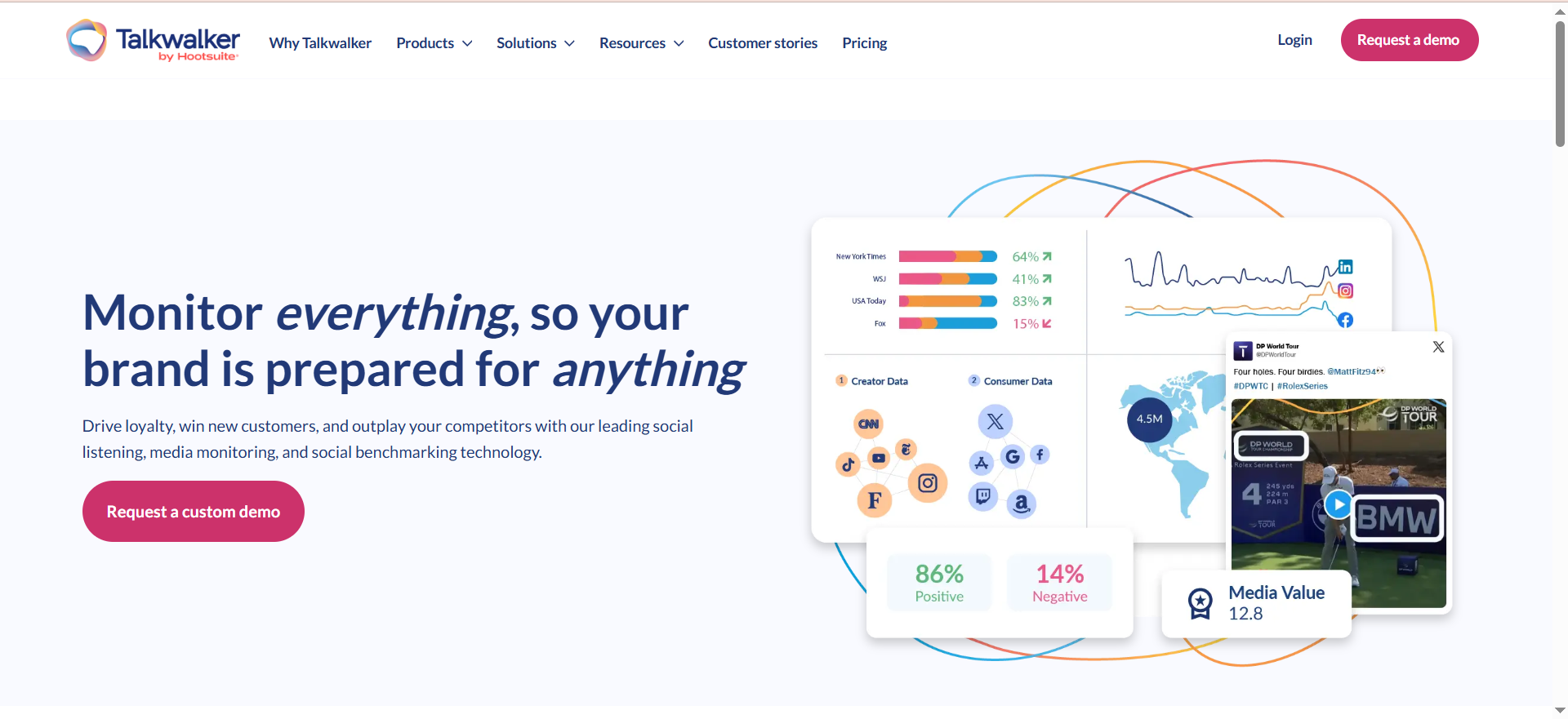
Talkwalker is a social listening and media monitoring platform that tracks brand mentions, sentiment, and trends across over 150 million sources including social media, news sites, blogs, forums, review sites, and more. It combines real-time monitoring with AI-powered analytics, image recognition, and customizable dashboards to give marketing and comms teams a comprehensive view of brand perception.
Why Teams Use It
Teams choose Talkwalker for its strong balance of social listening depth and media monitoring breadth at a more accessible price point than enterprise-only platforms. Its AI-powered sentiment analysis is highly regarded, and its image recognition feature — which can identify brand logos in photos even when the brand is not mentioned in accompanying text — is a standout capability that most competitors lack.
What It Is Good For
Talkwalker excels at social listening combined with traditional media monitoring. It is particularly strong for tracking brand sentiment trends over time, identifying emerging topics and conversations before they peak, and monitoring visual brand mentions through logo and image recognition. Its real-time trend research capabilities help teams spot opportunities and potential crises early. The platform also offers robust consumer insights and content ideation features.
When It Is a Good Fit
Talkwalker is a strong fit for mid-market marketing and comms teams that need both social listening and media monitoring, brands that want visual mention tracking through image recognition, teams that prioritize sentiment analysis and trend detection, and organizations looking for enterprise-grade capabilities without enterprise-level pricing.
When It Is Not a Good Fit
Talkwalker is not ideal for teams whose primary need is journalist outreach or press release distribution — it lacks the built-in media contacts database and distribution tools that Cision and Muck Rack offer. Teams that need very deep broadcast monitoring (TV and radio clips) may find Talkwalker's coverage in that area less comprehensive than Meltwater or Cision. The learning curve can also be steep for teams new to social listening tools.
How to Use It
Talkwalker operates through a web-based dashboard where you set up queries using keywords, Boolean operators, and filters to define what you want to monitor. The platform continuously scans its 150M+ sources and populates dashboards with real-time data. You can configure automated reports, set up alerts for spikes in mentions or sentiment shifts, and use the image recognition feature to track logo appearances across visual content.
Key Capabilities
Talkwalker's core capabilities include monitoring across 150M+ sources covering social media, news, blogs, forums, and reviews, AI-powered sentiment analysis with multilingual support, image and logo recognition for visual brand monitoring, real-time trend detection and automated alerts, customizable dashboards with drag-and-drop widgets, automated reporting and data export, consumer insights and audience analysis, and content ideation tools.
Pricing
Talkwalker offers tiered pricing starting at $500 per month for the Core plan. The Corporate plan runs approximately $1,000 per month ($12,000 annually), and the Enterprise plan is approximately $2,200 per month ($26,400 annually). Custom pricing is available for organizations with specific requirements. These prices make Talkwalker one of the more accessible options in the enterprise media monitoring category.
Free Tier?
Talkwalker offers a limited free trial that lets you explore basic functionality before committing to a paid plan. However, full access to advanced features like image recognition and deep analytics requires a paid subscription.
Downsides and Limitations
Talkwalker's lower-tier plans have restrictions on the number of queries, data volume, and historical data access that can limit usefulness for larger teams. The platform does not include journalist contact databases or press release distribution, so teams that need outreach capabilities will require a separate tool. Some users report that the dashboard can load slowly when processing complex queries across large datasets. Setup and query configuration can require training to get the most out of the tool.
4. Brandwatch
What It Does
Brandwatch is a digital consumer intelligence and social media management platform that monitors brand mentions across over 100 million sources worldwide. It combines deep social listening, sentiment analysis, audience insights, and image analytics into a platform designed for data-driven marketing and research teams. Brandwatch operates through three primary product suites: Consumer Intelligence, Social Media Management, and Influencer Marketing.
Why Teams Use It
Teams choose Brandwatch when they need the deepest possible consumer intelligence and analytics capabilities. Its AI-powered platform goes beyond simple mention tracking to provide nuanced sentiment classification, audience segmentation, trend analysis, and competitive benchmarking. The image and video recognition feature can identify brand logos in visual content, capturing mentions that text-based monitoring alone would miss.
What It Is Good For
Brandwatch excels at turning raw social and media data into actionable consumer intelligence. It is particularly strong for brands that need to understand not just what is being said about them, but who is saying it, why, and how sentiment is shifting over time. Its customizable dashboards with drag-and-drop widgets allow teams to build tailored views for different stakeholders, and its automated reporting reduces the manual effort of compiling coverage reports.
When It Is a Good Fit
Brandwatch is ideal for data-driven marketing and insights teams that need deep analytics, brands running large-scale social listening programs across multiple markets, organizations that need consumer intelligence beyond basic media monitoring, teams that want image and video recognition for visual brand tracking, and companies that also need social media management and influencer marketing in the same platform.
When It Is Not a Good Fit
Brandwatch's depth comes at a premium — pricing starts at approximately $800 per month and can exceed $15,000 per month for large enterprise configurations. This makes it a poor fit for smaller teams with limited budgets. It is also not the right tool for teams focused primarily on traditional media monitoring (print, broadcast) or journalist outreach, as its strength is in social and digital consumer intelligence rather than PR workflow.
How to Use It
Brandwatch is accessed through a web dashboard where you create queries to define what topics, brands, or keywords to monitor. The Consumer Intelligence suite provides deep-dive analytics through customizable dashboards, while the Social Media Management suite handles publishing and engagement. Data can be segmented by source, geography, sentiment, audience demographics, and more. Reports can be automated and scheduled for regular distribution.
Key Capabilities
Brandwatch's core capabilities include monitoring across 100M+ global sources, AI-powered sentiment analysis with nuanced classification, image and video recognition for logo detection, customizable drag-and-drop dashboards, audience segmentation and demographics analysis, trend analysis and competitive benchmarking, automated reporting and data export, social media management and publishing tools, and influencer identification and campaign management.
Pricing
Brandwatch pricing starts at approximately $800 per month, with all contracts custom-quoted based on scope. Pricing scales based on the number of social accounts, data sources, user seats, and query volume. Enterprise configurations can exceed $15,000 per month. Multi-year commitments (2–3 years) often unlock discounts. All pricing requires a sales conversation.
Free Tier?
No. Brandwatch does not offer a free plan or self-serve trial. Demos can be requested through the website.
Downsides and Limitations
Brandwatch's biggest limitation is price — it is among the most expensive tools in this category, and the custom pricing model means you will not know your exact cost until well into the sales process. The platform's depth can also be overwhelming for teams that only need basic monitoring, and the learning curve is steeper than simpler tools. Traditional media coverage (print and broadcast) is not as strong as its social and digital monitoring. Some users report that initial setup and query configuration requires dedicated time and training.
5. Muck Rack
What It Does
Muck Rack is a PR management platform that combines media monitoring, a comprehensive journalist database, media list building, and PR reporting into a single tool designed specifically for public relations professionals. It tracks brand mentions across online news, print publications, broadcast (TV and radio via TVEyes partnership), podcasts, and newsletters in real time.
Why Teams Use It
PR teams choose Muck Rack because it is purpose-built for their workflow. Unlike broader media intelligence platforms, Muck Rack focuses on the specific needs of PR professionals: finding the right journalists, building targeted media lists, pitching stories, monitoring resulting coverage, and reporting on PR impact. Its journalist database is continuously updated and includes detailed profiles with recent articles, social activity, and contact information.
What It Is Good For
Muck Rack is strongest as an integrated PR workflow tool. It excels at connecting journalist outreach with coverage monitoring, so teams can see which pitches led to coverage and measure the impact of their PR efforts in one place. The platform's media monitoring captures mentions across a wide range of sources including print (with full article text for thousands of publications), broadcast clips, podcasts, and newsletters — channels that some social-focused tools miss entirely.
When It Is a Good Fit
Muck Rack fits best for in-house PR teams and PR agencies that need journalist discovery, outreach, and monitoring in one tool, teams that prioritize traditional media coverage (print, broadcast, podcasts) alongside online monitoring, organizations that want to connect their outreach efforts directly to coverage results, and mid-market to enterprise companies with dedicated PR staff.
When It Is Not a Good Fit
Muck Rack is not the right tool for teams primarily interested in social listening or consumer intelligence — it does not offer the deep social analytics that Brandwatch or Talkwalker provide. Marketing teams without a PR function may find the journalist database and outreach features unnecessary. The platform also does not include press release distribution (unlike Cision's PR Newswire integration), so teams that regularly distribute releases will need an additional tool.
How to Use It
Muck Rack operates through a web-based platform. You set up media monitoring alerts by defining keywords, brand names, and competitor terms. The platform surfaces relevant coverage in real time and allows you to search its journalist database to find reporters covering your topics. Media lists can be built and managed within the platform, and pitches can be sent directly to journalists. Reporting dashboards track coverage volume, reach, sentiment, and PR impact over time.
Key Capabilities
Muck Rack's core capabilities include real-time media monitoring across online, print, broadcast (via TVEyes), podcasts, and newsletters, a comprehensive journalist contact database with detailed profiles, media list building and management, pitch tracking that connects outreach to resulting coverage, PR reporting dashboards with reach and sentiment metrics, full article text access for thousands of print publications, broadcast clip access through TVEyes partnership, and AI-powered advanced insights on the Premier tier.
Pricing
Muck Rack does not publish pricing publicly. Entry-level access starts near $5,000 per year, while most teams operate within the $12,000 to $15,000 annual range. Larger deployments with expanded monitoring, AI features, and multi-user access can exceed $25,000 per year. Three bundled tiers are available — Starter, Standard, and Premier — and annual contracts with upfront payment are standard.
Free Tier?
No. Muck Rack does not offer a free plan or self-serve free trial. You must request a custom quote through their sales team.
Downsides and Limitations
Muck Rack's social media monitoring capabilities are more limited compared to dedicated social listening tools like Brandwatch or Talkwalker. The platform's pricing is opaque and can be high for smaller teams, and the tiered structure means advanced AI features are only available on the most expensive Premier plan. Some users report that the journalist database, while comprehensive for US media, has less coverage of international journalists. The platform also does not include press release distribution.
What Is Media Monitoring and Why Does It Matter?
Media monitoring is the ongoing process of tracking and analyzing mentions of a brand, person, product, or topic across media channels — including online news, social media, print, broadcast, podcasts, blogs, and forums. The goal is to understand what is being said, where it is being said, and how sentiment is shifting over time.
For PR, comms, and marketing teams, media monitoring matters because it provides the visibility needed to manage brand reputation, measure campaign impact, and respond quickly to emerging issues. Without systematic monitoring, teams operate with blind spots — a negative article could gain traction before anyone on the team sees it, or a successful product mention could go unnoticed and unamplified. In 2026, media monitoring tools use AI to automate much of this work, summarizing mentions, detecting sentiment, clustering topics, and spotting anomalies before they become crises.
How to Choose the Right Media Monitoring Tool for Your Team
Choosing the right media monitoring tool depends on three main factors: your primary use case, your budget, and your team structure.
If your team is primarily focused on PR and journalist relationships, Muck Rack or Cision will serve you best because they combine monitoring with outreach and journalist databases. If your focus is on social listening and consumer intelligence, Brandwatch or Talkwalker are stronger choices. If you need the broadest possible source coverage across all media types and regions, Meltwater offers the widest net.
Budget is the other major differentiator. Talkwalker's published pricing starts at $500 per month, making it the most transparent and accessible option. Meltwater and Brandwatch sit at the premium end. Muck Rack and Cision fall somewhere in the middle but require sales conversations to get exact pricing.
Finally, consider whether you need a standalone monitoring tool or a platform that integrates monitoring with other workflows like social publishing, influencer marketing, or press release distribution. Consolidating tools can reduce cost and complexity, but specialized tools often go deeper in their specific area.
Media Monitoring vs Social Listening — What Is the Difference?
Media monitoring and social listening are related but distinct disciplines. Media monitoring is broader — it tracks mentions of your brand across all media types including news, print, broadcast, podcasts, and social media. The focus is on capturing coverage and understanding where and how your brand is mentioned.
Social listening is a subset that focuses specifically on social media platforms and online conversations. It goes deeper into audience sentiment, conversation trends, emerging topics, and consumer behavior patterns. Social listening is more proactive — it looks at broader market conversations, not just direct brand mentions.
In practice, most enterprise media monitoring tools now include social listening capabilities, and vice versa. Tools like Talkwalker and Brandwatch are particularly strong at combining both. Meltwater offers both but through separate modules. Muck Rack and Cision are more focused on traditional media monitoring with limited social listening depth.
How Much Do Media Monitoring Tools Cost?
Media monitoring tool pricing varies widely based on the platform, features, number of users, and scope of monitoring. Here is a summary of approximate pricing for the five tools covered in this guide:
Meltwater typically costs between $6,000 and $100,000+ per year, with a median around $25,000 annually. Cision starts at approximately $7,200 per year, with mid-size team contracts running $30,000 to $80,000. Talkwalker has the most transparent pricing, starting at $500 per month ($6,000 per year) and scaling to $2,200 per month ($26,400 per year). Brandwatch starts at approximately $800 per month ($9,600 per year) and scales based on data sources and seats. Muck Rack entry-level access starts near $5,000 per year, with most teams spending $12,000 to $15,000.
Most tools in this category require annual contracts and do not publish pricing on their websites. Budget-conscious teams should also consider tools outside this guide like Brand24 (starting at $79 per month) or Mention for more basic monitoring needs.
What Types of Media Can These Tools Track?
The five tools covered in this guide collectively track mentions across a wide range of media types. Online news and blogs are covered by all five tools — this is the baseline capability. Social media platforms (including X/Twitter, Facebook, Instagram, LinkedIn, Reddit, and others) are monitored by all five, though Brandwatch and Talkwalker offer the deepest social analytics.
Print media is tracked by Meltwater, Cision, and Muck Rack, with Muck Rack offering full article text for thousands of publications. Broadcast monitoring (TV and radio) is available through Meltwater, Cision, and Muck Rack (via its TVEyes partnership). Podcasts and newsletters are tracked by Muck Rack and Meltwater. Forums and review sites are best covered by Talkwalker and Brandwatch, which monitor over 150 million and 100 million sources respectively.
Image and visual mention tracking — where the tool recognizes your brand logo in photos even without a text mention — is a specialty of Talkwalker and Brandwatch.
How to Set Up Media Monitoring for Your Brand
Setting up effective media monitoring follows a consistent process regardless of which tool you choose. Start by defining your monitoring keywords — at minimum, include your brand name, product names, key executive names, and primary competitors. Use variations and common misspellings to avoid missing mentions.
Next, configure your alert thresholds. Most tools let you set real-time alerts for high-priority mentions (such as negative sentiment spikes or mentions in tier-one publications) and digest-style summaries for routine coverage. Avoid setting alerts too broadly or you will drown in noise.
Set up dashboards that track the metrics that matter to your stakeholders: mention volume over time, sentiment trends, share of voice against competitors, top sources, and geographic distribution. Finally, establish a review cadence — daily for active campaigns or crisis situations, weekly for ongoing brand health monitoring.
Can Media Monitoring Tools Track Competitor Mentions?
Yes — competitor monitoring is a core feature of all five tools in this guide. Each platform allows you to set up monitoring queries for competitor brand names, products, and executives alongside your own brand tracking.
Meltwater is particularly strong for competitive benchmarking, offering built-in share of voice analysis that shows how your brand's media presence compares to competitors over time. Brandwatch and Talkwalker provide deep competitive analytics through customizable dashboards that can segment competitor mentions by source, sentiment, geography, and topic. Cision and Muck Rack offer competitor coverage tracking with reporting capabilities, though their competitive analytics are less granular than the consumer intelligence platforms.
The most effective use of competitor monitoring goes beyond counting mentions — it involves analyzing the topics competitors are being covered for, which journalists are writing about them, and how their sentiment trends compare to yours.
What Is Sentiment Analysis in Media Monitoring?
Sentiment analysis is an AI-powered feature that automatically classifies mentions of your brand as positive, negative, or neutral based on the language and context used. Advanced tools go beyond this basic classification to provide nuanced sentiment scoring, emotion detection, and topic-level sentiment breakdowns.
Brandwatch and Talkwalker are considered the strongest for sentiment analysis among the five tools, with AI that can distinguish between sarcasm, contextual negativity, and genuine criticism across multiple languages. Meltwater offers brand-level sentiment scoring with predictive analytics for mention forecasting. Cision and Muck Rack provide sentiment classification as part of their monitoring output, though with less analytical depth.
Sentiment analysis is most valuable for tracking brand health over time, identifying emerging reputation risks, and measuring the impact of campaigns or product launches on public perception. However, no automated sentiment tool is perfectly accurate — all require periodic human review, particularly for nuanced or industry-specific language.
Best Free Media Monitoring Tools vs Paid Options
None of the five enterprise tools covered in this guide offer a free plan. However, teams with limited budgets have several options. Google Alerts is the simplest free media monitoring tool — it tracks mentions of specified keywords across Google-indexed web pages and sends email notifications. It is limited in scope (no social media, no sentiment analysis, no dashboards) but costs nothing.
For more robust free or low-cost monitoring, Brand24 starts at $79 per month and covers social media, news, blogs, and forums with sentiment analysis and basic reporting. Mention offers monitoring starting at $41 per month. These tools are suitable for small teams or startups that need core monitoring without the depth and breadth of enterprise platforms.
The trade-off with free and low-cost tools is clear: they cover fewer sources, lack advanced analytics like image recognition and competitive benchmarking, have limited historical data, and do not include journalist databases or outreach features. For teams doing serious PR or brand management, the investment in a paid platform typically pays for itself through time savings and insight quality.
How AI Is Changing Media Monitoring in 2026
AI has fundamentally transformed media monitoring from a manual, keyword-based process into an intelligent, automated system. In 2026, the most significant AI capabilities in media monitoring include automated summarization (Meltwater's Mira Studio and similar tools condense thousands of mentions into digestible briefs), predictive analytics that forecast mention volume and sentiment trends before they peak, and natural language processing that understands context and nuance across languages.
Image and video recognition — used by Brandwatch and Talkwalker — represents one of the most impactful AI applications, capturing brand mentions in visual content that text-based monitoring misses entirely. GenAI tracking is another emerging capability, with Meltwater's GenAI Lens monitoring how brands appear in LLM-generated content as AI search engines become more prevalent.
These AI capabilities mean that media monitoring tools can now detect potential crises before they escalate, identify trending topics before they hit mainstream coverage, and provide actionable insights without requiring teams to manually review thousands of mentions. The gap between enterprise tools (which invest heavily in AI) and budget tools (which offer basic keyword matching) continues to widen.