

TL;DR
If you manage a brand, run comms, or lead growth at a B2B SaaS company, you already know that tracking mentions alone is not enough. You need to understand how people feel when they talk about you. That is where brand monitoring tools with built-in sentiment analysis come in — they go beyond counting mentions to classify the emotional tone behind every conversation, giving you a real-time read on whether your brand perception is trending positive, negative, or neutral.
After evaluating dozens of platforms, these are the five brand monitoring tools with the strongest sentiment analysis capabilities in 2026: Brandwatch for enterprise-grade consumer intelligence, Talkwalker for multilingual visual and text sentiment, Brand24 for accessible AI-powered monitoring at mid-market pricing, YouScan for image-first sentiment analysis, and Meltwater for teams that need traditional media coverage alongside social sentiment. Below, you will find what each tool does well, where it falls short, what it costs, and which type of team it fits best.
Best Brand Monitoring Tools with Sentiment Analysis (Quick Comparison)
| Tool | Best For | Starting Price | Standout Feature |
|---|---|---|---|
| Brandwatch | Enterprise consumer intelligence | ~$800/mo (custom) | Image logo recognition + Boolean query builder |
| Talkwalker | Multilingual visual + text sentiment | ~$500/mo (custom) | AI visual sentiment across images and video |
| Brand24 | Mid-market teams and agencies | $249/mo ($199 annual) | AI anomaly detection + AI Visibility add-on |
| YouScan | Visual-first brand monitoring | $499/mo (billed annually) | Visual Insights — image-level brand analysis |
| Meltwater | PR and comms teams needing traditional media | ~$500/mo (custom) | TV, radio, print + social unified monitoring |
1. Brandwatch
What It Does
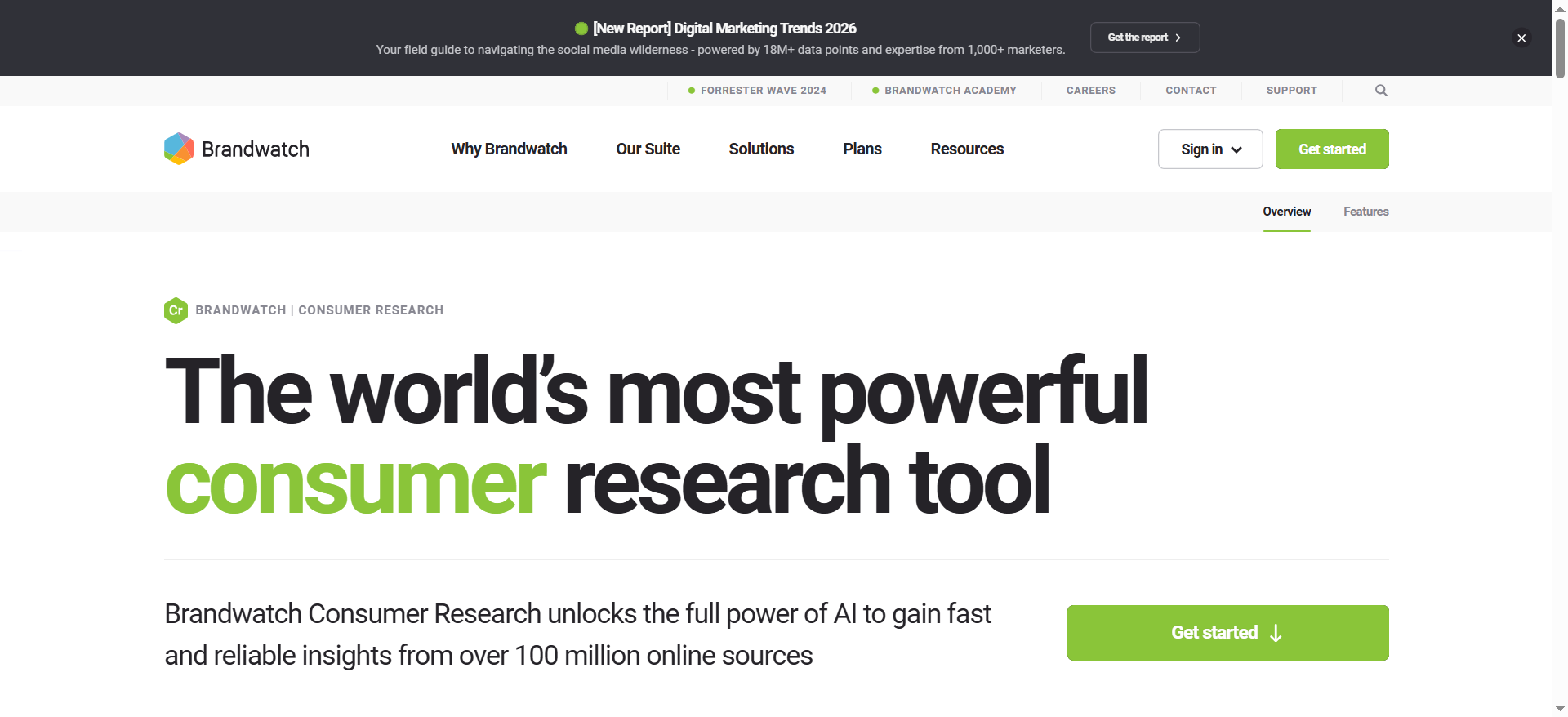
Brandwatch is a consumer intelligence and social media management platform that monitors brand mentions, consumer sentiment, and competitive activity across more than 100 million online sources. It combines social listening, audience analytics, content publishing, and influencer marketing into a single enterprise platform. The sentiment engine classifies mentions beyond basic positive and negative labels, detecting emotional nuances like joy, anger, surprise, and frustration to give brand and comms teams a more granular view of how audiences react.
Why Teams Use It
Teams at large SaaS companies and consumer brands choose Brandwatch because it offers a level of data depth and query flexibility that mid-market tools cannot match. The Boolean query builder lets analysts construct highly specific monitoring rules — filtering by region, language, source type, and even combinations of keywords that competitors' natural-language search bars struggle with. For organizations tracking dozens of product lines, sub-brands, or competitive sets simultaneously, this granularity makes a meaningful difference in data quality.
What It's Good For
Brandwatch excels at large-scale consumer intelligence projects. If your team needs to monitor brand health across multiple markets, run competitive benchmarking studies, or analyze audience segments by demographics and interests, this is the platform built for that workload. The image analytics feature — which recognizes brand logos in social media photos even when the brand is not mentioned in the text — opens up an entire layer of visual monitoring that text-only tools miss. This is particularly valuable for consumer brands with strong visual identities, sponsorship programs, or product placement strategies.
When It's a Good Fit
Brandwatch fits best when your organization has a dedicated insights or social intelligence team with the bandwidth to build and maintain complex queries. It is ideal for enterprise B2B SaaS companies at the growth or scale stage, consumer brands with global presence, and agencies managing multiple client accounts that require deep, customizable analytics. If your team already uses Falcon (now part of Brandwatch) for social media management, consolidating listening and publishing into one platform reduces tool sprawl.
When It's Not a Good Fit
If you are a startup or a lean marketing team looking for quick setup and immediate value, Brandwatch's complexity works against you. The platform has a steep learning curve, and building effective Boolean queries requires training. The lack of a self-serve free trial means you cannot test-drive the product before committing to a sales conversation and an annual contract. For teams with fewer than five brands or topics to monitor, the platform's enterprise-grade feature set is overkill and its pricing reflects that.
How to Use It
After onboarding (which Brandwatch provides through a dedicated customer success manager), you set up queries for the brands, products, or topics you want to track. Each query defines the keywords, Boolean operators, language filters, and source selections. From there, you build dashboards that visualize mention volume, sentiment trends, share of voice, and audience demographics. Alerts can be configured to notify your team of spikes in negative sentiment or unusual mention volume — useful for crisis detection. Reports can be scheduled and shared with stakeholders automatically.
Key Capabilities
Brandwatch's core capabilities include social listening across 100 million+ sources with Boolean query precision, AI-powered sentiment analysis with emotion detection, image analytics with logo recognition in social media photos, audience segmentation by demographics and interests, competitive benchmarking and share of voice tracking, customizable dashboards and automated reporting, content publishing and social media management (Brandwatch Social), influencer identification and campaign management, and support for 27+ languages with built-in spam filtering.
Pricing
Brandwatch uses fully custom pricing with no published rate card. Based on market data, pricing starts around $800 per month and scales to $15,000 or more per month for large enterprise configurations. Pricing depends on the number of active queries, data sources, user seats, and contract length. Annual contracts are standard, and multi-year commitments (two to three years) often unlock meaningful discounts. The platform is structured around three product suites — Consumer Intelligence, Social Media Management, and Influencer Marketing — each priced separately.
Free Tier?
No. Brandwatch does not offer a free tier or a self-serve free trial. Access requires going through their sales process, which typically involves a demo, scoping call, and custom proposal.
Downsides / Limitations
The biggest limitation is accessibility. Brandwatch is built for power users, and casual users or small teams will find the interface overwhelming. The lack of transparent pricing and the mandatory sales process create friction for teams that want to evaluate the tool quickly. Some users report that historical data access is limited on lower-tier plans, and the platform's full value only emerges when you invest significant time into query building and dashboard customization. For teams that just need basic sentiment tracking on a handful of keywords, the investment does not justify the output.
2. Talkwalker
What It Does
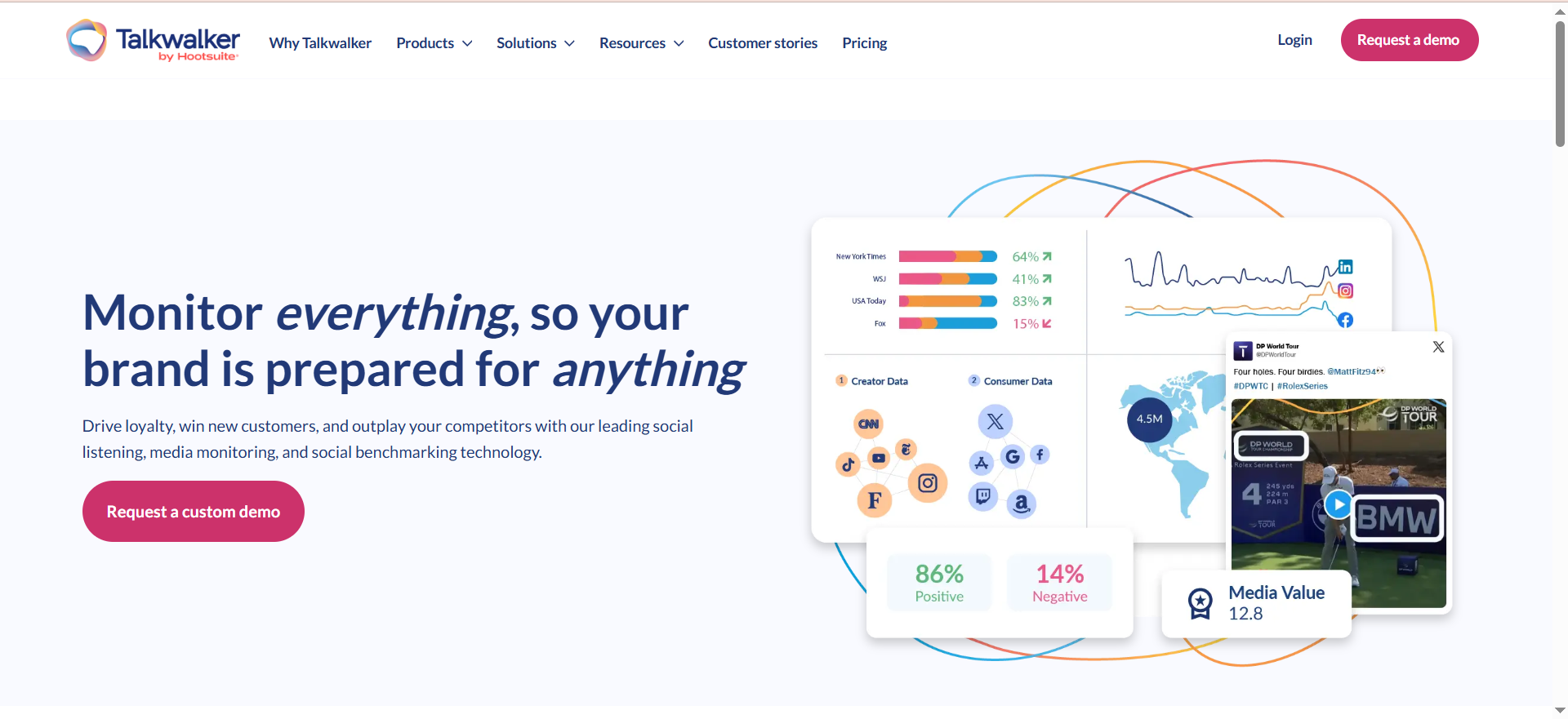
Talkwalker is a consumer intelligence platform — now owned by Hootsuite — that specializes in AI-powered sentiment analysis across text, images, and video content. The platform monitors social media, news sites, blogs, forums, podcasts, and broadcast media in 187 languages, making it one of the most linguistically comprehensive brand monitoring tools available. Its sentiment engine uses AI models trained across diverse linguistic and cultural contexts to classify the emotional tone of mentions with more accuracy than keyword-based approaches.
Why Teams Use It
Teams choose Talkwalker for two primary reasons: multilingual sentiment accuracy and visual content analysis. For global brands operating in markets where English is not the primary language, the ability to run sentiment analysis in 187 languages — with models that account for cultural nuance and idiomatic expression — is a significant advantage over competitors that support 30 or fewer languages. The visual recognition technology adds another dimension by detecting brand logos and emotional cues in images and videos posted across social platforms, which is increasingly important as more consumer conversation happens through visual content rather than text.
What It's Good For
Talkwalker is particularly strong for global brand health tracking, competitive intelligence, and trend detection. The platform's AI can analyze podcast transcripts, YouTube video sentiment, and even visual content tone — capabilities that most brand monitoring tools added only recently or still lack. For PR and comms teams, the ability to track sentiment across earned media (news), owned media (social), and shared media (forums, reviews) from a single dashboard reduces the need to stitch together reports from multiple tools.
When It's a Good Fit
Talkwalker fits teams that operate across multiple countries and languages and need sentiment analysis that works reliably outside of English. It is well suited for enterprise marketing and comms teams at SaaS companies with international customer bases, consumer brands launching in new markets, and agencies managing global client portfolios. If your organization already uses Hootsuite for social media management, the Talkwalker integration provides a natural extension into deeper analytics and listening.
When It's Not a Good Fit
If your monitoring needs are primarily domestic and English-language, you are paying for linguistic breadth you will not use. Users have reported that the automatic sentiment classification — while strong overall — still requires manual correction in certain edge cases, particularly with sarcasm, irony, and mixed-sentiment posts. This means teams without an analyst dedicated to reviewing and refining sentiment data may find the outputs less reliable than expected. The platform's pricing can also be a barrier for smaller teams or startups.
How to Use It
After purchasing a plan, you configure topics (similar to Brandwatch's queries) that define which brands, keywords, and sources to monitor. Talkwalker provides pre-built dashboards for brand health, competitive analysis, and campaign tracking that can be customized with drag-and-drop widgets. The AI Insights feature surfaces trending topics and anomalies automatically, reducing the time spent manually sifting through data. Alerts can be set for sentiment shifts, mention spikes, or specific keywords to support real-time crisis management.
Key Capabilities
Talkwalker offers AI-powered sentiment analysis in 187 languages, visual recognition for logos and emotional cues in images and video, podcast and video transcript sentiment analysis, trend detection and anomaly alerts, competitive benchmarking with share of voice, customizable dashboards with drag-and-drop reporting, integration with Hootsuite's social media management suite, real-time monitoring across social, news, blogs, forums, and broadcast, and consumer segmentation by demographics and interests.
Pricing
Talkwalker's pricing starts at approximately $500 per month for its entry-level plan. The Enterprise Plan is priced at around $2,200 per month ($26,400 annually) and is designed for large organizations that require extensive data analysis, high-volume tracking, and advanced features. Pricing is subscription-based and scales with the volume of results, number of users, and feature access. Custom pricing is available for organizations with specific requirements or large-scale deployments.
Free Tier?
Talkwalker offers a free trial for new users. The duration and scope of the trial vary depending on the plan and may require a sales conversation for enterprise-tier access.
Downsides / Limitations
The most commonly cited limitation is the manual effort required to correct sentiment misclassifications. While the AI handles straightforward positive and negative mentions well, nuanced content like sarcasm, cultural references, and code-switching between languages can produce inaccurate results that an analyst needs to review. The platform's interface, while feature-rich, can feel complex for new users, and the full value of the tool requires dedicated setup time. Some users also note that Talkwalker's social media management features are less robust than those offered by standalone social management platforms.
3. Brand24
What It Does
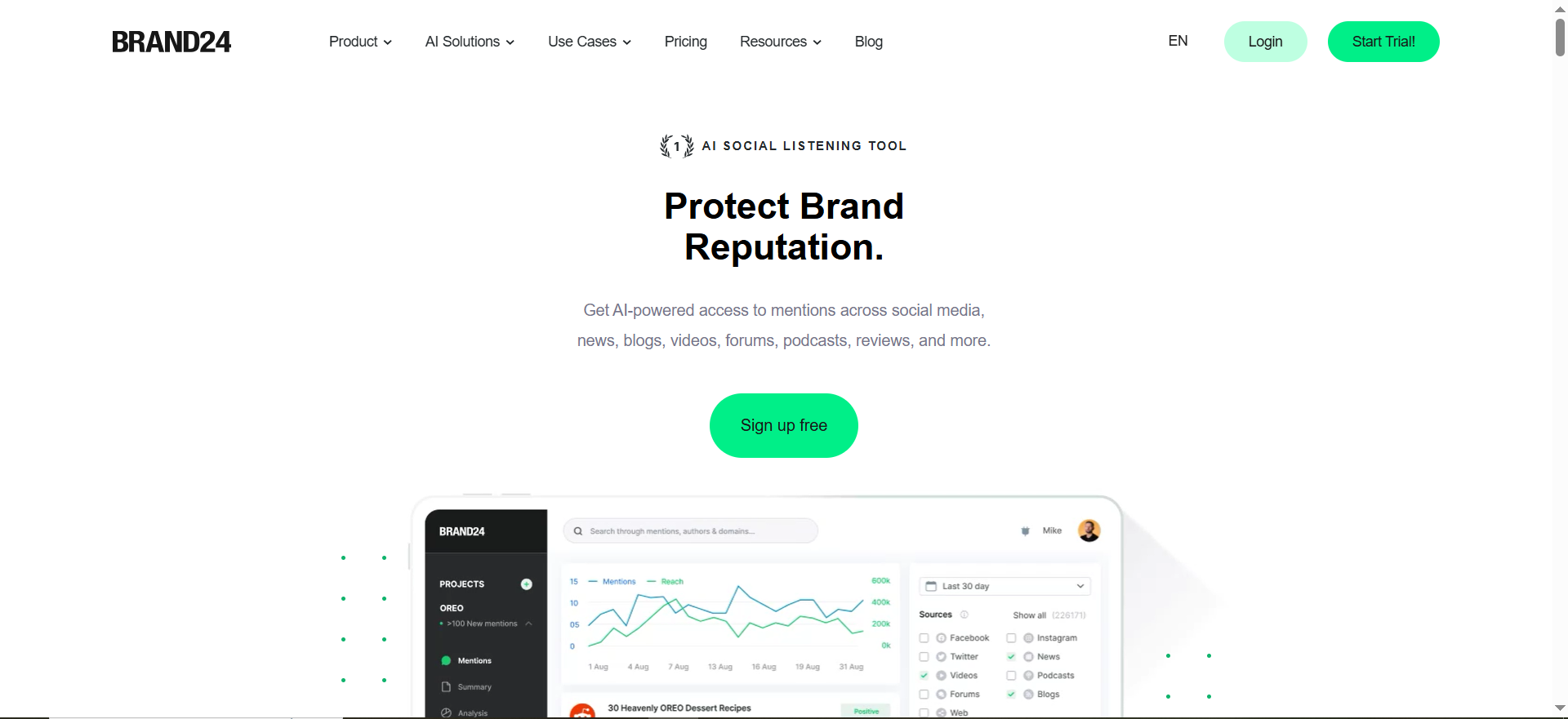
Brand24 is an AI-powered brand monitoring and social listening platform designed for mid-market teams, agencies, and growing brands that need real-time mention tracking and sentiment analysis without the complexity and cost of enterprise platforms. The tool monitors mentions across social media, news, blogs, forums, podcasts, and review sites, and applies AI-driven sentiment scoring to automatically classify each mention as positive, negative, or neutral. A standout addition in 2026 is its AI Visibility add-on, which tracks how AI chatbots like ChatGPT, Claude, Gemini, Perplexity, and Grok mention and recommend your brand — a feature increasingly relevant as AI search reshapes how buyers discover software. AI Visibility is available as a paid add-on across all plans.
Why Teams Use It
Teams choose Brand24 because it delivers the core functionality of enterprise brand monitoring platforms — real-time alerts, sentiment analysis, share of voice, and competitive tracking — at a price point that does not require enterprise budgets or enterprise-level onboarding. The platform is designed for fast setup: you can start monitoring a brand within minutes of creating an account. For lean marketing teams, founders, and agencies that need actionable brand intelligence without hiring a dedicated analyst, Brand24 hits the sweet spot between capability and usability.
What It's Good For
Brand24 is particularly effective for real-time reputation monitoring, campaign impact measurement, and competitive benchmarking. The AI anomaly detection feature flags unusual spikes or drops in mentions — such as a sudden surge in negative sentiment after a product update — which allows teams to respond before issues escalate. The Slack integration is a practical advantage for SaaS teams already living in Slack: mention alerts drop directly into channels, keeping the team informed without requiring anyone to log into another dashboard. Brand24's AI-generated summaries condense large volumes of mentions into digestible insights, saving time for teams that do not have the capacity to read through every individual mention.
When It's a Good Fit
Brand24 fits best for mid-market B2B SaaS companies, digital agencies managing client brand monitoring, and startups that have outgrown manual brand tracking through Google Alerts but are not ready for enterprise platforms like Brandwatch or Meltwater. It is also a strong choice for teams that want to track AI visibility — understanding how AI systems like ChatGPT reference their brand is becoming a strategic priority, and Brand24 is one of the few monitoring tools that offers this capability through its AI Visibility add-on.
When It's Not a Good Fit
If your team needs deep Boolean query customization, image-level sentiment analysis, or monitoring across 100+ languages with culturally tuned models, Brand24 will feel limiting. The keyword cap on lower-tier plans can be restrictive for companies tracking multiple product lines or competitive sets. Enterprise teams that require custom integrations, dedicated account management, or SLA-backed support will find Brand24's support model adequate but not enterprise-grade.
How to Use It
Setup takes minutes. You create a project, enter the keywords or brand names you want to track, and Brand24 begins collecting mentions immediately. The dashboard shows a real-time feed of mentions with sentiment labels, and you can filter by source, sentiment, language, or geography. The Discussion Volume chart visualizes mention trends over time, making it easy to correlate spikes with specific campaigns or events. Reports can be exported as PDFs or shared via link, and automated reports can be scheduled for daily, weekly, or monthly delivery.
Key Capabilities
Brand24's core capabilities include real-time mention tracking across social media, news, blogs, forums, podcasts, and review sites, AI-powered sentiment analysis with automatic positive, negative, and neutral classification, anomaly detection that flags unusual spikes or drops in mention volume, AI-generated mention summaries for fast insight extraction, AI Visibility add-on for tracking brand mentions across ChatGPT, Claude, Gemini, Perplexity, and Grok, geolocation and language filters for multi-market monitoring, native Slack integration for real-time mention alerts, Zapier integration for connecting to third-party workflows, white-label reporting on Pro and Business plans, and topic analysis for identifying the themes driving conversation around your brand.
Pricing
Brand24 offers five pricing tiers. The Individual plan is $249 per month ($199 per month when billed annually) and suits solo practitioners or small brands tracking a limited number of keywords. The Team plan is $349 per month ($299 per month when billed annually) and adds multi-user access and broader platform coverage. The Pro plan is $499 per month ($399 per month when billed annually) and includes advanced AI features and white-label reporting, making it popular with agencies. The Business plan is $699 per month ($599 per month when billed annually) and supports high mention volumes, podcast monitoring, and topic analysis for enterprise-scale needs. The Enterprise plan starts from $1,499 per month and is designed for industry leaders and large-scale enterprises with custom keyword counts and mention limits. Annual billing discounts are available across all plans.
Free Tier?
Brand24 offers a 14-day free trial that provides access to the full feature set, allowing teams to evaluate the platform before committing. No credit card is required to start the trial.
Downsides / Limitations
The main limitation is depth. Brand24 provides excellent coverage for its price range, but it does not match the query flexibility, data source breadth, or analytical depth of Brandwatch or Meltwater. The keyword caps on lower-tier plans can be frustrating for teams monitoring multiple brands or competitors. Sentiment accuracy, while generally reliable, can misclassify sarcasm and context-dependent mentions — a limitation shared across most AI sentiment tools, but more noticeable here because there is no manual correction workflow built into the platform. Image and video sentiment analysis is not available, which is a gap for brands with heavy visual content strategies.
4. YouScan
What It Does
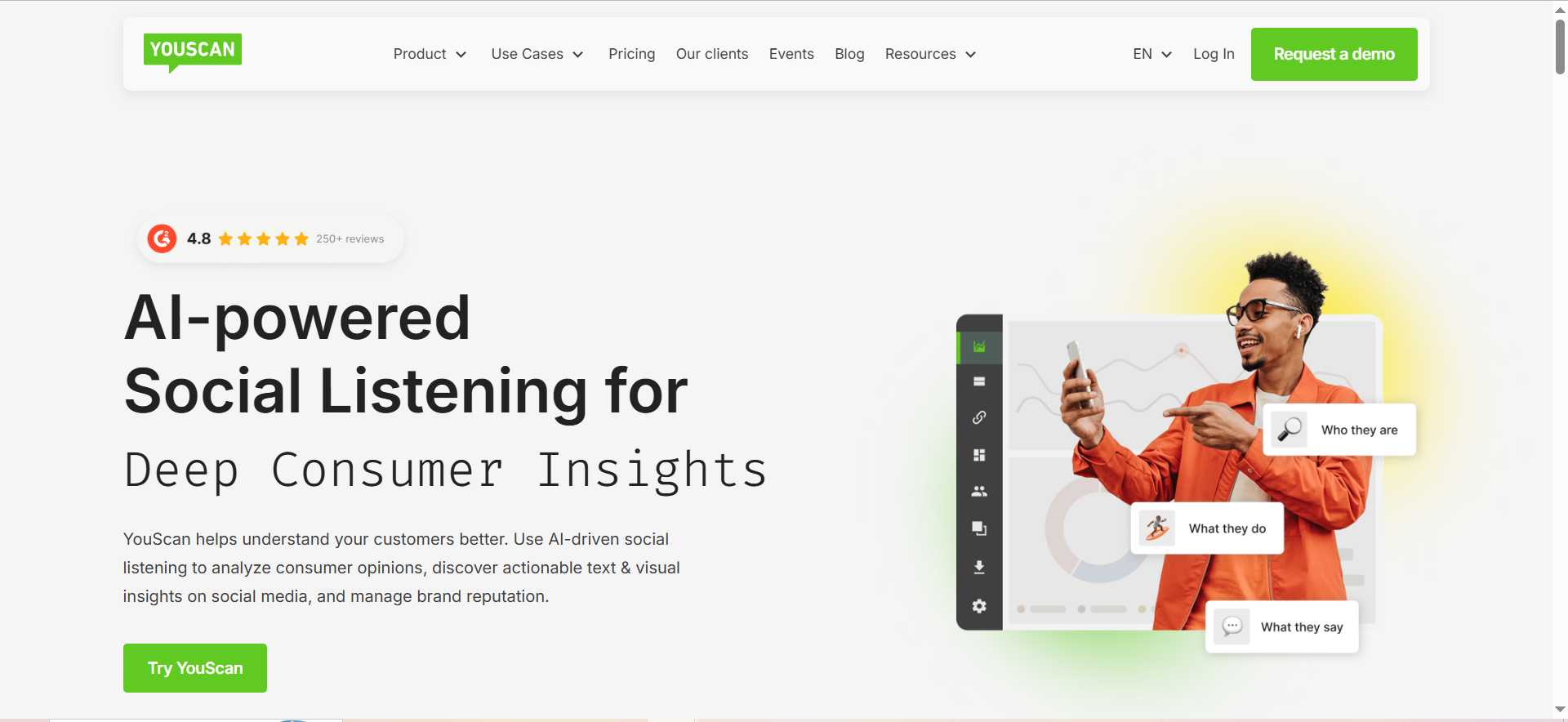
YouScan is an AI-powered social listening platform that differentiates itself through visual-first brand monitoring. While most brand monitoring tools start with text-based mention tracking and add image analysis as a secondary feature, YouScan built its platform around Visual Insights — the ability to analyze social media images to reveal how people engage with brands and products in real life. The platform detects brand logos in images, analyzes visual context (where and how products appear), and applies sentiment analysis to both text mentions and visual content. This combination gives marketing, research, and CX teams a more complete picture of brand perception than text-only monitoring provides.
Why Teams Use It
Teams choose YouScan because visual content is where an increasing share of brand-relevant conversations happens. A customer posting a photo of your product on Instagram without tagging your brand, a competitor's product appearing in a YouTube thumbnail, or your logo showing up in event photography — these are all brand signals that text-based monitoring misses entirely. YouScan captures and analyzes these visual mentions alongside traditional text-based monitoring, giving teams a more complete view of brand presence and sentiment across platforms where visual content dominates.
What It's Good For
YouScan is particularly effective for consumer packaged goods brands, food and beverage companies, fashion and lifestyle brands, and any organization where visual brand presence is a key marketing metric. In the B2B SaaS context, YouScan adds value for companies with strong visual branding, event sponsorship programs, or products that appear frequently in user-generated visual content (screenshots, workspace photos, conference presentations). The Insights Copilot — an AI assistant that answers natural-language questions about your social listening data — makes it possible to extract insights without building complex queries or navigating multiple dashboard views.
When It's a Good Fit
YouScan fits teams that need to monitor visual brand presence as much as text-based mentions. It is well suited for brand managers at consumer-facing SaaS companies, market research teams studying product perception in real-world usage contexts, and CX teams that want to understand how customers visually interact with products. If your brand invests heavily in events, sponsorships, or visual marketing campaigns, YouScan gives you measurement capabilities that text-focused tools do not offer.
When It's Not a Good Fit
If your brand monitoring needs are primarily text-based — tracking blog mentions, news coverage, or forum discussions — YouScan's visual analysis premium may not justify the cost. The platform's starting price of $499 per month positions it above Brand24, and teams that do not have a significant visual content component to their brand presence will not extract full value from the Visual Insights feature. Enterprise teams that need deep Boolean query building, extensive historical data access, or integration with traditional media monitoring (TV, radio, print) will find YouScan's capabilities more limited than Brandwatch or Meltwater in those areas.
How to Use It
After signing up, you create monitoring topics by entering keywords, brand names, or hashtags. YouScan begins collecting mentions across social media, news, blogs, forums, and review sites. The Visual Insights dashboard displays images where your brand appears, organized by context (product in use, logo visible, competitor comparison, etc.). The Insights Copilot lets you ask questions in natural language — for example, "What are customers saying about our packaging this month?" — and receive summarized answers with supporting examples from your data. Automated reports can be customized to focus on specific metrics and scheduled for regular delivery.
Key Capabilities
YouScan offers Visual Insights that analyze social media images for brand logos, product placement, and visual context, AI-powered sentiment analysis across text and visual content, Insights Copilot — an AI conversational assistant for querying social listening data in natural language, real-time monitoring with instant alerts for mention spikes or sentiment shifts, customizable reporting with automated delivery, competitive analysis and share of voice tracking, demographic and geographic filtering, integration with major platforms including Slack and CRM systems, and support for 45+ languages.
Pricing
YouScan's most accessible plan, Starter-3, starts at $499 per month when billed annually. The platform offers flexible subscription tiers designed for different business sizes, from agencies to global enterprises. Pricing scales based on the number of topics monitored, data volume, and feature access. Unlimited plans are available for organizations that need advanced functionality and dedicated support. Custom pricing is provided for enterprise deployments with specific requirements.
Free Tier?
Yes. YouScan offers a free trial for new users to explore the platform's features before committing to a paid plan.
Downsides / Limitations
The primary limitation is YouScan's narrower source coverage compared to enterprise platforms like Brandwatch or Meltwater. While visual analysis is best-in-class, the text-based monitoring capabilities — while solid — do not match the depth, source breadth, or query flexibility of more established enterprise tools. The platform's language support (45+ languages) is significantly less than Talkwalker's 187 languages, which may be a concern for truly global brands. The $499 per month starting price can feel steep for small teams that primarily need text-based monitoring, and the visual analysis feature set is less relevant for B2B SaaS brands that generate limited visual user content.
5. Meltwater
What It Does
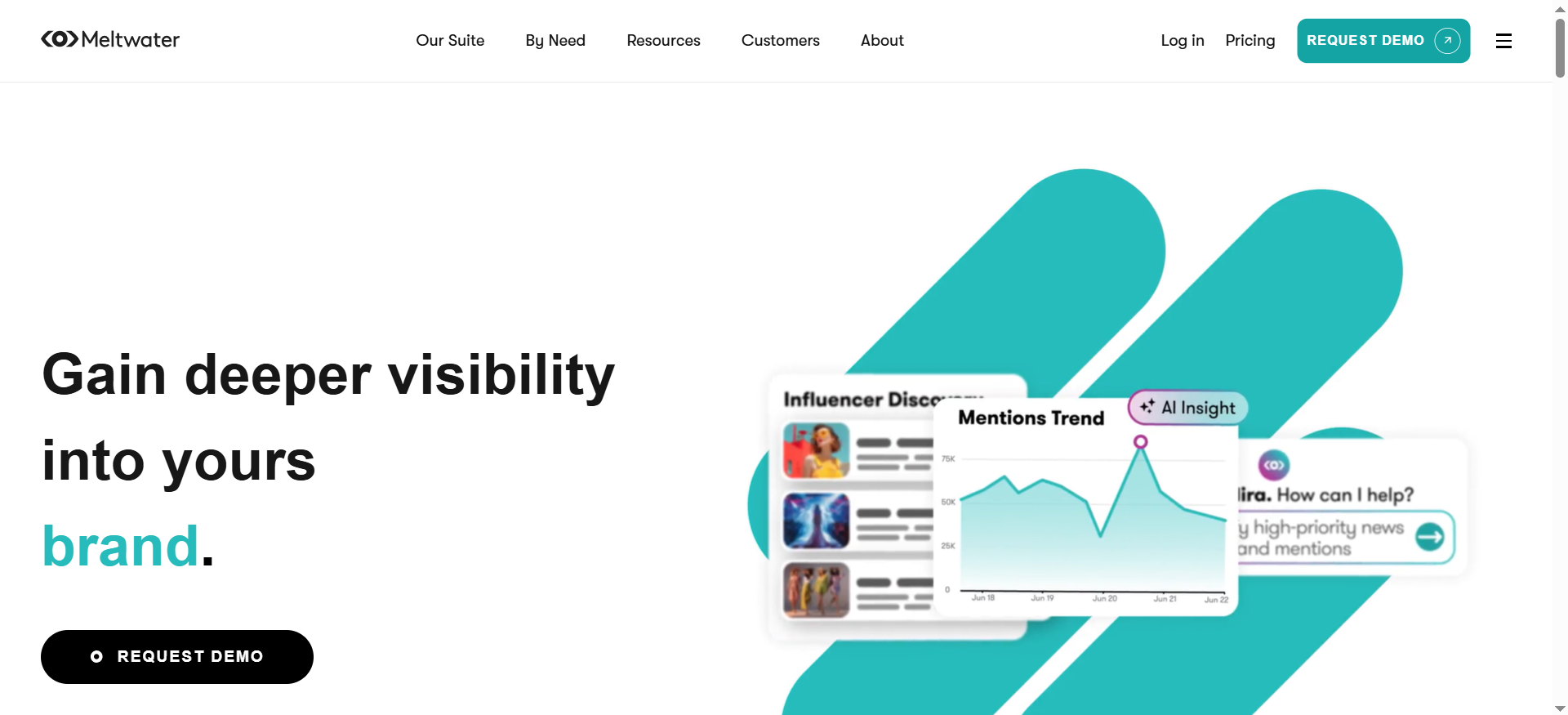
Meltwater is a media intelligence platform that combines traditional media monitoring (TV, radio, print, and online news) with social media listening and sentiment analysis. The platform tracks mentions across more than 6 million media sources, including outlets that social-only tools like Brand24 and YouScan do not cover. For PR, comms, and marketing teams at B2B SaaS companies, Meltwater provides a unified view of brand perception across both earned media and social conversations — eliminating the need to maintain separate tools for media monitoring and social listening.
Why Teams Use It
Teams choose Meltwater because it is the only tool in this comparison that provides comprehensive traditional media monitoring alongside social listening. If your brand's reputation is shaped by news coverage, industry analyst reports, trade publications, and broadcast media as much as by social media conversations, Meltwater captures all of those channels in one platform. The Mira Studio AI assistant helps PR and comms teams cut through large volumes of media data by surfacing trends, generating summaries, and providing predictive analytics on mention forecasting — giving teams an early warning system for potential reputation issues.
What It's Good For
Meltwater excels at media intelligence for PR-heavy organizations. If your team tracks press coverage, manages journalist relationships, monitors competitor media presence, and reports on share of voice across both traditional and digital channels, Meltwater is purpose-built for that workflow. The platform's journalist database and media contact features make it particularly valuable for comms teams that need to identify and engage relevant journalists as part of their brand strategy. The unified reporting — combining TV, radio, print, online news, and social data — produces a more complete brand perception picture than any social-only tool can offer.
When It's a Good Fit
Meltwater fits PR and comms teams at mid-to-enterprise B2B SaaS companies, corporate communications departments, and agencies that manage media relations for multiple clients. It is ideal for organizations where traditional media coverage significantly influences brand perception — such as companies in regulated industries, publicly traded SaaS companies, or brands that rely on industry analyst coverage and trade publications for credibility. If your team reports to the C-suite on brand health and needs to include earned media metrics alongside social sentiment, Meltwater provides that consolidated view.
When It's Not a Good Fit
If your brand monitoring is primarily social-media-focused and you do not track traditional media, Meltwater's pricing includes capabilities you will not use. The platform's fully custom pricing and mandatory sales process create friction for teams that want to evaluate the tool quickly. Some users report that the social listening component, while capable, is less refined than dedicated social listening platforms like Brandwatch or Talkwalker — particularly in sentiment accuracy on social media content. For lean teams or startups, the cost and complexity are disproportionate to the monitoring needs.
How to Use It
Meltwater's onboarding process involves working with an account manager to configure your monitoring topics, source selections, and dashboards. The platform provides pre-built templates for common use cases — brand health, competitive analysis, campaign tracking, and media coverage reporting. Alerts can be set for media mentions, sentiment shifts, or specific journalist coverage. The Mira Studio AI generates summaries and trend reports from your media data, reducing the time spent on manual analysis. Reports can be customized and scheduled for automatic delivery to stakeholders.
Key Capabilities
Meltwater provides monitoring across 6 million+ media sources including TV, radio, print, and online news, social media listening and sentiment analysis, Mira Studio AI for conversational media intelligence and trend analysis, journalist database for media contact identification and relationship management, competitive benchmarking and share of voice reporting, predictive analytics for mention forecasting, unified dashboards combining traditional and social media data, social media publishing and scheduling across 9 platforms, content creation tools with AI-generated captions and carousels, and customizable automated reporting.
Pricing
Meltwater uses fully custom pricing with no public rate card. Based on market data, the median annual cost is approximately $25,000, with a range of $6,000 to $100,000+ depending on the configuration. The Essentials tier starts at an estimated $6,000 to $15,000 annually for one to five users, while the Suite tier ranges from $15,000 to $35,000 annually with expanded features. Pricing depends on the number of users, media sources monitored, modules included (media monitoring, social listening, contacts database, influencer marketing), geographic coverage, and contract length.
Free Tier?
No. Meltwater does not offer a free tier or a self-serve free trial. Access requires going through their sales process.
Downsides / Limitations
The most significant limitation for teams evaluating Meltwater purely for social sentiment analysis is that its social listening capabilities — while functional — are not as deep or refined as those of dedicated social listening platforms. The sentiment accuracy on social media content specifically can be less nuanced than what Brandwatch or Talkwalker deliver. The custom pricing and sales-driven buying process make it difficult to compare costs and evaluate ROI before committing. Some users report that the platform's interface can feel dated compared to newer, more design-forward tools, and the learning curve for advanced features is steep. For organizations that do not need traditional media monitoring, a significant portion of what you pay for goes unused.
How Does Sentiment Analysis Work in Brand Monitoring Tools?
Sentiment analysis in brand monitoring tools relies on natural language processing (NLP) and machine learning models trained to classify the emotional tone of text. When a brand monitoring tool collects a mention — whether from a tweet, a blog post, a forum comment, or a news article — the sentiment engine processes the text through multiple layers of analysis.
The first layer identifies the overall polarity of the mention: positive, negative, or neutral. More advanced tools like Brandwatch and Talkwalker go further, detecting specific emotions such as joy, anger, frustration, or surprise. The models analyze word choice, sentence structure, context, and — in the case of multilingual platforms — language-specific patterns that affect meaning.
The training data behind these models matters. Sentiment engines trained on diverse, domain-specific datasets (such as SaaS product reviews versus general social media) produce more accurate results because they understand the vocabulary and tone patterns specific to different industries. In 2026, the strongest sentiment tools also incorporate transformer-based language models that can process longer text passages and understand relationships between sentences, improving accuracy on complex or multi-topic mentions.
The output is typically a sentiment score (positive, negative, neutral, and sometimes a confidence percentage) attached to each mention, which is then aggregated into dashboards, trend charts, and reports that show how brand perception evolves over time.
What Is the Difference Between Brand Monitoring and Social Listening?
Brand monitoring and social listening are related but serve different purposes. Brand monitoring is reactive and specific — it tracks direct mentions of your brand, product names, key people, and branded terms across online channels. When someone mentions your company on Twitter, posts a review on G2, or publishes a blog post about your product, brand monitoring captures that mention and delivers it to your team.
Social listening is broader and more proactive. It goes beyond direct brand mentions to analyze the larger conversation happening in your industry, including topics, trends, competitor discussions, and customer pain points that may not mention your brand at all. Social listening helps you understand market dynamics, identify emerging opportunities, and anticipate shifts in customer sentiment before they directly affect your brand.
In practice, most modern brand monitoring tools with sentiment analysis — including all five platforms reviewed in this article — offer some degree of social listening functionality. The distinction matters when evaluating tools because a platform marketed as a "brand monitoring tool" may focus primarily on mention tracking, while a "social listening platform" typically includes broader conversation analysis, trend detection, and competitive intelligence capabilities.
Can Brand Monitoring Tools Track Sentiment in Multiple Languages?
Yes, but the quality and breadth of multilingual sentiment analysis varies significantly across platforms. Talkwalker leads with support for 187 languages, using AI models trained specifically for different linguistic and cultural contexts. This is important because sentiment expression varies dramatically across languages — a phrase that indicates strong approval in English may carry a different connotation in Japanese, Arabic, or Portuguese.
Brand24 supports over 100 languages, Meltwater covers 50+, YouScan handles 45+, and Brandwatch supports 27+ languages. However, language support is not the same as sentiment accuracy. Many tools report broad language support but rely on machine translation to English before running sentiment analysis, which strips cultural nuance and reduces accuracy. The most reliable multilingual sentiment analysis comes from platforms that train language-specific models rather than translating everything to English first.
For global B2B SaaS brands with customers and conversations in multiple languages, multilingual sentiment accuracy should be a primary evaluation criterion — not just the number of languages listed on the feature page.
How to Measure Brand Sentiment Over Time
Measuring brand sentiment over time requires establishing a baseline, tracking consistently, and correlating sentiment shifts with specific events. Here is a practical framework that works across all five tools reviewed in this article.
Start by defining your monitoring scope — the brand names, product terms, and competitor names you want to track. Set up your monitoring tool to collect mentions across all relevant channels (social media, news, blogs, forums, reviews). Most tools produce a daily or weekly sentiment score, typically expressed as a ratio of positive to negative mentions or as a net sentiment score (positive minus negative as a percentage of total mentions).
Track this score over time on a consistent cadence — weekly for most teams, daily during launches or crisis periods. The value comes from identifying patterns: a gradual decline in sentiment over three months may indicate a growing product satisfaction issue, while a sudden spike in negative sentiment after a pricing change suggests an immediate problem that needs addressing.
Correlate sentiment data with your business calendar — product launches, pricing changes, marketing campaigns, PR announcements, competitor moves, and industry events. This correlation turns raw sentiment data into actionable intelligence by connecting perception shifts to specific causes.
What Are the Key Features to Look for in a Brand Monitoring Tool with Sentiment Analysis?
When evaluating brand monitoring tools with sentiment analysis, focus on the features that directly impact data quality and team productivity. Sentiment accuracy is the most important factor — a tool that misclassifies 30% of mentions creates more confusion than insight. Look for platforms that offer emotion detection beyond basic positive/negative/neutral classification, as nuanced emotions (frustration versus anger, satisfaction versus enthusiasm) provide more actionable insights.
Source coverage determines what you can see. Ensure the tool monitors the channels where your audience and customers actually have conversations — for B2B SaaS, this typically means tech blogs, G2 and Capterra reviews, Reddit, LinkedIn, Twitter, industry forums, and news sites. If traditional media coverage matters to your brand, Meltwater's TV, radio, and print monitoring is essential.
Real-time alerting ensures your team can respond to sentiment shifts as they happen, not days later in a weekly report. Look for customizable alert thresholds — being notified of every mention creates noise, but being alerted when negative sentiment exceeds a specific threshold or when mention volume spikes unexpectedly is genuinely useful.
Reporting and integration capabilities determine how easily sentiment data flows into your existing workflows. Native integrations with Slack, CRM systems, and business intelligence tools reduce the friction of acting on insights. Automated reporting saves time and ensures stakeholders receive consistent updates.
How Do Brand Monitoring Tools Handle Sarcasm and Context?
Sarcasm and context remain the most challenging aspects of automated sentiment analysis. A mention that says "Great, another software update that breaks everything" is textually positive ("great") but semantically negative. Handling this correctly requires models that understand context, sentence structure, and implied meaning — not just individual word sentiment.
In 2026, the leading tools use transformer-based language models that process entire passages rather than analyzing words in isolation. Brandwatch and Talkwalker have invested heavily in contextual sentiment models that improve accuracy on sarcastic, ironic, and mixed-sentiment content. However, even the best models still misclassify a meaningful percentage of nuanced mentions.
Brand24 and YouScan acknowledge this limitation and focus on providing easy manual override capabilities — allowing analysts to quickly correct sentiment labels when the AI gets it wrong. Meltwater's approach balances automated classification with analyst review workflows.
The practical takeaway is that no brand monitoring tool achieves perfect sentiment accuracy on sarcastic or heavily contextual content. The best approach is to choose a tool with strong baseline accuracy, plan for periodic human review of flagged mentions, and use sentiment data as a directional indicator rather than an absolute measurement.
Is AI-Powered Sentiment Analysis Accurate Enough for Enterprise Decisions?
AI-powered sentiment analysis is accurate enough to inform enterprise decisions, but with important caveats. Modern sentiment engines typically achieve 75-85% accuracy on straightforward mentions (clearly positive or clearly negative), with accuracy dropping to 60-70% on nuanced, sarcastic, or mixed-sentiment content. For aggregate analysis — understanding whether overall brand sentiment is trending up or down — this level of accuracy is sufficient because individual errors tend to balance out across large mention volumes.
Where accuracy matters most is in crisis detection and response. A sentiment tool that misclassifies a critical complaint as neutral could delay your team's response to an emerging issue. For this reason, enterprise teams should configure their tools to surface all mentions above a certain engagement threshold for human review, regardless of automated sentiment classification.
The tools in this comparison handle enterprise accuracy differently. Brandwatch and Talkwalker invest in domain-specific sentiment models that improve accuracy within specific industries. Brand24 uses anomaly detection to flag unusual patterns that may indicate sentiment shifts, even if individual mention classification is imperfect. YouScan's visual sentiment analysis adds another data layer that text-only tools miss. Meltwater's value at the enterprise level comes from combining media sentiment with social sentiment for a more complete picture.
How to Use Brand Monitoring for Crisis Management
Brand monitoring with sentiment analysis is one of the most effective early warning systems for reputation crises. The key is setting up your monitoring tool to detect problems before they escalate — not just to report on crises after they have gone viral.
Configure real-time alerts for sudden spikes in mention volume, increases in negative sentiment percentage, and mentions from high-authority accounts or publications. Most of the tools reviewed here — particularly Brandwatch, Talkwalker, and Brand24 — offer customizable alert thresholds that trigger notifications when metrics exceed normal ranges.
When a potential crisis is detected, the sentiment trend data helps your team assess severity. A brief spike in negative mentions from a small number of accounts is different from a sustained increase in negative sentiment across multiple channels. The sentiment analysis breakdown (by source, geography, and topic) helps identify the specific issue driving the negative reaction and the audience segments most affected.
During active crisis response, monitor sentiment in real time to gauge the effectiveness of your response. A well-crafted public statement should produce a measurable shift in sentiment within 24-48 hours. If sentiment continues to decline after your response, the data is telling you the response is not working and needs adjustment.
Post-crisis, use the historical sentiment data to analyze the full arc of the crisis — from detection through response to resolution — and identify opportunities to improve your crisis playbook.
What Is Visual Sentiment Analysis in Brand Monitoring?
Visual sentiment analysis extends brand monitoring beyond text to analyze images and videos for brand-relevant insights. Instead of only tracking what people write about your brand, visual sentiment analysis examines the photos and videos they share — detecting brand logos, product appearances, and visual context even when the brand is not mentioned in the accompanying text.
YouScan is the leader in this category, with its Visual Insights feature specifically designed to analyze social media images at scale. The platform can identify your brand logo in user-generated photos, categorize the visual context (product in use, event setting, comparison with competitors), and apply sentiment analysis to the visual content itself — assessing whether the image presents the brand in a positive, neutral, or negative light.
Brandwatch offers image analytics that recognizes logos in social media photos, though its visual analysis is less comprehensive than YouScan's purpose-built visual intelligence platform. Talkwalker provides AI visual recognition for logos and emotional cues in images and videos, positioning it between Brandwatch and YouScan in visual analysis depth.
For B2B SaaS brands, visual sentiment analysis is most relevant when your product appears frequently in user-generated content — screenshots shared on social media, workspace setup photos, conference presentation slides, or product comparison videos. If visual content is a significant part of how your audience discusses and discovers your product, visual sentiment analysis adds a monitoring dimension that text-only tools cannot provide.
How to Choose Between Enterprise and SMB Brand Monitoring Tools
The choice between enterprise and SMB brand monitoring tools depends on four factors: monitoring scope, team size, budget, and integration needs.
If you are tracking fewer than ten brands or topics, have a team of one to three people managing brand monitoring, and operate primarily in English-speaking markets, an SMB tool like Brand24 provides the best balance of capability and cost. The $199-$599 per month price range delivers real-time monitoring, sentiment analysis, and reporting that covers the essential use cases without requiring dedicated analyst support.
Enterprise tools like Brandwatch, Talkwalker, and Meltwater justify their higher price points when your monitoring needs cross multiple markets and languages, when you need deep query customization, when traditional media monitoring is essential, or when the brand monitoring platform needs to integrate tightly with enterprise marketing and analytics stacks. The investment in these platforms pays off when the volume and complexity of monitoring data requires advanced filtering, segmentation, and analysis capabilities.
YouScan occupies a middle ground — priced above SMB tools but below full enterprise platforms — and is the right choice when visual brand monitoring is a priority regardless of company size.
The practical advice is to start with a clear inventory of what you actually need to monitor, how many people will use the tool, and what you will do with the data. Buy for your current needs, not for capabilities you might use someday.