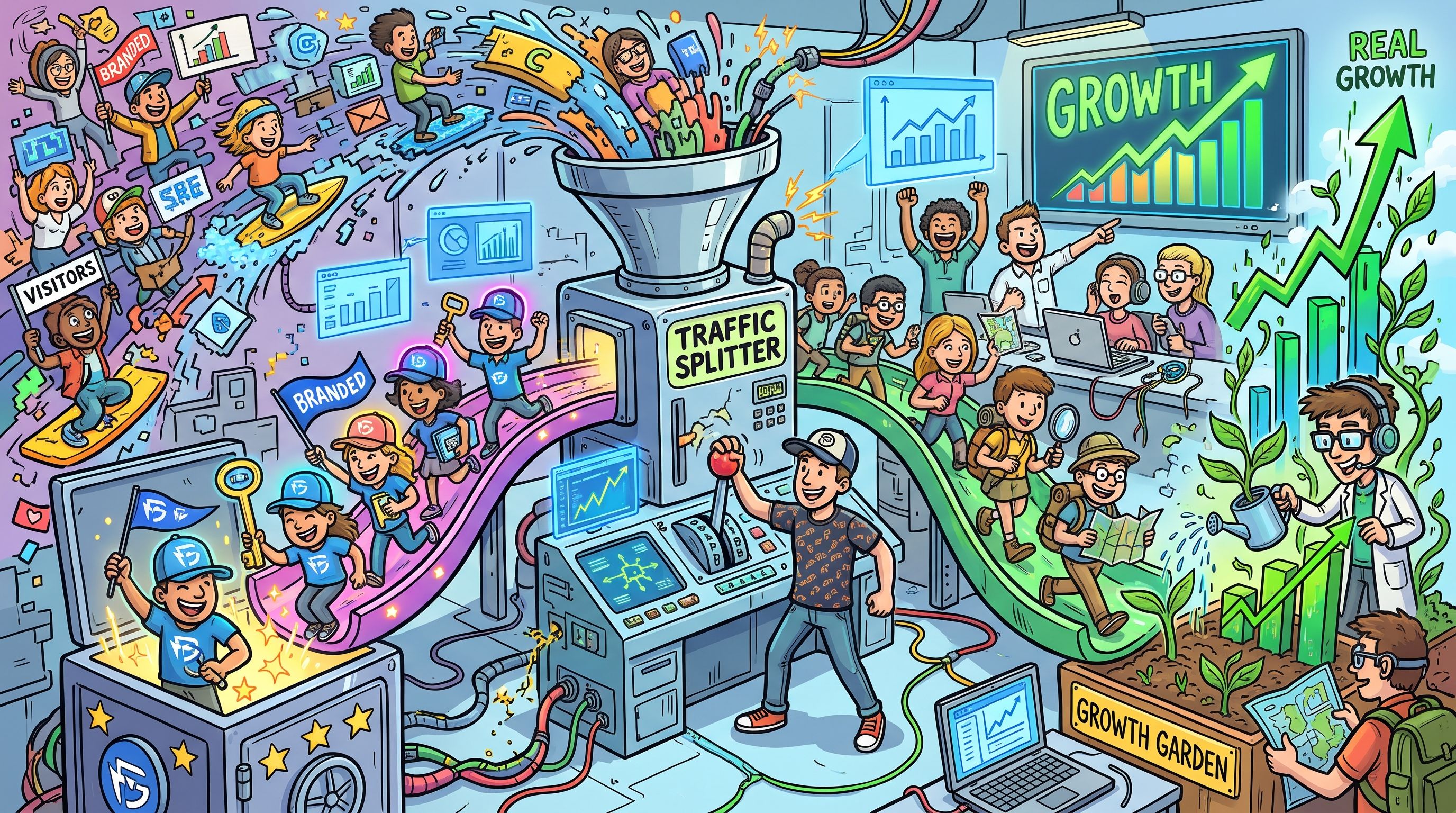
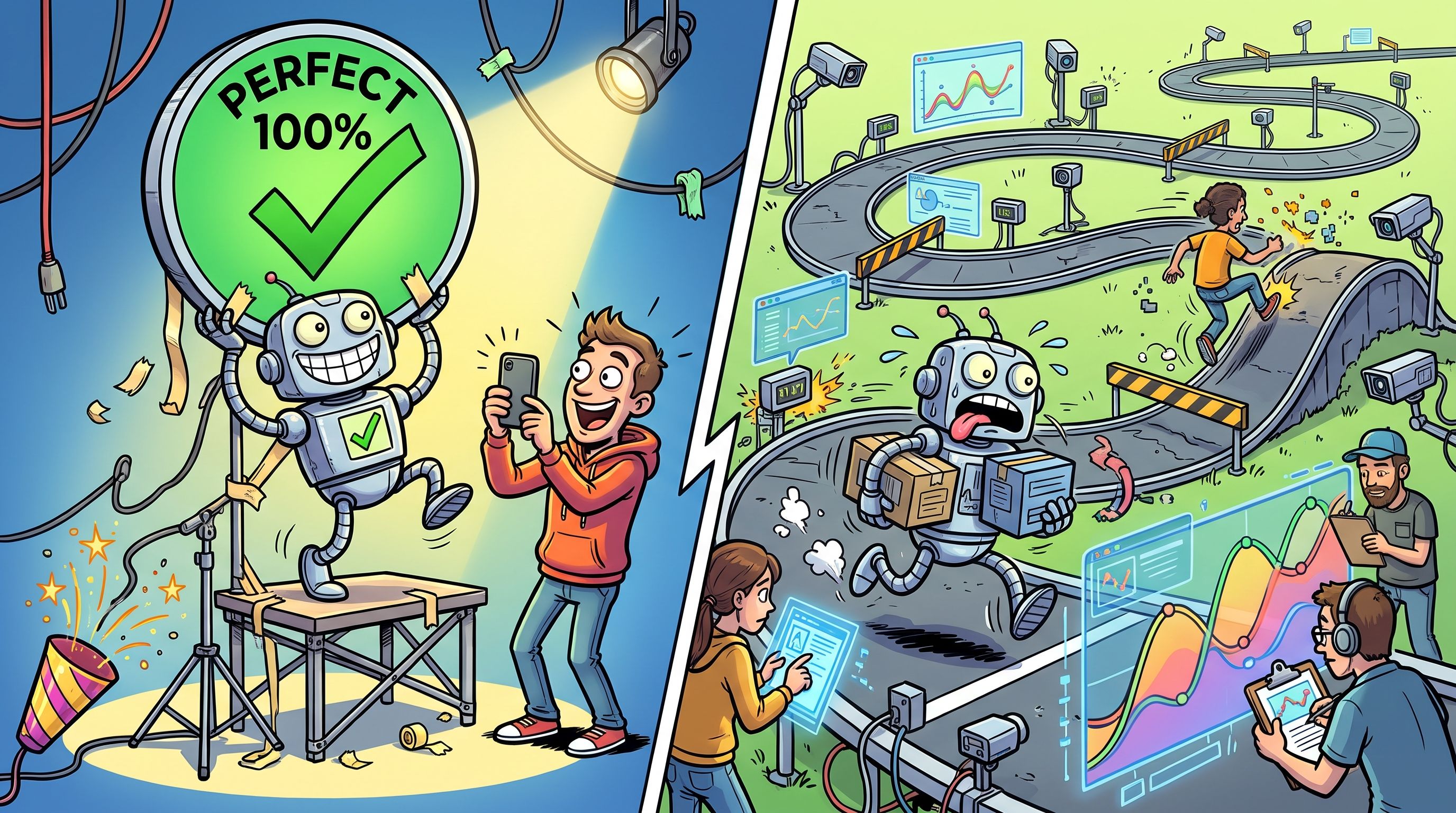
A single AI visibility check is one draw from a noisy answer, not a measurement, and its number should not go in a report. Repeated runs of the same prompts, pooled over a window, are the only baseline that holds up, and five to seven runs per prompt is the practical floor.
That floor applies to brand-level reads on a fixed prompt set, per engine. A portfolio of hundreds of prompts can get by with one run per prompt per day because the noise averages out across prompts.
The published studies disagree on the exact run count and are recent. Use the floor as a starting rule and check it against the spread in your own runs.
We run this repeated-run method for B2B SaaS teams. If you want a baseline built on your own prompt set, start with our Generative Engine Optimization service.
Why A Single AI Visibility Check Tells You Almost Nothing
One run is a sample of one. Ask ChatGPT or a Google AI surface the same question twice and you will often get two different sets of brands and sources, which means the number you got today is only one of many numbers you could have got.
SparkToro ran a test of this, with an AI tracking vendor, so weigh it with that in mind. Across 2,961 prompts, and with 12 prompts run 60 to 100 times per platform, an identical brand list came back in under 1 percent of repeated runs of the same prompt on ChatGPT and Google AI surfaces. Treat a single check on either as a sample of one.
Three more figures point the same way.
- Source overlap: Within a single day, the sources cited for the same prompt overlapped with a Jaccard score of only about 0.32 to 0.43.
- Error at one run: The standard error of a per-brand detection rate is about 0.37 with one run and about 0.08 with seven.
- Repeated domains: In a vendor's own paired-run test of 20 prompts on one day, the same model repeated only about 40 percent of its cited domains when asked minutes apart.
A standard error of 0.37 on a rate that sits between 0 and 1 is not a rounding problem. It means a brand that is really visible half the time could show up as invisible or as dominant on any given check.
What AI Search Monitoring Actually Measures
Definition: AI search monitoring is the practice of tracking whether and how a brand is mentioned or cited in answers from ChatGPT, Perplexity and Google AI Overviews over time. The unit it measures is a rate across many answers, not the result of one answer.
Vendors use AI search monitoring and LLM monitoring interchangeably, so do not read much into which label a tool picks. What matters is the second half of the definition. Monitoring is repetition over time. A visibility rate is the share of answers in which your brand appears, and a share needs a denominator bigger than one.
That is the gap between a check and monitoring. A check tells you what one answer said. Monitoring tells you how often your brand shows up, and whether that is moving. If you want the wider concept first, start with what AI search visibility is, and see how it ties to answer engine optimization as a discipline.
Where The Run-To-Run Noise Comes From
Three things move the number between runs. The answer itself changes, the wording of the prompt matters less than people assume, and different engines return different answers to the same question.
The first is the big one. In a study of brand-sentiment answers, repeated runs of the same prompt accounted for about 34.8 percent of response-level variance, measured on a stability subset of 1,435 cells with about five resamples each. The prompt itself accounted for about 1.1 percent of single-response variance, measured across the full corpus of 12,933 responses. Put plainly, rerunning the same prompt moves the answer far more than rewording it does.
That is why obsessing over prompt phrasing is a poor use of a week. The same prompt asked again is already a different experiment. Anyone who has watched ChatGPT answer monitoring tools report a swing between Monday and Tuesday has seen this.
Engine and location are likely to add further spread on top. Each engine builds its answers differently, and where a search runs from can change what comes back, so a check from one country may not describe what buyers in another see. A tool that only searches from the US may limit some checks. If location matters to your market, look at location-based prompt monitoring before you trust a single-region number.
How Many Runs Do The Studies Say You Need?
The published answers run from one run per prompt per day to 50 or more per prompt, and they are not wrong so much as they measure different things. Some study a portfolio of hundreds of prompts, some a single brand, some a single prompt.
| Source | What It Measured | Runs Or Answers Proposed |
|---|---|---|
| arXiv 2604.07585 | Per-brand detection rate and source coverage | Seven runs per prompt per day, eight for source-level coverage |
| arXiv 2607.13304 | Variance in brand-sentiment answers | Negligible gain beyond five repeats per prompt |
| Meikai | Citation share across a 500-prompt portfolio | One run per prompt per platform per day |
| cloro | Visibility rate per engine per period | About 300 answers per engine per period |
| Parse.gl | Per-prompt tracking over a week | About 50 runs per prompt per platform |
The figures behind the table are specific. In the first arXiv paper, the standard error of a per-brand detection rate falls from about 0.37 to about 0.08 between one run and seven, which is why it sets seven runs per prompt per day as the minimum for brand visibility monitoring and eight where source-level coverage matters. The second found that going beyond five repeats yields negligible reduction in relative-error variance.
Meikai tested a 500-prompt portfolio across 5 platforms over ten days, 13 to 22 July 2026. One run per prompt per platform per day gave citation share within 0.17 percentage points of the all-run result. A single platform is harder. For Copilot citation share the error was 1.33 points at one run a day and 0.49 at ten, and three runs a day first brought it under one point.
Vendor-published analysis from cloro puts it at about 300 answers per engine per comparison period for a visibility rate within roughly plus or minus 5 percentage points. Parse.gl, also a vendor, suggests about 50 runs per prompt per platform for weekly tracking.
So why the spread? A portfolio of hundreds of prompts averages the noise away across prompts, which is why one run a day is enough there. A single prompt has nothing to average against, so it needs many more runs. The sample you need is set by the width of the confidence interval relative to the size of the change you want to claim, and the margin of error on a proportion narrows as the number of answers grows. There is no magic number. There is a gap between what you want to detect and how wide your interval is.
If you do run hundreds of prompts, read about large-scale prompt monitoring before you decide whether the portfolio shortcut fits you.
The Repeat-Sampling Rule: Five Steps To A Usable Baseline
This is the rule the figures above support. It is a starting point, so check it against the spread in your own runs.
- Freeze the prompt set and the engine list. Write both down before the first run and do not edit them mid-baseline. Change the set and you change the experiment, and you can no longer tell a real move from a new question.
- Run each prompt five to seven times per engine per day. Seven is the recommended daily minimum for brand visibility, and past five repeats the gain is negligible in the sentiment study, so five to seven is the working band.
- Pool the runs over a rolling window of two to four weeks. Keep going until the interval is narrower than the change you care about. With seven runs a day, brand standard error falls below 0.10 at about 10 days and below 0.05 at about 24 days.
- Report the pooled rate with its interval, never a single run. For a sense of scale, about 300 answers per engine per period resolves a visibility rate to roughly plus or minus 5 percentage points.
- Log engine, date and prompt version with every run. Without the log, a change in your setup gets read as a change in visibility, and you will chase a movement you caused yourself.
The portfolio shortcut: If you track hundreds of prompts, one run per prompt per engine per day is enough for portfolio-level reads, as the Meikai result above shows. It does not carry over to a read on one brand or one prompt, where the five to seven run floor applies.
The rule in short. Fix the prompt set and the engine list, run each prompt five to seven times per engine per day, pool the runs over two to four weeks, and report the pooled rate with its interval and run count. A single run is never the baseline.
If you would rather hand the repeats, the prompt log and the monthly interval reporting to a team that has done it before, the GEO + SEO Growth Programme covers all three. Every later change is then read against the same baseline.
Choosing Prompts, Engines And Cadence
Build the prompt set from real buyer questions. Prompts are not keywords, and a list lifted from a keyword tool rarely matches how a buyer actually asks an engine for a recommendation. Pull questions from sales calls, support tickets and the way customers describe the problem, then group them by intent.
Cover the engines your buyers actually use. A sensible starting list is below.
- ChatGPT: Widely used for research questions, so the baseline should include it.
- Perplexity: Answers with visible citations, which makes source tracking straightforward.
- Google AI Overviews: Sits on top of the results page your buyers already search.
- Gemini: Worth adding once the first three are stable.
For engine choice in more depth, see this view of AI engine coverage.
Cadence is where most teams go wrong. Daily reads are noise, and weekly reads are sound once enough answers are pooled. In cloro's analysis, about 300 answers per engine per period is what makes a weekly read hold, and a single day of runs falls far short of that. Parse.gl makes the same point from the other side, finding that below 30 runs the intervals are wider than the moves you would typically be trying to detect. A daily number is a data point for the pool. It is not a baseline.
If you already pay for Semrush, use its position tracking to cover the organic-rank side of the cadence. Compare your pooled AI rate with your Google position over the same weeks, so you can see whether the two move together or apart. Check any AI feature it offers against the run rule above before you rely on it.
Keep the metric list short at first, and see the metrics and KPIs worth tracking for the full set. If you want a tool to schedule the repeats for you, compare tools that run daily prompt runs and check how many runs per prompt each one actually takes.
How To Tell A Real Change From Noise
A change in visibility rate is real only when it exceeds the noise threshold, persists across two consecutive reviews, appears across several prompts or platforms, and has a known cause. That four-part test comes from Parse.gl's analysis of visibility drops, and it is worth turning into a checklist.
- Clears the noise threshold. The move is bigger than the interval around your pooled rate.
- Persists across two consecutive reviews. One good week followed by a flat week is a wobble.
- Appears across several prompts or platforms. A move on one prompt in one engine is a prompt story, not a brand story.
- Has a known cause. You shipped a page, earned a mention or changed the prompt set, and the timing fits.
The interval logic is what makes the first condition usable. The wider your interval, the bigger a change has to be before it means anything. Parse.gl offers a working rule rather than a formal test. A 5-point move, on 50 or more runs, sustained for two cycles, across 20 or more prompts, is worth acting on.
Here is a worked illustration you can check yourself. To confirm a move from 20 to 30 percent visibility, cloro's analysis says you need about 294 answers per period. Now do the arithmetic for a small prompt set.
- Five prompts: 5 prompts times 7 runs a day times 7 days is 245 answers, which falls short of 294.
- Six prompts: 6 prompts times 7 runs a day times 7 days is 294 answers, which just reaches it.
So a team with five prompts cannot confirm a 10-point move in a week, however confident the chart looks. One more prompt gets it there. Treat the numbers as an illustration of the method, because the inputs shift with your base rate and your engine.
What To Do With The One-Off Numbers You Already Have
If you are holding a single result, do not throw it away and do not report it. Keep it as a hypothesis to test. It tells you where to look, which is useful, but it does not tell you where you stand.
- Rerun it under the rule: Run each prompt five to seven times per engine per day for two to four weeks, and compare the pooled rate with your original number.
- Report the pooled rate and its interval: Give the reader the range, not the point, so nobody mistakes a draw for a fact.
- State the run count: Put the number of runs behind every figure in the report, so anyone reading can judge how much weight it carries.
When you are ready to go further, how to run an AI visibility audit walks through the next step. If you want the repeats and the reporting done for you, our approach to ongoing AI visibility reporting covers it.
What Repeated Runs Do Not Fix
Repetition reduces sampling error. It does not remove bias in the prompt set, it does not undo the effect of an engine update, and it does not widen a single-engine view into a market view. A badly chosen prompt set run a hundred times gives a very precise answer to the wrong question. The evidence base is also recent, partly vendor-run and mostly single-engine, and the SparkToro study was co-run with a tracking vendor. Read every figure here as a reason to sample properly, and check the rule against your own spread.
FAQs
What Is The Difference Between AI Search Monitoring And SEO Rank Tracking?
Do Traditional SEO Tools Track AI Visibility?
Which AI Platforms Should I Monitor?
Can I Monitor AI Visibility Manually?
What Is A Good AI Visibility Score?
How Long Does It Take To Improve AI Visibility Once I Start Tracking?
How Do I Measure The ROI Of AI Search Visibility?
What Is Generative Engine Optimization (GEO)?
Does A Tool That Runs Each Prompt Several Times Fix The Sampling Problem On Its Own?
If you are holding a one-off number and are unsure whether to act on it, send us a message. We will tell you whether it can stand as a baseline and what repeated runs would add.
📑 Disclosure!
Some links in this article are affiliate links. If you sign up through them, The Rank Masters may earn a commission at no additional cost to you. This does not influence which tools we recommend or what we say about them.