

If you’re an SDR doing outbound, you don’t need “more leads. You need better targets, cleaner contact data, and a workflow that turns research into consistent, relevant touches. For most B2B SaaS teams, a practical 2026 core stack looks like this:
- Apollo for all-in-one prospecting (database + basic sequencing + enrichment).
- Clay when you need flexible, multi-source enrichment and research automation.
- ZoomInfo when you need enterprise-grade coverage, org data, and scale.
- Outreach when sequencing, tasks, and reporting need to be bulletproof across a team.
- LinkedIn Sales Navigator for the highest-signal relationship and org research layer.
📋 Get Listed / Advertisement
We update this guide monthly. Want your tool featured? Contact: [email protected].
Best prospecting tools for SDR outbound research (quick comparison)
| Tool | Best for | What it replaces | Watch-outs |
|---|---|---|---|
| Apollo | All-in-one prospecting + enrichment | Multiple starter tools | Credit limits and data quality can vary by segment |
| Clay | Research automation + enrichment waterfalls | Manual enrichment and “glue work” across tools | Can get messy without a clear spec and governance |
| ZoomInfo | Enterprise coverage + org charts | Most standalone data vendors | Higher cost and annual contracts are common |
| Outreach | Sales engagement + workflow discipline | Ad-hoc sequencing | Works best with solid ops/admin support |
| LinkedIn Sales Navigator | Org and persona research | Guesswork about buyers | Not a contact database, you’ll still need email/phone data |
1. Apollo
What it does
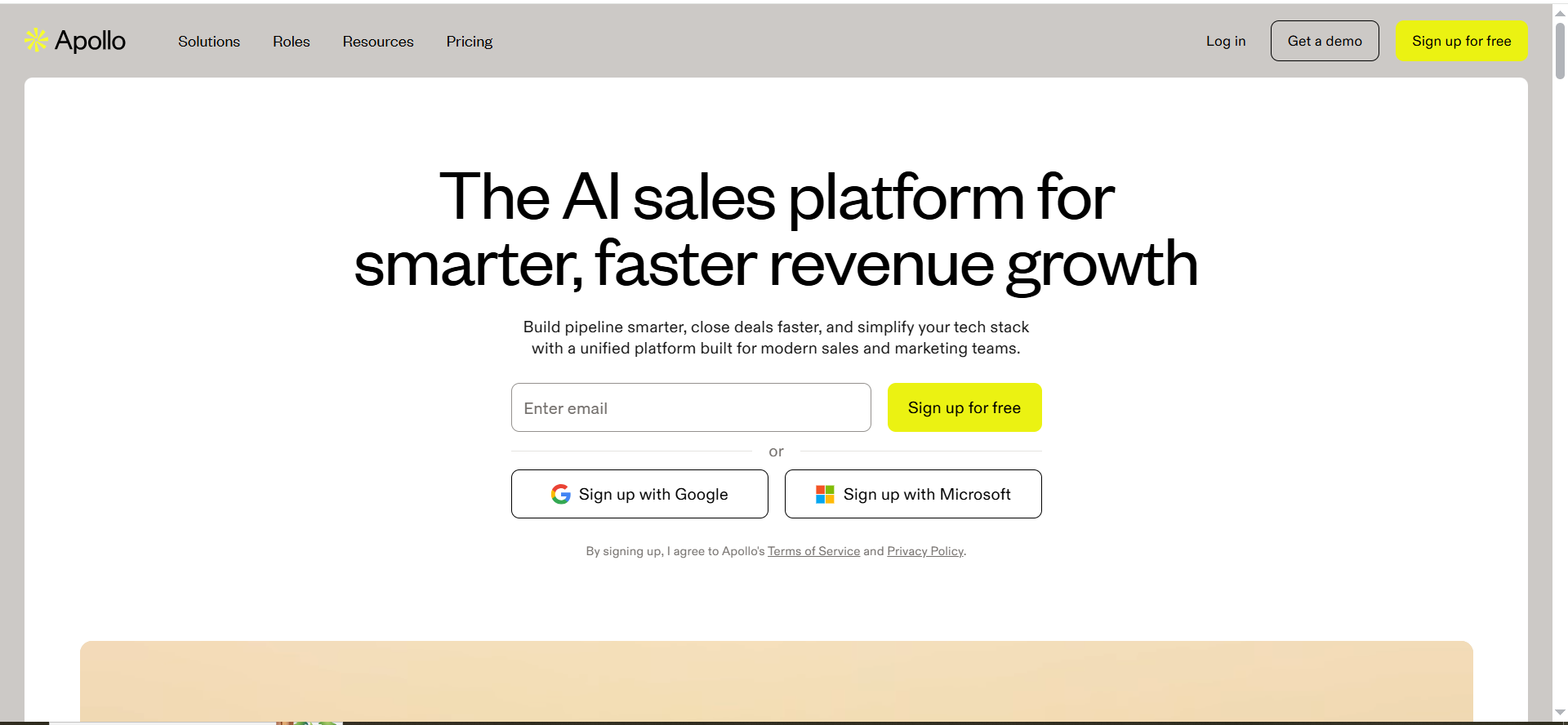
Apollo is an all-in-one prospecting platform that combines a B2B contact database, enrichment, list building, and outbound workflows in one place. It’s popular because you can go from “ICP idea” to “exported list + sequence” without stitching together five tools.
Why teams use it
Most SDR teams pick Apollo because it has a fast path to productivity:
- Build targeted lists quickly (titles, geo, company size, industry, tech, etc.).
- Pull emails and sometimes phone numbers.
- Push contacts into CRM and sequences with fewer handoffs.
What it’s good for
- Seed to growth teams that want a single system to start outbound.
- SDRs who need a database plus light workflow support (notes, tasks, simple sequences).
- Teams running “good enough” enrichment at scale without heavy ops.
When it’s a good fit
Apollo is a good fit when:
- You want one tool that does “80% of everything.”
- You don’t have RevOps time for a complex data stack.
- You’re optimizing for speed and iteration over perfect data.
When it’s not a good fit
Apollo can be the wrong fit when:
- You need highly reliable direct dials for a calling-heavy motion.
- Your ICP requires deep firmographic accuracy (multi-subsidiary orgs, complex hierarchies).
- You need strict governance around fields, routing, and CRM integrity.
How to use it
Here’s a workflow that keeps Apollo useful without letting it become messy:
- Define your ICP filters first
- Company: industry, headcount band, geo, tech stack, funding stage.
- Persona: titles, seniority, department, keywords (avoid overly broad title nets).
- Build a “saved search + list hygiene” loop
- Save a search per segment (example: “US SaaS, 200–1k employees, Head of RevOps”).
- Create one list per campaign, not one list per day.
- Add naming conventions: ICP | GEO | Persona | Offer | Month.
- Export only what you can work
- Export batches that match your capacity (example: 200–500 contacts per SDR per week).
- Keep a “do not touch” list for disqualified segments so you don’t recycle junk.
- Enrich, then validate
- Enrich inside Apollo.
- Spot-check: sample 25 contacts for role accuracy and deliverability signals.
- If bounce rates climb, tighten filters and add external verification steps.
- Push to sequence/CRM with clear field mapping
- Map fields like persona, segment, campaign name, and trigger signal.
- Keep the CRM clean by controlling which fields Apollo is allowed to overwrite.
Key capabilities
- Strong filtering and list building
- CRM sync and enrichment workflows
- Credit model transparency and export rules
Pricing
Apollo’s pricing starts at $49 per user/month on the Basic plan (billed annually).
Free tier?
Apollo offers a free tier.
Downsides / limitations
- Credits are the real constraint. You can “have the tool” and still run out of useful exports.
- Data coverage varies by region and vertical.
- Without rules, Apollo can become a parallel CRM that creates duplicate truth.
2. Clay
What it does
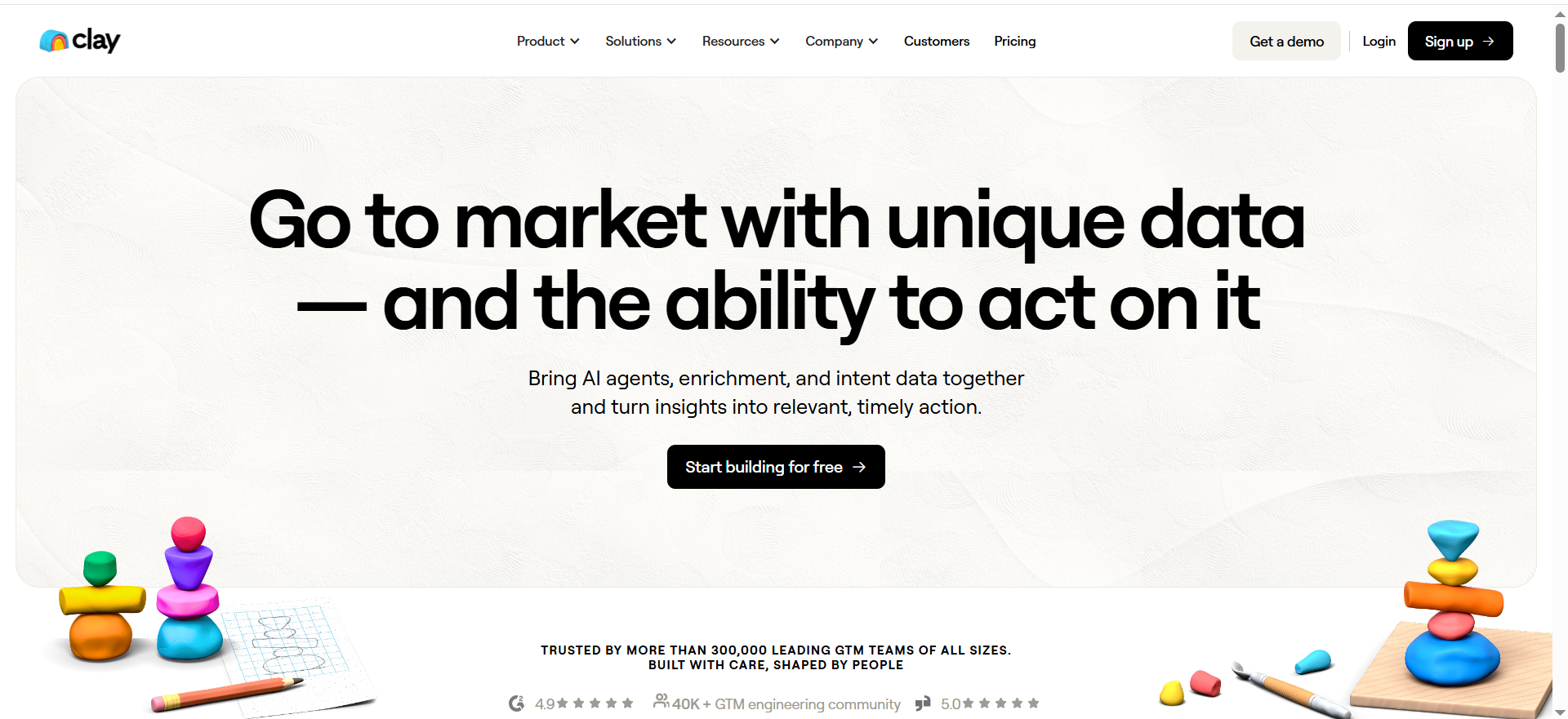
Clay is a workflow layer that helps you enrich and research leads using multiple data providers, web sources, and AI agents. If Apollo is a “single vendor database,” Clay is the tool you use when one database isn’t enough and you want control over how research happens.
Why teams use it
SDR teams adopt Clay when they hit one of these walls:
- “Our database coverage is inconsistent in this niche.”
- “We need custom fields that no vendor gives us out of the box.”
- “Manual research is killing our throughput.”
Clay is also where a lot of teams build:
- Waterfall enrichment (try provider A → if blank, try provider B → then provider C).
- Trigger capture (job changes, recent posts, tech installs, hiring signals).
- Personalization inputs at scale.
What it’s good for
- Building high-quality, research-rich lists that power strong personalization.
- Fixing data gaps for hard-to-reach personas (security, engineering, niche ops roles).
- Creating repeatable “research recipes” that SDRs can run weekly.
When it’s a good fit
Clay is a great fit when:
- You already have a data source (Apollo/ZoomInfo/etc.) but need better coverage.
- You have at least light ops support to standardize fields and outputs.
- You want more than “email + title”; you want context.
When it’s not a good fit
Clay is not ideal when:
- You just want a straightforward database and basic sequencing.
- You don’t have a clear spec for what data you need (Clay can become a playground).
- You don’t have someone accountable for templates and QA.
How to use it
A simple Clay playbook that works for SDR outbound research:
- Start with accounts, not people
- Import a target account list (from CRM, Apollo, or a CSV).
- Enrich firmographics and segmentation fields first.
- Add personas
- Pull 2–3 personas per account (example: VP Sales + RevOps + Director Enablement).
- Run a waterfall enrichment
- Provider 1 for emails/phones
- Provider 2 if missing
- Verification step (email validity score)
- Output a “confidence” field so SDRs know what’s safe to send
- Add trigger signals
- Hiring for relevant roles
- Recent funding
- New leadership hires
- Tooling signals (tech stack changes)
- Generate personalization inputs
- One sentence about “why now”
- One sentence about “why you”
- A safe, factual compliment (avoid hallucinated claims).
- Export to Outreach/CRM
- Export only the fields that matter.
- Include a campaign name, persona, and trigger so reporting stays clean.
Key capabilities
- Flexible enrichment workflows with “credits” and many provider options
- Clear billing documentation for plans and limits
Pricing
Clay’s pricing starts at $134/month on the Starter plan (billed annually).
Free tier?
Clay offers a free tier, and it also offers a 14-day Pro free trial.
Downsides / limitations
- Clay can turn into an ungoverned “data science project” unless you standardize templates.
- Costs can creep up if you enrich too many fields for too many leads.
- Outputs are only as good as your QA process.
3. ZoomInfo
What it does
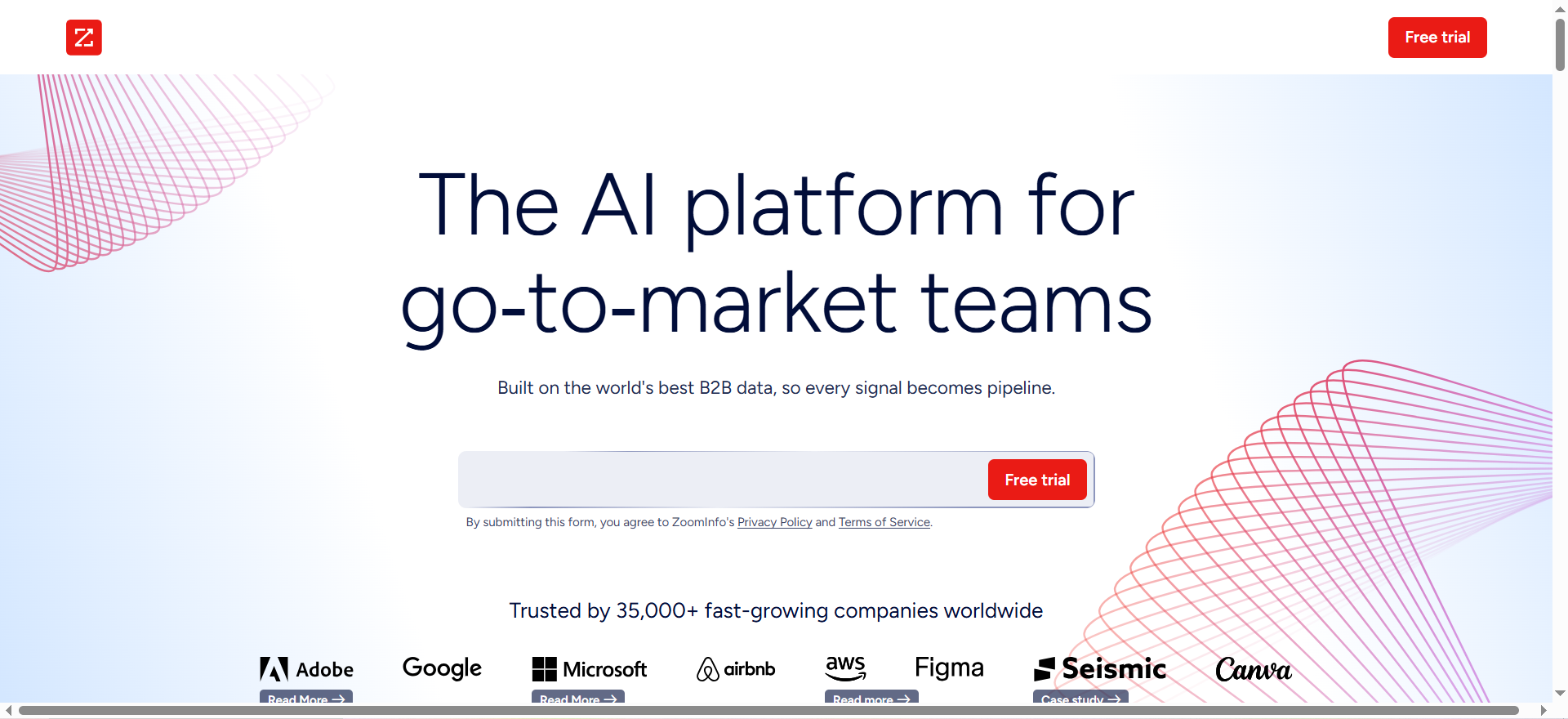
ZoomInfo is a large B2B data platform typically used by teams that need scale: broad coverage, firmographic depth, and sales org intelligence (depending on what packages you buy). ZoomInfo also emphasizes CRM integrations and workflows for syncing and enriching records.
Why teams use it
Teams choose ZoomInfo when:
- They’re serious about outbound volume and need a big, structured database.
- They want deeper company intelligence and team mapping.
- They can support annual pricing and procurement.
What it’s good for
- Enterprise and upper-midmarket outbound
- Multi-territory SDR teams that need consistent lists
- Firms where accurate company records and structure matter
When it’s a good fit
ZoomInfo is a good fit when:
- Your TAM is broad and you need coverage.
- You want stronger org intelligence and a more “enterprise” data stack.
- You can handle contracts and credit-based usage.
When it’s not a good fit
ZoomInfo is often not a fit when:
- You’re early-stage and can’t justify annual cost.
- Your outbound motion is narrow and you only need a few thousand contacts per month.
- You don’t have ops support to manage credits, governance, and integrations.
How to use it
A ZoomInfo workflow for SDR outbound research:
- Build a territory-smart account universe
- Use firmographics to define TAM.
- Segment by territory rules (geo, vertical, size).
- Pull personas and buying committees
- Don’t stop at one title.
- Map 3–6 stakeholders depending on deal size.
- Enrich into CRM with strict rules
- Decide which fields ZoomInfo can overwrite.
- Use enrichment schedules to avoid “field churn”.
- Operationalize weekly refresh
- Job changes, role changes, and account movement drive list freshness.
- Re-enrich “stale” leads before recycling sequences.
Key capabilities
- Strong CRM integrations highlighted in ZoomInfo’s own pricing FAQ.
- Packaged tiers and bundled credits are common in how ZoomInfo is sold (details vary by deal).
Pricing
ZoomInfo’s pricing is not publicly listed; it’s available by quote.
Free tier?
ZoomInfo doesn’t offer a free tier, but it does offer a free trial.
Downsides / limitations
- Cost can be significant, especially for teams that don’t fully use the platform.
- If you don’t enforce governance, your CRM can get messy fast.
- Your results still depend on SDR execution: targeting + message + timing.
4. Outreach
What it does
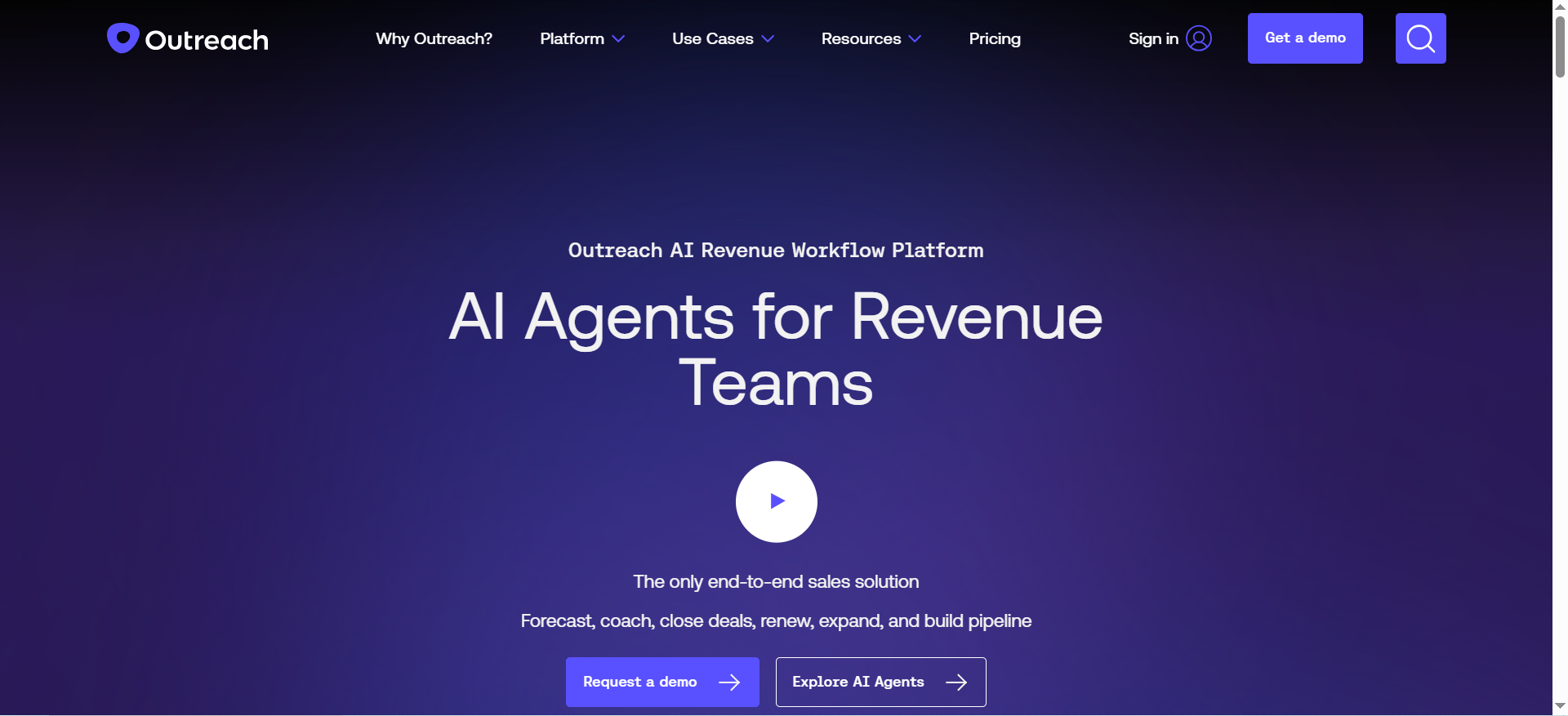
Outreach is a sales engagement platform focused on sequencing, tasks, and rep workflows. In a “prospecting tools” conversation, outreach matters because research is only useful if it becomes consistent action: touches, follow-ups, multi-threading, and reporting. Outreach positions its platform around sales engagement workflows and AI-assisted capabilities.
Why teams use it
Teams use Outreach because it creates consistency:
- Sequencing that scales across a team
- Task and workflow prioritization
- Reporting that helps managers coach activity and outcomes
What it’s good for
- Growth and enterprise teams where outbound is a system, not a side quest
- Multi-SDR teams that need standardized plays
- Orgs that care about reporting, experimentation, and governance
When it’s a good fit
Outreach is a fit when:
- You have enough outbound volume to justify a dedicated engagement platform.
- You want consistent sequencing quality across reps.
- You have RevOps/admin capacity (even part-time) to maintain the system.
When it’s not a good fit
It may be overkill when:
- You’re a one-person outbound shop.
- You don’t have a defined process (you’ll pay to “discover” one slowly).
- You only need basic sequences and would rather keep it simple.
How to use it
Use Outreach as the “execution engine”:
- Standardize sequences by segment
- One sequence per offer + persona + segment.
- Keep variants controlled (A/B test, don’t create 30 clones)
- Inject research fields cleanly
- Personalization fields: trigger, why-now, account note, persona pain.
- Validate that fields populate reliably before you launch.
- Run a weekly optimization loop
- Reply rates by segment and persona
- Step-level performance (which step is failing?)
- Bounce rate and spam indicators
Key capabilities
Outreach highlights sales engagement features like task prioritization, sequences, and AI-assisted insights on its platform pages.
Pricing
Outreach’s pricing is not publicly listed; it’s available by quote (licensed per user with customizable packages).
Free tier?
Outreach doesn’t offer a free tier, but it does offer a demo.
Downsides / limitations
- Implementation and admin effort are real.
- If your data inputs are messy, Outreach will help you scale the mess.
📋 Get Listed / Advertisement
We update this guide monthly. Want your tool featured? Contact: [email protected].
5. LinkedIn Sales Navigator
What it does
LinkedIn Sales Navigator is the research layer SDRs use to understand accounts and people: org structure, role relevance, job changes, shared connections, and real-world context you can’t get from a static database.
Why teams use it
Because outbound lives or dies on relevance. Sales Nav helps you:
- Confirm the persona is real and active in the role
- Identify the right seniority level and adjacent stakeholders
- Spot trigger events (job changes, posts, company news)
- Build warmer pathways (mutual connections, TeamLink features in some tiers)
LinkedIn’s own Sales Navigator help and plan pages highlight advanced search and lead management features, along with plan-based pricing.
What it’s good for
- ABM research: account mapping and multi-threading
- Personalization that’s factual and safe (posts, role context, shared experiences)
- Improving list quality (removing the “wrong persona” problem)
When it’s a good fit
It’s a fit when:
- You sell to people who actually use LinkedIn (most B2B SaaS does).
- You want better buying- about trigger-driven outreach (new role, new post, team growth).
When it’s not a good fit
It’s not enough on its own when:
- You need verified emails/phones at scale (Sales Nav isn’t a database for that).
- Your ICP is rarely on LinkedIn or has thin profiles.
How to use it
A fast, repeatable SDR approach:
- Account list first
- Search accounts by headcount, industry, geo.
- Save target accounts for alerts.
- Persona search
- Filter by function + seniority + title keywords.
- Save leads into persona-specific lists.
- Add a “proof of relevance” note
- One sentence: why this person is a likely stakeholder.
- One sentence: what trigger you’re using (job change, post, growth signal).
- Feed into enrichment + sequencing
- Export lead URLs to Clay (for research automation) or use your database tool for contact data.
- Push the final contact record into Outreach/CRM.
Key capabilities
- Plan comparison and pricing are listed on LinkedIn’s plan pages.
- Advanced search filters and saved search alerts are part of how LinkedIn describes Sales Navigator’s workflow.
Pricing
LinkedIn Sales Navigator pricing starts at $119.99/month per license for the Core plan, and Advanced Plus pricing is custom/quote-based.
Free tier?
LinkedIn Sales Navigator doesn’t offer a free tier, but it does offer a free trial.
Downsides / limitations
- You still need a data/enrichment step to get reliable outreach channels.
- Without a process, reps can spend too long “researching” and not enough shipping touches.
The SDR outbound research workflow (end-to-end)
Most teams fail outbound because they treat research like a one-time task. The winners treat it like a system that runs every week.
Step 1: Start with your segment spec (not a tool)
Before you open any platform, write a one-page “segment spec”:
- ICP: industry, size, region, business model
- Persona: function + seniority + “why they care”
- Trigger: what changes in their world that makes your message timely?
- Disqualifiers: what makes an account a hard no?
This prevents the most common SDR failure mode: building a giant list and hoping messaging fixes it.
Step 2: Build accounts first, then people
A clean workflow is: Accounts → Personas → Contacts
Why it works:
- Accounts don’t bounce.
- Accounts don’t change jobs.
- You can run ABM touches with better multi-threading.
Tool pattern
- Build the account universe in Apollo or ZoomInfo.
- Add the LinkedIn layer to confirm org structure.
- Use Clay if you need extra signals or custom fields.
Step 3: Enrich with a “confidence score”
Don’t treat all contact records equally. Add a simple confidence score (High/Medium/Low) based on:
- Verified email present
- Role relevance confirmed
- Trigger signal present
- Duplicate check passed
This alone can reduce bounced outreach and improve SDR focus.
Step 4: Convert research into fields that sequences can use
The best research output isn’t a paragraph. It’s 3–6 structured fields:
- persona_pain (short phrase)
- trigger (what happened, factual)
- why_now (1 sentence)
- proof (LinkedIn post, hiring signal, tech signal)
- angle (which offer / case study / hook)
These fields plug into Outreach and make personalization consistent.
Step 5: Launch a sequence built for the persona, not your product
A simple rule: every sequence should answer:
- Why are you?
- Why now?
- Why this person?
If any of those are missing, you’ll see “no response” even with perfect data.
Step 6: Weekly refresh loop (the part most teams skip)
Every week:
- Refresh job changes for open accounts
- Re-enrich contacts that haven’t been touched in 60–90 days
- Retire segments that aren’t converting
- Double down on segments that are
Outbound is a compounding system when the data stays fresh.
A simple framework for choosing the right stack
If you’re early-stage (lean team, need speed)
Start with:
- Apollo (database + basic outbound)
- LinkedIn Sales Navigator (research layer)
Add Clay later when you know exactly which data fields you’re missing.
If you’re growth-stage (multiple SDRs, need consistency)
You’ll usually want:
- Apollo or ZoomInfo (data)
- Outreach (execution and reporting)
- LinkedIn Sales Navigator (account + stakeholder mapping)
Add Clay if:
- You’re selling into tricky personas
- You want better trigger-based personalization
- You’re doing ABM and need deeper account context
If you’re enterprise (big TAM, strict ops, governance matters)
Typical pattern:
- ZoomInfo (core data coverage + integrations)
- Outreach (sales engagement workflows)
- LinkedIn Sales Navigator (org + stakeholder intelligence)
- Clay (custom research automation where needed)
What are the best prospecting tools for SDRs doing outbound research?
The “best” prospecting tools depend on how mature your outbound motion is and how complex your ICP is. But for most SDR teams, the tools that consistently show up in high-performing stacks fall into five buckets:
1) Prospecting databases (find people + companies)
- Apollo: Strong all-in-one option for building lists fast and getting usable contact data. Best for SMB to mid-market motions that value speed and coverage.
- ZoomInfo: Enterprise-grade data platform with deeper company intelligence and often better coverage at scale, especially for larger orgs.
2) Research automation + enrichment orchestration
- Clay: Ideal when you need to enrich from multiple sources, build custom research fields, and automate repetitive research tasks.
3) Relationship and org research
- LinkedIn Sales Navigator: Still the most practical way to verify “is this the right person,” map the org, and find adjacent stakeholders.
4) Sales engagement (turn research into touches)
- Outreach: Best-in-class for sequencing discipline, task flows, team workflows, and performance reporting.
5) Supporting “quality control” tools (often overlooked)
Even if you don’t add these as named tools in your article’s main shortlist, teams often rely on:
- Email verification tools to reduce bounces
- Data hygiene workflows to avoid duplicates and stale records
If you want a simple recommendation: Apollo + Sales Nav is a great baseline. Add Outreach as soon as you have multiple reps and need consistent execution. Add Clay when you need deeper context, better enrichment reliability, or scalable personalization.
What’s the difference between prospecting, enrichment, and sales engagement tools?
These categories get mixed up constantly, so here’s the clean distinction.
Prospecting tools
Purpose: Help SDRs find accounts and contacts.
Outputs: Target lists, firmographics, role filters, sometimes emails/phones.
Examples: Apollo, ZoomInfo.
Think of prospecting tools as the top-of-funnel sourcing engine. They answer:“Who should I reach out to?”
Enrichment tools
Purpose: Help SDRs complete and improve contact and account data.
Outputs: Verified emails, phones, titles, company attributes, tech stack, triggers, intent signals.
Examples: Clay (as an enrichment orchestrator), plus various enrichment providers.
Enrichment answers: “Do we have the right fields to reach them and personalize them correctly?
Sales engagement tools
Purpose: Help SDRs execute outbound consistently.
Outputs: Sequences, tasks, touchpoints, reporting, coaching insights.
Examples: Outreach.
Sales engagement answers:“Are we running a repeatable process that turns research into meetings?”
How they fit together (simple mental model)
- Prospecting = who
- Enrichment = how + why now
- Sales engagement = do it at scale
A lot of teams fail because they try to “fix” weak targeting with engagement tooling. Better sequences won’t save a bad list.
What tools help SDRs find verified emails and direct dials?
This is where precision matters, because “having an email” isn’t the same as having a deliverable email, and “having a phone number” isn’t the same as having a usable direct dial.
Verified emails: what works in practice
Most SDR teams do this in two steps:
Step 1: Pull emails from a primary database
- Apollo and ZoomInfo are common sources for initial emails.
Step 2: Verify deliverability before sequencing
This reduces:
- bounce rates
- domain reputation damage
- wasted touches
If you’re running any serious volume, a verification step is not optional. It’s one of the easiest ways to improve deliverability and protect your sending infrastructure.
Direct dials: what to expect
Direct dial quality varies a lot by:
- region
- seniority (VP+ is harder)
- industry
- how frequently records are refreshed
Enterprise teams often rely on ZoomInfo for stronger coverage at scale, while SMB teams may accept “good enough” coverage from Apollo depending on their market.
Best-practice workflow for emails + dials
- Source contacts from your main database (Apollo/ZoomInfo).
- Run verification for emails before sequencing.
- Assign a “confidence score” per contact (email verified? phone present? role confirmed?).
- Route calling efforts toward high-confidence direct dials and high-value accounts.
That last part matters: don’t treat calling like an equal-opportunity activity, outbound voice AI. Put your best dials on your best accounts.
What’s the best stack for SDR outbound research in B2B SaaS?
There isn’t one perfect stack, but there are “stack patterns” that work depending on stage and complexity.
Minimum viable stack (small team, move fast)
Apollo + LinkedIn Sales Navigator
- Apollo sources contacts and basic enrichment.
- Sales Nav confirms persona relevance and maps stakeholders.
- Best for: early-stage outbound, narrow ICPs, fast iteration.
Growth stack (multiple SDRs, need consistency + reporting)
Apollo or ZoomInfo + Sales Nav + Outreach
- The database tool provides contact coverage.
- Sales Nav supports ABM research and multi-threading.
- Outreach standardizes execution and makes performance measurable
- Best for: teams scaling outbound volume and needing repeatable plays.
Advanced stack (hard ICP, deep personalization, ABM)
ZoomInfo (or Apollo) + Clay + Sales Nav + Outreach
- Clay adds enrichment waterfalls, triggers, and research automation.
- Sales Nav adds org mapping and relationship context.
- Outreach turns it into consistent outbound execution.
- Best for: competitive categories, niche personas, higher ACVs.
What “best” really means
The best stack is the one that:
- keeps bounce rates low
- keeps ICP targeting tight
- makes research reusable (structured fields, not paragraphs)
- pushes clean data into sequencing and CRM
- lets managers measure outcomes
Tools don’t win outbound. Systems do.
How do SDRs use intent signals (job changes, tech stack, hiring, funding)?
Intent signals aren’t magic. They’re just timing amplifiers. A good signal doesn’t replace a good offer, but it makes your outreach more relevant and harder to ignore.
Here’s how SDRs use the common signals without overcomplicating it.
1) Job changes
Why it matters: New leaders often review vendors, reset priorities, and seek early wins.How to use it:
- Congratulations briefly (keep it real, not cheesy).
- Tie your message to the “first 90 days” reality: visibility, pipeline, process fixes, quick wins.
- Keep the task small: 10–15 minutes, or a resource.
Example angle: “Congrats on the new role. A lot of new RevOps leaders I talk to audit pipeline hygiene and outbound performance early. If it’s useful, I can share a quick benchmark pack.”
2) Tech stack signals
Why it matters: Tools reveal process and maturity.
How to use it:
- Mention the tool only when it’s directly relevant.
- Use it to tailor your angle (integration, replacement, augmentation).
- Avoid sounding like you’re stalking their stack.
Example angle:“Noticed you’re on X. We often help teams using X improve Y without ripping anything out.”
3) Hiring signals
Why it matters: Hiring often indicates growth, new initiatives, or operational strain.
How to use it:
- Tie the open roles to the pain they likely have (scaling pipeline, onboarding, process).
- Use the signal to justify “why now.”
Example angle: “Saw you’re hiring SDRs. Usually that’s when teams tighten targeting and sequencing so new reps ramp faster. Want a quick playbook we’ve used with similar teams?”
4) Funding signals
Why it matters: New capital can trigger new goals, new teams, and urgency.
How to use it:
- Don’t assume “they’re buying.” Assume they’re prioritizing.
- Connect funding to growth pressure: pipeline targets, expansion, new markets.
Example angle: “Congrats on the round. Most teams I see use that moment to pressure-test their outbound engine. If helpful, I can share what ‘good’ looks like on stage.”
How to operationalize intent signals (so SDRs don’t drown in research)
- Pick 2–3 signals per segment that you’ll actually use.
- Convert signals into structured fields: trigger_type, trigger_detail, why_now.
- Build sequences that include a “trigger step” variant.
Clay is often used to automate capture and formatting of these signals. Sales Nav helps validate and add human context.
What tools help with multi-threading and buying committees?
Multi-threading is the difference between “single-threaded hope” and “predictable pipeline.” If your deals stall, it’s often because you only reached one person.
What multi-threading requires
- Seeing the org structure
- Identifying adjacent stakeholders
- Reaching multiple contacts with consistent messaging
- Tracking coverage: “Do we have enough people in this account engaged?”
Tools that help most
LinkedIn Sales Navigator
- Best for mapping stakeholders: function, seniority, reporting lines (as best as LinkedIn allows).
- Helps find the “next best person” when your primary contact goes dark.
ZoomInfo
- Often stronger for org-level data and contact coverage at scale, depending on package.
- Useful for pulling multiple personas quickly across the same account.
Apollo
- Useful for quickly sourcing multiple contacts per account in SMB/mid-market.
- Works best when you enforce account-first workflows.
Outreach
- Critical for execution: sequences that support multi-threading without duplicating chaos.
- Helps managers see account coverage and activity consistency.
Clay
- Useful when you want to automate: “For each target account, pull 5 stakeholders across 3 personas, enrich, add triggers, push to Outreach.”
- Great for ABM-lite plays without manual spreadsheets.
A simple multi-threading play
For each target account:
- Identify 3 personas (example: VP, Director, Ops/Enablement).
- Pull 2 contacts per persona (6 total).
- Create a messaging theme per persona (same core value, different angle).
- Sequence in waves:
- Wave 1: primary persona
- Wave 2: adjacent stakeholders
- Wave 3: exec sponsor
This keeps messaging consistent while increasing your odds of reaching someone who cares.
FAQs
What are prospecting tools vs outbound research tools?
Do I really need a LinkedIn Sales Navigator if I already have a database?
Apollo vs ZoomInfo: which is better for SDR prospecting?
When does it make sense to add Clay?
What’s the minimum viable stack for outbound research?
How do I stop wasting time on research?
What metrics prove outbound research is working?
📋 Get Listed / Advertisement
We update this guide monthly.Want your tool featured? Contact: [email protected].