

TL;DR
When a customer complaint goes viral or a competitor launches a campaign that mentions your brand, the difference between a managed situation and a full-blown crisis often comes down to minutes. Real-time alerts are the dividing line. The five tools in this guide — Talkwalker, Brandwatch, Mention, Brand24, and Meltwater — all promise instant notifications, but they differ significantly in alert speed, signal quality, source coverage, and what you actually pay for that speed. Below is a direct comparison built around the factors that matter most to brand, comms, and growth teams evaluating their next monitoring stack.
This guide covers how each tool handles real-time alerting, what sources it pulls from, how its pricing works, and where it fits (or does not fit) in your workflow. A quick-comparison table comes first, followed by a deep dive on each product, then answers to the most common follow-up questions buyers ask during evaluation.
Best Brand Monitoring Tools with Real-Time Alerts (Quick Comparison)
| Feature | Talkwalker | Brandwatch | Mention | Brand24 | Meltwater |
|---|---|---|---|---|---|
| Best For | Enterprise teams needing global, multilingual monitoring | Large orgs wanting deep consumer intelligence + social management | Small-to-mid teams wanting fast, affordable alerts | Mid-market teams wanting accessible AI-powered listening | Enterprise PR and comms teams needing media intelligence |
| Real-Time Alert Speed | Near-instant across all channels | Near-instant with spike detection | Within minutes via email, Slack, or mobile | Real-time on Pro plan and above; 12-hour delay on Individual | Near-instant with spike detection |
| Source Coverage | 150M+ websites, blogs, forums; social; print; broadcast | 100M+ sources; social, news, blogs, forums, review sites | Social media, news, blogs, forums, review sites | 25M+ sources across social, news, blogs, forums, podcasts | 6M+ media sources; 200B+ social conversations |
| Languages Supported | 180+ | 100+ | Multiple (key global languages) | 108 | 100+ |
| AI Capabilities | Logo recognition in images/video; AI sentiment | AI-driven sentiment; consumer intelligence; image analysis | Sentiment analysis; Boolean search | Proprietary Presence Score; AI sentiment; topic detection | Predictive analytics; AI sentiment; influencer scoring |
| Starting Price | ~$12,000/year (custom quote) | ~$800/month (custom quote) | $599/month (Company) | $249/month (Individual) | Custom quote only |
| Free Trial | Demo only | Demo only | 14-day free trial | 14-day free trial (no credit card) | Demo only |
1. Talkwalker
What It Does
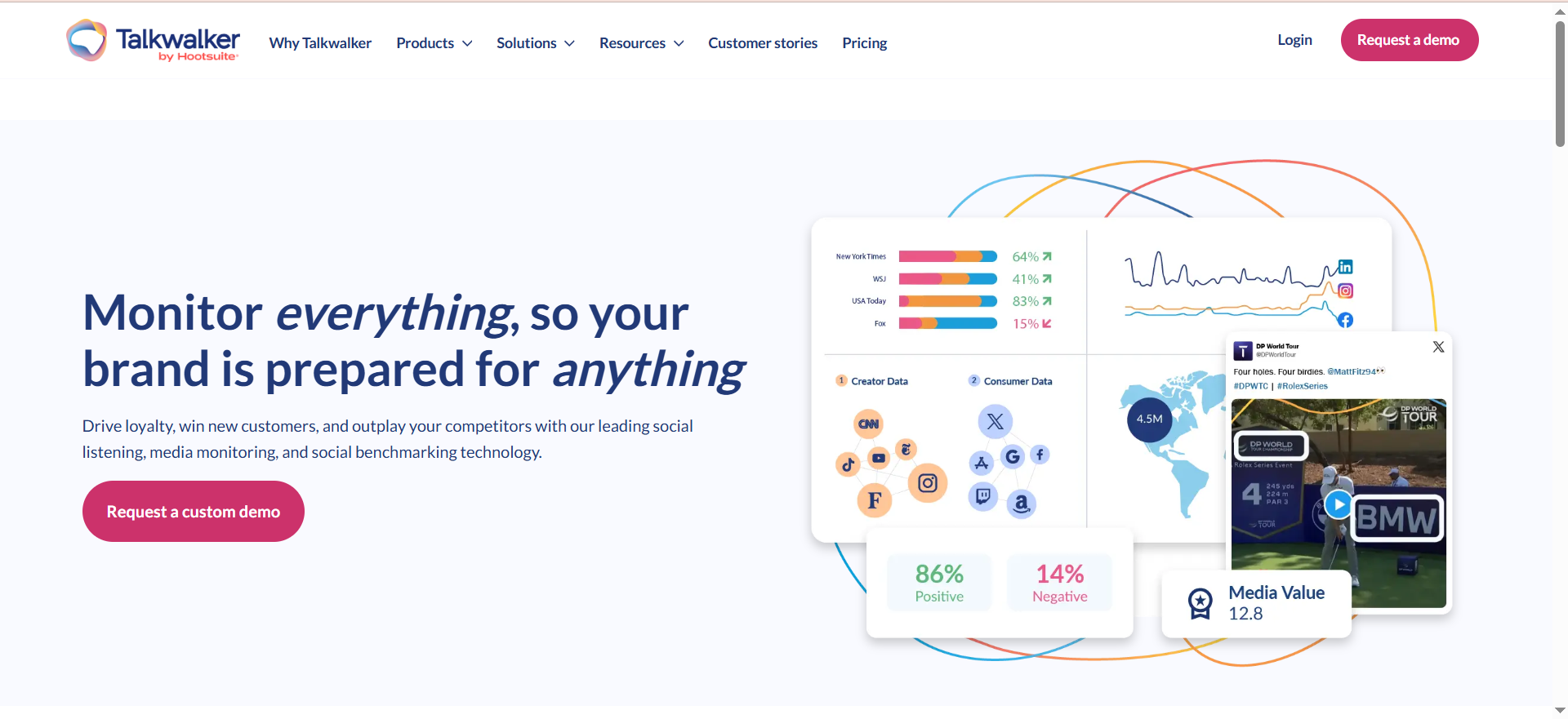
Talkwalker is an enterprise-grade consumer intelligence and social listening platform that monitors brand mentions across 150 million-plus websites, forums, blogs, social channels, print media, and broadcast sources. It provides real-time alerts, AI-powered sentiment analysis, visual recognition (logo detection in images and video), and competitive benchmarking — all from a single dashboard.
Why Teams Use It
Teams choose Talkwalker when they need truly global monitoring coverage. With support for over 180 languages and data sources spanning every major region, it is one of the few platforms where a multinational brand can monitor its reputation in Japanese news outlets, German forums, and Brazilian social media from the same interface. The visual recognition capability — detecting your logo in images and videos even when your brand name is not mentioned in text — fills a gap that most competing tools leave open.
What It Is Good For
Talkwalker excels at large-scale, multilingual brand monitoring where depth of source coverage matters. It is particularly strong for tracking brand mentions across earned media (news, blogs, forums) alongside social channels, giving PR and comms teams a unified view. The AI-powered image and video recognition adds a layer of monitoring that text-only tools miss entirely. Crisis detection dashboards and customizable alert thresholds let teams prioritize high-impact mentions without drowning in noise.
When It Is a Good Fit
Talkwalker fits best when you operate across multiple markets and languages, when visual brand monitoring matters (consumer goods, retail, sports sponsorships), or when your comms team needs to combine social listening with traditional media monitoring in one platform. It is also a strong fit for organizations that need unlimited users, reports, and alerts without per-seat pricing surprises.
When It Is Not a Good Fit
Talkwalker is not the right choice for small teams or early-stage companies with limited budgets. The minimum annual commitment starts around $12,000, and the platform's depth can feel overwhelming if you only need basic mention tracking for a single brand in one market. Teams looking for a quick self-serve setup will find the sales-led onboarding process slower than tools like Mention or Brand24.
How to Use It
After onboarding, you set up monitoring queries using Boolean logic or guided query builders. Talkwalker crawls its source network continuously and surfaces new mentions in your dashboard. You configure real-time alerts by channel (email, Slack, in-app), set thresholds for volume spikes or sentiment shifts, and assign alert routing to specific team members. Dashboards are customizable — most teams build separate views for crisis monitoring, competitive tracking, and campaign performance.
Key Capabilities
Talkwalker's core capabilities include real-time brand mention alerts across all monitored channels, AI-powered sentiment analysis with 90-plus percent accuracy, visual recognition for logos in images and video content, competitive benchmarking against unlimited competitors, crisis detection with customizable spike alerts, conversation clustering to identify emerging themes, customizable dashboards and automated reporting, and API access for integration with existing martech stacks.
Pricing
Talkwalker uses a custom-quote model with four tiers: Listen, Analyze, Business, and Premium. Published estimates place annual costs between $12,000 and $26,400 depending on data volume and feature access. All plans include unlimited users, reports, and alerts. You will need to contact their sales team for a tailored quote.
Free Tier
No free tier is available. Talkwalker offers product demos but does not provide a self-serve free trial.
Downsides and Limitations
The lack of transparent, self-serve pricing makes it difficult to evaluate cost before engaging with sales. The platform has a steeper learning curve compared to lighter tools — expect dedicated onboarding time. Some users report that the sheer volume of configuration options can slow down initial setup. Historical data access may be limited on lower-tier plans.
2. Brandwatch
What It Does
Brandwatch is a consumer intelligence and social media management platform that monitors brand mentions, competitor activity, and industry trends across more than 100 million sources. It combines real-time social listening with AI-driven sentiment analysis, crisis management tools, and a full social media management suite for publishing and engagement.
Why Teams Use It
Teams choose Brandwatch when they need more than just monitoring — they want consumer intelligence. Brandwatch goes deeper than surface-level mention tracking by analyzing audience demographics, purchase intent signals, and conversation context. The platform's crisis management module is particularly valued by PR teams because it detects anomalies in mention volume or sentiment and triggers alerts before a situation escalates.
What It Is Good For
Brandwatch is strongest when you need to combine listening with action. The platform connects monitoring data directly to social publishing and engagement workflows, so the same team that spots a trending conversation can respond from the same interface. Its AI categorization automatically tags mentions by topic, sentiment, and intent, reducing the manual triage work that bogs down large monitoring operations. The depth of its analytics — including demographic breakdowns and historical trend analysis — makes it a strong choice for teams that use monitoring data to inform strategy, not just react to crises.
When It Is a Good Fit
Brandwatch fits teams that want an all-in-one social intelligence and management platform. It works well for mid-to-large marketing and comms organizations that need listening, publishing, engagement, and analytics in a single tool. It is also a good fit when your use case extends beyond brand monitoring into market research, trend analysis, or competitive intelligence at scale.
When It Is Not a Good Fit
Brandwatch is not ideal for small teams on tight budgets. The entry-level plan starts at around $800 per month, and meaningful enterprise use often pushes costs significantly higher. Teams that only need basic alert-and-respond monitoring without the analytics layer may find Brandwatch over-engineered for their needs. The learning curve can also be steep for teams without a dedicated analyst.
How to Use It
You start by setting up listening queries using Boolean operators or Brandwatch's guided query builder. The platform continuously crawls its source network and populates your dashboard with categorized mentions. Real-time alerts are configured per query — you set conditions like volume spikes, sentiment drops, or specific keyword triggers, and choose delivery via email, in-app notification, or Slack integration. The crisis management module layers on top, providing a dedicated view that highlights potential escalation risks.
Key Capabilities
Brandwatch offers real-time monitoring across 100 million-plus sources worldwide, AI-powered sentiment analysis and automatic mention categorization, crisis management with spike detection and anomaly alerts, consumer intelligence including audience demographics and intent analysis, competitive benchmarking and share-of-voice tracking, integrated social media publishing and engagement tools, customizable dashboards with automated report scheduling, and historical data access for trend analysis.
Pricing
Brandwatch offers three plans: Pro, Advanced, and Enterprise. The Pro plan starts at approximately $800 per month for a single user. Multi-user pricing scales to around $2,500 per month for 10 users and up to $10,000 per month for larger teams. Enterprise pricing is fully custom. Contact Brandwatch directly for a detailed quote.
Free Tier
No free tier is available. Brandwatch offers guided demos but does not provide a self-serve free trial for its consumer intelligence platform.
Downsides and Limitations
Pricing is not transparent — you cannot evaluate costs without going through a sales process. The platform is feature-dense, which means a longer ramp-up time for new users. Some teams report that the social management features, while useful, add complexity if you only need the listening side. Data export options can be restrictive on lower-tier plans.
3. Mention
What It Does
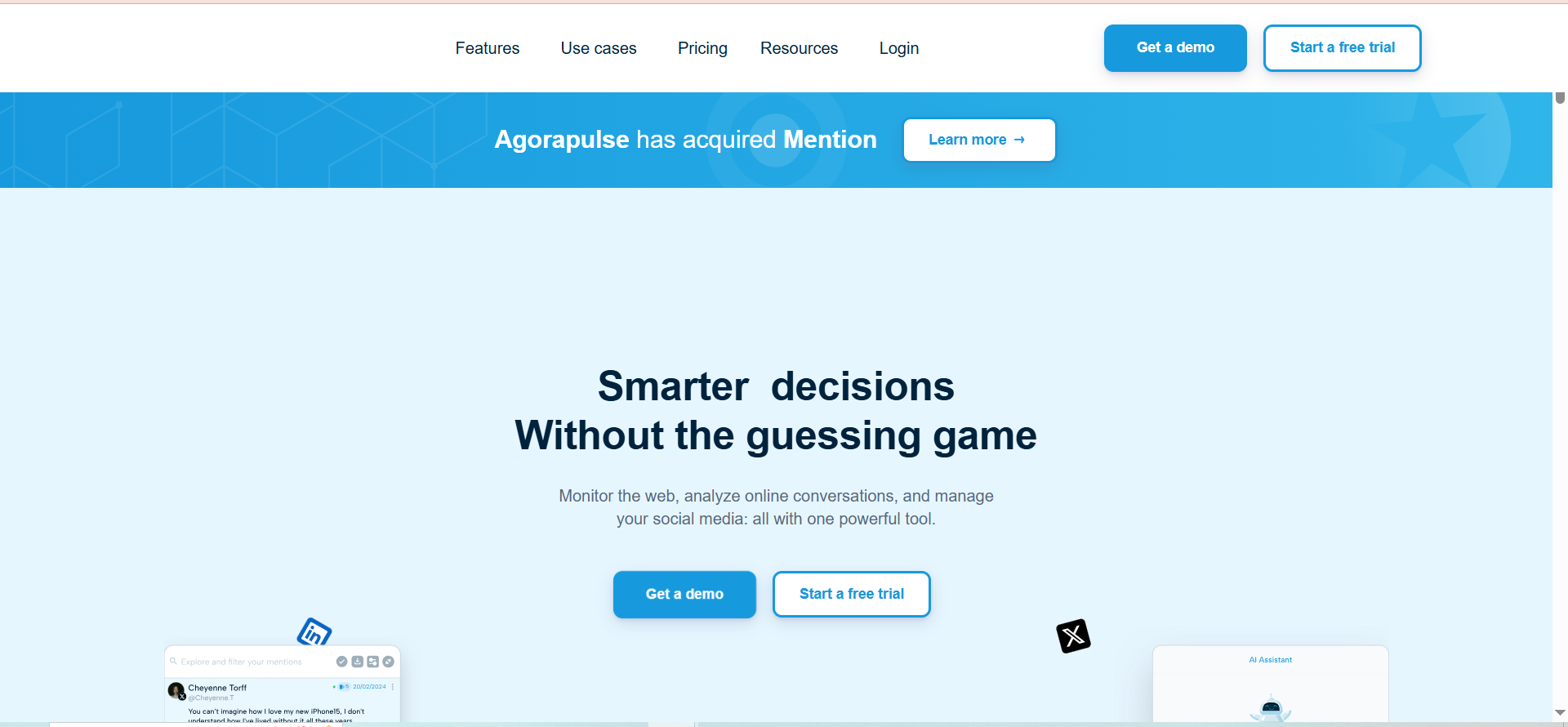
Mention is a real-time media monitoring tool that tracks brand mentions across social media, news sites, blogs, and forums. It delivers alerts within minutes of a mention appearing online and provides sentiment analysis, competitive tracking, and Boolean search capabilities — all at a price point that makes it accessible to small and mid-sized teams.
Why Teams Use It
Teams choose Mention because it delivers the core monitoring-and-alert workflow without the complexity or cost of enterprise platforms. The setup takes minutes, not weeks. You enter your brand name, configure your alert preferences, and start receiving notifications. For teams that have been relying on Google Alerts and need a meaningful upgrade without committing to a five-figure annual contract, Mention fills that gap.
What It Is Good For
Mention is strongest when speed-to-value matters. It handles the essential monitoring loop — detect mentions, analyze sentiment, alert the team, and track competitors — with a clean interface that does not require training. The Boolean search functionality gives power users enough flexibility to build precise queries, while the default setup works well enough for teams that just want to know when their brand is mentioned. Integrations with Slack and email mean alerts reach your team where they already work.
When It Is a Good Fit
Mention fits small-to-mid marketing teams, agencies monitoring multiple client brands, startups that need monitoring without enterprise overhead, and any team that values simplicity and fast setup over deep analytics. It is also a strong choice for teams that need advanced Boolean search and comprehensive source monitoring without per-alert pricing.
When It Is Not a Good Fit
Mention is not the right choice if you need deep consumer intelligence, AI-powered image recognition, or analytics that go beyond sentiment and volume trends. Its source coverage is narrower than enterprise tools like Talkwalker or Meltwater — it does not monitor broadcast media or print publications. Teams that need multi-language monitoring across dozens of markets may find its language support more limited than enterprise alternatives.
How to Use It
You create an alert by entering a keyword (your brand name, a competitor, or a topic). Mention begins crawling its source network and delivers results to your dashboard. Alert notifications are configurable — you choose email digests, real-time email alerts, Slack messages, or mobile push notifications. The competitive analysis view lets you track up to five competitors side by side. Boolean operators are available for more precise query building.
Key Capabilities
Mention provides real-time alerts delivered within minutes via email, Slack, or mobile app, Boolean search for advanced query building, sentiment analysis on detected mentions, competitive monitoring for up to five competitors, automated reporting with scheduled email delivery, a browser extension for on-the-go monitoring, and API access for custom integrations.
Pricing
Mention currently offers one plan for new customers: the Company plan at $599 per month (billed annually), built for businesses that need advanced listening, reporting, and collaboration. Legacy Solo ($49 per month), Pro ($99 per month), and ProPlus ($179 per month) plans are no longer available to new customers as of mid-2025, though existing subscribers retain access. A 14-day free trial may be available — check the official website for current trial options.
Free Tier
Mention has historically offered a 14-day free trial. Confirm current trial availability on the official website, as the plan structure changed in mid-2025. There is no permanent free tier.
Downsides and Limitations
Source coverage does not extend to broadcast, print, or podcast media. The analytics layer is functional but lacks the depth of enterprise platforms — you will not get audience demographics, purchase intent signals, or predictive analytics. Language support covers key global languages but does not approach the 100-plus language coverage of larger competitors. The shift to a single Company plan at $599 per month removes the affordable entry points that previously made Mention accessible to very small teams and solo practitioners.
4. Brand24
What It Does
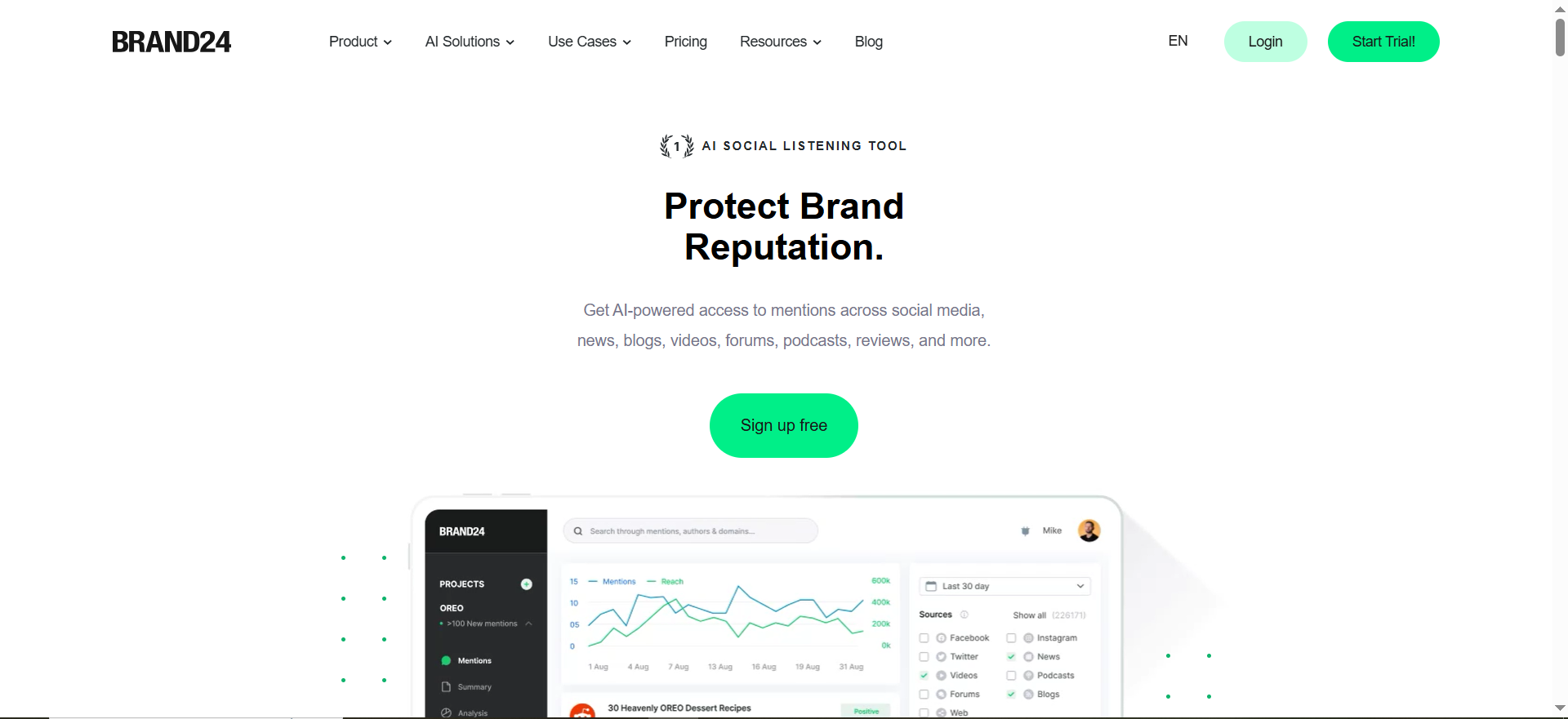
Brand24 is an AI-powered social listening and media monitoring tool that tracks online mentions of your brand, competitors, or any keyword across 25 million-plus sources including social media, news sites, blogs, forums, review sites, podcasts, and video platforms. It provides real-time alerts, sentiment analysis, influencer identification, and proprietary metrics like the Presence Score that quantify your brand's online visibility.
Why Teams Use It
Teams choose Brand24 because it provides enterprise-level feature breadth — AI sentiment analysis, influencer discovery, hashtag tracking, automated reporting — at a mid-market price point. The 14-day free trial with no credit card requirement makes it low-risk to test. The proprietary Presence Score gives marketing teams a single metric to track brand visibility over time, which is simpler to report upward than raw mention counts.
What It Is Good For
Brand24 is strongest for mid-market teams that need more than basic mention alerts but cannot justify enterprise pricing. It handles the full monitoring workflow — detection, sentiment analysis, alert routing, influencer identification, and reporting — in a single platform. The breadth of its source coverage (including podcasts and video) is unusual at its price point. Slack integration means alerts can flow directly into team channels without additional configuration.
When It Is a Good Fit
Brand24 fits mid-market marketing and comms teams, growth teams tracking brand perception alongside campaign performance, PR teams that need sentiment tracking and influencer identification, and organizations monitoring brand mentions across English and non-English markets (108 languages supported). It is also a good fit for teams that want the option to start small and scale up as monitoring needs grow.
When It Is Not a Good Fit
Brand24 is not the right choice if you need real-time alerts on the lowest-cost plan. The Individual tier ($249 per month, or $199 billed annually) updates every 12 hours — true real-time monitoring requires the Pro plan at $499 per month or higher. Teams that need broadcast media or print monitoring will need to look elsewhere. The platform's analytics, while solid, do not match the depth of Brandwatch's consumer intelligence capabilities.
How to Use It
You start a project by entering your target keywords (brand name, competitor names, or topic phrases). Brand24 begins tracking mentions across its source network and populating your dashboard with categorized results. You configure alerts by choosing delivery channels (email, Slack, in-app) and setting conditions — mention volume thresholds, sentiment shifts, or specific source types. The Discussion Volume chart gives you an at-a-glance view of mention trends, and the Presence Score tracks your overall visibility over time.
Key Capabilities
Brand24 offers AI-powered sentiment analysis across all monitored mentions, a proprietary Presence Score for tracking brand visibility trends, real-time email and Slack alerts for mention volume and sentiment shifts, influencer identification and scoring within your mention data, source coverage across 25 million-plus sources in 108 languages, automated PDF reporting with white-label options on higher tiers, hashtag tracking and analysis, and topic detection that groups related mentions into themes.
Pricing
Brand24 offers four main pricing tiers. The Individual plan costs $249 per month ($199 per month billed annually) with 3 keywords, 2,000 mentions per month, and 12-hour update intervals. The Team plan is $349 per month (or $299 billed annually) with hourly updates. The Pro plan costs $499 per month (or $399 annually) and unlocks real-time updates along with more advanced AI features. The Business plan is $699 per month ($599 billed annually) covering 25 keywords and 100,000 mentions per month.
Free Tier
Brand24 offers a 14-day free trial that does not require a credit card. No permanent free tier is available.
Downsides and Limitations
Real-time updates are only available on the Pro plan and above, which starts at $499 per month. The Individual plan's 12-hour update delay makes it unsuitable for teams that need instant alert response. Source coverage, while broad, does not include broadcast or print media. The platform's AI features are progressively gated across pricing tiers, meaning lower-tier users get a noticeably reduced experience.
5. Meltwater
What It Does
Meltwater is an enterprise media intelligence platform that monitors brand mentions across 6 million-plus media sources, 200 billion-plus social conversations, and 300 million-plus social profiles. It combines traditional media monitoring (news, print, broadcast) with social listening, influencer identification, predictive analytics, and competitive benchmarking in a unified platform.
Why Teams Use It
Teams choose Meltwater when their monitoring needs span both traditional media and social channels. Unlike social-first tools, Meltwater has deep roots in media monitoring — it tracks print publications, broadcast segments, and online news alongside social media conversations. PR and comms teams value this because a brand crisis rarely stays in one channel; Meltwater lets you see the full picture from a single dashboard. The predictive analytics capability helps teams anticipate emerging trends rather than simply reacting to them.
What It Is Good For
Meltwater is strongest for enterprise PR, comms, and marketing teams that need comprehensive media intelligence. It handles the traditional-media-plus-social-listening combination better than most competitors because it was built for media monitoring from the ground up. The influencer database (300 million-plus profiles) is one of the largest available, making it useful for teams that combine monitoring with influencer marketing. Competitive benchmarking and share-of-voice reporting give strategy teams the data they need for quarterly reviews and board presentations.
When It Is a Good Fit
Meltwater fits enterprise PR and communications teams, organizations that need traditional media monitoring alongside social listening, teams running influencer marketing programs at scale, and multi-brand or multi-market organizations that need centralized monitoring with regional breakdowns. It is also a good fit for organizations that need to track broadcast and print coverage — a capability that most social-first monitoring tools lack entirely.
When It Is Not a Good Fit
Meltwater is not the right choice for small teams, early-stage companies, or anyone looking for transparent, self-serve pricing. The sales-led buying process and custom quoting model means you cannot evaluate costs without committing to a discovery call. Teams that only need social monitoring without traditional media coverage will find Meltwater's breadth unnecessary — and will pay for source coverage they do not use.
How to Use It
After onboarding with a Meltwater account team, you set up monitoring searches using keyword queries and Boolean operators. Meltwater crawls its media and social source network continuously. Real-time alerts are configured through the platform's alerting module — you set triggers for mention volume spikes, sentiment changes, specific source types, or keyword combinations. Alerts are delivered via email or in-platform notifications. Dashboards are customizable, and most teams build separate views for media monitoring, social listening, and competitive analysis.
Key Capabilities
Meltwater provides real-time alerts with spike detection for unusual volume changes, media monitoring across 6 million-plus sources including print and broadcast, social listening across 200 billion-plus social conversations, an influencer database covering 300 million-plus profiles, predictive analytics for emerging trend detection, competitive benchmarking and share-of-voice reporting, unified reporting across earned, owned, and paid media, journalist and media contact database for PR outreach, and API access for integration with CRM and martech platforms.
Pricing
Meltwater uses a fully custom pricing model. Costs depend on the number of users, monitored sources, product modules (media monitoring, social listening, influencer marketing, etc.), geographic coverage, and contract length. Published estimates place entry-level monitoring packages at approximately $6,000–$15,000 per year, with full-feature suites ranging from $15,000–$50,000+ per year. Enterprise configurations can exceed $100,000 annually. You will need to contact Meltwater directly for an accurate quote.
Free Tier
No free tier or self-serve trial is available. Meltwater offers product demos through its sales team.
Downsides and Limitations
Pricing opacity is Meltwater's biggest barrier — you cannot estimate costs or compare value without engaging their sales process. The platform's breadth means a longer onboarding period and steeper learning curve compared to focused tools like Mention or Brand24. Some users report that the interface can feel dated compared to newer competitors. Contract terms tend to be annual with limited flexibility for scaling down mid-term.
What Is Brand Monitoring with Real-Time Alerts?
Brand monitoring with real-time alerts is the practice of continuously tracking where and how your brand is mentioned online — across social media, news outlets, blogs, forums, review sites, podcasts, and video platforms — and receiving instant notifications when new mentions appear. The "real-time" component means you find out about mentions within seconds or minutes of publication, not hours or days later. This speed matters because brand-relevant conversations move fast: a negative review, a viral social post, or a competitor comparison can shape public perception before your team even knows it exists. Real-time alert systems use continuous crawling, API connections to social platforms, and notification pipelines (email, Slack, mobile push) to close the gap between when something is said and when your team can respond.
How Do Real-Time Brand Monitoring Alerts Work?
Real-time brand monitoring alerts operate through a three-stage pipeline: data collection, signal processing, and notification delivery. In the collection stage, the monitoring tool continuously crawls or connects to data sources — social media APIs, news feeds, web crawlers scanning blogs and forums, and in some cases broadcast and print media databases. In the processing stage, incoming data is matched against your monitoring queries (brand names, keywords, competitor names, Boolean expressions) and run through classification models that assign sentiment, categorize by topic, and score relevance. In the delivery stage, mentions that match your criteria trigger notifications through your configured channels — email, Slack, mobile app push, SMS, or in-platform dashboard alerts. The speed of this pipeline varies by tool and plan tier. Enterprise platforms like Talkwalker and Meltwater process and deliver alerts within seconds for high-priority queries. Mid-market tools like Brand24 offer true real-time on higher tiers but delay updates on entry-level plans. The quality of the processing stage matters as much as the speed — a fast alert that misclassifies sentiment or surfaces irrelevant mentions creates more noise than value.
What Is the Difference Between Brand Monitoring and Social Listening?
Brand monitoring and social listening are related but distinct practices. Brand monitoring focuses on tracking specific mentions of your brand, product names, key personnel, and competitors. It answers the question: "What are people saying about us, and where?" The output is actionable alerts — someone mentioned your brand in a negative tweet, a journalist published a story about your competitor, a customer posted a product complaint on a forum.
Social listening goes broader. It tracks conversations around topics, trends, industries, and audience behaviors — not just your brand name. It answers the question: "What does our market care about, and how is sentiment shifting?" The output informs strategy: what themes should your next campaign address, what pain points are emerging in your category, where is the market conversation heading. Both are also distinct from social media management software, which is built around publishing, scheduling, and engagement on the accounts you own — it surfaces mentions that land on your own profiles, not the conversations happening elsewhere across the web.
In practice, most modern tools blend both capabilities. Brandwatch and Talkwalker lean toward social listening with deep consumer intelligence. Mention and Brand24 lean toward focused brand monitoring with some listening features. Meltwater bridges both with its media intelligence approach. When evaluating tools for real-time alerts specifically, the distinction matters because brand monitoring alerts are typically keyword-triggered (your brand was mentioned), while social listening alerts are trend-triggered (conversation volume around a topic is spiking).
How to Set Up Effective Real-Time Brand Alerts
Setting up real-time brand alerts that actually help (rather than overwhelming your team with noise) requires deliberate configuration. Start by defining your core monitoring queries: your brand name and common misspellings, product names, key executive names, branded hashtags, and top competitor names. Use Boolean operators to exclude irrelevant matches — for example, if your brand name is a common word, add exclusion terms to filter noise. Next, set alert priority levels. Not every mention needs an instant notification. Configure immediate alerts for high-impact triggers: negative sentiment spikes, mentions by journalists or influencers above a follower threshold, competitor comparison posts, or volume anomalies that could indicate a crisis. Route routine mentions to daily or weekly digest emails instead. Choose delivery channels based on team workflow. Slack integration works well for distributed teams that live in chat. Email alerts work for individuals who need a personal notification queue. Mobile push notifications are essential for on-call comms team members who need to respond outside business hours. Finally, review and refine. Most teams over-alert in the first week and then tune their queries and thresholds based on what actually matters. Schedule a monthly review of alert effectiveness — are you catching the signals that matter and filtering the noise that does not?
Which Industries Need Real-Time Brand Monitoring the Most?
Real-time brand monitoring delivers outsized value in industries where reputation directly impacts revenue and where negative events can escalate quickly. Financial services, healthcare, and regulated industries need real-time alerts because a compliance issue, data breach, or product safety concern can trigger regulatory scrutiny and stock price impact within hours. Consumer packaged goods and retail brands need real-time monitoring because product complaints, recall discussions, and viral customer experiences spread across social media before traditional PR response cycles can activate. Technology and SaaS companies benefit because product outages, feature complaints, and competitive comparisons happen in real time on platforms like X (formerly Twitter), Reddit, and Hacker News — and the audience expects rapid acknowledgment. Travel, hospitality, and food service industries face real-time reputation risk because individual customer experiences are shared publicly and influence booking decisions immediately. Political campaigns and public-sector organizations need real-time monitoring because narrative shifts happen in hours, not days. Any industry where brand trust is a primary purchase driver — which includes most B2B SaaS — benefits from monitoring that closes the gap between what is being said and when your team knows about it.
Can You Get Real-Time Brand Monitoring for Free?
Free brand monitoring options exist, but they come with significant limitations that make "real-time" a stretch. Google Alerts is the most widely used free option, but it monitors only web pages indexed by Google (not social media), updates are delayed by hours or even days, and there is no sentiment analysis, no dashboard, and no control over alert granularity. Some tools offer limited free tiers or trial periods that include real-time features. Brand24 and Mention both offer 14-day free trials with full feature access, which lets you test real-time alerting before committing to a paid plan. Mention's trial gives you access to its Pro-level features temporarily. For teams that need ongoing free monitoring, the realistic approach is to combine Google Alerts (for web mentions) with native social media notifications (for direct mentions on platforms you manage) and manual searches. This gives you partial coverage with inconsistent timing — it is better than nothing but not a replacement for a dedicated monitoring tool. The practical answer: you can monitor for free, but you cannot get reliable, comprehensive, real-time alerts for free. The gap between free and paid is the alerting pipeline — the speed, the source coverage, the signal processing, and the notification routing that turns raw mentions into actionable intelligence.
How to Measure ROI from Brand Monitoring Tools
Measuring ROI from brand monitoring requires connecting monitoring activities to business outcomes. Start with response time improvement: measure the average time between a brand mention appearing and your team's first response, then track how that metric changes after implementing a real-time monitoring tool. Faster response times to negative mentions have been shown to reduce escalation rates and improve customer retention. Second, track crisis prevention and mitigation. Quantify the cost of past brand crises (revenue impact, stock price movement, customer churn, recovery campaign spend) and compare against incidents caught early by your monitoring tool. A single prevented crisis can justify years of monitoring spend. Third, measure competitive intelligence value. Track how monitoring data informs your marketing strategy — competitive positioning changes, product messaging adjustments, or campaign pivots based on market conversation trends. Fourth, track PR and media outreach efficiency. Tools that identify journalists writing about your space or influencers discussing your category can reduce the time and cost of media outreach. Fifth, measure customer insight generation. Brand monitoring surfaces unfiltered customer feedback — product complaints, feature requests, comparison discussions — that product and marketing teams can act on without commissioning formal research. The strongest ROI case for real-time monitoring specifically comes from the first two metrics: response time and crisis prevention. These are the areas where the difference between a 5-minute alert and a 12-hour alert translates directly into measurable business impact.
What Makes a Good Brand Monitoring Alert System?
A good brand monitoring alert system balances speed, accuracy, and actionability. Speed alone is not enough — an alert that arrives instantly but surfaces irrelevant mentions or misclassifies sentiment creates work, not value. The key attributes of an effective alert system are detection speed (mentions surfaced within minutes, not hours), source breadth (coverage across social, news, blogs, forums, review sites, and ideally podcasts and broadcast), signal quality (accurate sentiment classification, relevance filtering, and noise reduction), configurable thresholds (volume spike detection, sentiment shift triggers, influencer mention flags), routing flexibility (delivery via email, Slack, mobile push, SMS, or webhook), contextual information (alerts include enough detail — source, sentiment, reach, full text — to decide on action without clicking through), and escalation paths (critical alerts can be routed to senior team members or on-call responders automatically). The best systems let you customize all of these dimensions per query, so your brand name monitoring runs with different sensitivity and routing than your competitor tracking or industry trend queries.
Brand Monitoring for Crisis Management and PR Response
Real-time brand monitoring is most valuable during crisis situations — and the tools covered in this guide vary in how well they support crisis workflows. Effective crisis monitoring requires three capabilities: early detection (identifying a potential crisis before it escalates), real-time tracking (monitoring the situation as it evolves), and response coordination (enabling your team to act quickly and consistently). Talkwalker and Brandwatch both offer dedicated crisis management modules with anomaly detection dashboards, automated escalation alerts, and historical baseline comparisons that help teams distinguish a genuine crisis from normal volume variation. Meltwater's spike detection serves a similar function but is oriented more toward media coverage spikes than social virality. Brand24 and Mention provide the detection and tracking layers but lack dedicated crisis management workflows — your team would need to build response coordination processes around the alerts they generate. For organizations where crisis management is a primary use case, evaluate tools on three questions: How quickly does the tool detect unusual activity? How does it differentiate a real crisis from routine volume spikes? And does it provide workflows (not just alerts) for coordinating your team's response?
How AI Is Improving Real-Time Brand Monitoring in 2026
AI capabilities in brand monitoring tools have moved well beyond basic sentiment scoring. In 2026, the most significant AI-driven improvements are in signal quality (reducing false positives and irrelevant alerts), contextual understanding (interpreting sarcasm, irony, and nuanced sentiment in multiple languages), visual monitoring (detecting brand logos and products in images and video without text mentions), predictive alerting (identifying emerging trends or potential crises before they reach critical mass based on early-signal patterns), and automated categorization (classifying mentions by topic, intent, and urgency without manual tagging). Talkwalker leads in visual AI with its logo and image recognition across video content. Brandwatch has invested heavily in consumer intelligence AI that identifies purchase intent signals and audience behavior patterns. Brand24's proprietary Presence Score uses AI to create a composite visibility metric that is easier to track than raw mention data. Meltwater's predictive analytics module uses historical pattern matching to forecast mention trends. The practical impact for monitoring teams is less noise and more signal. A well-tuned AI-powered monitoring system in 2026 should deliver alerts that are relevant, correctly classified, and actionable — without requiring your team to manually filter through hundreds of low-value mentions to find the ones that matter.