
TL;DR
Picking a brand sentiment analysis tool comes down to three things: how accurately it reads tone, how clearly it reports what it finds, and whether the price makes sense for the size of your team. Some platforms are built for enterprise marketing orgs that need to monitor hundreds of thousands of mentions across dozens of markets. Others are designed for growth-stage SaaS teams that want reliable sentiment data without a six-figure annual contract.
This guide compares five brand monitoring tools — Brandwatch, Talkwalker, Brand24, YouScan, and Meltwater — on exactly those factors. Each section covers what the tool does, who it works best for, how much it costs, and where it falls short, so you can shortlist faster and skip the demo-heavy discovery process.
Best Tools for Brand Sentiment Analysis (Quick Comparison)
| Tool | Best For | Starting Price | Free Trial |
|---|---|---|---|
| Brandwatch | Enterprise consumer intelligence teams needing deep emotion detection | ~$800/mo (custom) | No (demo only) |
| Talkwalker | Multilingual global brands with heavy visual content | ~$500/mo (custom) | No (demo only) |
| Brand24 | Mid-market and growth-stage teams wanting accessible AI monitoring | $199/mo (annual) | 14-day free trial |
| YouScan | Brands where product imagery drives purchasing decisions | $499/mo | No (demo only) |
| Meltwater | Teams needing traditional media coverage alongside social sentiment | ~$6,000/yr (custom) | No (demo only) |
1. Brandwatch
What It Does
Brandwatch is a consumer intelligence platform that tracks brand mentions across more than 100 million online sources including social media, forums, blogs, news sites, and review platforms. Its sentiment engine uses transformer-based language models to classify mentions as positive, negative, or neutral, and goes further by detecting six specific emotions: anger, disgust, fear, joy, sadness, and surprise. The platform also includes image analytics that can recognize brand logos in photos and analyze visual sentiment across social media.
Why Teams Use It
Marketing and insights teams at enterprise-level organizations use Brandwatch when they need granular control over what they monitor. The platform supports Boolean query building, which lets analysts create precise search parameters to filter noise and surface only relevant conversations. Combined with audience segmentation by demographics and interests, it gives teams the ability to track how different customer segments feel about their brand in near real time.
What It Is Good For
Brandwatch excels at competitive benchmarking and share-of-voice tracking. If your team regularly reports on how brand perception stacks up against three or four direct competitors, Brandwatch's dashboard customization and automated reporting make that workflow efficient. It also handles crisis monitoring well — when negative sentiment spikes, the platform surfaces the drivers behind the shift so comms teams can respond before coverage spreads.
When It Is a Good Fit
Brandwatch fits best when the organization has a dedicated insights or social intelligence team, the brand operates in multiple markets and needs granular audience segmentation, the team requires Boolean-level query precision rather than simple keyword tracking, and the budget supports an enterprise-grade platform with custom pricing.
When It Is Not a Good Fit
Brandwatch is not ideal for small teams or early-stage companies that do not have a dedicated analyst to build and maintain complex queries. The learning curve is steep, the interface can feel overwhelming for users who just need a high-level sentiment read, and the price point puts it out of reach for most teams spending under $10,000 per year on monitoring tools. Its language support at 27+ languages also trails behind competitors like Talkwalker and Brand24 for brands operating in non-English markets.
How to Use It
Set up starts with defining the topics and brands you want to track using Boolean queries. From there, configure dashboards to visualize sentiment trends, volume changes, and competitive comparisons. The platform integrates with tools like Slack, Microsoft Teams, and various BI platforms for automated reporting. Most teams schedule weekly sentiment summaries and set up real-time alerts for significant negative spikes.
Key Capabilities
Core capabilities include AI-powered sentiment analysis with six-emotion detection, image analytics with logo recognition across social media photos, audience segmentation by demographics and interests, competitive benchmarking and share-of-voice tracking, customizable dashboards with automated reporting, content publishing and social media management via Brandwatch Social, influencer identification and campaign management, and emoji sentiment analysis that understands emotional context beyond text.
Pricing
Brandwatch uses fully custom pricing with no published rate card. Pricing starts at approximately $800 per month for smaller configurations and scales to $15,000 or more per month for large enterprise setups. The total cost depends on the number of active queries, data sources, user seats, and contract length. There is no free trial — prospective users go through a guided demo with the sales team.
Free Tier
No. Brandwatch does not offer a free tier or a self-serve trial. All access requires a sales conversation and custom quote.
Downsides and Limitations
The platform has a significant learning curve, especially for teams new to social listening. Setting up Boolean queries requires training, and the interface can feel complex for users who just need basic sentiment tracking. Language support is limited to 27+ languages, which falls short for brands with audiences in markets where Talkwalker or Brand24 offer broader coverage. The lack of a free trial or transparent pricing makes it difficult for teams to evaluate before committing budget.
2. Talkwalker
What It Does
Talkwalker is a consumer intelligence platform that combines text-based sentiment analysis with visual and audio recognition technology. The platform tracks mentions across social media, news, blogs, forums, podcasts, and broadcast media, then applies AI models to classify sentiment and detect trends. One of its differentiators is image and video recognition — Talkwalker tracks more than 40,000 brand logos, objects, and scenes in social images and videos, and monitors over 60 million new videos each day for brand mentions.
Why Teams Use It
Global brands use Talkwalker because it handles multilingual sentiment analysis better than most competitors. With support for 187 languages and AI models trained for different linguistic and cultural contexts, it gives international marketing teams a single platform to monitor sentiment across every market they operate in. The visual recognition layer adds coverage that text-only tools miss — a customer photographing a product on Instagram without tagging the brand still gets captured and analyzed.
What It Is Good For
Talkwalker performs well for brands that need to track sentiment across both text and visual content simultaneously. It is particularly strong for crisis detection and trend monitoring, where the combination of text sentiment, image analysis, and video monitoring surfaces emerging issues faster than tools limited to text. The customizable dashboard and reporting features support teams that need to present sentiment data to leadership on a regular cadence.
When It Is a Good Fit
Talkwalker fits best when the brand operates in multiple countries and needs sentiment analysis across many languages, visual content like product photos and unboxing videos is a significant part of how customers interact with the brand, the team needs to monitor podcasts and broadcast media alongside social and web, and the organization has the budget for an enterprise platform with custom pricing.
When It Is Not a Good Fit
Talkwalker's automatic sentiment classification has drawn some criticism for requiring manual correction. Users have reported that the AI gets the tone wrong on a noticeable percentage of mentions, which means analysts need to spend time reviewing and adjusting sentiment labels. This manual overhead makes it less appealing for lean teams that want to set up monitoring and trust the outputs without heavy curation. The pricing, starting around $500 per month with enterprise plans reaching $2,200 per month or more, also puts it out of range for teams with smaller budgets.
How to Use It
Onboarding involves setting up brand and competitor topics, configuring dashboards, and connecting integrations. Talkwalker supports integrations with Slack, Salesforce, Tableau, and other BI tools. Teams typically configure alerts for sentiment threshold changes and schedule automated reports. The visual insights panel is where image and video recognition data surfaces, and it can be layered on top of text sentiment dashboards for a combined view.
Key Capabilities
Key capabilities include sentiment analysis across 187 languages with culturally adapted models, image recognition tracking 40,000+ brand logos and objects in social photos, video monitoring across 60 million new videos daily, podcast transcript sentiment analysis, trend detection and predictive analytics, customizable dashboards and automated reporting, and social benchmarking across competitors.
Pricing
Talkwalker uses custom pricing. Entry-level plans start around $500 per month, while enterprise plans run approximately $2,200 per month or $26,400 annually. Custom pricing is available for organizations with specific requirements. Direct contact with the sales team is required for a precise quote.
Free Tier
No. Talkwalker does not offer a free tier or self-serve trial. A guided demo is provided instead.
Downsides and Limitations
The biggest drawback is sentiment accuracy on nuanced content. While the AI performs well on straightforward positive and negative mentions, it struggles with sarcasm, irony, and mixed sentiment — a limitation shared across the category but more frequently cited by Talkwalker users. The manual correction workflow adds analyst time that may not be accounted for in initial planning. The interface also has a learning curve, particularly around setting up advanced dashboards and configuring the visual recognition features.
3. Brand24
What It Does
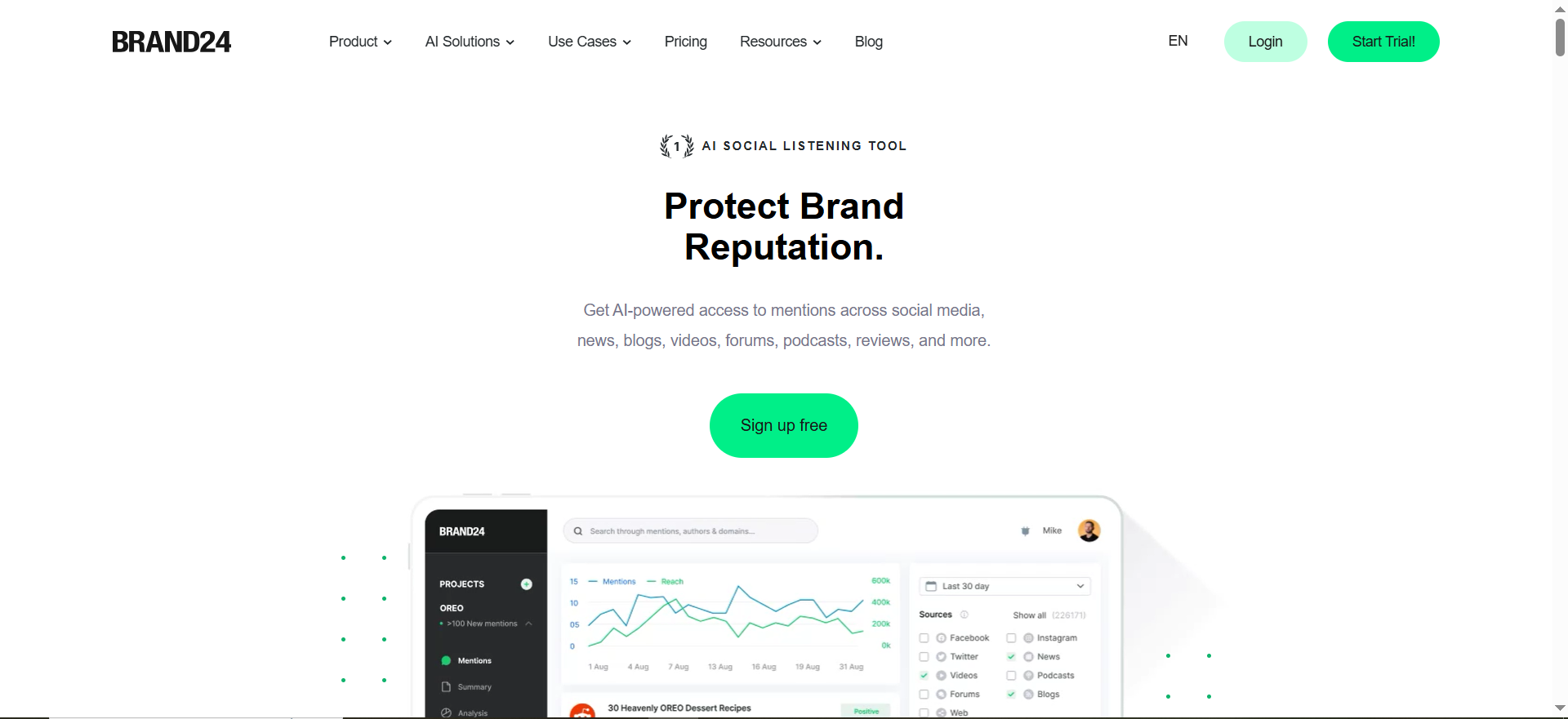
Brand24 is a social listening and brand monitoring platform that tracks mentions across social media platforms (Instagram, X, TikTok, Reddit, LinkedIn, YouTube, Facebook, Quora, Telegram, and Twitch), review sites (TripAdvisor, Yelp, Trustpilot, App Store, and Google Play), news outlets, blogs, and forums. Each mention gets AI-powered sentiment classification — positive, negative, or neutral — along with contextual analysis. A standout addition for 2026 is LLM monitoring (available as an add-on across all plans), which tracks how AI chatbots like ChatGPT, Claude, Gemini, Perplexity, and Grok mention and recommend your brand.
Why Teams Use It
Growth-stage SaaS companies and mid-market marketing teams use Brand24 because it delivers reliable sentiment analysis at a price point that does not require enterprise-level budget approval. The AI Brand Assistant lets users ask natural language questions about their monitoring data, turning what would normally be a manual data pull into a conversational query. This makes Brand24 accessible to marketers who are not trained as data analysts.
What It Is Good For
Brand24 is particularly effective for teams that need to track brand perception across a wide range of sources without configuring complex Boolean queries. The platform handles setup quickly — most teams are monitoring within minutes of creating an account. The reporting suite includes customizable PDF and Excel exports that can be automated, and the weekly Executive Summary feature delivers a pre-built report with Net Sentiment Score and Share of Voice compared to competitors directly to stakeholders' inboxes.
When It Is a Good Fit
Brand24 fits best when the team needs a brand sentiment tool that is operational within hours rather than weeks, the budget is in the $200–$500 per month range, monitoring AI chatbot mentions of the brand is a priority, the team prefers natural language queries over Boolean query building, and the organization values a 14-day free trial to evaluate before committing.
When It Is Not a Good Fit
Brand24 has less depth in visual content analysis compared to Brandwatch or YouScan, which may matter more for DTC brands. If product imagery and video mentions are a major part of how customers interact with the brand, Brand24 will miss some of that coverage. The platform also generates fewer total mentions than enterprise tools, which means brands with very high mention volumes may find coverage gaps. Advanced customization for complex multi-market tracking is more limited than what Brandwatch or Talkwalker offer.
How to Use It
Create a project, enter the keywords and brand names to track, and Brand24 starts collecting mentions immediately. The dashboard shows real-time sentiment trends, mention volume, and source breakdowns. Set up email alerts for sentiment shifts and configure the AI Brand Assistant to surface specific insights. Reports can be scheduled on a weekly or monthly basis and sent automatically to team leads.
Key Capabilities
Key capabilities include AI-powered sentiment analysis across 100+ languages, LLM monitoring (add-on) tracking brand mentions in ChatGPT, Claude, Gemini, Perplexity, and Grok, AI Brand Assistant for natural language data queries, real-time mention tracking and alerts, Net Sentiment Score and Share of Voice reporting, automated PDF and Excel report exports, sarcasm and slang detection with updated NLP models for 2026, and a 14-day free trial.
Pricing
The Individual plan starts at $199 per month on annual billing (or $249 monthly) and includes 3 keywords, 2,000 mentions per month, 1 user, updates every 12 hours, and AI sentiment analysis. The Team plan is $299 per month annually ($349 monthly) with hourly updates. The Pro plan is $399 per month annually ($499 monthly) with real-time updates and more advanced AI features.
Free Tier
No permanent free tier, but a 14-day free trial is available with full feature access. No credit card required to start.
Downsides and Limitations
The Individual plan caps mentions at 2,000 per month with 12-hour update intervals, which may be too slow for brands that need real-time crisis monitoring. Visual content analysis is limited compared to tools like YouScan and Brandwatch. The platform is better suited for mid-market use cases — enterprise teams managing dozens of brands across global markets will likely outgrow it. Advanced Boolean query configuration is not available, which limits precision for analysts who need granular filtering.
4. YouScan
What It Does
YouScan is a social listening platform built around visual intelligence. While it handles standard text-based sentiment analysis, its primary differentiator is the ability to analyze images and videos for brand logos, product appearances, and visual context. The platform applies AI-driven sentiment analysis that detects tone from text, emojis, and slang, and offers aspect-based sentiment analysis that breaks down sentiment by product features, service quality, or specific campaign elements rather than giving a single overall score.
Why Teams Use It
Consumer brands — especially in food, beverage, beauty, and retail — use YouScan because customer sentiment often lives in product photos rather than written reviews. A customer posting a photo of a damaged package on Instagram without tagging the brand, or sharing a meal featuring a product, contains sentiment signals that text-only tools miss entirely. YouScan's image recognition captures these visual mentions and feeds them into the overall sentiment analysis.
What It Is Good For
YouScan excels at aspect-based sentiment analysis, which is valuable for product teams that need to understand how customers feel about specific product attributes rather than just the brand overall. For example, a beauty brand can track sentiment separately for packaging, formula, and scent, giving product development teams actionable data rather than a generic positive or negative score. The platform also performs well for competitive visual benchmarking — tracking how often competitors' products appear alongside or instead of your own in consumer-generated images.
When It Is a Good Fit
YouScan fits best when visual content like product photos and user-generated images is a significant driver of brand perception, the team needs aspect-based sentiment breakdowns by product feature or attribute, the brand operates in consumer-facing industries like food, beverage, beauty, fashion, or retail, and the organization wants a platform that goes beyond text to capture the full picture of customer sentiment.
When It Is Not a Good Fit
YouScan is not the strongest choice for brands where text-based conversations are the primary source of customer sentiment. B2B SaaS companies, financial services, or professional services firms where customer feedback happens in written reviews, forum discussions, and support tickets will get less value from the visual intelligence features. The starting price of $499 per month also puts it above Brand24 for teams that mainly need text-based monitoring. Language support is narrower than Talkwalker or Brand24.
How to Use It
Set up topics and brand keywords, then configure the visual insights dashboard to track logo appearances and product imagery. YouScan's Insights Copilot — an AI agent introduced as part of the platform — helps surface trends and answer questions about monitoring data. Integrate with Slack, email, or other notification channels for real-time alerts on sentiment shifts or visual mention spikes.
Key Capabilities
Key capabilities include AI-driven visual intelligence with image and video recognition, aspect-based sentiment analysis by product feature, text sentiment analysis with emoji and slang detection, Insights Copilot AI agent for automated trend surfacing, smart alerts and auto-categorization, customizable reporting dashboards, competitive visual benchmarking, and a client base including brands like Nestle, L'Oreal, PepsiCo, Coca-Cola, and McDonald's.
Pricing
YouScan's Starter-3 plan starts at $499 per month when billed annually. Higher-tier packages include more keywords, mentions, and advanced features. Unlimited plans with custom pricing are available for organizations needing dedicated support and advanced functionality. Contact the sales team for enterprise quotes.
Free Tier
No. YouScan does not offer a free tier. A product demo is available upon request.
Downsides and Limitations
The platform's strength in visual intelligence comes with a trade-off — its text-only sentiment analysis is less sophisticated than what Brandwatch or Talkwalker offer for complex linguistic analysis. Language support is narrower than competitors, which limits its usefulness for global brands operating in many non-English markets. The $499 per month starting price makes it more expensive than Brand24 for teams that do not need visual analytics. The platform is less established in the B2B monitoring space and primarily serves consumer-facing brands.
5. Meltwater
What It Does
Meltwater is a media intelligence and social listening platform that monitors more than 200 billion social conversations and analyzes over 300 million social profiles. What sets Meltwater apart from pure social listening tools is its deep integration of traditional media monitoring — news outlets, broadcast, print, and online publications — alongside social media and consumer review tracking. The platform's 2025 mid-year update introduced GenAI Lens for LLM tracking capabilities and Mira, an AI teammate that assists with Boolean search creation and insights summarization.
Why Teams Use It
PR and communications teams use Meltwater because they need to track earned media coverage alongside social sentiment. Most sentiment analysis tools focus on social media and web sources, but Meltwater covers the full media landscape including news wires, print archives, and broadcast transcripts. This makes it the default choice for teams that measure brand perception through both public relations and social listening lenses.
What It Is Good For
Meltwater performs best when teams need a unified view of brand sentiment across earned, owned, and social channels. The platform's influencer identification and journalist engagement tools make it useful for PR teams that not only want to track sentiment but also act on it by reaching out to relevant media contacts. Predictive analytics for brand measurement and forecasting add a forward-looking layer that helps teams anticipate sentiment shifts rather than only reacting to them.
When It Is a Good Fit
Meltwater fits best when the team includes PR and comms alongside marketing and needs both media monitoring and social listening in one platform, traditional media coverage like news articles, broadcast mentions, and print publications is important to the brand's measurement framework, the organization wants AI-powered tools for Boolean search creation and sentiment summarization, and the budget can support a custom enterprise contract starting at approximately $6,000 per year.
When It Is Not a Good Fit
Meltwater's custom pricing model means there is no published rate card, and the sales process involves extended conversations with the vendor. Teams that need to move fast and self-serve will find the procurement cycle frustrating. The median annual cost of $25,000 puts it firmly in enterprise territory, and the lack of a free trial means teams cannot evaluate the platform independently before committing. For organizations that only need social media sentiment without traditional media coverage, Meltwater's breadth becomes unnecessary overhead.
How to Use It
Implementation starts with a guided onboarding process with the Meltwater team. Configure media monitoring searches, set up social listening topics, and build dashboards that combine traditional and social sentiment data. The Mira AI teammate can help create Boolean searches and summarize insights. Integrate with CRM and BI tools for automated reporting workflows. Most teams configure daily media briefings and weekly sentiment reports.
Key Capabilities
Key capabilities include monitoring of 200B+ social conversations and 300M+ social profiles, traditional media monitoring across news, broadcast, and print, GenAI Lens for tracking how AI models discuss the brand, Mira AI teammate for search creation and insight summarization, influencer and journalist identification and engagement tools, predictive analytics for brand sentiment forecasting, shareable reporting across earned, owned, and paid social, and real-time podcast transcript sentiment analysis.
Pricing
Meltwater uses custom pricing only. The median annual cost is approximately $25,000, with a range from $6,000 to over $100,000 depending on the number of users, features, regions, and data volume included. Three main tiers are available — Essentials, Suite, and Enterprise. There is no published rate card, no free trial, and no self-serve option. A guided demo with the sales team is provided instead.
Free Tier
No. Meltwater does not offer a free tier or free trial. All access begins with a sales conversation.
Downsides and Limitations
The biggest barrier is the pricing and procurement process. With no transparent pricing, no free trial, and a sales-driven onboarding model, evaluating Meltwater requires a significant time investment before the team even sees the product. The median $25,000 annual cost is out of reach for most growth-stage companies. The platform's breadth — covering everything from print media to social sentiment to influencer engagement — can feel overwhelming for teams that only need focused sentiment analysis. Some users have also reported that the social listening component is less specialized than dedicated tools like Brandwatch or Brand24.
How Does Brand Sentiment Analysis Work
Brand sentiment analysis uses natural language processing and machine learning models to classify mentions of a brand — across social media, reviews, forums, news, and other sources — as positive, negative, or neutral. Modern tools in 2026 use transformer-based language models that process entire passages rather than analyzing words in isolation, which improves accuracy on complex language patterns like sarcasm, irony, and mixed sentiment.
The process starts with data collection: the tool monitors configured keywords, brand names, and competitor mentions across its source network. Each mention gets processed through the sentiment model, which assigns a polarity score (typically on a scale from -1 to 1) and, in advanced tools, detects specific emotions like joy, anger, frustration, or surprise. The results are aggregated into dashboards that show sentiment trends over time, sentiment breakdowns by source, and comparisons against competitors.
Some tools also layer visual intelligence on top of text analysis. Platforms like YouScan and Talkwalker analyze images and videos for brand logos and product appearances, adding sentiment signals from visual content that text-only tools miss entirely. The latest addition to the category is AI model monitoring — Brand24 and Meltwater now track how large language models like ChatGPT, Claude, and Perplexity mention and characterize brands, which is increasingly relevant as consumers turn to AI assistants for product recommendations.
What Metrics Should You Track for Brand Sentiment
The most commonly tracked metrics in brand sentiment analysis include Net Sentiment Score, Share of Voice, mention volume, sentiment distribution, and emotion breakdown. Net Sentiment Score measures the ratio of positive mentions to negative mentions, giving a single number that represents overall brand perception. A score in the 65 to 75 percent positive range is considered healthy for most consumer brands.
Share of Voice compares your brand's mention volume and sentiment against competitors in the same category. This metric is useful for understanding whether your brand is gaining or losing ground in consumer conversations. Mention volume on its own shows reach and awareness, but combining it with sentiment data reveals whether growing visibility is positive or negative.
For teams using advanced tools, aspect-based sentiment analysis provides the most actionable data. Instead of a single overall score, aspect-based analysis breaks sentiment down by product attribute — pricing, quality, customer support, ease of use — so product and marketing teams can see exactly where perception is strong and where it needs work. YouScan and Brandwatch both support this level of granularity.
Can Brand Sentiment Analysis Detect Sarcasm
Sarcasm detection remains one of the hardest challenges in sentiment analysis. Even the best tools in 2026 misclassify a meaningful percentage of sarcastic, ironic, and mixed-sentiment content. Brandwatch and Talkwalker have invested heavily in contextual sentiment models that improve accuracy on this type of content, but neither claims perfect detection.
The practical approach most teams take is to treat sentiment data as a directional indicator rather than an absolute measurement. Tools like Brand24 and YouScan prioritize easy manual override capabilities — when the AI gets the sentiment label wrong, analysts can quickly correct it. This hybrid approach of automated classification with human review produces more reliable data than trusting any single model's output entirely.
How Much Do Brand Sentiment Analysis Tools Cost
Pricing for brand sentiment analysis tools in 2026 ranges from approximately $200 per month for mid-market tools to over $100,000 per year for enterprise configurations. Brand24 offers the lowest entry point at $199 per month on annual billing, while Meltwater sits at the highest end with a median annual cost of $25,000. YouScan starts at $499 per month, Talkwalker begins around $500 per month, and Brandwatch starts at approximately $800 per month.
The total cost depends on several factors: the number of keywords or brand topics being tracked, the volume of mentions processed, how many user seats are needed, and whether the organization requires advanced features like visual intelligence, predictive analytics, or traditional media monitoring. Teams should also account for the analyst time required to manage the platform — tools with steeper learning curves or less accurate automated sentiment often require more human oversight, which adds to the effective cost.
What Is the Difference Between Brand Sentiment and Brand Reputation
Brand sentiment is a real-time, quantitative measure of how people feel about your brand based on what they are saying across social media, reviews, forums, and news. It is measured continuously and fluctuates in response to campaigns, product launches, crises, and customer experiences. Brand reputation is a broader, longer-term concept that encompasses overall public perception, trust, credibility, and the accumulated impact of brand actions over time.
Sentiment analysis is one input into reputation measurement, but reputation also includes factors like NPS scores, customer satisfaction survey data, media coverage quality, industry awards, and executive visibility. A brand might have temporarily negative sentiment during a product recall but still maintain a strong overall reputation if it handles the crisis well. The tools covered in this guide focus primarily on sentiment measurement, which feeds into but does not fully define brand reputation.
Which Brand Sentiment Analysis Tool Is Best for Small Teams
Brand24 is the strongest fit for small and growth-stage teams. It starts at $199 per month on annual billing, offers a 14-day free trial with no credit card required, and requires minimal setup time. The AI Brand Assistant removes the need for a dedicated analyst by letting any team member ask questions about monitoring data in plain language. Small teams also benefit from the automated reporting features, which reduce the time spent building manual sentiment summaries.
For teams with even smaller budgets, free tools like Google Alerts provide basic mention tracking without sentiment classification, and open-source libraries like VADER offer sentiment scoring for teams with technical resources to build custom solutions. However, these free options lack the automated coverage, accuracy, and reporting capabilities that paid platforms provide.
How Do AI Chatbot Mentions Affect Brand Sentiment
AI chatbot mentions are an emerging factor in brand perception that most traditional sentiment tools do not yet track. When a consumer asks ChatGPT or Perplexity for a product recommendation, the AI's response can positively or negatively influence that consumer's perception of the brands mentioned — and these interactions happen outside of the social media and review channels that standard monitoring tools cover.
Brand24 and Meltwater have both introduced LLM monitoring capabilities in 2025 and 2026. Brand24 tracks how ChatGPT, Claude, Gemini, Perplexity, and Grok mention and recommend brands, while Meltwater's GenAI Lens provides similar visibility. For brands in competitive categories, understanding how AI models characterize your product versus competitors is becoming an important complement to traditional sentiment analysis.