
If you like PEEC AI’s clean AI visibility dashboard but need a different fit on workflow depth, reporting, or pricing, the best alternatives right now are Profound, AthenaHQ, LLMrefs, Scrunch, and Conductor, and many buyers also compare them with the best AI visibility tools for share of voice in AI answers. Profound is the strongest option for large teams that want a deeper operating system around AI visibility, prompt demand, and action layers, especially when comparing the best AI visibility tools by engine coverage. AthenaHQ is a better fit if you want a more opinionated AEO and GEO platform with strong action workflows. LLMrefs is the budget-friendly pick for lean teams that still want wide engine coverage and practical reporting, making it relevant for buyers researching GEO prompt monitoring tools. Scrunch stands out when you want not just monitoring, but also an “agent experience” layer for making your site easier for AI systems to consume. Conductor makes the most sense for enterprises that want AI visibility inside a broader organic search and content platform, especially if they also care about AI visibility tools for category tracking.
As AI search becomes a bigger part of how buyers research software, more teams want to track how their brand appears in tools like ChatGPT, Perplexity, Gemini, and Google AI Overviews tracking tools. That is where PEEC AI comes in. It helps companies monitor AI visibility, track prompt performance, compare competitors, and understand how often they show up in AI-generated answers.
Still, PEEC AI will not be the right fit for everyone, and some teams want a platform that connects AI visibility with a broader AI search visibility strategy. This guide covers the best PEEC AI alternatives and helps you choose the right option based on your goals, budget, and team needs, especially if you are still learning what generative engine optimization looks like in practice.
📋 Get Listed / Advertisement
We update this guide monthly. Want your tool featured? Contact: [email protected].
Table of Contents
Best PEEC AI alternatives (quick comparison)
| Tool | Best for | Main strength | Public pricing signal |
|---|---|---|---|
| Profound | Enterprise teams that want depth | AI visibility plus prompt demand, citations, dashboards, and action workflows | Official site says enterprise-custom pricing; official Profound content also references self-serve plans starting at $99/month |
| AthenaHQ | Teams that want an opinionated AEO/GEO platform | Monitoring plus recommendation and optimization workflows | Self-Serve starts at $295+/month |
| LLMrefs | Budget-conscious growth teams and agencies | Affordable multi-engine visibility with keyword-first workflow | $79/month public entry point |
| Scrunch | Teams that want monitoring plus AI-agent delivery | Citations, page audits, agent traffic, AXP layer | Core plan starts at $250/month with free trial |
| Conductor | Enterprises that want AI visibility in a broader SEO stack | AI search reporting tied to content, technical SEO, and business impact | Demo-led / enterprise-style pricing |
All five can replace PEEC AI, but they replace it in different ways, which is why it helps to compare them against a broader AI visibility platform showdown. Some are better if your biggest problem is executive reporting, while others are stronger if your team is focused on AI citation tools at the URL level.Others are better if your real constraint is budget, team size, or the need to run multiple brands and markets, especially if you are evaluating the best AI visibility tools for share of voice.
Why teams look for alternatives to PEEC AI
PEEC AI is built around a model many teams like: set up prompts, use prompt and search-volume guidance to focus on promising opportunities, add competitors, and track performance across major AI models, which is why many buyers also compare it with other AI visibility tracking tools. Its pricing is usage-based, tied to tracked prompts and analyzed models, and the public pricing page says multiple countries and languages do not add extra cost. That is a compelling setup for teams that want a straightforward AI visibility dashboard without a lot of extra platform complexity.
But that same simplicity is also why some teams start looking elsewhere.
The first reason is workflow depth, because once a team moves past “show me where I appear,” it often wants clearer next steps, content recommendations, and a stronger answer engine optimization workflow. PEEC AI covers the visibility layer well, but some buyers want more prescriptive action or richer orchestration around those insights, which is why many teams also look at best AI content optimization tools for search visibility.That is where tools like Profound, AthenaHQ, Scrunch, and Conductor start to pull attention, particularly for teams comparing best AI visibility tools for citation tracking.
The second reason is fit by company size. A lean startup, a growth-stage B2B SaaS team, a global enterprise, and an agency each need different things. A smaller team may care most about affordability and low setup overhead, while a larger team may need broader workflow support and stronger best SEO reporting software. A larger team may need role-based controls, multi-brand reporting, APIs, BI support, or broad workflow integration, which makes a clear AI visibility platform buyer guide especially useful. The “best” PEEC AI alternative is usually not the most feature-rich product. It is the one that matches how your team already works.
The third reason is how you define AI visibility in the first place, because some vendors stay close to prompts and mentions while others expand into citation authority, sentiment, personas, and broader AI visibility metrics. That changes the buying decision. You are not only choosing a dashboard, because you are also choosing a philosophy about how AI strategic visibility should be measured and improved.
1. Profound
What it does
Profound positions itself as a broader AI visibility and answer-engine platform. Its public product pages emphasize Answer Engine Insights for tracking AI visibility, citations, and brand representation, while the broader platform also includes Prompt Volumes and Agents. In other words, it is not just a PEEC-style reporting layer. It is trying to become a full operating system for marketers adapting to answer engines.
Why teams use it
Teams usually look at Profound when they want more than dashboards, especially when they need to tie AI visibility into content, research, and reporting AI visibility to leadership. The product narrative is built around understanding how AI talks about your brand, identifying which sites and prompts shape that narrative, and then using additional platform layers to act on those insights. That makes it attractive to teams with bigger programs, more stakeholders, and a need to tie AI visibility into content, research, and AI search visibility audits.
What it’s good for
Profound is strongest for organizations that want three things in one place, which is why it often comes up in conversations about best AI visibility tools for competitor benchmarking.
First, visibility analysis, including presence, citations, and benchmarking.
Second, demand intelligence, through its Prompt Volumes product.
Third, deeper operational workflows, including newer dashboard and agent layers.
That is a meaningful upgrade path from PEEC AI if your team has outgrown a lighter reporting-first workflow and is now comparing the best AI visibility tools for daily prompt runs.
When it’s a good fit
Profound is a strong fit when you are:
- managing multiple teams or stakeholders
- investing seriously in AI search as a strategic channel
- trying to understand not only current visibility, but also prompt demand and topic opportunity
- willing to pay for a more enterprise-leaning platform
It is especially compelling for teams that want custom dashboards, richer market insight, and stronger internal reporting than a simpler monitoring product usually provides, particularly if they care about reporting AI visibility to leadership.
When it’s not a good fit
Profound is usually not the best fit if your main goal is “just give me a simple dashboard and let me move on.” It can also be a mismatch for smaller teams that want transparent, very low-cost public pricing, because official pricing signals are mixed: the pricing page states customized enterprise pricing, while official Profound blog content references self-serve plans starting at $99/month. That suggests buyers should expect some packaging complexity and verify the current offer directly with sales.
How to use it
A sensible rollout is to start with a focused set of category, comparison, and branded prompts, then layer in Prompt Volumes to understand where real demand is moving, which fits well with best SEO strategies for AI visibility. After that, use custom dashboards for executives and specialists separately. That operating model is more mature than a simple visibility tracker, but it is also where Profound creates most of its value. This usage pattern is an inference based on the platform modules Profound publicly promotes.
Key capabilities
Public Profound materials highlight:
- visibility tracking in AI answers
- analysis of how AI represents your brand
- citation discovery
- prompt demand data through Prompt Volumes
- custom dashboards
- agent-based workflow extensions
Pricing
Profound’s pricing isn’t fully public on its pricing page and is available by quote for enterprise buyers. In official Profound materials, its self-serve plans start at $99/month.
Free tier?
Profound doesn’t publicly list a free tier. It does offer a demo, and its site also includes some free report or tool entry points.
Downsides / limitations
The biggest downside is clarity. PEEC AI feels easier to understand fast. Profound may be better, but it is also broader, more layered, and less immediately transparent on packaging, which is why buyers often compare it in a broader AI visibility platform showdown. For lean teams, that extra depth can feel like overhead rather than value.
2. AthenaHQ
What it does
AthenaHQ is an AEO and GEO platform that combines monitoring with a stronger action layer. Its plans page describes visibility across ChatGPT, Perplexity, Google AI Overviews, Google AI Mode, Gemini, Claude, Copilot, Grok, and more. It also lists competitor tracking, prompt variations, conversation context, sentiment intelligence, Shopify and Webflow integrations, GA4 and Google Search Console integration, and several optimization features.
Why teams use it
AthenaHQ appeals to teams that do not want AI visibility as a passive dashboard, and instead want the platform to help shape execution through a more opinionated AEO tools workflow. Its plans page emphasizes recommendation and optimization-oriented capabilities such as on-page and off-page SEO and SEO actions, citation intelligence, content optimization agents, and an Athena Recommendation Engine in enterprise packaging.
What it’s good for
AthenaHQ is strong for teams that want a more opinionated system, which is why it belongs in any shortlist of the best AI visibility tool for GEO. Compared with PEEC AI’s cleaner monitoring-first posture, AthenaHQ looks better suited for buyers who want:
- deeper optimization workflows
- more enterprise controls
- stronger built-in recommendation layers, especially if they are also evaluating best AI visibility solutions for content optimization teams
- reporting tied more directly to traffic and execution
That makes it a smart PEEC AI alternative for companies that already know visibility data alone will not change outcomes and need stronger most effective strategies for AI visibility enhancement.
When it’s a good fit
AthenaHQ is a strong fit for growth and enterprise teams with cross-functional needs, especially if they are investing in structuring AEO content for the AI era. Its public plan details mention unlimited seats, role-based access control, multiple-country support in enterprise, BI tool support, dedicated specialists, and API access in higher tiers. If your program needs governance and operational depth, AthenaHQ is a serious candidate for teams building a stronger answer engine optimization motion.
When it’s not a good fit
It is less attractive for teams that want the cheapest possible entry point. AthenaHQ’s public self-serve pricing starts at $295+/month, which places it above LLMrefs and above the kind of lightweight entry many teams expect when they are just testing the category. It also appears more structured and process-heavy than PEEC AI.
How to use it
The best way to use AthenaHQ is to treat it like a working system, not just a report, which makes sense for teams building a more durable AI overview SEO case study. Set up brands, topics, prompt variations, and competitors first. Then use the platform’s integrations and recommendation layers to connect visibility changes with execution. That is where its value compounds. This workflow is an inference drawn from the public feature layout and plan structure.
Key capabilities
AthenaHQ publicly highlights:
- broad engine coverage
- competitor tracking and benchmarking
- prompt variations and conversation context
- sentiment intelligence
- citation intelligence
- GA4 and GSC integration
- content optimization agents
- recommendation engines
- executive and BI-ready dashboards in enterprise plans
Pricing
AthenaHQ’s Self-Serve plan starts at $295/month, and its Enterprise plan is custom priced.
Free tier?
AthenaHQ doesn’t publicly list a free tier. Its official site offers a free audit and demo, but I did not verify a standard public free trial on the main pricing page.
Downsides / limitations
AthenaHQ may feel like too much of a platform for teams that mostly want clean weekly visibility checks. It is also not the most budget-friendly entry in this list.
3. LLMrefs
What it does
LLMrefs takes a notably practical angle: it says users only need to think in keywords, while the platform handles prompt complexity and aggregates responses, citations, and brand data into a dashboard. Its homepage says it tracks major AI engines and focuses on making AI search visibility accessible.
Why teams use it
The biggest reason teams consider LLMrefs as a PEEC AI alternative is simple: it is dramatically easier to justify on price, especially for companies reviewing their broader AI marketing stack. The public homepage lists an All in One plan at $79/month, with 500 prompts tracked, broad engine access, weekly refreshes, citation tracking, geo-targeting, unlimited team members, unlimited projects, CSV export, API access, and extra utilities.
What it’s good for
LLMrefs is ideal for teams that want breadth without enterprise friction. It is especially appealing if you care about:
- affordable multi-engine coverage
- simple onboarding
- keyword-first workflow instead of full custom prompt strategy
- agency-friendly structure with unlimited projects and seats
- lightweight but useful built-in tools
That makes it one of the best “PEEC AI but cheaper and easier to roll out” alternatives on this list.
When it’s a good fit
LLMrefs is a strong fit for:
- lean in-house teams
- agencies managing several domains
- SEO teams that still think naturally in keywords
- buyers who want to experiment in AI visibility without a high-commitment contract
If PEEC AI feels slightly too bespoke for your current maturity level, LLMrefs can be a very practical middle ground for teams that want to move faster on AI search visibility.
When it’s not a good fit
LLMrefs is less ideal if you want a heavily opinionated enterprise workflow, advanced stakeholder management, or deep platform orchestration, which is why some teams move up to broader AI strategic visibility platforms. It is strong on accessibility and value, but it does not present itself as a giant enterprise operating system in the same way AthenaHQ, Profound, or Conductor do. That is an inference based on public positioning and plan design.
How to use it
LLMrefs works best when you start with high-value categories and product terms, then let the platform translate that into fan-out query coverage, which is useful for teams exploring best AI visibility tools for bulk prompt upload and tagging. Because the workflow is keyword-first, it is easier for traditional SEO teams to adopt quickly than platforms that assume a more advanced custom-prompt methodology, especially for teams learning how to audit brand visibility on LLMs.
Key capabilities
LLMrefs publicly lists:
- 500 prompts tracked on the public plan
- all AI search engines without extra engine fees
- weekly AI visibility reports
- citation tracking
- geo-targeting in 50+ countries and 20+ languages
- unlimited team members
- unlimited projects
- CSV export and API access
- extra tools such as crawlability checking, llms.txt generation, Reddit thread finding, and more
Pricing
LLMrefs’ pricing starts at $79/month.
Free tier?
LLMrefs doesn’t offer a free tier, but it does offer a 7-day free trial.
Downsides / limitations
The downside is mostly about ceiling, not floor, so if you want serious enterprise controls you may also need a stronger plan for evergreen content visibility in AI search.
4. Scrunch
What it does
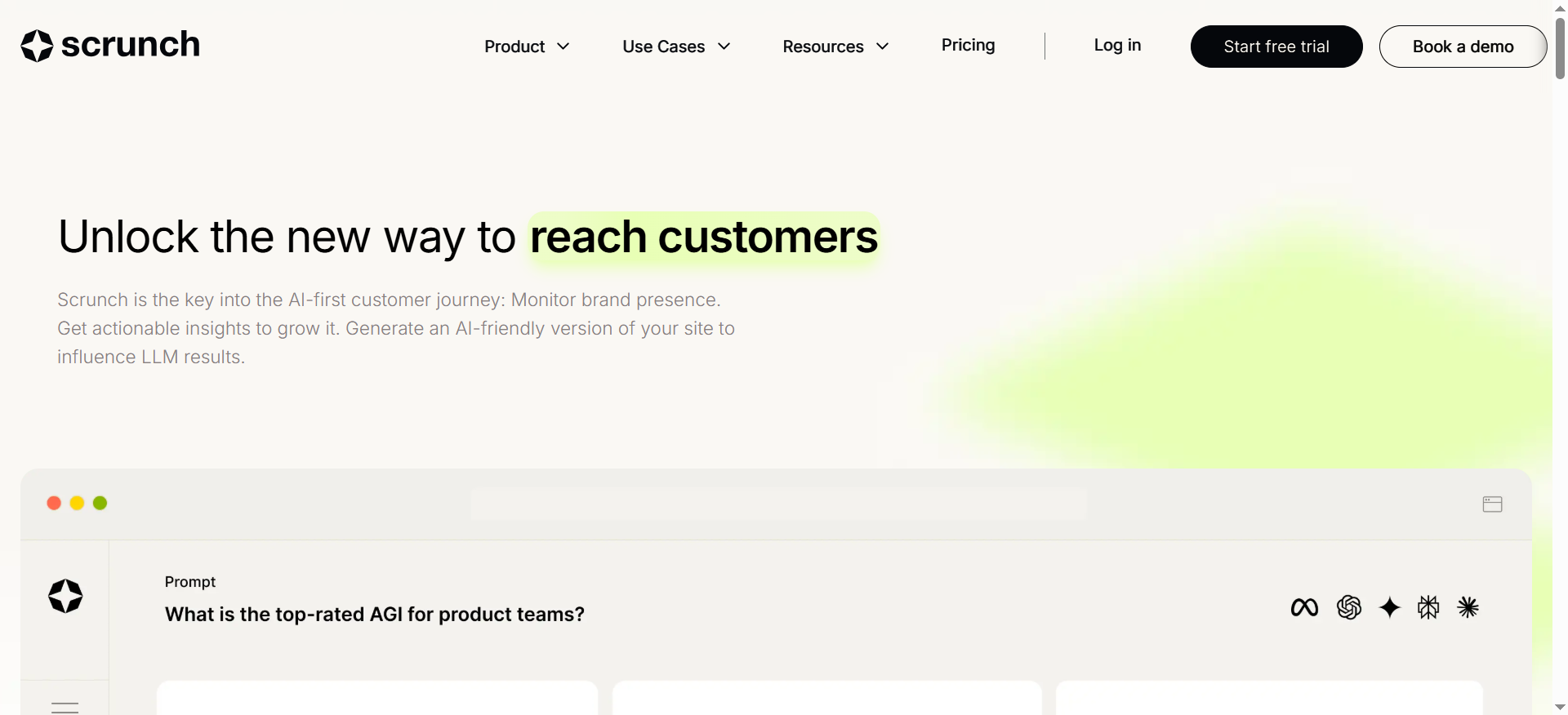
Scrunch is more than a visibility tracker. Its product positioning combines monitoring, insights, page audits, agent traffic monitoring, and an AXP layer that generates an AI-friendly version of a site for AI-driven experiences. That means Scrunch is not only asking “How visible are you?” but also “How easily can AI agents actually consume and use your site?”
Why teams use it
Teams choose Scrunch when they want action and infrastructure together, especially if they are focused on content engineers driving AI search visibility. The pricing page lists prompt management, citations tracking, page audits, reporting dashboards, key topic monitoring, agent traffic monitoring, personas, and integrations in all plans. It also claims support for ChatGPT, Claude, Gemini, Perplexity, Google AI Mode and AI Overviews, and Meta.
What it’s good for
Scrunch is particularly good for brands that believe AI search is becoming an experience and delivery problem, not only a monitoring problem, which makes it relevant for teams evaluating the best AI visibility solutions for content optimization teams.If you care about making content easier for AI systems to parse and cite, Scrunch stands out, especially for teams researching how to get cited in AI answers. That gives it a differentiated position versus a more dashboard-centric PEEC AI workflow.
When it’s a good fit
Scrunch is a smart fit when:
- you want monitoring plus page-level action
- you care about agent traffic as a signal, especially if your team is also researching best AI search engines.
- you want onboarding that is still fairly approachable
- you like the idea of an AI-optimized delivery layer for your site
It is a particularly interesting option for teams that feel visibility tools are useful but incomplete unless they also improve machine readability and support most effective AI visibility enhancement strategies.
When it’s not a good fit
It may be less attractive if your team does not want an opinionated approach to AI delivery. Some buyers simply want rankings, mentions, and competitor reporting. For them, Scrunch could feel broader than necessary. It is also pricier than the low-cost end of the market.
How to use it
Scrunch makes the most sense if you use it in two loops. First, a measurement loop with prompts, citations, personas, and dashboards. Second, an improvement loop with page audits and AXP. If you only use the first loop, you are not really buying the product’s strongest distinction. That workflow recommendation is an inference based on the public feature set.
Key capabilities
Scrunch publicly lists:
- Prompt Manager
- citations tracking
- page audits
- reporting dashboards
- prompts monitored
- key topic monitoring
- agent traffic monitoring
- personas
- integrations
- AXP for AI-friendly site delivery
- enterprise security and data API in higher tiers
Pricing
Scrunch’s pricing starts at $250/month when billed annually, or $300/month billed month-to-month. Enterprise pricing is custom.
Free tier?
Scrunch doesn’t offer a free tier, but it does offer a 7-day free trial.
Downsides / limitations
Scrunch is differentiated, but that differentiation can also make evaluation harder. If you do not yet believe AI-agent delivery is important to your strategy, its biggest selling point may not matter to you.
📋 Get Listed / Advertisement
We update this guide monthly. Want your tool featured? Contact: [email protected].
5. Conductor
What it does
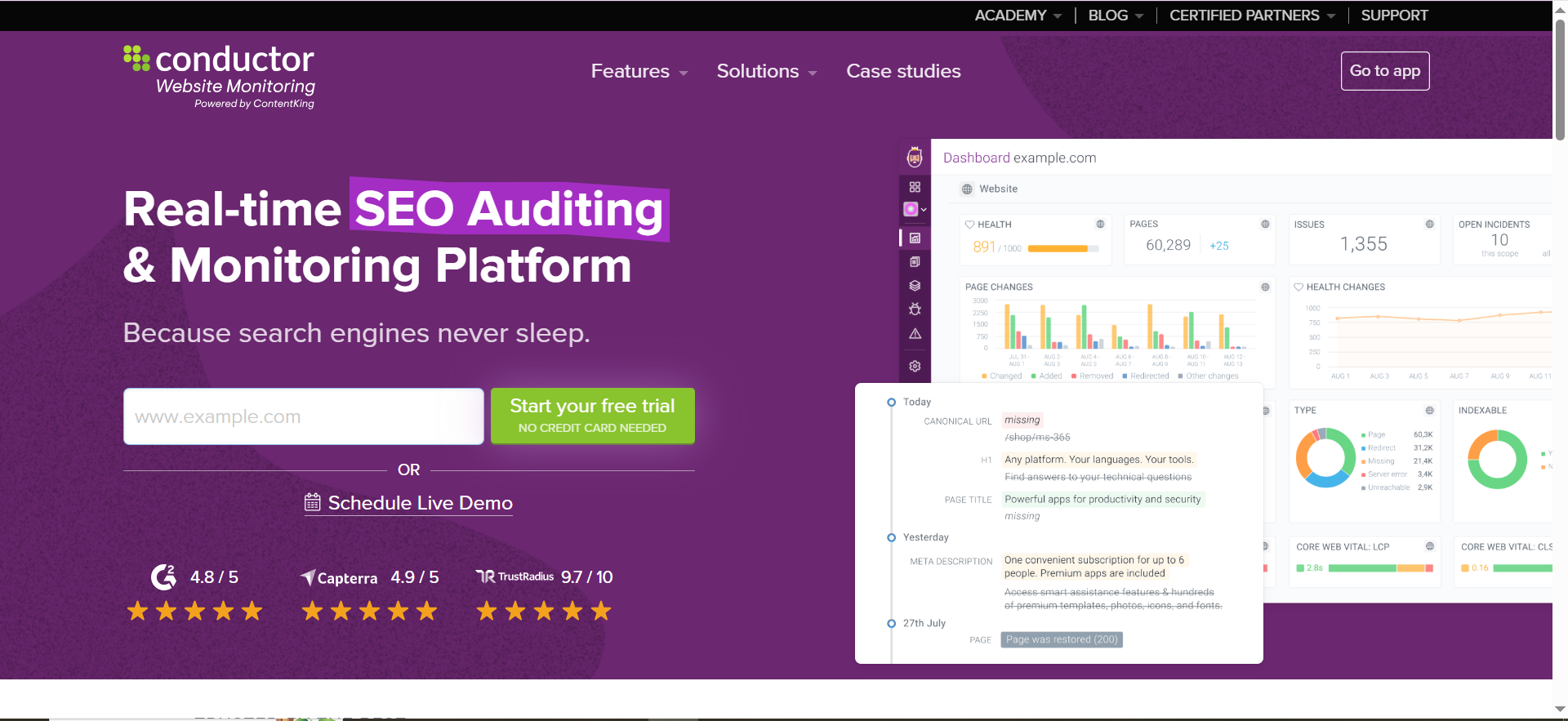
Conductor positions itself as an enterprise AEO platform inside a broader organic marketing stack. Its homepage says it helps brands increase visibility, traffic, and conversions across ChatGPT, Perplexity, Google, and more, while its support documentation describes an AI Search Performance report that tracks brand mentions, website citations, sentiment, persona performance, intent, and market share analysis.
Why teams use it
The appeal of Conductor is not that it is the most niche AI visibility platform. It is that it integrates AI visibility into a larger system that also covers content, technical performance, monitoring, and data. For enterprises already bought into Conductor’s ecosystem or looking for consolidation, that is a major advantage.
What it’s good for
Conductor is strongest for teams that do not want another standalone tool, especially if they want AI visibility tied into content, technical performance, and a broader AI visibility platform showdown. Its public materials emphasize unified workflows from insight to action to impact, plus the ability to connect AI visibility with traffic, engagement, conversion, and ROI, which aligns with stronger PR and brand messaging for AI visibility.
If PEEC AI feels too point-solution oriented, onductor is one of the clearest platform-upgrade alternatives for teams that want AI visibility tied into a larger enterprise SEO tool stack.
When it’s a good fit
Conductor is a strong fit when you are:
- an enterprise or large multi-stakeholder team
- already running serious SEO and content operations
- looking for AI visibility plus content and technical workflow alignment
- trying to tie AI search directly to business metrics
Its support docs also show detailed engine support and richer interpretation of AI response text, including mentions, sentiment, and citations.
When it’s not a good fit
It is usually not the best fit for small teams looking for a cheap, narrow replacement for PEEC AI. Conductor clearly sells itself as an enterprise platform, and public pricing is not exposed in the way LLMrefs or AthenaHQ self-serve pricing is.
How to use it
Conductor makes the most sense if you connect AI Search Performance with the rest of your organic workflow. Use AI visibility data to identify narrative and citation gaps, then push those insights into content and technical improvements as part of a stronger AE SEO playbook for AI answers and citation. That is the kind of connected operating model Conductor is designed to support.
Key capabilities
Conductor publicly describes:
- AI search visibility reporting
- brand mentions
- website citations
- sentiment analysis
- persona and intent views
- market share analysis
- support for ChatGPT, Gemini, Google AI Mode, Google AI Overview, and Perplexity
- broader content and performance workflow alignment
Pricing
Conductor’s pricing is not publicly listed and is available by quote. Its official documentation says plans vary by product and configuration.
Free tier?
Conductor doesn’t publicly list a free tier. It does offer a free AI Visibility Report, and its site says you can try Conductor for free.
Downsides / limitations
The main downside is scope. If all you want is a tight AI visibility product, Conductor may be more platform than you need.
How to choose the right PEEC AI alternative
The easiest mistake here is choosing by feature count. That usually leads to overspending or underusing the tool.
A better way is to choose by operating model.
If you want the deepest strategic platform, choose Profound. It is the strongest fit for larger teams that want visibility, prompt demand data, and more advanced workflows in one system.
If you want a more prescriptive AEO and GEO engine with action layers, choose AthenaHQ, especially if your team is building AEO-ready SaaS blogs. It is a good fit when your team wants the software to recommend and structure more of the work.
If you want the best value and the easiest cost justification, choose LLMrefs, but it also helps to compare it against other best AI tools for monitoring SaaS brand visibility in ChatGPT and Perplexity.
If you want visibility plus an AI-friendly delivery layer, choose Scrunch, because it treats AI search as both a measurement problem and a machine-consumption problem, which overlaps closely with best tools for tracking brand visibility in AI search.
If you want AI visibility inside a broader enterprise SEO stack, choose Conductor, but if you are still comparing options it also helps to review the best AI visibility tools for competitor benchmarking. It is the right fit when consolidation matters more than specialization.
Which alternative is best for each use case
Best overall for enterprise depth: Profound
Best for structured AEO/GEO workflows: AthenaHQ
Best budget-friendly PEEC AI alternative: LLMrefs
Best for AI-agent readiness and delivery: Scrunch
Best for enterprise stack consolidation: Conductor
That is the cleanest way to think about the category. Do not ask, “Which tool has the most features?” Ask, “Which tool matches the way our team will actually run this every week?”
Absolutely. Here are insert-ready H2 sections for those three fan-out queries, written in the same blog style and based on currently visible public pricing/trial info.
Which PEEC AI alternative is best for agencies?
The best PEEC AI alternative for agencies is LLMrefs. Its public offer is especially agency-friendly because it includes unlimited team members and unlimited projects on its advertised plan, which makes it easier to manage multiple clients without getting boxed in by seat limits or brand caps. For agencies that need broad AI engine coverage, affordable reporting, and a workflow that is easy to roll out across several accounts, LLMrefs has the clearest fit.
Another strong option for agencies is Scrunch, especially for firms that want to do more than report on visibility. Scrunch has a dedicated agency path on its site and combines monitoring with page audits, citations tracking, and AI-agent experience features, which can be useful if an agency wants to offer both reporting and implementation support. That said, its public starting price is higher, so it tends to make more sense for agencies with larger retainers or more technical service offerings.
If the agency’s clients are larger enterprise brands, AthenaHQ and Conductor may also be worth considering, but for most agencies comparing value, flexibility, and rollout speed, LLMrefs is the best overall pick. It is the easiest recommendation when you want a tool that is affordable, simple to explain to clients, and built to support multiple brands at once.
Which PEEC AI alternative is cheapest?
The cheapest PEEC AI alternative with a clearly visible public entry price is LLMrefs, which advertises a plan starting at $79 per month. That makes it the lowest-cost option among the main alternatives covered in this article with publicly stated pricing on the homepage or pricing page.
By comparison, Scrunch publicly says pricing starts at $250 per month, while AthenaHQ shows a Self-Serve starting point of $295 on its public site. Profound and Conductor appear more sales-led or enterprise-oriented from the pages reviewed, so they are harder to compare on a simple like-for-like price basis without talking to the vendor directly.
That means if price is your main filter, LLMrefs is the best fit. It gives smaller teams and budget-conscious buyers a way to get AI visibility tracking without moving into enterprise-style spend too early. For companies that are still testing the category or proving ROI internally, that lower starting point is a major advantage.
Which PEEC AI alternative has a free trial?
Several PEEC AI alternatives appear to offer a free trial, but the clearest publicly stated options are LLMrefs and Scrunch. LLMrefs advertises a 7-day free trial on its homepage, while Scrunch also promotes a 7-day free trial on its public site and pricing-related pages. That makes both tools strong options if you want to test the category before committing to a paid plan.
There are also signs that PEEC AI itself offers a free trial, based on its comparison and blog pages, so teams comparing alternatives may be able to test PEEC directly alongside competitors. AthenaHQ’s terms mention free trials, which suggests trial access exists, but its public pricing presentation is less explicit about a simple standard trial flow than LLMrefs or Scrunch.
Final verdict
PEEC AI still makes sense if you want a straightforward AI visibility dashboard focused on prompts, rankings, competitors, and model tracking. But if you are actively shopping for alternatives, the market gives you five clearly different paths.
Choose Profound if your team is ready for a more strategic and expansive answer-engine platform. Choose AthenaHQ if you want stronger built-in optimization logic. Choose LLMrefs if price and ease matter most. Choose Scrunch if you believe AI visibility and AI-agent delivery belong together. Choose Conductor if AI visibility needs to live inside a broader enterprise search system.
For most growth-stage B2B teams, LLMrefs is the easiest recommendation on value. For mature enterprises, Profound and Conductor are stronger long-term bets. For teams that want a dedicated AI visibility dashboard without building internal tracking systems from scratch, PEEC AI offers a focused way to monitor performance in this fast-moving channel and compare it against the best AI visibility platforms for buyer evaluation.
📋 Get Listed / Advertisement
We update this guide monthly. Want your tool featured? Contact: [email protected].
FAQs
For large, mature teams, Profound is probably the strongest overall alternative because it goes beyond visibility monitoring into prompt demand and broader workflow layers. For smaller or growth-stage teams, LLMrefs is often the best overall choice because the value-to-price ratio is much easier to justify.
From the public pricing I verified, LLMrefs has the lowest clear entry point at $79/month. AthenaHQ starts at $295+/month, while Scrunch starts at $250/month, and Conductor and Profound are more sales-led at the higher end of the market.
LLMrefs is attractive for agencies because its public plan includes unlimited projects and unlimited team members. PEEC AI also has agency packaging, but among the alternatives in this shortlist, LLMrefs has one of the clearest agency-friendly value propositions on the public site.
Conductor and Profound are the strongest picks if enterprise reporting and executive visibility are central to the buying decision. Conductor is stronger if you want AI visibility tied into a larger SEO stack, especially if your team is already investing in SEO reporting software.
AthenaHQ and Scrunch are the most action-oriented options in this list. AthenaHQ leans into recommendation and optimization workflows, while Scrunch combines monitoring with page audits and AI-friendly delivery through AXP.
Yes. If you want a simpler visibility-first workflow with prompt setup, competitor tracking, model tracking, and usage-based pricing, PEEC AI still looks like a credible choice. The reason to leave is not that PEEC AI is weak, but that your team may need a different shape of product and a stronger understanding of AISO vs SEO, AEO, and GEO.