

TL;DR
Tracking where and when your brand gets mentioned across blogs and websites is no longer optional for growth-stage SaaS teams. The five tools that consistently surface in this category are Brand24, Mention, Ahrefs Alerts, BuzzSumo, and Google Alerts. Brand24 is the strongest all-around pick if you need broad web coverage with real-time alerts and sentiment analysis. Ahrefs Alerts is the better choice if your priority is catching unlinked mentions that can turn into backlinks. Google Alerts works as a free starting point, but its coverage gaps and lack of analytics make it a poor standalone solution for any team running structured brand monitoring.
This guide breaks down each tool by what it actually does, who it works best for, current pricing, and where it falls short so you can pick the right fit for your team's workflow and budget.
Best Tools to Monitor Brand Mentions on Blogs and Websites (Quick Comparison)
| Tool | Best For | Starting Price | Free Tier |
|---|---|---|---|
| Brand24 | All-around brand monitoring with AI insights | $249/mo ($199/mo billed annually) | 14-day trial |
| Mention | Real-time mention alerts with competitive tracking | $599/mo (Company plan) | Free trial available |
| Ahrefs Alerts | SEO teams tracking unlinked mentions and backlinks | Included with Ahrefs ($129/mo base) | No (requires Ahrefs subscription) |
| BuzzSumo | Content teams tracking content performance and mentions | $199/mo | 30-day trial |
| Google Alerts | Budget-conscious teams needing basic web monitoring | Free | Yes (fully free) |
1. Brand24
What It Does
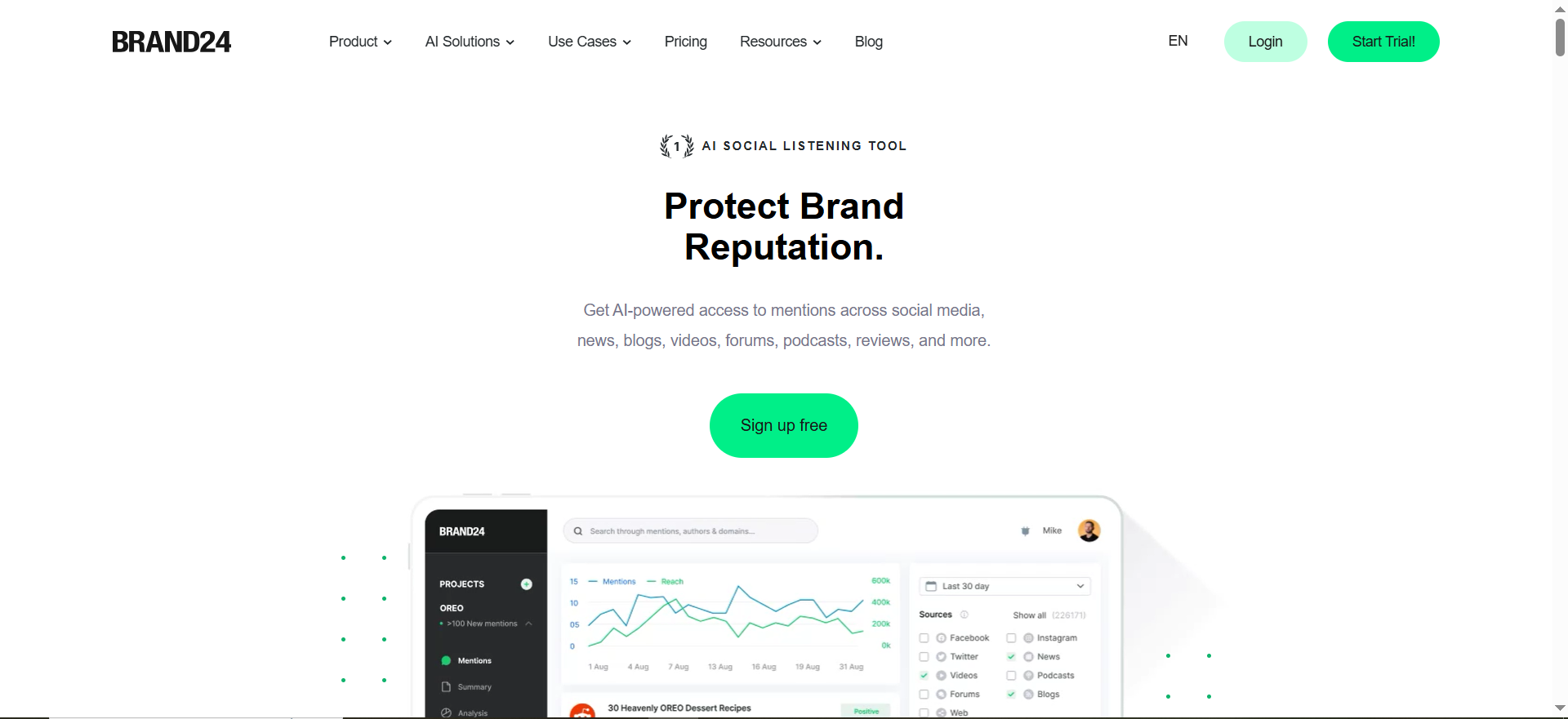
Brand24 is a media monitoring platform that scans blogs, news sites, social media, forums, podcasts, video platforms, and review sites for mentions of tracked keywords. It collects mentions in a real-time feed, applies AI-driven sentiment analysis, calculates reach and engagement metrics, and flags spikes in mention volume so teams can respond quickly to emerging conversations.
Why Teams Use It
Marketing and communications teams rely on Brand24 because it centralizes brand mentions from across the web into a single dashboard. Instead of manually searching blogs and news sites, teams get automated alerts whenever someone writes about their brand, product, or relevant industry topics. The AI-powered analytics layer adds context by sorting mentions as positive, negative, or neutral, and identifying the most influential sources driving those conversations.
What It's Good For
Brand24 performs well in three areas: web-wide coverage, real-time alerting, and AI-assisted analysis. Its crawler indexes content from blogs, forums, review sites, and news outlets alongside the usual social platforms. The Discussion Volume chart makes it easy to spot PR crises or campaign-driven spikes before they escalate. The AI Topic Analysis feature clusters related mentions so teams can identify emerging themes without reading every individual mention.
When It's a Good Fit
Brand24 works best for growth-stage SaaS companies, agencies managing multiple client brands, and PR teams that need to track brand perception across the open web. If your primary concern is knowing what blogs, news outlets, and niche forums are saying about your brand rather than just tracking social media engagement, Brand24's web-first coverage model delivers.
When It's Not a Good Fit
Teams that only need social media monitoring may find Brand24 more expensive than necessary since its strength is web-wide coverage. Solo founders or very early-stage startups tracking a single brand keyword will find the $249/month entry point steep for limited keyword volume (or $199/month on annual billing). Enterprise teams needing deep influencer analytics may need the higher-tier plans, which push costs to $499-$699/month.
How to Use It
Set up a project by entering your brand name, product names, and any common misspellings as tracked keywords. Configure alert frequency (instant, daily, or weekly digest), connect Slack for team notifications, and apply Boolean filters to exclude irrelevant mentions. Use the Analytics tab to review sentiment trends weekly and the Influencer tab to identify high-reach sources mentioning your brand.
Key Capabilities
Brand24 monitors mentions across blogs, news, social media (including X, Facebook, Instagram, LinkedIn, YouTube, TikTok), forums, review sites, and podcasts. Core features include AI sentiment analysis, reach and engagement scoring, influencer identification, hashtag tracking, automated PDF reports, Slack and email notifications, competitor comparison projects, and exportable data feeds.
Pricing
Brand24 offers four main plans (monthly pricing shown, with annual billing discounts of approximately 20%):
- Individual: $249/month ($199/month billed annually) — 3 keywords, 2,000 mentions/month, 1 user, 12-hour update intervals
- Team: $349/month ($299/month billed annually) — 7 keywords, 10,000 mentions/month, unlimited users, 1-hour updates
- Pro: $499/month ($399/month billed annually) — 12 keywords, 40,000 mentions/month, unlimited users, real-time updates, white-label reports
- Business: $699/month ($599/month billed annually) — 25 keywords, 100,000 mentions/month, unlimited users, real-time updates, advanced reports
Enterprise pricing starts at $1,499/month with custom configuration.
Free Tier?
No permanent free plan. Brand24 offers a 14-day free trial that gives access to the full feature set so teams can evaluate coverage and alert quality before committing.
Downsides / Limitations
The entry-level Individual plan limits updates to every 12 hours, which is too slow for teams that need to react to mentions quickly. Mention volume caps can be restrictive for brands generating significant online discussion. Pricing has increased significantly in recent years, with the base plan now at $249/month (or $199/month on annual billing). The 2,000 mentions/month cap on the Individual plan is tight for brands with moderate online discussion volume.
2. Mention
What It Does
Mention is a real-time media monitoring tool that tracks brand mentions across social media, news sites, blogs, and forums. It delivers alerts within minutes of a mention appearing online and provides sentiment analysis, competitive tracking, and Boolean search capabilities for filtering relevant results.
Why Teams Use It
PR teams and brand managers use Mention because of its alert speed. When a blog post or news article mentions your brand, Mention surfaces it quickly rather than batching alerts into daily digests. The competitive monitoring feature lets teams track how often competitors are being mentioned alongside their own brand, which is useful for market positioning analysis.
What It's Good For
Mention excels at real-time alerting across web sources. Its Boolean search operators give teams granular control over what triggers an alert, reducing noise from irrelevant mentions. The competitive intelligence module lets you benchmark your mention volume, sentiment, and share of voice against competitors simultaneously.
When It's a Good Fit
Mention works well for mid-market SaaS companies and agencies that need real-time web monitoring with competitive benchmarking. It is a strong fit for PR and communications teams that need fast alerts and the ability to filter mentions with Boolean logic. Teams already using a separate social media management tool will appreciate that Mention focuses on monitoring and listening rather than trying to be an all-in-one social suite.
When It's Not a Good Fit
The retirement of legacy self-serve plans (Solo at $49/mo, Pro at $99/mo, ProPlus at $179/mo) in mid-2025 means Mention is now a $599/month commitment on its Company Plan. Small teams and startups that would have benefited from the lower tiers are effectively priced out. Additionally, Mention retired its Publish and Respond features in January 2026, so teams that need social publishing alongside monitoring will need a separate tool like Agorapulse.
How to Use It
Create an alert by entering your brand name and any product names. Use Boolean operators (AND, OR, NOT) to refine what triggers notifications. Set alert frequency to real-time for critical brand keywords and daily digest for broader industry topics. Connect the Slack integration for team-wide visibility and use the competitive analysis dashboard to compare your brand's mention trends against competitors.
Key Capabilities
Mention monitors blogs, news sites, forums, review sites, and social platforms (X, Facebook, Instagram, Reddit). Core features include real-time alerts, Boolean search filtering, sentiment analysis, competitive tracking, share-of-voice calculations, automated reports, API access, and Slack/email notifications.
Pricing
Mention now offers a single purchasable plan:
- Company Plan: $599/month (billed annually) — competitive monitoring, API access, priority support, dedicated account manager
Legacy self-serve tiers (Solo $49/mo, Pro $99/mo, ProPlus $179/mo) were discontinued in July 2025 and are no longer available to new customers.
Free Tier?
Mention offers a free trial for evaluation. However, there is no permanent free plan. The current pricing model is enterprise-focused with the Company Plan as the sole option.
Downsides / Limitations
The biggest limitation is price accessibility. At $599/month, Mention is now positioned as an enterprise tool, which is a significant jump for teams that previously relied on the Solo or Pro plans. The removal of Publish and Respond features means teams need an additional tool for social management. Coverage of niche blogs and smaller forums can be inconsistent compared to Brand24's broader web crawling.
3. Ahrefs Alerts
What It Does
Ahrefs Alerts is a monitoring module within the Ahrefs SEO platform that notifies users when new web mentions of their brand or specified keywords appear across pages indexed by the Ahrefs crawler. It also alerts on new and lost backlinks, making it the only tool in this comparison that directly ties brand mention monitoring to link-building opportunities.
Why Teams Use It
SEO teams and content marketers use Ahrefs Alerts because it bridges the gap between brand monitoring and link acquisition. When a blog mentions your brand without linking to your site, Ahrefs surfaces that unlinked mention so you can reach out and request a backlink. This turns passive brand monitoring into an active link-building workflow, which is a use case the other tools in this list do not serve directly.
What It's Good For
Ahrefs Alerts is strongest at catching unlinked brand mentions, tracking new backlinks from blog posts and articles, monitoring competitor mentions for link-building intelligence, and identifying content that references your brand across the indexed web. The alerts also cover keyword mentions, so teams can track industry terms and competitor names alongside their own brand.
When It's a Good Fit
Ahrefs Alerts is the right choice for SaaS teams where SEO is a primary growth channel and the brand monitoring use case is tied to link reclamation and competitive backlink analysis. If you already have an Ahrefs subscription for keyword research and site auditing, Alerts is included at no extra cost, making it the most cost-efficient option for teams already in the Ahrefs ecosystem.
When It's Not a Good Fit
Ahrefs Alerts is not a substitute for a full media monitoring tool. It does not cover social media mentions, does not offer sentiment analysis, and does not provide real-time alerting. Mentions only appear after the Ahrefs crawler re-indexes the page, which can take days or weeks for smaller blogs. Teams that need comprehensive brand perception tracking across social, news, and forums will need to pair Ahrefs Alerts with a dedicated monitoring platform like Brand24 or Mention.
How to Use It
Navigate to Ahrefs > More > Alerts. Create a new alert by entering your brand name or target keyword. Choose between Mentions (for web mentions) or New backlinks (for link monitoring). Set the alert frequency to daily or weekly. Ahrefs emails you a digest with each new mention, including the source URL, the context in which your brand was mentioned, and a domain rating score for the mentioning site.
Key Capabilities
Ahrefs Alerts monitors web mentions across Ahrefs-indexed pages, tracks new and lost backlinks, sends email notifications on a daily or weekly schedule, shows Domain Rating for each mentioning source, supports keyword and competitor mention tracking, and integrates with the broader Ahrefs SEO toolkit for link-building workflows.
Ahrefs also offers Brand Radar as an add-on (starting at $199/month) for tracking brand mentions inside AI-generated results from platforms like ChatGPT, Perplexity, and Google AI Overviews. This is separate from the standard Alerts feature.
Pricing
Ahrefs Alerts is included with any Ahrefs subscription:
- Starter: $29/month — limited access to core tools, suitable for personal projects
- Lite: $129/month — 5 projects, 750 tracked keywords
- Standard: $249/month — 20 projects, 2,000 tracked keywords
- Advanced: $449/month — 50 projects, 5,000 tracked keywords
- Enterprise: $1,499/month (annual commitment required) — unlimited historical data, SSO, uncapped API access
There is no separate charge for the Alerts feature. Brand Radar (AI mention tracking) is an additional add-on starting at $199/month.
Free Tier?
No free tier for Alerts. Ahrefs offers Ahrefs Free (formerly Ahrefs Webmaster Tools) with limited access to Site Explorer and Site Audit, but Alerts is not included in the free tier. Ahrefs does not currently offer a free trial.
Downsides / Limitations
The primary limitation is coverage scope. Ahrefs only monitors pages its own crawler has indexed, which means smaller blogs, new pages, and niche forums may not appear in alerts for days or weeks after publication. There is no social media monitoring, no sentiment analysis, and no real-time alerting. The number of alerts available depends on your plan tier and credit allocation. The Brand Radar AI add-on has documented accuracy issues, with independent testing showing significant gaps between reported and actual AI mentions.
4. BuzzSumo
What It Does
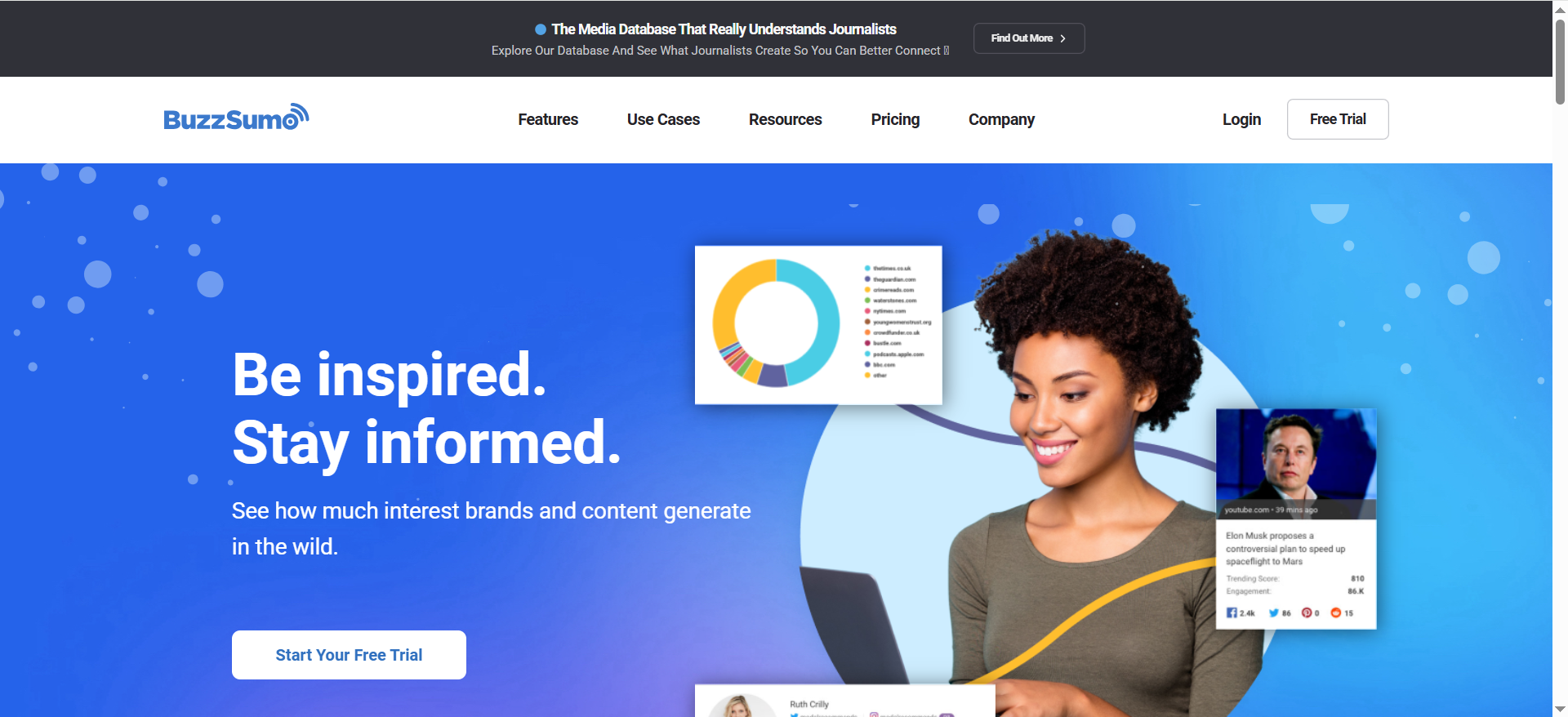
BuzzSumo is a content research and monitoring platform that tracks where brand mentions appear across news sites, blogs, and web articles while also measuring the social sharing performance of that content. It combines brand monitoring with content discovery, making it possible to find both who is mentioning your brand and which pieces of content about your brand are generating the most engagement.
Why Teams Use It
Content marketing teams use BuzzSumo because it answers two questions simultaneously: where is my brand being mentioned, and which of those mentions are actually getting shared and read? The content performance data helps teams understand not just the volume of mentions but the reach and virality of each one, which is useful for measuring the impact of PR placements, guest posts, and organic brand coverage.
What It's Good For
BuzzSumo performs well at monitoring brand mentions in news articles and blog posts, measuring the social sharing performance of content that mentions your brand, identifying trending topics and content formats in your industry, discovering journalists and content creators writing about your space, and tracking competitor content performance.
When It's a Good Fit
BuzzSumo is the right tool for content marketing teams and editorial teams at growth-stage SaaS companies who need to combine brand monitoring with content strategy. If your team is publishing blog content, pitching to journalists, or running content-led PR campaigns, BuzzSumo's ability to show which mentions are actually generating engagement gives context that pure monitoring tools miss.
When It's Not a Good Fit
BuzzSumo's monitoring coverage is narrower than Brand24 or Mention when it comes to forums, niche blogs, and real-time social media mentions. It is primarily a content-first tool with monitoring as a secondary feature, so teams that need comprehensive web-wide mention tracking as their primary use case will find gaps. At $199/month for a single user, it is also expensive for teams that only need the monitoring feature and not the content research capabilities.
How to Use It
Navigate to the Monitoring section and create a new alert for your brand name. BuzzSumo will surface mentions from news sites, blogs, and web articles along with their social share counts. Use the Content Analyzer to see which brand mentions generated the most engagement. Set up alerts for competitor brand names to benchmark your mention quality and volume against the competition.
Key Capabilities
BuzzSumo monitors brand mentions across news sites, blogs, and web articles. Features include social share tracking (Facebook, X, Reddit, Pinterest), content performance analysis, journalist and influencer discovery, trending topic identification, backlink monitoring for specific content, competitor content benchmarking, and configurable email alerts.
Pricing
BuzzSumo has four plans:
- Content Creation: $199/month — 1 user, 2 alerts, content discovery, basic monitoring
- PR & Comms: $299/month — 5 users, 5 alerts, journalist database, coverage reports
- Suite: $499/month — 10 users, 10 alerts, full feature access including influencer discovery
- Enterprise: $999/month — 30 users, 50 alerts, premium support, advanced analytics
Annual billing offers approximately 20% savings. A 30-day free trial is available on all plans.
Free Tier?
No permanent free plan. BuzzSumo offers a 30-day free trial with full feature access. Current access requires a paid plan or active trial.
Downsides / Limitations
BuzzSumo's brand monitoring is a secondary feature rather than its core product, which means coverage is not as comprehensive as dedicated monitoring tools. Social share data can lag behind real-time mentions. Forum and community monitoring is limited compared to Brand24. Pricing starts at $199/month for a single user, which is expensive if monitoring is the only feature your team needs. The Content Creation plan caps alerts at just 2, which is very restrictive for multi-brand or competitive monitoring.
5. Google Alerts
What It Does
Google Alerts is a free notification service from Google that sends email alerts when new content matching your specified keywords appears in Google's search index. It monitors web pages, news articles, blogs, and other content that Google crawls, delivering notifications at a frequency you choose: as-it-happens, once a day, or once a week.
Why Teams Use It
Teams use Google Alerts because it is completely free and takes less than a minute to set up. For early-stage startups, freelancers, and small teams with no monitoring budget, it provides a baseline level of brand awareness by surfacing Google-indexed mentions without any cost. It also serves as a simple way to track industry topics, competitor names, or specific keywords without committing to a paid tool.
What It's Good For
Google Alerts works for basic, low-volume brand monitoring where the goal is simply to know when new web content mentions your brand. It is adequate for tracking mentions on major news sites and established blogs that Google indexes quickly. It also works well as a supplementary alert for teams already using a paid monitoring tool, adding a free layer of coverage for keywords outside their primary tracking scope.
When It's a Good Fit
Google Alerts is appropriate for pre-revenue startups and solo founders who need basic brand awareness without any budget. It is also useful as a secondary alerting layer for teams that already run Brand24, Mention, or BuzzSumo and want an additional free check on web mentions. Teams monitoring a small number of keywords (under 10) across mainstream websites will get acceptable results.
When It's Not a Good Fit
Google Alerts is not suitable for any team that needs reliable, comprehensive brand monitoring. It does not cover social media at all. The as-it-happens alert frequency is often delayed by hours or days, and many mentions are missed entirely. There is no sentiment analysis, no competitive benchmarking, no analytics dashboard, no team collaboration features, no API access, and no historical data. For any growth-stage SaaS company running active marketing campaigns, Google Alerts alone is insufficient.
How to Use It
Go to google.com/alerts and sign in with your Google account. Enter your brand name in the search field. Click Show options to configure the source type (news, blogs, web, video, books, discussions), language, region, delivery frequency, and volume (all results vs. only the best results). Click Create Alert. Repeat for competitor names, product names, and relevant industry keywords.
Key Capabilities
Google Alerts monitors Google-indexed web pages, news articles, blog posts, and discussion forums. Features include email delivery at three frequency intervals, source type filtering, language and region targeting, and the ability to create unlimited alerts at no cost. Results link directly to the indexed pages for easy review.
Pricing
Google Alerts is completely free with no paid tiers, no usage limits on number of alerts, and no premium upgrade path.
Free Tier?
Yes. Google Alerts is entirely free. There are no paid plans or premium features.
Downsides / Limitations
Google Alerts misses a significant percentage of web mentions because it only surfaces content that Google's main search index has processed and deemed relevant. Social media is completely excluded. The as-it-happens option is unreliable, with documented delays of hours to days. There is no sentiment analysis, no analytics, no team collaboration, no API, and no historical data. Alert quality varies unpredictably, with some relevant mentions never appearing. There is no way to monitor images, videos, or podcast mentions. For any team that depends on comprehensive brand monitoring, Google Alerts should be treated as a free supplement, not a primary tool.
How Do Brand Mention Monitoring Tools Track Blogs Specifically?
Brand mention monitoring tools track blogs through a combination of web crawling, RSS feed indexing, and partnership integrations with content databases. Tools like Brand24 and Mention deploy proprietary crawlers that scan millions of blog URLs on regular intervals, checking for new posts or updated content that matches your tracked keywords. When the crawler detects a keyword match, it captures the surrounding context, the source URL, publication date, and estimated reach, then delivers this as a mention in your feed.
The key differentiator between tools is crawling frequency and blog coverage depth. Brand24 updates every hour on its Team plan and in real-time on Pro and above. Mention delivers alerts within minutes for major blog networks. Ahrefs Alerts relies on its own SEO-focused crawler, which re-indexes pages on its own schedule, meaning smaller blogs may take days to weeks to appear. Google Alerts depends entirely on Google's main search index, which means a blog post must first be discovered, crawled, and indexed by Google before it can trigger an alert.
Coverage scope also varies. Paid tools like Brand24 and BuzzSumo maintain databases of millions of blog domains, including niche industry blogs and personal sites hosted on platforms like WordPress, Medium, Substack, and Ghost. Google Alerts only covers blogs that appear in Google's search results, which excludes many newer, smaller, or poorly-optimized sites.
What Is the Difference Between Brand Monitoring and Social Listening?
Brand monitoring and social listening overlap but serve different primary functions. Brand monitoring focuses on tracking specific mentions of your brand name, product names, or related keywords across the web, including blogs, news sites, forums, and social platforms. The goal is awareness: knowing when and where your brand is being discussed.
Social listening goes deeper by analyzing the conversations, sentiment, and trends surrounding your brand and industry on social media platforms specifically. While brand monitoring tells you someone mentioned your product on a blog, social listening tells you what people feel about your product category, what problems they are discussing, and how your brand perception compares to competitors over time.
In practice, tools like Brand24 and Mention combine both capabilities. They monitor specific brand mentions (brand monitoring) while also providing sentiment analysis and trend tracking (social listening elements). BuzzSumo leans more toward content monitoring and performance analysis. Ahrefs Alerts and Google Alerts are purely brand monitoring tools with no social listening capabilities.
For growth-stage SaaS teams, the distinction matters when choosing a tool. If you only need to know when blogs write about you, a monitoring-focused tool or alert system works. If you need to understand market perception and track sentiment shifts, you need a tool with social listening capabilities built in.
Can You Monitor Brand Mentions for Free?
Yes, but with significant limitations. Google Alerts is the primary free option for monitoring brand mentions on blogs and websites. It sends email notifications when Google indexes new content matching your keywords. For a zero-budget starting point, it covers major news sites and established blogs adequately.
Other free options include manually setting up Google Search with quoted brand name queries and checking periodically, using Ahrefs Free (free) for backlink notifications on your own site, and setting up IFTTT recipes that trigger on RSS feeds from specific blogs you want to monitor.
The limitations of free monitoring are substantial. Google Alerts misses many mentions, has unreliable timing, offers no analytics or sentiment tracking, and does not cover social media. Free approaches also require manual effort to review, categorize, and act on mentions. For any team actively running marketing campaigns or managing brand reputation, free tools serve as a supplement to paid monitoring rather than a replacement.
The most cost-effective paid entry point is an existing Ahrefs subscription (starting at $129/month for Lite), which includes Alerts for web mentions. If you are already paying for Ahrefs for SEO work, the Alerts feature adds brand monitoring at no additional cost.
How to Set Up Brand Mention Alerts for Your Website?
Setting up brand mention alerts involves three layers: basic free monitoring, keyword-specific alerts, and comprehensive paid monitoring.
Layer 1 — Google Alerts (Free, 2 minutes): Go to google.com/alerts, enter your brand name in quotes, select frequency and sources, and create the alert. Repeat for common misspellings, your domain name without the TLD, and your product names.
Layer 2 — Ahrefs Alerts (If you have an Ahrefs subscription): Navigate to Ahrefs > More > Alerts. Create a Mentions alert with your brand name. Set to daily frequency. This catches web mentions on pages Ahrefs indexes, including link opportunities.
Layer 3 — Dedicated Monitoring Tool (Brand24, Mention, or BuzzSumo): Sign up for a trial, create a monitoring project with your primary keywords, configure Boolean exclusions to filter noise, set up Slack or email notifications, and configure team access.
For maximum coverage, use all three layers simultaneously. Google Alerts catches some mentions the paid tools miss (and vice versa), and Ahrefs Alerts specifically surfaces link-building opportunities that dedicated monitoring tools do not highlight.
Brand24 vs Mention: Which Is Better for Blog Monitoring?
For blog monitoring specifically, Brand24 currently holds the advantage over Mention for most teams. Here is why:
Coverage: Brand24 maintains broader blog coverage through its own web crawling infrastructure, indexing millions of blog domains across WordPress, Medium, Substack, Ghost, and independent sites. Mention's coverage is strong for major blogs and news sites but has documented gaps on smaller niche blogs.
Pricing accessibility: Brand24 starts at $249/month with its Individual plan ($199/month billed annually) with 3 keywords and 2,000 mentions. Mention's only available plan is the Company tier at $599/month, making it more than double the entry cost for comparable blog monitoring.
Feature depth: Both tools offer sentiment analysis and competitive tracking. Brand24 adds AI Topic Analysis, which clusters related blog mentions by theme, and influencer scoring that identifies which bloggers have the most reach. Mention offers stronger Boolean filtering for precise alert targeting.
Update speed: Mention typically surfaces new blog mentions within minutes. Brand24's speed depends on your plan: 12-hour intervals on Individual, 1-hour on Team, and real-time on Pro and above.
Verdict: For teams that primarily need blog and website monitoring, Brand24 offers better value at a lower price point with comparable or broader coverage. Mention is the better choice only if you need enterprise-grade monitoring at scale with strong Boolean filtering and are comfortable with the $599/month commitment.
How Do Brand Monitoring Tools Handle Sentiment Analysis?
Brand monitoring tools use natural language processing (NLP) and increasingly AI/LLM models to classify the sentiment of each mention as positive, negative, or neutral. Here is how the tools in this comparison handle sentiment:
Brand24 uses AI-powered sentiment analysis that classifies each mention and assigns a sentiment score. It also provides an overall Sentiment Score for your brand across all mentions over a selected time period, making it easy to track sentiment shifts after product launches, PR events, or negative press.
Mention applies automated sentiment analysis to each detected mention, categorizing it as positive, negative, or neutral. The sentiment data feeds into its reporting dashboard, where teams can filter mentions by sentiment and track trends over time.
BuzzSumo offers limited sentiment analysis compared to dedicated monitoring tools. Its strength is measuring engagement and social sharing rather than emotional tone.
Ahrefs Alerts and Google Alerts do not offer any sentiment analysis. Mentions are delivered as raw notifications without any classification of tone or context.
For teams where brand perception management is a priority, Brand24 and Mention are the only tools in this list that provide actionable sentiment data.
What Are Unlinked Brand Mentions and Why Do They Matter?
Unlinked brand mentions are instances where a blog, news site, or web page references your brand name in text without including a hyperlink back to your website. For example, a blog post that discusses your tool without linking to your domain is an unlinked mention.
These mentions matter for two reasons. First, they represent earned link-building opportunities. Since the author already knows and references your brand, a polite outreach email asking them to add a link often converts at a much higher rate than cold link-building outreach. Second, unlinked brand mentions may serve as a ranking signal, contributing to your site's authority even without a direct hyperlink.
Ahrefs Alerts is the strongest tool for surfacing unlinked mentions because it specifically identifies pages mentioning your brand that do not link to your domain. Teams can export these mentions, filter by Domain Rating, and run targeted link reclamation campaigns. Brand24 also shows unlinked mentions but does not provide the same level of SEO context (like Domain Rating or link status) that Ahrefs offers.
For growth-stage SaaS companies, systematically converting unlinked mentions into backlinks is one of the highest-ROI link-building tactics available.
How Often Should You Check Brand Mentions?
The right frequency depends on your brand's mention volume and the nature of your monitoring goals:
Real-time (instant alerts): Essential for crisis management, customer complaints, and time-sensitive PR situations. If a negative blog post or viral criticism can damage your brand quickly, instant alerts from Brand24 (Pro plan) or Mention let you respond within hours rather than days.
Daily review: Sufficient for most growth-stage SaaS companies running normal operations. A daily digest from your monitoring tool gives you a complete picture of the previous day's mentions without creating notification fatigue. This is the default recommendation for teams starting with brand monitoring.
Weekly summary: Appropriate for low-volume brands, early-stage startups with minimal online presence, or as a secondary review cadence for teams that already monitor daily. Weekly is also sufficient for Google Alerts, which often delivers mentions with multi-day delays anyway.
The most effective approach for active SaaS marketing teams is a tiered system: instant alerts for critical negative mentions (configured through sentiment filters), daily digests for routine monitoring, and weekly reports for trend analysis and team reviews.
Do Brand Monitoring Tools Track Competitor Mentions Too?
Yes. Every paid tool in this comparison supports competitor mention tracking, though the implementation varies:
Brand24 lets you create separate monitoring projects for each competitor, then compare mention volume, sentiment, and reach side-by-side in its comparison dashboard.
Mention supports competitive monitoring with share-of-voice calculations, sentiment comparison, and source overlap analysis.
BuzzSumo tracks competitor content performance, showing which competitor mentions generate the most social shares and engagement.
Ahrefs Alerts monitors competitor brand mentions the same way it monitors yours, with the added benefit of showing which sites link to competitors (useful for competitive link-building).
Google Alerts allows you to create alerts for competitor names at no cost, but provides no comparison analytics, sentiment data, or competitive benchmarking.
Competitive monitoring is one of the primary reasons teams upgrade from Google Alerts to a paid tool. Knowing your own mentions is useful; knowing how your mention volume, sentiment, and source quality compare to competitors is what drives strategic decisions.
How to Turn Brand Mentions Into Backlinks?
Converting brand mentions into backlinks is a three-step process that works best with Ahrefs Alerts as the discovery tool:
Step 1 — Identify unlinked mentions: Use Ahrefs Alerts to find pages that mention your brand without linking to your site. Filter by Domain Rating (DR 30+ is typically worth pursuing) and relevance (the mention should be in a context where a link adds value for the reader).
Step 2 — Evaluate the opportunity: Check the page's traffic using Ahrefs Site Explorer, verify the mention is positive or neutral (not a complaint), and confirm the site accepts external links (some publishers have strict no-link policies).
Step 3 — Outreach for link placement: Send a brief, personalized email to the author or editor. Reference the specific page and mention, explain why a link would benefit their readers, and provide the exact URL you would like them to link. Keep the email under 100 words.
Conversion rates for unlinked mention outreach typically range from 5-15%, which is significantly higher than cold link-building outreach (1-3%). The key is speed — reaching out within days of publication while the content is still fresh and the author remembers writing it.
Brand24 can also surface unlinked mentions through its feed, though it lacks the Domain Rating scoring that helps prioritize which mentions are worth pursuing from an SEO perspective.
What Is the Best Free Brand Monitoring Tool for Startups?
For pre-revenue and early-stage startups with no monitoring budget, Google Alerts is the best starting point. It costs nothing, takes two minutes to set up, and covers mentions across Google-indexed blogs and news sites. The limitations (missed mentions, delayed alerts, no analytics) are acceptable when the alternative is no monitoring at all.
To maximize free monitoring coverage, startups should combine Google Alerts with these supplementary approaches: set up Ahrefs Free (free) to get notified about new backlinks to your site, use social media native search (X/Twitter search, Reddit search) for social mentions, manually check Google Search with your brand name in quotes weekly, and monitor relevant Hacker News and Reddit threads where your product category is discussed.
When a startup reaches the point where brand mentions matter strategically (usually around product-market fit or first significant PR coverage), the natural upgrade path is Brand24's Individual plan ($249/month, or $199/month on annual billing) or using Ahrefs Alerts if an Ahrefs subscription ($129/month) is already justified for SEO work.
How Does Google Alerts Compare to Paid Brand Monitoring Tools?
Google Alerts and paid brand monitoring tools serve fundamentally different needs:
Coverage: Google Alerts only surfaces content Google has indexed and deemed relevant to your query. Paid tools like Brand24 and Mention crawl the web independently, catching mentions that Google misses or has not yet indexed. Paid tools also monitor social media platforms, which Google Alerts ignores entirely.
Speed: Google Alerts' as-it-happens option regularly delivers mentions hours or days late. Brand24 (Pro plan) and Mention deliver alerts within minutes of publication.
Analytics: Google Alerts provides zero analytics. Paid tools offer sentiment analysis, trend charts, competitive benchmarking, influencer scoring, and exportable reports.
Reliability: Google Alerts inconsistently surfaces mentions, with many relevant results never appearing. Paid tools provide systematic coverage with documented source lists.
Collaboration: Google Alerts is tied to individual Google accounts with no sharing. Paid tools offer team dashboards, shared alerts, Slack integrations, and multi-user access.
Cost: Google Alerts is free. Brand24 starts at $249/month ($199/month billed annually), BuzzSumo at $199/month, Ahrefs (with Alerts included) at $129/month, and Mention at $599/month.
For any team that depends on brand monitoring for business decisions (PR response, competitive intelligence, link building, campaign tracking), paid tools are justified. Google Alerts works as a free supplement but should not be the sole monitoring tool for any active SaaS brand.