
TL;DR
Enterprise marketing teams send millions of emails every quarter, and the difference between a 15% open rate and a 25% open rate compounds into serious revenue over time. Generative AI email optimization tools now handle everything from writing subject lines and body copy to predicting the best send time for each individual contact. The five platforms covered here — Persado, Jacquard, Phrasee (now Jacquard), Seventh Sense, and HubSpot AI — represent the leading options for enterprise teams that need AI-powered email performance at scale. Persado and Jacquard focus on AI-generated language and copy optimization, Seventh Sense specializes in send-time personalization, and HubSpot AI bundles email optimization into a full CRM-native marketing suite. This guide breaks down what each tool actually does, where it fits, what it costs, and when it makes sense for your team.
Table of Contents
Best Enterprise Generative AI Email Optimization Tools (Quick Comparison)
| Tool | Best For | AI Focus | Starting Price |
|---|---|---|---|
| Persado | Enterprise brands in regulated industries needing compliant, high-performing copy | AI-generated language and emotional resonance | Custom enterprise pricing (typically six-figure annual contracts) |
| Jacquard | Global enterprise brands needing multilingual, on-brand messaging at scale | Predictive language generation across email, SMS, push, and web | Starting at $24,000/year |
| Phrasee (Now Jacquard) | Teams already searching for Phrasee — same platform, rebranded in 2024 | Subject line optimization, email copy, CTAs with brand-voice calibration | Starting at $24,000/year (same as Jacquard) |
| Seventh Sense | HubSpot or Marketo users who need send-time and frequency optimization | Personalized send-time prediction per contact | $80/month (HubSpot) or $450/month (Marketo) |
| HubSpot AI | Teams already on HubSpot wanting CRM-native email AI without a separate vendor | CRM-powered content generation, subject lines, and send-time suggestions | Free tier available; Professional at $890/month |
1. Persado
What It Does
Persado is an AI-powered content generation platform built specifically for enterprise marketing teams in regulated industries. The platform uses what it calls Motivation AI to generate marketing language — email subject lines, body copy, CTAs, SMS messages, web banners, and social ads — that is designed to resonate emotionally with target audiences. Rather than relying on generic templates or A/B testing a handful of variations, Persado generates language based on a proprietary database of emotional and motivational triggers mapped across millions of consumer interactions.
The platform produces fully coded responsive HTML emails that are dark-mode tested and Litmus QA'd. It also handles direct mail (print-ready, CMYK, variable data), web banners across all IAB sizes, social ads in platform-native formats, and SMS. Every piece of content goes through embedded regulatory validation during generation — not as a post-production review — which means content clears legal compliance the first time across more than 20 financial services frameworks.
Why Teams Use It
Enterprise marketing teams in banking, insurance, financial services, telecommunications, and retail choose Persado because it solves two problems simultaneously: generating high-performing copy and keeping that copy compliant. For regulated industries, the compliance piece alone can save weeks of legal review cycles. The platform dynamically tailors campaigns for different audience segments, testing language variations until it identifies the top performers, and then scales those winners across channels.
What It Is Good For
Persado excels when your email program operates at scale in a regulated environment where every piece of copy needs legal clearance. It is particularly strong for financial services companies running lifecycle marketing campaigns where small improvements in open rates and click-through rates translate directly into significant revenue. Companies using Persado have reported over 40% greater engagement and an average 43% performance lift on launched campaigns.
When It Is a Good Fit
Persado makes sense when you have a large email database (hundreds of thousands to millions of contacts), operate in a regulated industry, need multilingual or multi-market content generation, and have the budget for a six-figure annual contract. It is ideal for enterprise marketing teams that are already mature in their email operations and are looking for incremental performance gains that compound at scale.
When It Is Not a Good Fit
Persado is not the right choice for small or mid-market teams, companies with limited email volume, or organizations that do not operate in regulated industries where the compliance features justify the premium pricing. If you send fewer than 500,000 emails per month, the ROI case becomes harder to make. Startups and growth-stage companies will find the pricing prohibitive and the feature set overbuilt for their needs.
How to Use It
Implementation typically begins with a discovery and onboarding process where Persado's team maps your brand voice, compliance requirements, and campaign workflows. The platform integrates with your existing ESP or marketing automation platform via API. From there, you set up campaign briefs within Persado, the AI generates language variations, and the system runs experiments to identify top-performing content. Over time, the model learns from your specific audience's responses and improves its predictions.
Key Capabilities
Persado's core capabilities include Motivation AI language generation across email, SMS, web, social, and direct mail; embedded regulatory compliance validation across 20+ frameworks; real-time A/B and multivariate testing with automated winner selection; audience segmentation and personalization at the language level; performance analytics with attribution to specific emotional and motivational triggers; and fully coded email output (responsive HTML, dark-mode tested, Litmus QA'd).
Pricing
Persado uses custom enterprise pricing that requires a consultation and demo. Contracts are typically six-figure annual agreements. There is no self-serve pricing tier, no monthly plan, and no free trial. Budget conversations start in the low six figures and scale based on volume, channels, and markets covered.
Free Tier?
No. Persado does not offer a free tier, freemium plan, or self-serve trial. Access requires a sales conversation and a signed enterprise agreement.
Downsides and Limitations
The biggest limitation is cost — Persado is built for enterprise budgets, and smaller teams are priced out entirely. The platform requires a meaningful onboarding investment (both time and internal resources), and the value proposition is strongest in regulated verticals where compliance automation offsets the cost. If you are in an unregulated industry with a straightforward email program, Persado's compliance features become dead weight you are paying for but not using. Additionally, the platform's effectiveness improves with data volume, so organizations with smaller email lists will see slower model training and less dramatic performance lifts.
2. Jacquard
What It Does
Jacquard (formerly Phrasee) is an AI-powered brand messaging platform that generates, optimizes, and personalizes marketing language across email, SMS, mobile push, in-app messaging, web push, and ChatGPT apps. The platform is purpose-built to produce on-brand messaging that resonates at scale, using a combination of language expertise and a proprietary predictive AI engine called Neural² that is trained on over 60 billion data points from more than a decade of campaign performance.
Unlike general-purpose AI writing tools, Jacquard is calibrated specifically for marketing performance. The platform does not just generate copy — it predicts which language variations will perform best before they are sent, and then optimizes in real time based on actual engagement data.
Why Teams Use It
Global enterprise brands use Jacquard because it maintains brand voice consistency while generating high-performing content at scale across multiple languages and channels. The platform achieves native-quality generation and calibration across 27+ languages and dialects, and performance learnings in one region (such as UK English) inform content performance in other regions (such as US English or German). This makes it particularly valuable for multinational brands that need to maintain unified messaging standards while adapting to local markets.
What It Is Good For
Jacquard is strongest when your organization needs to generate large volumes of marketing messages that must be on-brand, multilingual, and performance-optimized. It excels at subject line optimization, promotional email copy, push notification messaging, and SMS campaigns. The predictive AI engine gives marketers confidence in their content choices before campaigns launch, reducing the need for extensive A/B testing cycles. Brands using Jacquard have reported engagement improvements of up to 19%.
When It Is a Good Fit
Jacquard fits when you are an enterprise brand with a substantial email and multi-channel messaging program, especially if you operate across multiple countries and languages. It works well for retail, e-commerce, financial services, travel, and media companies that send high volumes of promotional and lifecycle messages. If your marketing team spends significant time crafting and testing subject lines and email copy, Jacquard can automate and optimize that workflow.
When It Is Not a Good Fit
Jacquard is not ideal for small businesses, early-stage startups, or teams with limited messaging volume. At $24,000 per year as a starting price, it requires enough email and messaging volume to justify the investment. It is also not the right tool if you need only send-time optimization (Seventh Sense is better for that) or if your email program is primarily transactional rather than promotional.
How to Use It
Jacquard integrates with major marketing platforms including Braze, Salesforce Marketing Cloud, Adobe Campaign, and others via API. After onboarding, your team sets brand voice parameters and campaign goals within the platform. Jacquard's AI then generates language options, predicts performance, and optimizes content either before send (predictive mode) or in real time (dynamic optimization mode). The platform provides detailed performance reporting that shows which language elements drove engagement.
Key Capabilities
Jacquard's capabilities span predictive content generation via the Neural² engine trained on 60 billion+ data points; native-quality multilingual generation across 27+ languages and dialects; cross-channel content optimization for email, SMS, push, in-app, and web push; brand voice calibration that maintains consistent tone across all generated content; real-time optimization that adjusts content based on live engagement data; and performance analytics with language-level attribution.
Pricing
Jacquard pricing starts at $24,000 per year. Full pricing details are not publicly listed and require contacting Jacquard's sales team for a tailored package based on your brand's messaging volume, channels, and language requirements. Enterprise contracts scale based on usage.
Free Tier?
No. Jacquard does not offer a free tier or self-serve trial. A demo and sales conversation are required to access the platform.
Downsides and Limitations
The starting price of $24,000 per year puts Jacquard out of reach for smaller organizations. The platform requires sufficient historical campaign data to train its predictive models effectively, so brands with limited email history may see slower initial results. Integration complexity can vary depending on your marketing stack, and some teams report a learning curve in adapting their workflows to leverage Jacquard's optimization capabilities fully. The platform is focused on messaging optimization rather than broader email marketing functions like automation workflows or template design.
3. Phrasee (Now Jacquard)
What It Does
Phrasee is the former brand name for what is now Jacquard. In June 2024, Phrasee officially rebranded to Jacquard as part of a strategic repositioning that expanded the platform beyond its original focus on email subject line optimization to cover full brand messaging across all digital channels. If you are searching for Phrasee in 2026, you are looking at Jacquard — the same team, the same technology, and the same platform under a new name.
The original Phrasee platform was known specifically for using AI to generate and optimize email subject lines, email body copy, and CTAs. It analyzed email data to learn what language patterns drove opens and clicks, then generated optimized alternatives that consistently outperformed human-written copy. This core capability now lives within Jacquard's broader platform.
Why Teams Use It
Teams that previously used Phrasee continue to use the platform under the Jacquard brand. The reason they adopted it initially remains the same: Phrasee proved that AI-generated subject lines could reliably outperform human-written ones at scale. The system learns from your specific email performance data, stays consistent with your brand voice, and generates variations that are optimized for engagement rather than creativity alone.
What It Is Good For
Phrasee (now Jacquard) built its reputation on email subject line optimization specifically. If that is your primary pain point — low open rates driven by underperforming subject lines — the Jacquard platform (which inherited all of Phrasee's subject line technology) is one of the strongest options available. The technology also extends to email CTAs, promotional copy, and push notifications.
When It Is a Good Fit
If you were evaluating Phrasee before the rebrand, or if your team has legacy Phrasee contracts, the transition to Jacquard should be seamless. The platform is a good fit for the same use cases described in the Jacquard section above: enterprise brands with high email volumes that need AI-optimized messaging across multiple channels and languages.
When It Is Not a Good Fit
The same limitations apply as with Jacquard: the $24,000+ annual price point makes it unsuitable for small businesses or teams with limited messaging volume. If you are looking for a standalone subject-line-only tool at a lower price point, there are simpler options available, though they will not offer the same depth of predictive optimization.
How to Use It
All Phrasee functionality is now accessed through the Jacquard platform. Existing Phrasee customers were migrated to the Jacquard interface. New customers should go directly to jacquard.com and follow the onboarding process described in the Jacquard section above.
Key Capabilities
Phrasee's original capabilities — AI-generated subject lines, email copy optimization, CTA generation, multivariate testing, brand voice compliance, and performance analytics — are all now part of the Jacquard platform. Jacquard has expanded these with the Neural² predictive engine, 27+ language support, and additional channels including SMS, push, in-app, and web push.
Pricing
Same as Jacquard: starting at $24,000 per year with custom enterprise pricing. Legacy Phrasee contracts have been transitioned to Jacquard terms.
Free Tier?
No. Same policy as Jacquard — no free tier, no self-serve trial.
Downsides and Limitations
The primary consideration for teams searching for Phrasee is understanding that it no longer exists as a standalone brand. All development, support, and roadmap decisions are now under the Jacquard name. If you had a Phrasee-specific workflow or integration, verify that it has been maintained in the Jacquard transition. The pricing, platform requirements, and feature limitations are otherwise identical to those described in the Jacquard section.
4. Seventh Sense
What It Does
Seventh Sense is an AI-powered email delivery optimization platform that personalizes when each individual contact in your database receives your marketing emails. Unlike tools that focus on what your email says, Seventh Sense focuses entirely on when and how often it gets delivered. The platform uses machine learning to analyze historical engagement patterns for every contact in your database and then schedules email delivery at the precise time each person is most likely to open and engage.
The platform processes over 400 million personalized email deliveries monthly and layers in additional capabilities including email throttling, frequency optimization, and engagement-based suppression to maintain database health.
Why Teams Use It
Marketing teams on HubSpot and Marketo use Seventh Sense because send-time optimization is one of the highest-impact, lowest-effort improvements available for email performance. Research consistently shows that personalized send times improve open rates by 20–35% on well-segmented lists. Seventh Sense automates what would be impossible to do manually: determining the optimal delivery window for each individual contact based on their historical engagement behavior.
What It Is Good For
Seventh Sense excels at improving open rates, click-through rates, and overall engagement metrics without requiring any changes to your email content, design, or strategy. It is particularly powerful for teams that already have strong email content but are underperforming on engagement metrics due to suboptimal send timing. The platform is also valuable for managing email frequency — it understands and adapts to the preferred communication frequency for different segments, reducing unsubscribe rates and maintaining sender reputation.
When It Is a Good Fit
Seventh Sense is a strong fit when you use HubSpot or Marketo as your marketing automation platform and have enough contact data to feed the AI model (the more engagement history, the better the predictions). It works best for teams sending regular promotional, newsletter, or lifecycle emails where timing directly impacts engagement. The price point ($80/month for HubSpot, $450/month for Marketo) makes it accessible even for mid-market teams.
When It Is Not a Good Fit
Seventh Sense only works with HubSpot and Marketo. There is no Salesforce Marketing Cloud integration, no Klaviyo, no Mailchimp, no standalone ESP support. If you are on any platform other than HubSpot or Marketo, Seventh Sense is not an option. It is also not the right tool if your challenge is content quality rather than send timing — it optimizes delivery, not messaging. And for very small databases (under 5,000 contacts), there may not be enough engagement data for the AI to generate meaningful personalization.
How to Use It
Seventh Sense integrates directly with HubSpot or Marketo through native connections. After connecting your account, the platform ingests your historical email engagement data and begins building individual contact profiles. You then configure your email campaigns to send through Seventh Sense instead of your platform's default send mechanism. The AI distributes your campaign across optimized time windows for each contact. Setup is straightforward and typically takes less than a day for the initial integration, though the model improves over the first 30–60 days as it accumulates more data.
Key Capabilities
Seventh Sense delivers personalized send-time optimization using AI analysis of individual contact engagement patterns; adaptive email throttling that staggers campaign delivery to manage system load and improve deliverability; dynamic frequency optimization that adjusts communication frequency based on each contact's engagement preferences; engagement-based suppression that automatically manages audience health by reducing sends to disengaged contacts; real-time campaign adjustment based on live feedback during sends; and detailed analytics on engagement timing patterns across your database.
Pricing
Seventh Sense pricing starts at $80 per month for HubSpot users and $450 per month for Marketo users. Pricing scales based on database size and email volume. There is no free plan, but the entry point is significantly lower than the other tools in this comparison.
Free Tier?
No. Seventh Sense does not offer a free tier, but the starting price of $80/month (HubSpot) makes it the most accessible tool in this roundup by a wide margin.
Downsides and Limitations
The biggest limitation is platform lock-in: Seventh Sense works exclusively with HubSpot and Marketo. If you migrate to another marketing automation platform, you lose Seventh Sense entirely. The tool also does not address content optimization at all — it will not help you write better subject lines or body copy. For teams that need both content and timing optimization, Seventh Sense would need to be paired with a tool like Jacquard or Persado, adding complexity and cost. Finally, the AI model needs time and data to reach peak performance; teams with limited email history or small databases will see less dramatic initial results.
5. HubSpot AI
What It Does
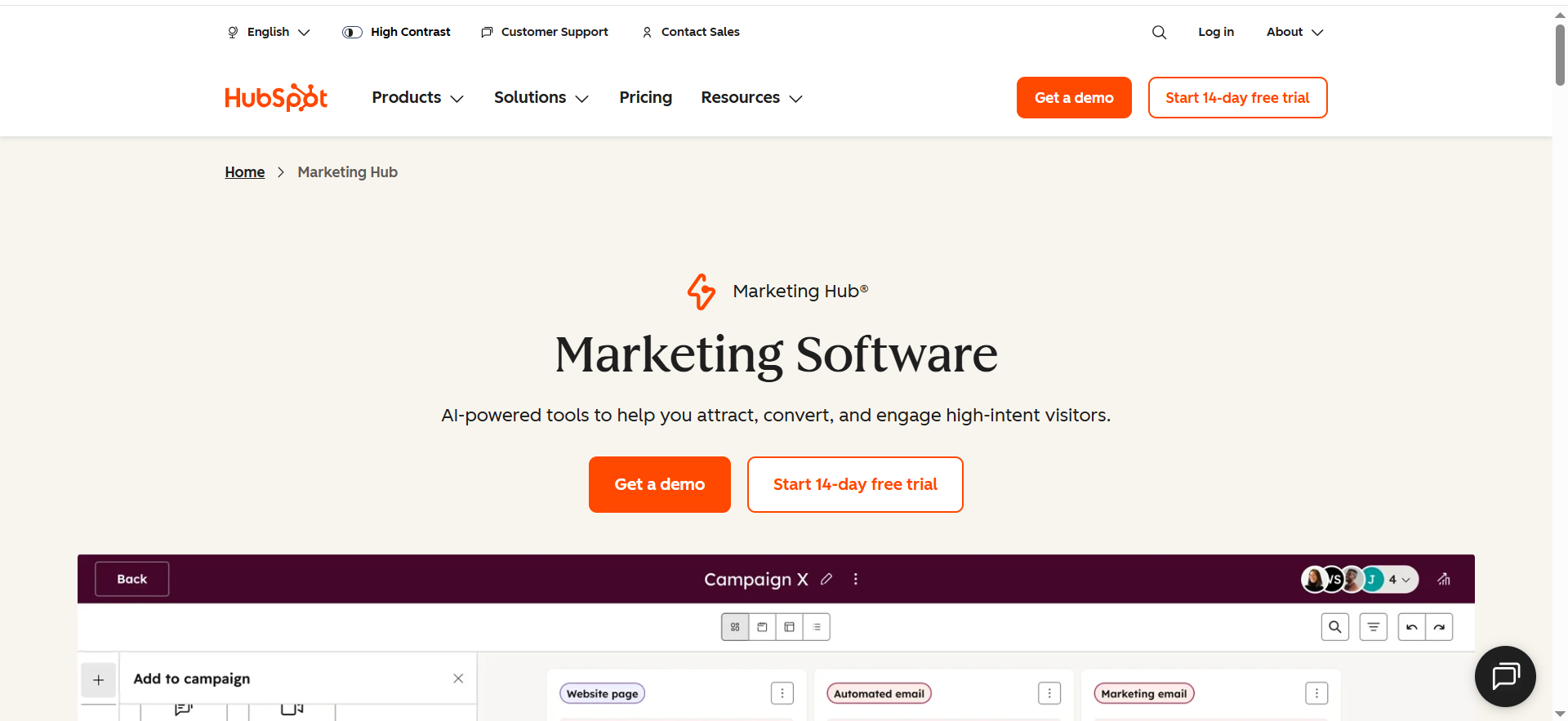
HubSpot AI refers to the suite of artificial intelligence features built natively into HubSpot’s Marketing Hub, with email optimization capabilities powered by HubSpot's Breeze AI system. Unlike standalone AI email tools, HubSpot AI is embedded directly into the CRM platform, which means it uses contact records, deal data, engagement history, and company information to generate and optimize email content without requiring a separate vendor or integration.
The email-specific AI capabilities include generating personalized subject lines and email body content based on CRM data, suggesting optimal send times based on past campaign performance, converting uploaded email templates (from tools like Mailchimp or Figma) into editable HubSpot templates, and providing content recommendations optimized for conversion and engagement.
Why Teams Use It
Teams already invested in the HubSpot ecosystem use HubSpot AI because it requires zero additional integration, zero additional vendor management, and zero additional budget beyond their existing HubSpot subscription. Every AI-generated email is automatically logged against the contact record, creating a closed loop between content creation, delivery, engagement tracking, and CRM data. For organizations that have standardized on HubSpot as their marketing and sales platform, adding a separate AI email tool introduces unnecessary complexity.
What It Is Good For
HubSpot AI is good for teams that want AI-assisted email marketing without the overhead of implementing and managing a specialized tool. It handles everyday email optimization tasks well: generating subject line variations, drafting email body copy, suggesting send times, and personalizing content based on CRM properties. It is especially useful for teams that run both marketing and sales email programs on HubSpot, since the AI can draw on data from both sides to inform its recommendations.
When It Is a Good Fit
HubSpot AI makes sense when your team is already on HubSpot Marketing Hub Professional or Enterprise and wants to leverage AI capabilities without adding another tool to the stack. It is ideal for mid-market to enterprise B2B companies that value CRM integration over specialized email language optimization. If your email program is one component of a broader inbound marketing strategy managed through HubSpot, the native AI features add value incrementally without disrupting existing workflows.
When It Is Not a Good Fit
HubSpot AI is not the right choice if you need deep, specialized email language optimization at the level Persado or Jacquard provides. The AI features are general-purpose — they generate good subject lines and copy, but they do not have the predictive depth of tools with billions of data points specifically trained on marketing language performance. HubSpot AI is also not ideal if you are not already on HubSpot, since adopting the entire Marketing Hub just for AI email features would be overbuilt and expensive. And for teams in heavily regulated industries, HubSpot AI does not include the embedded compliance validation that Persado offers.
How to Use It
HubSpot AI features are available within the Marketing Hub interface. When composing an email in HubSpot, AI-powered suggestions appear inline for subject lines, body copy, and CTAs. Send-time optimization is configured at the campaign level. To access the full range of AI features, you need Marketing Hub Professional or Enterprise. The Starter tier and free tools include limited AI capabilities. Usage is straightforward — there is no separate setup or configuration required beyond having the right HubSpot plan.
Key Capabilities
HubSpot AI email capabilities include CRM-powered content generation that uses contact and deal data to personalize subject lines and body copy; AI-generated subject line suggestions optimized for open rates; email template conversion from external formats (Mailchimp, Figma) into editable HubSpot templates; send-time recommendations based on historical campaign performance data; content optimization recommendations for conversion and engagement; and native integration with HubSpot's reporting, automation, and CRM tools.
Pricing
HubSpot Marketing Hub pricing follows a tiered model. A free tier with basic email marketing is available. Starter costs $9 per seat per month. Professional is $890 per month and includes the full suite of AI-powered email features. Enterprise is $3,600 per month with advanced capabilities. AI email features are most robust at the Professional and Enterprise tiers. In spring 2026, HubSpot also introduced outcome-based pricing for its AI agents, charging based on resolved conversations and viable leads.
Free Tier?
Yes. HubSpot offers a free tier that includes basic email marketing capabilities. However, the AI-powered features (subject line generation, content optimization, send-time suggestions) are limited at the free and Starter levels. Full AI email functionality requires Marketing Hub Professional ($890/month) or Enterprise ($3,600/month).
Downsides and Limitations
HubSpot AI email features are solid but not specialized. They do not match the depth of prediction and language optimization that purpose-built tools like Persado and Jacquard deliver. The AI capabilities are bundled into the broader Marketing Hub pricing, so you are paying for a full marketing platform rather than a focused email optimization tool — which is either a benefit or a drawback depending on your existing stack. Send-time optimization suggestions are based on aggregate campaign data rather than individual contact-level prediction (unlike Seventh Sense). And the AI features evolve according to HubSpot's product roadmap, so you are dependent on their prioritization of email AI improvements.
What Is Generative AI Email Optimization?
Generative AI email optimization refers to the use of artificial intelligence — specifically generative models and predictive engines — to create, test, and improve marketing email content automatically. This goes beyond traditional A/B testing, where a human writes two subject lines and picks the winner. Generative AI platforms produce dozens or hundreds of language variations, predict which ones will perform best based on historical data, and optimize content in real time as campaigns run.
The generative component means the AI creates new content rather than just analyzing existing content. Platforms like Persado and Jacquard generate subject lines, email body copy, CTAs, and even full HTML email layouts using language models trained specifically on marketing performance data. The optimization component means the AI continuously learns from engagement metrics — opens, clicks, conversions — and adjusts its output to improve results over time.
In an enterprise context, generative AI email optimization also encompasses send-time personalization (predicting when each contact should receive an email), frequency management (determining how often to email each segment), and compliance validation (ensuring generated content meets regulatory requirements). The combined effect is an email program that generates better content, delivers it at the right time, and improves automatically with each campaign.
How Does AI Improve Email Marketing Performance?
AI improves email marketing performance across three primary dimensions: content quality, delivery timing, and audience management. On the content side, AI analyzes millions of historical email campaigns to identify which language patterns, emotional triggers, and structural elements drive engagement. It then generates new content that incorporates these patterns while maintaining brand voice. This consistently produces higher open rates and click-through rates compared to human-only workflows — platforms in this guide report improvements ranging from 19% to over 40%.
On the delivery timing side, AI analyzes each contact's historical engagement patterns to determine when they are most likely to check and respond to email. Personalized send-time optimization alone can improve open rates by 20–35% on well-segmented lists, making it one of the highest-impact applications of AI in email marketing.
On the audience management side, AI identifies engagement trends across your database, automatically suppresses sends to disengaged contacts (protecting sender reputation), adjusts frequency based on individual preferences, and segments audiences based on behavioral patterns that would be invisible to manual analysis. The cumulative effect is higher engagement rates, lower unsubscribe rates, better deliverability, and more revenue per email sent.
What Are the Benefits of AI-Powered Email Subject Line Optimization?
Email subject lines are the single most important factor in determining whether an email gets opened. AI-powered subject line optimization delivers several specific benefits that manual testing cannot match.
First, speed and scale. AI generates and evaluates hundreds of subject line variations in seconds, while a human team might test two or three per campaign. This dramatically increases the odds of finding a high-performing option.
Second, pattern recognition. AI models trained on billions of data points can identify language patterns that correlate with higher open rates — specific word choices, character lengths, emotional tones, and structural elements — at a level of granularity that humans cannot detect through manual analysis.
Third, brand consistency. Platforms like Jacquard and Persado calibrate their AI to match your specific brand voice, ensuring that optimized subject lines still sound like your brand rather than generic marketing copy.
Fourth, continuous improvement. AI subject line tools learn from every campaign's results, which means performance improves over time as the model accumulates more data specific to your audience.
Fifth, reduced reliance on subjective judgment. Marketing teams often debate subject line choices based on personal preference. AI shifts the decision to data-driven prediction, reducing internal friction and improving consistency across campaigns and team members.
How Do Enterprise AI Email Tools Handle Brand Compliance?
Enterprise AI email tools handle brand compliance through a combination of pre-configured guardrails and real-time validation during content generation. The approach varies by platform.
Persado embeds regulatory compliance directly into its content generation process. For financial services brands operating under frameworks like FINRA, CFPB, or GDPR, the AI generates content that clears legal requirements the first time — across more than 20 regulatory frameworks. This eliminates the back-and-forth between marketing and legal that typically adds days or weeks to campaign timelines.
Jacquard approaches brand compliance through voice calibration. During onboarding, the platform maps your brand's tone, vocabulary, approved terminology, and communication guidelines. The AI then generates all content within those parameters, ensuring that every variation maintains brand consistency. Language experts calibrate the models, and the platform provides approval workflows for reviewing generated content before deployment.
HubSpot AI relies on its CRM data to maintain personalization accuracy but does not include specialized compliance features comparable to Persado. For teams in regulated industries, HubSpot AI would need to be supplemented with manual compliance review or a separate compliance tool.
Seventh Sense does not address content compliance at all — it focuses exclusively on delivery timing and does not generate or modify email content.
What Is the Difference Between AI Email Copywriting and AI Send-Time Optimization?
AI email copywriting and AI send-time optimization address two fundamentally different aspects of email performance, and understanding the distinction is important when evaluating tools.
AI email copywriting tools (Persado, Jacquard) focus on what your email says. They generate subject lines, body copy, CTAs, and other text elements using AI models trained on marketing language performance. Their goal is to produce content that drives higher engagement through better word choices, emotional resonance, and persuasive structure. These tools answer the question: what should this email say to maximize opens and clicks?
AI send-time optimization tools (Seventh Sense) focus on when your email arrives. They analyze each contact's historical engagement behavior — when they open emails, how frequently they engage, which days of the week they are most active — and schedule delivery at the individual level. These tools answer the question: when should this email arrive in each person's inbox to maximize the chance they see and open it?
HubSpot AI does a bit of both, but at a less specialized level than dedicated tools. It generates content suggestions and provides send-time recommendations based on campaign-level data.
The two capabilities are complementary, not competing. A well-written email sent at the wrong time still underperforms, and a perfectly timed email with a weak subject line still gets ignored. Enterprise teams looking for maximum email performance often pair a copywriting tool (Persado or Jacquard) with a send-time tool (Seventh Sense), though this adds complexity and cost to the stack.
How Much Do Enterprise AI Email Optimization Tools Cost?
Enterprise AI email optimization tools span a wide pricing range depending on specialization, capabilities, and target market. Here is a straightforward pricing breakdown for the five tools covered in this guide.
Persado operates on custom enterprise pricing with annual contracts that typically start in the low six figures. There is no self-serve plan or published price list — access requires a sales conversation.
Jacquard (formerly Phrasee) starts at $24,000 per year, with pricing scaling based on messaging volume, channels, and language requirements. Like Persado, full pricing requires a sales discussion.
Seventh Sense is the most affordable option in this comparison, starting at $80 per month for HubSpot users and $450 per month for Marketo users. Pricing scales with database size and email volume.
HubSpot AI is included in HubSpot Marketing Hub plans. A free tier exists with basic email marketing, but meaningful AI email features require Professional ($890/month) or Enterprise ($3,600/month). The AI capabilities are bundled — you are paying for the full marketing platform, not just email optimization.
When evaluating cost, consider total cost of ownership rather than just subscription price. Factor in implementation and onboarding time, internal resources needed to manage the tool, integration costs with your existing marketing stack, and the opportunity cost of the engagement improvements you are leaving on the table without optimization.
Can AI Email Tools Integrate With Existing Marketing Stacks?
Integration capability varies significantly across the tools in this comparison, and it is one of the most important factors in your evaluation.
Persado integrates with major ESPs and marketing automation platforms via API. It functions as an overlay that generates and optimizes content, then delivers it through your existing email infrastructure. This means it can work alongside most enterprise email setups without requiring a platform migration.
Jacquard has pre-built integrations with Braze, Salesforce Marketing Cloud, Adobe Campaign, and several other enterprise marketing platforms. Like Persado, it functions as a content optimization layer that plugs into your existing stack.
Seventh Sense is more restrictive — it works exclusively with HubSpot and Marketo through native integrations. There is no API option for other platforms, no Salesforce Marketing Cloud connector, and no support for standalone ESPs like Klaviyo or Mailchimp.
HubSpot AI is natively built into HubSpot Marketing Hub, so there is no integration required if you are already a HubSpot customer. However, it also means HubSpot AI only works within HubSpot — you cannot use it with a different marketing automation platform.
Before committing to any tool, verify that it integrates cleanly with your specific marketing automation platform, CRM, and data infrastructure. Request an integration demo and ask about data syncing frequency, custom field mapping, and any limitations that might affect your specific use case.
How Do AI Email Optimization Tools Measure ROI?
AI email optimization tools measure ROI through a combination of engagement metrics, revenue attribution, and efficiency gains. The specific metrics depend on the tool and its focus area.
For content optimization tools (Persado, Jacquard), ROI measurement centers on lift in engagement metrics. These platforms run controlled experiments comparing AI-generated content against control groups (often human-written alternatives or historical benchmarks). They report percentage improvements in open rates, click-through rates, conversion rates, and revenue per email. Persado reports an average 43% performance lift on launched campaigns, while Jacquard cites up to 19% engagement improvement.
For send-time optimization tools (Seventh Sense), ROI is measured through improved engagement metrics resulting from personalized delivery timing. The platform tracks changes in open rates, click-through rates, and response rates compared to fixed-time or random-time sending. It also measures reductions in unsubscribe rates and improvements in sender reputation health.
For CRM-native tools (HubSpot AI), ROI measurement is integrated into the broader HubSpot reporting framework, where email AI improvements are tracked alongside pipeline contribution, deal velocity, and customer lifecycle metrics.
When evaluating ROI claims from any vendor, ask for customer case studies from companies similar to yours in size, industry, and email maturity. Generic performance lift numbers may not translate to your specific situation.
What Industries Benefit Most From AI Email Optimization?
AI email optimization delivers value across most industries that rely on email as a significant marketing or communication channel, but certain sectors see outsized returns.
Financial services and insurance benefit substantially because they send high volumes of regulated communications where both performance optimization and compliance matter. Persado was built specifically for this use case, and the ROI from reducing compliance review cycles alone can justify the investment.
E-commerce and retail benefit from the volume and frequency of their promotional email programs. AI subject line optimization, send-time personalization, and content personalization all directly impact revenue for brands sending daily or weekly promotional emails to large consumer databases.
SaaS and technology companies benefit from AI email optimization in their lifecycle marketing, onboarding sequences, product updates, and renewal campaigns. For B2B SaaS companies with longer sales cycles, AI-optimized nurture sequences can meaningfully accelerate pipeline velocity.
Travel and hospitality benefit from the time-sensitive nature of their promotional offers, where send-time optimization and compelling subject lines directly impact booking rates.
Media and publishing companies benefit from optimized newsletter subject lines and delivery timing, which drive higher open rates and ad revenue from email-based content distribution.
Is AI Email Optimization Worth It for B2B vs B2C?
AI email optimization is valuable for both B2B and B2C, but the specific use cases and tool choices differ.
B2C teams typically see the most dramatic measurable impact because they send higher volumes of promotional emails to larger contact databases. More data means better AI model training, and the direct revenue attribution (click to purchase) makes ROI easy to measure. B2C teams benefit most from content optimization tools (Jacquard, Persado) for subject lines and promotional copy, and send-time tools (Seventh Sense) for maximizing engagement across large consumer lists.
B2B teams see equally important but differently shaped returns. B2B email volumes are typically lower, but the value per conversion is much higher. An AI-optimized nurture sequence that converts one additional enterprise deal can generate more revenue than thousands of optimized B2C promotional emails. B2B teams benefit most from send-time optimization (Seventh Sense) for reaching decision-makers during their specific engagement windows, and CRM-native AI (HubSpot AI) for personalizing outreach based on deal stage and company data.
The tools in this guide tilt enterprise and can serve both models. Persado and Jacquard are most often used by B2C and B2B2C brands. Seventh Sense and HubSpot AI are widely used by B2B teams. The right choice depends more on your email volume, marketing stack, and budget than on whether you sell to businesses or consumers.
How Do AI Email Tools Handle Personalization at Scale?
Personalization at scale is one of the primary value propositions of AI email optimization tools, and each platform approaches it differently.
Persado personalizes at the language level by generating copy variations tailored to different audience segments. The platform identifies which emotional triggers and motivational elements resonate with specific demographics, behavioral segments, and customer lifecycle stages, then produces targeted messaging for each group automatically.
Jacquard combines language personalization with dynamic campaign optimization. The platform generates messaging variations, tests them across segments, and automatically shifts budget and volume toward winning content in real time. Its multilingual capability extends this personalization across 27+ languages, maintaining performance optimization even for global campaigns targeting diverse markets.
Seventh Sense personalizes at the delivery level. Rather than personalizing what the email says, it personalizes when each individual contact receives it. The AI builds a unique engagement profile for every contact in your database and schedules delivery accordingly — meaning two contacts receiving the same email campaign might get it hours or even days apart.
HubSpot AI personalizes using CRM data. Because it has access to the full contact record — company size, industry, deal stage, past interactions, website behavior — it can generate content that references specific data points relevant to each recipient. This is particularly powerful for B2B personalization where the email content itself needs to vary based on the recipient's role, company, or stage in the buying process.
What Should You Look for When Evaluating AI Email Optimization Software?
When evaluating AI email optimization software for enterprise use, focus on these practical factors rather than marketing claims.
First, match the tool to your specific problem. If your open rates are low, you need content optimization (Persado, Jacquard) or send-time optimization (Seventh Sense). If your click-through rates are low despite good opens, you need body copy and CTA optimization. If your issue is deliverability, you need send-time throttling and frequency management. Do not buy a content optimization tool to solve a timing problem, or vice versa.
Second, verify platform compatibility. Seventh Sense only works with HubSpot and Marketo. HubSpot AI only works within HubSpot. Persado and Jacquard integrate more broadly, but you should still verify compatibility with your specific stack before entering a sales process.
Third, assess data requirements. AI tools need historical engagement data to train their models. Ask each vendor what minimum data volume they need, how long the initial training period takes, and what performance you can expect during that ramp-up phase.
Fourth, understand the pricing model. Some tools charge flat annual fees, others scale by volume. Calculate total cost of ownership over 12 months including onboarding, integration, and internal labor costs.
Fifth, request results from similar customers. Ask for case studies or references from companies in your industry, of similar size, and with similar email maturity. A tool that delivers 40% lift for a Fortune 500 retail brand may deliver very different results for a mid-market B2B SaaS company.
Sixth, evaluate the vendor's roadmap and support model. Enterprise AI tools require ongoing support, model tuning, and feature updates. Understand what support is included in your contract and how actively the vendor invests in product development
FAQs
No. AI email optimization tools augment human copywriters rather than replacing them. These platforms generate and test language variations at a speed and scale that humans cannot match, but they still require human oversight for brand strategy, creative direction, and context that AI cannot fully grasp. The best results come from teams that use AI-generated options as a starting point and apply human judgment to refine messaging for specific campaigns and audiences.
Most platforms show initial performance improvements within the first 30 to 60 days of implementation. However, AI email tools improve over time as they accumulate more engagement data from your specific audience. Expect the most significant performance gains after three to six months of consistent use, as the AI model becomes increasingly calibrated to your audience's preferences and behavior patterns.
Most of the tools in this guide are priced for enterprise budgets. Persado and Jacquard both require annual contracts starting at $24,000 or more. However, Seventh Sense starts at $80 per month (for HubSpot users), and HubSpot AI is included in Marketing Hub plans starting at $9 per month. Small businesses are better served by HubSpot AI or Seventh Sense rather than the dedicated language optimization platforms.
Platforms like Persado and Jacquard include brand voice calibration as a core feature. During onboarding, teams define their brand's tone, vocabulary, terminology, and communication guidelines. The AI then generates content within those parameters, ensuring that every variation stays on brand. Some platforms also include approval workflows where generated content is reviewed against brand guidelines before it can be sent.
AI email optimization tools typically need historical email engagement data (opens, clicks, conversions), contact-level behavioral data, campaign performance metrics, and ideally CRM data for personalization. The more data available, the better the AI performs. Most platforms require a minimum of 30 to 90 days of engagement history before their models can generate meaningful predictions. Larger databases with richer engagement histories produce faster and more accurate optimization.
In aggregate, yes. Platforms like Jacquard and Persado consistently report that their AI-generated subject lines outperform human-written alternatives in controlled tests. Jacquard cites up to 19% engagement improvement, while Persado reports over 40% greater engagement on average. However, individual results vary based on industry, audience, and the quality of the human copywriting being compared against. AI excels at identifying patterns across large data sets that humans miss, but it does not replace the creative insight that strong copywriters bring to campaign strategy.