

The best Nightwatch LLM tracking alternatives in 2026 are Peec AI, OtterlyAI, Akii, Profound, Conductor AI, Promptmonitor, and Authoritas AI Tracker. For most mid-market B2B SaaS teams, Peec AI is one of the strongest dedicated alternatives if you want focused AI visibility tracking without jumping straight into an enterprise-heavy platform. OtterlyAI is a strong fit for lean teams and agencies that want transparent pricing and straightforward monitoring, while Profound and Conductor AI make more sense for larger organizations that need deeper reporting and broader search workflow integration.
This guide compares each option by use case, strengths, limitations, and team fit so you can choose the right platform faster. You’ll get a quick comparison first, then detailed tool breakdowns, a migration checklist, and FAQs.
📋 Get Listed / Advertisement
We update this guide monthly. Want your tool featured? Contact: [email protected].
Best Nightwatch LLM Tracking alternatives at a glance
| Tool | Best for | Strength | Limitation |
|---|---|---|---|
| Peec AI | Mid-market teams that want dedicated AI search tracking | Clean AI visibility workflow and prompt tracking depth | Less useful if you want full traditional SEO tooling in the same platform |
| OtterlyAI | Startups, lean teams, and agencies | Transparent pricing and practical AI monitoring coverage | Lighter strategic depth than enterprise platforms |
| Akii | Teams that want more actionability from AI visibility data | Change detection and recommendation-oriented workflow | Less established than broader enterprise suites |
| Profound | Enterprise brands with advanced AI search needs | Deep AI visibility, brand intelligence, and agent analytics positioning | Enterprise motion and pricing may be overkill for small teams |
| Conductor AI | Teams that want AI visibility inside a broader search stack | Strong fit for organizations already thinking across SEO and performance workflows | Can be heavier than pure-play AI tracking tools |
The shortlist above is intentionally mixed, and if you want a broader market view beyond this article, it helps to compare an AI visibility platform buyer guide. It includes pure-play AI visibility tools, enterprise AEO platforms, and more operational monitoring products. That is the right way to evaluate Nightwatch alternatives. You are not just shopping for a rank tracker with an AI tab. You are deciding how your team will monitor prompts, interpret citations, benchmark competitors, report progress, and decide what to do next.
1. Peec AI
What it does
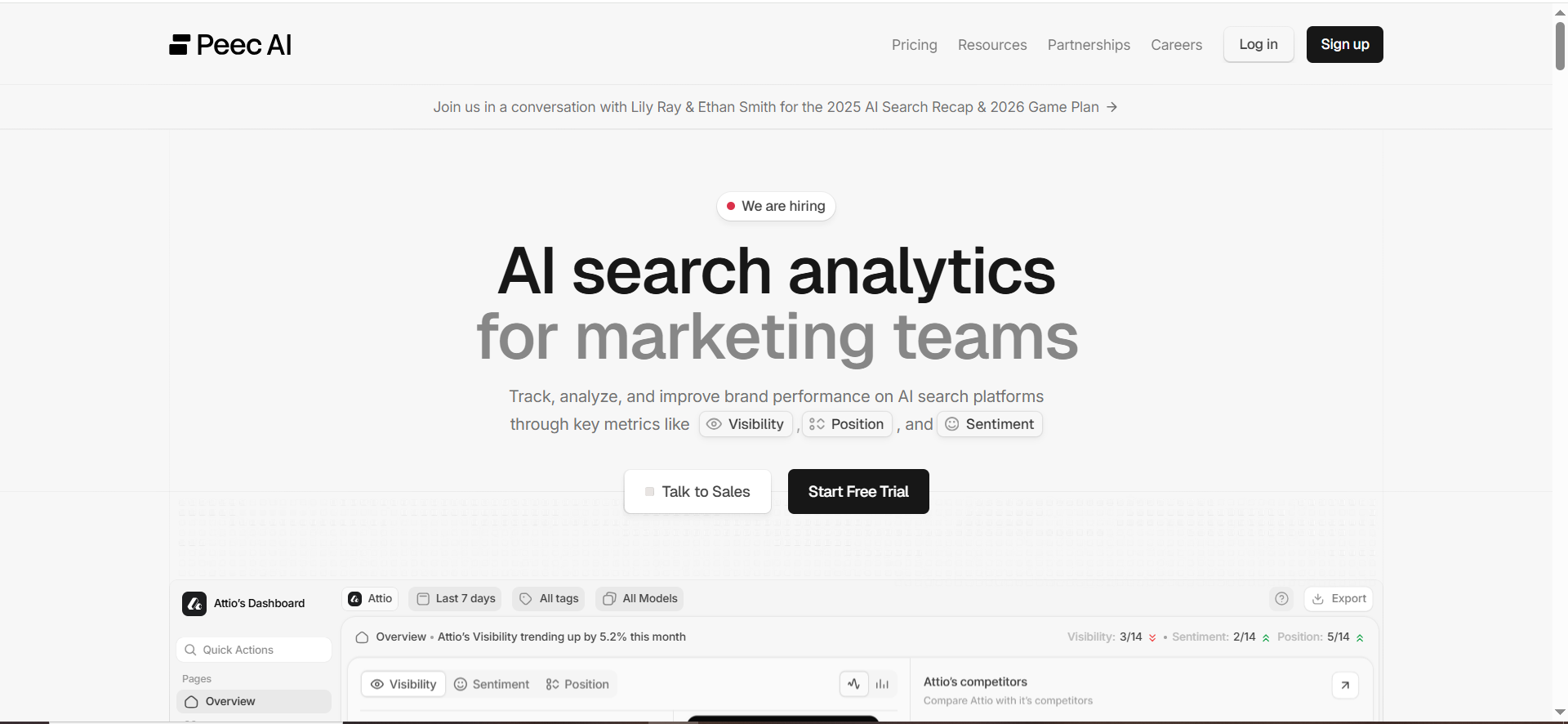
Peec AI is a dedicated AI search analytics platform built around prompt tracking, visibility monitoring, and competitive analysis. It is one of the cleaner choices for teams that want a modern AI visibility workflow without the bulk of a broader legacy SEO suite.
Why teams use it
Peec works well for teams that want clarity, especially teams comparing AI visibility solutions for content optimization teams. Its value is not that it tries to do everything. It is that it keeps the core AI visibility workflow focused: identify relevant prompts, monitor how you perform, compare yourself against competitors, and keep iterating based on what moved.
What it’s good for
Peec is a strong fit for marketing teams that want a dedicated AI search monitoring product, especially if they are already evaluating the best AI visibility tool for GEO. It is especially useful when prompt segmentation, visibility tracking, and consistent reporting matter more than classic SEO rank tracking.
When it’s a good fit
Choose Peec when your team already understands the importance of prompt sets and wants a platform built specifically around AI search visibility. It is also a good option if you care about sharing prompts across brands or projects and do not want pricing to explode every time you add another region or language.
When it’s not a good fit
If you want a traditional SEO platform plus AI monitoring in one interface, Peec may feel too specialized. It may also be the wrong fit for buyers who need very deep attribution, crawler intelligence, or a fully service-led enterprise motion.
Key capabilities
Peec focuses on prompt setup and organization, competitive tracking, and AI search analytics, which makes it relevant for teams comparing AI visibility tools for category tracking. Its pricing pages make clear that pricing is tied to tracked prompts and analyzed models, and its agency pricing supports multiple models with daily tracking. That usually maps well to teams that think in prompt portfolios rather than keywords.
Pricing
Peec AI’s pricing is usage-based. Its official materials reference a Starter plan at €89/month, and pricing scales based on tracked prompts and models.
Free tier?
Peec AI doesn’t offer a free tier, but it does offer a free trial.
Downsides / limitations
The main tradeoff with Peec is specialization. That is a strength if you want a focused AI visibility platform, but a weakness if your team wants one tool to cover rankings, site audits, and broader organic search reporting too.
2. OtterlyAI
What it does
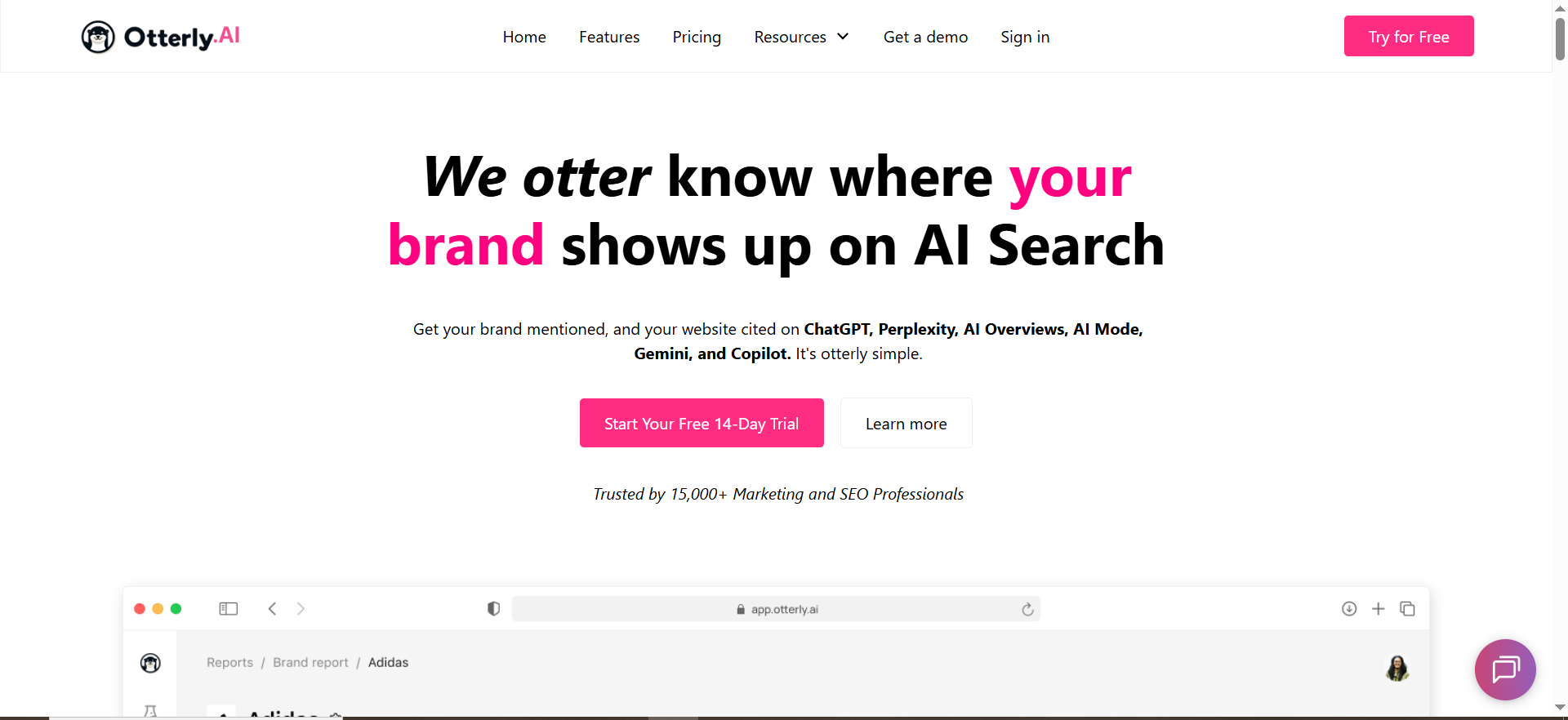
OtterlyAI is one of the most visible self-serve AI search monitoring tools in the market, which makes it a relevant comparison point in guides to the best AI visibility tools for daily prompt runs. It is built around prompt tracking, AI answer monitoring, and brand visibility across platforms such as ChatGPT, Perplexity, and Google AI results.
Why teams use it
Teams use OtterlyAI because it is easy to understand. The pricing is relatively transparent, the setup is approachable, and the core use case is obvious. You track prompts, see where you show up, and use that visibility data to guide content and brand strategy.
What it’s good for
OtterlyAI is especially good for smaller teams, consultants, and agencies that want a practical AI visibility tool without a heavy buying process, similar to the buyers comparing the best AI marketing tools for agencies.It is also useful for teams that want to test the category without immediately committing to an enterprise platform, especially if they are still reading an AI visibility platform buyer guide.
When it’s a good fit
Choose OtterlyAI if you want a clear entry point into AI search monitoring, especially if your team is already building around prompt templates for AI visibility tools. It is also a good fit for agencies that need multiple workspaces and teams that want weekly or daily prompt monitoring without much operational overhead.
When it’s not a good fit
It may not be the best choice if you need very deep enterprise analytics, strategic services, or broad integration into a larger SEO and analytics stack. Teams with highly complex reporting requirements may outgrow it.
Key capabilities
OtterlyAI highlights AI search monitoring, brand visibility tracking, citation observation, competitor comparisons, and workspace-oriented setups for different brands or clients, which overlaps with the use cases covered in AI mention and prominence tools.
Pricing
OtterlyAI’s pricing starts at $29/month on the Lite plan. Paid plans then scale to $189/month for Standard and $489/month for Premium on monthly billing.
Free tier?
OtterlyAI doesn’t offer a free tier, but it does offer a free 14-day trial.
Downsides / limitations
Its biggest limitation is that it remains a focused monitoring tool. That is great for speed and clarity, but teams looking for broader search intelligence or more advanced enterprise strategy layers may need more.
3. Akii
What it does
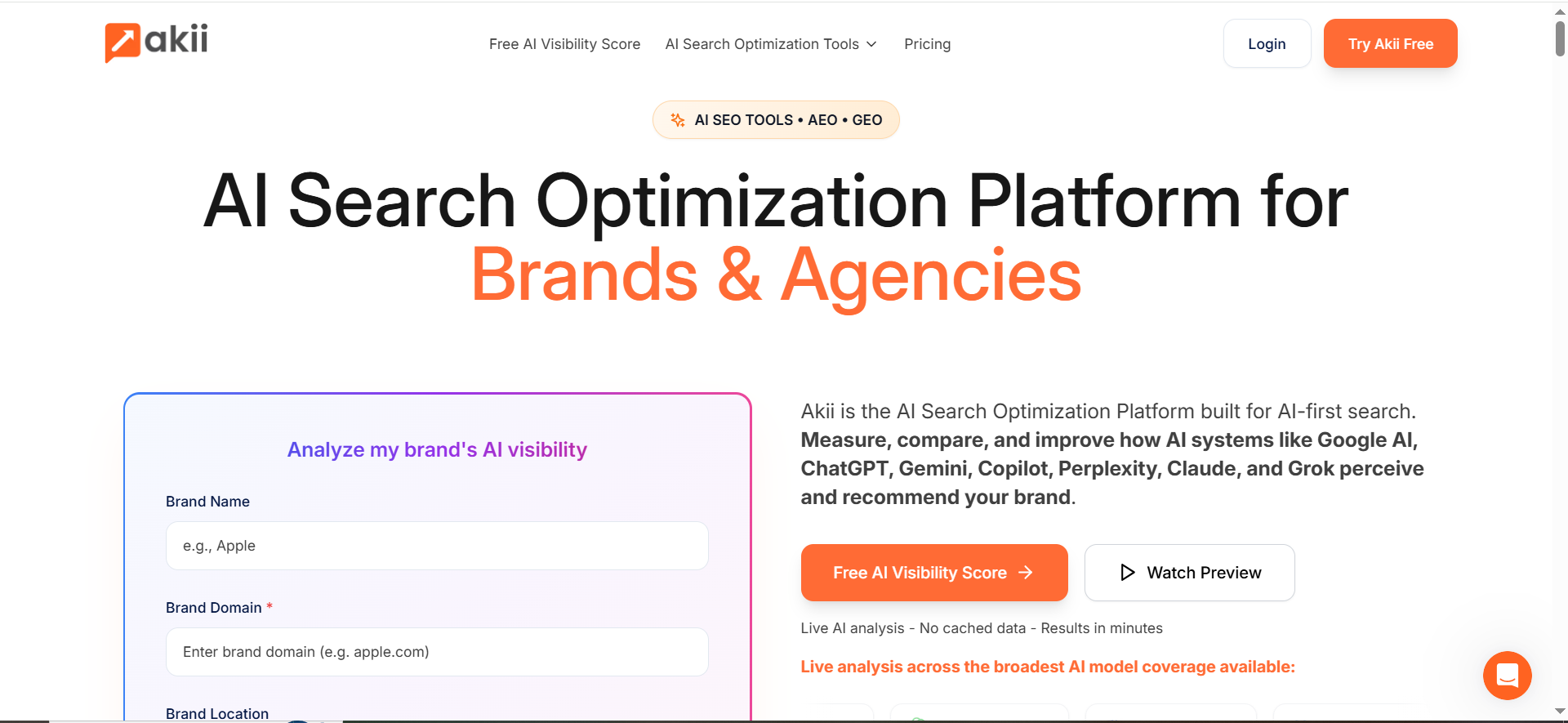
Akii is an AI visibility platform with a strong emphasis on monitoring, change detection, and recommended actions. Instead of simply telling teams whether their brand appeared in AI results, Akii leans into what changed and what should happen next.
Why teams use it
Akii is attractive to teams that do not just want dashboards because they want signals they can use, which fits naturally with real-time dashboards for reporting AI visibility to leadership. In that sense, it sits in an interesting position between analytics and workflow support.
What it’s good for
Akii is a good fit for teams that want more prescriptive insight from AI visibility data. If your team often gets stuck at the “okay, but what do we do with this?” stage, Akii’s positioning is compelling.
When it’s a good fit
It is a strong option for growth and content teams that need a practical operating layer for GEO and AI visibility. It also makes sense if your organization values alerts and recommended next steps more than building custom analysis around raw exports.
When it’s not a good fit
If your buying process centers on established enterprise procurement, extremely broad integrations, or a legacy SEO platform relationship, Akii may feel less familiar than some alternatives. It may also be less suited to buyers who only need a simple low-cost monitor.
Key capabilities
Akii emphasizes monitoring AI platforms, spotting changes, surfacing insights, and helping teams prioritize the next move, which aligns with how teams use AI search visibility audit tools. That makes it one of the more action-oriented alternatives in this list.
Pricing
Akii’s pricing starts at $99/month after a trial. Its higher public plans start at $499/month for Growth and $1,999/month for Agency.
Free tier?
Akii doesn’t offer a free tier, but it does offer a 14-day free trial.
Downsides / limitations
The main limitation is category maturity and market familiarity. Compared with larger brands, some buyers may need more hands-on evaluation before they feel confident rolling it out across teams.
4. Profound
What it does
Profound is an enterprise AI visibility and agent analytics platform positioned for brands that care deeply about how they appear across AI assistants and emerging answer engines. It is built for buyers that want a serious strategic layer, not just prompt snapshots.
Why teams use it
Teams use Profound when AI search becomes important enough to justify executive attention. Its value is in helping large organizations understand brand visibility, cited sources, competitor presence, and AI agent behavior at a level that supports a broader strategic program.
What it’s good for
Profound is best for enterprise brands, large content organizations, and teams with a significant reputation or pipeline stake in AI-generated answers, much like the buyers evaluating the best tools for AI share of voice in AI answers. It is more than a starter monitor. It is a platform for operating an AI visibility function.
When it’s a good fit
Choose Profound when your team needs serious reporting depth, strategic dashboards, and more enterprise-grade support, especially if you are benchmarking against the best AI visibility tools for competitor benchmarking. It is also a strong fit when AI visibility is becoming a board-level or leadership-level topic rather than an experimental SEO project.
When it’s not a good fit
Profound is likely too much for startups and smaller teams that only need lightweight visibility checks. It can also be unnecessary if your primary need is just to watch a few prompts and export a simple report.
Key capabilities
Profound’s public positioning highlights enterprise AI visibility, agent analytics, brand monitoring, and structured intelligence for generative search environments, which overlaps with broader work in PR and brand messaging for AI visibility.
Pricing
Pricing is not publicly listed by plan on Profound’s pricing page. Profound says it is currently available through customized enterprise pricing.
Free tier?
Profound doesn’t offer a free tier. Its official site promotes a demo, and I did not find an official public free-trial offer on the pricing page.
Downsides / limitations
The downside is mostly complexity and cost. Profound is a premium option, and the platform will make more sense to teams with the scale and budget to use that depth well.
5. Conductor AI
What it does
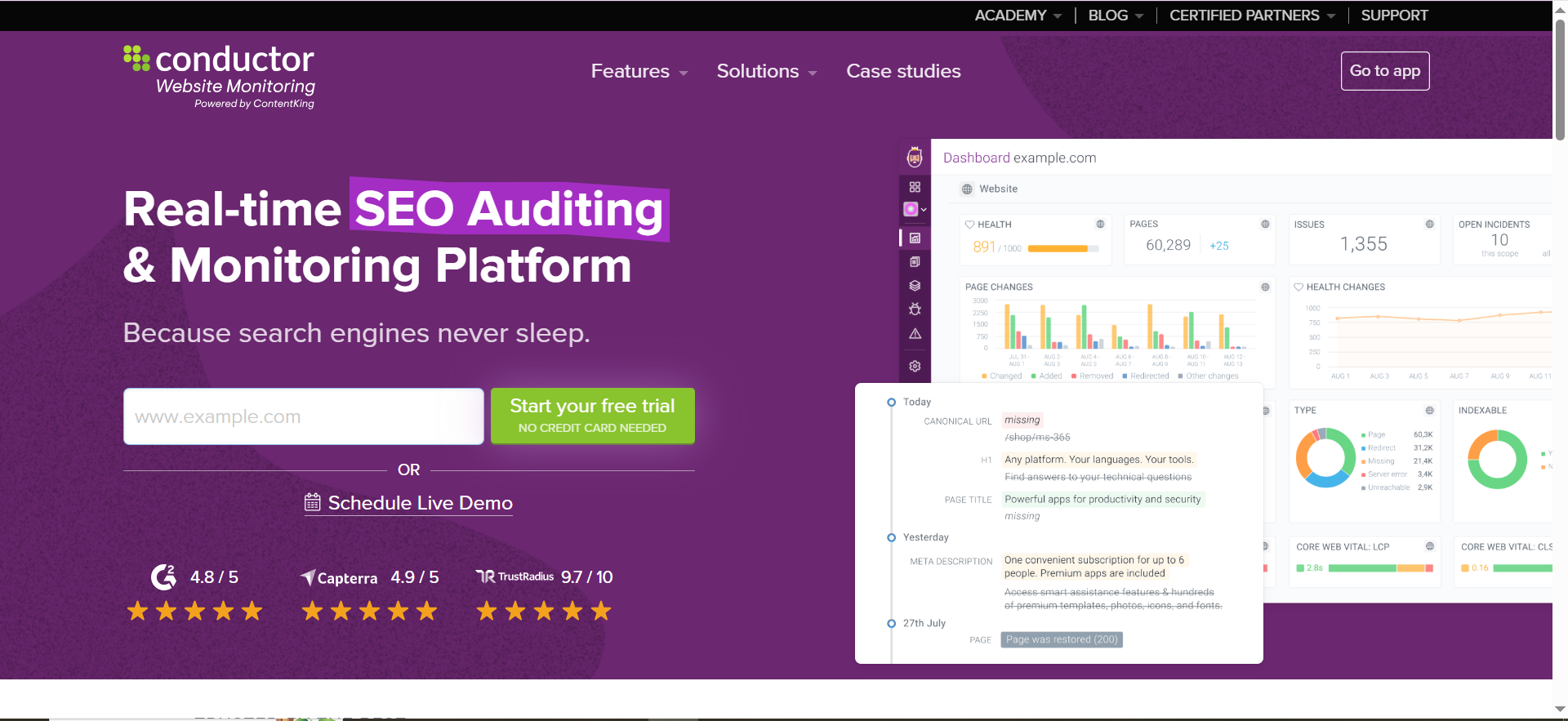
Conductor has expanded into AI visibility and generative search monitoring as part of a broader search intelligence platform. That makes it a strong candidate for teams that do not want a standalone AI tool if they are already thinking in terms of integrated organic performance.
Why teams use it
Teams use Conductor because they want continuity, and that usually matters most for organizations already investing in the best enterprise SEO tools. If AI visibility is becoming part of the same workflow as search performance, content planning, and executive reporting, Conductor has an obvious appeal.
What it’s good for
It is a strong fit for organizations that want AI visibility to sit within a larger search and content operating system, especially if they are also comparing the best SEO tools for SaaS. This is especially relevant for larger marketing teams that already need coordination across SEO, content, and performance stakeholders.
When it’s a good fit
Choose Conductor when you care about combining AI visibility with broader organic search intelligence, especially if your team is already comparing the best enterprise SEO tools.
When it’s not a good fit
It may be too broad for buyers who simply want a fast and focused AI tracking tool. Teams looking for a dedicated AI visibility specialist may prefer products like Peec, OtterlyAI, or Profound depending on scale.
Key capabilities
Conductor’s AI-related positioning includes generative engine monitoring, visibility insights, workflow integration, and a broader connection to search performance data, so it also fits teams following best SEO strategies for AI visibility.
Pricing
Pricing is not publicly listed as a fixed monthly starting price. Conductor says access to AI Search Performance uses a value-based, usage-based model tied to AI Response Credits, and its product plans scale with business needs.
Free tier?
Conductor doesn’t offer a free tier, but it does offer a free trial and a demo.
Downsides / limitations
The main tradeoff is that Conductor’s value comes from breadth. If you only need AI prompt tracking, that breadth may feel unnecessary. But if you want AI visibility to live inside a larger organic performance stack, it can be a strength.
📋 Get Listed / Advertisement
We update this guide monthly. Want your tool featured? Contact: [email protected].
Why teams look for a Nightwatch alternative
Nightwatch has a strong angle because it brings AI and LLM tracking into a familiar SEO tracker workflow, which is why some teams also compare the best SEO rank tracking software. For some teams, that is exactly what makes it attractive. But it is also why some buyers eventually look elsewhere.
The first reason is depth. Many teams quickly discover that “we can track AI results” is only the starting point.Once leaders begin asking harder questions such as which prompts matter most, which competitors gained visibility this week, which citations are helping, which pages are being mentioned, and where we lost share of voice, they often need more purpose-built AI visibility metrics.
The second reason is workflow fit. A company that already has a mature SEO stack may not want another SEO-first platform. Instead, it may want a dedicated AI visibility product for content, brand, and communications teams, which is why some buyers start with The Rank Masters’ answer engine optimization service. On the other hand, an agency may need workspace isolation, white-label exports, and fast cross-client reporting, which is why many agency buyers also review the best AI visibility tools with daily prompt runs. A lean startup may simply need a low-friction way to watch ChatGPT, Perplexity, Google AI Overviews, and Gemini without signing a large annual contract, which is why teams often compare the best tools for tracking brand visibility in AI search.
The third reason is actionability, and that becomes easier to evaluate when you compare AI visibility tools for competitor benchmarking. Plenty of tools can tell you that your brand appeared or disappeared, but fewer can support a real AI search visibility program. Fewer tools make it obvious what happened, why it happened, and what to fix next. This is where alternatives start to separate from each other. Some are reporting products. Some are intelligence products. Some are workflow products.
The fourth reason is pricing clarity, but buyers also care about whether a platform fits their workflow for AI visibility tracking, SEO, and GEO services. Nightwatch publishes self-serve pricing, which many buyers like. But when teams compare alternatives, they often find that they want one of two things: either a cheaper entry point for basic monitoring or a much deeper platform that justifies enterprise pricing with richer datasets, stronger support, and more strategic guidance.
What to look for in an LLM tracking tool
Before switching tools, decide what problem you are actually solving, especially if your team is choosing between software and AI visibility tracking, SEO, and GEO services. The strongest buying process usually starts with five filters.
1. Engine coverage
At minimum, most teams want visibility into ChatGPT, Perplexity, and Google AI experiences, so engine support is easier to judge against lists of AI visibility tools by engine coverage. Depending on your market, Gemini, Copilot, Claude, and AI Mode may matter too. If your buyers discover you in more than one AI environment, broad model coverage matters, especially when evaluating the best AI search engines.
2. Prompt management
Prompt monitoring is not just about running a list of questions, and teams evaluating platforms often look at dedicated GEO prompt monitoring tools. Good tools help you organize prompts by topic, funnel stage, product line, geography, or competitor set, and that structure becomes even more useful when paired with AI visibility tools for bulk prompt upload and tagging. That structure is what turns monitoring into reporting and reporting into strategy, especially when paired with content engineering for AI search visibility.
3. Mention and citation analysis
Mentions tell you whether your brand shows up, and citations tell you what sources the model leaned on, which is why many teams also evaluate AI citation tracking tools. In practice, both matter. If a tool is weak on citation tracking, it becomes much harder to connect AI visibility back to content strategy and authority building, which is why URL-level AI citation tools are worth comparing too.
4. Change detection and competitive context
Raw visibility snapshots are useful, but the real value is often in trends, especially when you are comparing platforms built for AI share of voice tracking. What changed week over week? Which competitor gained? Did your citation sources vanish? Did a product page start surfacing for a category prompt it never owned before? The better tools flag movement instead of making you hunt for it, which is why many teams also compare AI brand mention tracking tools.
5. Reporting and decision support
An LLM tracking platform should help different stakeholders at once. Executives want trend lines and share of voice, so it helps when your reporting setup is built around AI visibility reporting dashboards for leadership. SEO teams want prompt clusters, cited URLs, and competitor deltas. Content teams want ideas for what to refresh or publish next, which is where AI content optimization tools for search visibility can complement tracking data. Agencies want exports and client-safe reporting. If the platform only works for one of those groups, adoption usually stalls.
📋 Get Listed / Advertisement
We update this guide monthly. Want your tool featured? Contact: [email protected].
How to choose the right alternative by team type
If you are a lean team or consultant, start with OtterlyAI or Akii. Both make it relatively easy to start monitoring quickly, and both are easier to pilot than large enterprise platforms. OtterlyAI has the edge on pricing transparency. Akii has the edge if you want more direction on what to do next.
If you are a mid-market B2B SaaS team that already takes AI visibility seriously, Peec is one of the best places to start if your team wants a platform built specifically around AI search visibility. It feels purpose-built for prompt and competitive monitoring without forcing you into a full enterprise suite too early.
If you are an enterprise brand, Profound and Conductor should be near the top of your list. Profound is the stronger choice when you want specialized AI visibility depth. Conductor is stronger when AI visibility needs to connect tightly to existing search and business performance workflows.
If you are an agency, the answer depends on your business model. OtterlyAI is attractive for transparent multi-workspace deployment. Peec’s agency packaging is also relevant if you want prompt-driven monitoring at scale. Akii is worth considering if your clients value actionable recommendations over raw dashboards.
If you only need focused mention monitoring and early GEO signal tracking, Promptmonitor can be a pragmatic lower-complexity option for teams that are still learning how to audit brand visibility on LLMs. It is less ambitious than the larger platforms, but that can be exactly what some teams need.
Migration checklist from Nightwatch to another platform
Switching AI visibility tools is not just a procurement exercise. It is a measurement design exercise. Use this checklist before you migrate.
Rebuild your prompt library first
Do not move tools until you know which prompts matter, because a stronger prompt set usually comes from structuring content for the AI era with AEO principles. Group prompts by product, problem, competitor, customer stage, and market. The platform matters less than the quality of your prompt set.
Define your reporting layer
Decide what leadership actually needs to see. Most teams only need a few top-line metrics: visibility rate, citation count, share of voice, prompt win rate, top cited pages, and biggest weekly changes.
Map engines to business importance
Not every model matters equally for every company, so teams that want a more durable program often start with the best SEO strategies for AI visibility tools. If your audience lives in Perplexity and Google AI Overviews, do not over-invest in dashboards for engines that do not influence the pipeline, and instead focus on a tighter AI Overview SEO strategy backed by case study evidence.
Preserve a baseline period
Keep at least a few weeks of overlap if possible. AI systems are volatile, and without a baseline, it is too easy to confuse platform differences with real performance changes.
Assign owners
AI visibility work usually fails when nobody owns it. Someone has to maintain the prompt set, review weekly deltas, ship fixes, and report results. A better tool helps, but it does not replace ownership, and the strongest programs usually connect tooling decisions back to a larger AI search visibility audit toolkit.
Best LLM tracking tools for marketers
The best LLM tracking tools for marketers do more than show whether a brand appears in AI-generated answers. They help teams understand where visibility is improving, which prompts matter most, which competitors are gaining ground, and what actions to take next. That matters because marketers are not just tracking outputs for curiosity. They are trying to connect AI visibility to pipeline, brand discovery, content performance, and category positioning.
For most marketers, the best tools fall into a few clear buckets. Peec AI is a strong fit for teams that want focused AI visibility tracking with organized prompt monitoring and competitive analysis. OtterlyAI works well for lean teams and agencies that want a simpler, more transparent way to monitor prompts across major AI platforms.
Akii is useful for teams that want more actionability from the data, especially when the priority is spotting changes and turning those changes into next steps. Profound is better suited to enterprise brands that need deeper strategic reporting and broader brand intelligence. Conductor AI makes sense for teams that want AI visibility inside a wider organic search and content workflow.
The right choice depends on how marketing operates inside your company. If your team is still proving the value of AI visibility, a lighter tool may be enough, but once AI answers begin influencing category education and branded search, it helps to ground the work in a defined AI visibility metrics framework. If AI answers are already influencing branded search, category education, or buyer research, then deeper reporting and stronger competitive context become more important.
In other words, the best LLM tracking tool for marketers is not always the most advanced one. It is the one that helps your team make decisions consistently.
A good marketer-focused LLM tracking platform should support five things well, but for SaaS teams it also helps to anchor that choice in a broader AI visibility playbook for AE and SEO. First, it should let you build and organize prompt sets around use cases, categories, and competitors. Second, it should track visibility across the engines your audience actually uses. Third, it should show citations and source patterns, not just brand appearances.
Fourth, it should provide competitive comparison so your team can benchmark progress. Fifth, it should produce reports that leadership can actually understand without needing a long explanation every week.
That is why Nightwatch is not always the final answer for every team. It can be a useful starting point, especially for organizations that like familiar SEO workflows, but many marketers eventually need a tool that is more purpose-built for AI visibility analysis, prompt strategy, and executive reporting.
Nightwatch alternative for ChatGPT tracking
If your main goal is tracking ChatGPT visibility, the best Nightwatch alternatives are usually tools that offer stronger prompt-level monitoring, clearer brand mention reporting, and better visibility into how answers change over time, which is why many teams review tools that monitor SaaS brand visibility across ChatGPT and Perplexity. ChatGPT tracking is often one of the first reasons teams enter the AI visibility category, because it is where brand discovery, product comparison, and category education increasingly happen.
A strong Nightwatch alternative for ChatGPT tracking should help you answer a few core questions. Which prompts is your brand appearing for? Which pages or assets are being cited or mentioned? Which competitors show up more often than you do? How is that visibility changing week over week? And what should your team do next based on what the model is surfacing?
OtterlyAI is one of the more practical alternatives for ChatGPT tracking if you want a simple workflow and transparent setup. It works well for startups, agencies, and smaller marketing teams that want to monitor AI answers without a heavy onboarding process.
Peec AI is another strong choice when your team wants a more dedicated AI search monitoring setup with deeper prompt organization and competitive analysis. Akii stands out if your team wants more prescriptive insights, especially when the job is not just measuring ChatGPT appearance but acting on shifts in visibility. For enterprise teams, Profound becomes more relevant because ChatGPT tracking is rarely handled in isolation at that level. It is usually part of a broader brand intelligence and AI visibility program.
The reason ChatGPT tracking deserves its own evaluation is that it behaves differently from traditional search rank tracking. You are not simply measuring a position on a results page, which is why teams evaluating ChatGPT visibility often compare the best tools for tracking brand visibility in AI search. You are evaluating whether your brand, product, or content is included in generated answers, whether those answers are favorable, and whether your authority signals are being reflected in the response. That means the best alternative is often the tool that gives you clearer context, not just more rows of data.
If ChatGPT is the primary environment your buyers use during research, prioritize tools with strong prompt grouping, repeatable monitoring, and competitive comparison. If it is only one environment among several, then it makes more sense to choose a platform that balances ChatGPT tracking with Perplexity, Google AI Overviews, Gemini, and other answer engines.
Nightwatch alternative for Perplexity visibility
If you are specifically looking for a Nightwatch alternative for Perplexity visibility, you should prioritize tools that are strong at citation tracking, source analysis, and competitive comparison, and this is where AI citation gap analysis tools can also be useful. Perplexity is especially important because it tends to foreground sources more explicitly than some other AI interfaces. That makes it a valuable environment for teams trying to understand not only whether they are visible, but also why they are visible.
A good Perplexity tracking tool should help your team monitor which prompts trigger brand mentions, which URLs are cited, how often competitors appear, and how those patterns shift across topics. This is where a lightweight visibility checker stops being enough. For Perplexity, the quality of source-level insight matters a lot more because your content and authority strategy are directly tied to citation performance.
Peec AI is a strong alternative here because it offers a focused AI visibility workflow that suits prompt monitoring and competitor benchmarking well. OtterlyAI is also a practical choice for teams that want accessible Perplexity monitoring without jumping into a larger enterprise platform.
Akii is useful when you want more actionability from the monitoring layer, especially if changes in Perplexity visibility need to feed into a weekly optimization process. Profound becomes especially compelling for larger brands that treat Perplexity as a serious research and brand discovery channel and want more strategic visibility into how they appear across AI ecosystems.
Perplexity visibility is often more operationally useful than teams initially expect.Because the interface highlights sources, it creates a more visible bridge between AI performance and content strategy, which is why many teams also study how to get cited in AI answers. If your company is being cited from help docs, category pages, comparison pages, or third-party publications, that gives you concrete direction.
If competitors dominate the citations, that also tells you something important. So the best Nightwatch alternative for Perplexity is usually the one that helps your team translate source patterns into content, PR, and authority-building decisions.
For many B2B SaaS teams, Perplexity tracking is one of the clearest use cases for a dedicated AI visibility platform, especially if they are already working from an AEO-ready SaaS blog guide. It is not just about whether your logo appears. It is about whether your expertise, product pages, and supporting content are becoming part of the answer layer buyers trust.
Nightwatch alternative for Google AI Overviews tracking
If your priority is Google AI Overviews tracking, the best Nightwatch alternatives are tools that connect AI answer visibility with broader search behavior, citation patterns, and page-level opportunity analysis, which is why it helps to compare dedicated Google AI Overviews tracking tools. Google AI Overviews matter because they sit much closer to traditional search behavior than some standalone AI assistants do. That means they can directly influence clicks, branded demand, and how users interpret your authority in a category.
The challenge with Google AI Overviews tracking is that it is not enough to know whether you appeared. Marketing and SEO teams need to know which queries trigger AI Overviews, whether their brand or pages are included, which sources are referenced, and how visibility changes by query cluster or topic area. A tool that only gives snapshot-level monitoring will not be enough for serious optimization.
Conductor AI is one of the more relevant alternatives when Google AI Overviews matter a lot, because it fits teams that want AI visibility inside a broader organic search stack. That broader context can be useful when your reporting needs to connect AI Overview presence with overall search performance.
Peec AI is also a strong option if your team wants a more dedicated AI monitoring workflow without the overhead of a larger platform. OtterlyAI can be a good fit for leaner teams that want to begin tracking Google AI visibility in a simpler way. For enterprise brands, Profound becomes attractive when Google AI Overviews are only one part of a broader AI answer ecosystem that leadership wants to understand at a strategic level.
This is also one area where the choice of tool should reflect your internal workflow.If SEO owns the project and needs to tie AI Overview visibility back to query sets, landing pages, and broader organic reporting, then a more integrated platform may be more useful, especially alongside AEO tools for AI Overviews. If content, brand, and growth teams are collaborating on AI visibility as a separate initiative, then a dedicated AI tracker may be the better option.
The key point is that Google AI Overviews are not just another rank-tracking feature, so it helps to review dedicated Google AI Overviews tracking tools. They are part of a new answer layer that changes how users interact with search results. That means the best Nightwatch alternative for this use case is the one that helps your team understand not just appearance, but impact, source patterns, and the specific content opportunities behind that visibility.
FAQs
What is the best Nightwatch LLM Tracking alternative overall?
Which Nightwatch alternative is best for agencies?
Which alternative is best for enterprise brands?
Is there a cheaper alternative to Nightwatch for AI visibility?
Do I need a separate AI visibility tool if I already use SEO software?
What should I track first after switching tools?
Final verdict
The best Nightwatch LLM Tracking alternative depends on the shape of your team.
Peec is one of the strongest options for dedicated AI search monitoring with a clean, modern workflow. OtterlyAI is one of the best practical picks for smaller teams and agencies that want transparent pricing and useful depth without enterprise overhead. Akii is a strong choice if you want prioritized actions and change detection, not just reports. Profound is the premium enterprise pick for brands that need scale and strategic depth. Conductor is the better fit when AI visibility needs to plug into a larger search and performance stack. PromptMonitor is a reasonably lightweight option for early-stage monitoring. Authoritas is worth a look for teams that want a dedicated AI tracker with strong comparison-led positioning.
For most B2B SaaS teams, the smartest next step is not to ask which platform has the longest feature list. Ask which platform fits the way your team will actually work every week. The winning tool is the one your team will keep using after the novelty wears off.