
If you’re looking for Otterly AI alternatives, the best options right now are Peec AI, LLMrefs, AthenaHQ, Profound, and Rankscale AI. Peec AI is the strongest overall choice for teams that want better analytics and reporting, LLMrefs is a great fit for SEO-led teams that prefer a keyword-first workflow, AthenaHQ works well for companies that want a broader AEO and GEO platform, Profound is the best fit for enterprise brands that need scale and governance, and Rankscale AI is a practical option for focused AI visibility tracking. This guide breaks down what each tool does best, where Otterly AI still holds up, and how to choose the right platform for your team.
📋 Get Listed / Advertisement
We update this guide monthly. Want your tool featured? Contact: [email protected].
Top 5 Otterly AI Alternatives at a Glance
| Tool | Best for | Main strength | Potential limitation | Pricing visibility |
|---|---|---|---|---|
| Peec AI | Marketing teams and agencies that want stronger analytics and reporting | Better workflow depth, competitor tracking, integrations, and reporting structure | May feel heavier than needed for very small teams | Public plans available |
| LLMrefs | SEO-led teams that want a keyword-first workflow | Familiar SEO-style tracking, broad AI engine coverage, and lower entry cost | Less enterprise-oriented than some larger platforms | Public plans available |
| AthenaHQ | Growth and enterprise teams building a broader AEO/GEO program | Combines visibility tracking with optimization depth and workflow support | Can be more complex for teams that only need monitoring | Public pricing structure partially visible |
| Profound | Enterprise brands that need scale, governance, and executive reporting | Strong enterprise posture, deeper analytics, and broader strategic use | Likely too advanced and expensive for smaller teams | Custom enterprise pricing |
| Rankscale AI | Lean teams that want focused AI visibility tracking | Practical tracking for mentions, citations, and competitor visibility | Less transparent packaging than some alternatives | Limited public pricing visibility |
Why teams start with Otterly AI, and why they switch
Otterly AI has a lot going for it. For one, it is built around a problem that is easy to explain to buyers: track how your brand, content, and citations appear across AI-driven experiences like ChatGPT, Google AI Overviews, Perplexity, Copilot, Gemini, and Google AI Mode. It also offers practical features such as prompt research, dedicated brand reports, GEO audits, citation gap analysis, CSV exports, workspaces, and a Looker Studio connector. That combination makes it attractive to smaller marketing teams, agencies, and consultants who want a tool they can start using quickly without a huge implementation project.
But tools get outgrown for predictable reasons. The first is depth. A simple monitoring layer is useful, yet many buyers eventually need more nuanced competitive benchmarking, better filtering, richer cross-market analysis, and a clearer path from insight to action.
The second is reporting. Once AI visibility becomes a real KPI, dashboards need to answer more than “did we show up?”, which is why many teams end up comparing best SEO reporting software alongside newer AI visibility tools. Teams want to know which prompts drive visibility, which competitors own the conversation, which cited pages matter most, and what to fix next if they are trying to get cited in AI answers. The third is the operating model. A single in-house brand team has different needs from an agency with ten clients or an enterprise with regional teams, governance requirements, and higher scrutiny around attribution and security.
That is why the best Otterly AI alternative depends less on headline features and more on how your team works day to day. The right replacement should match the way you research prompts, report results, prioritize optimizations, and communicate wins internally, which is why many teams review AI visibility tools for prompt templates.
1. Peec AI
What it does
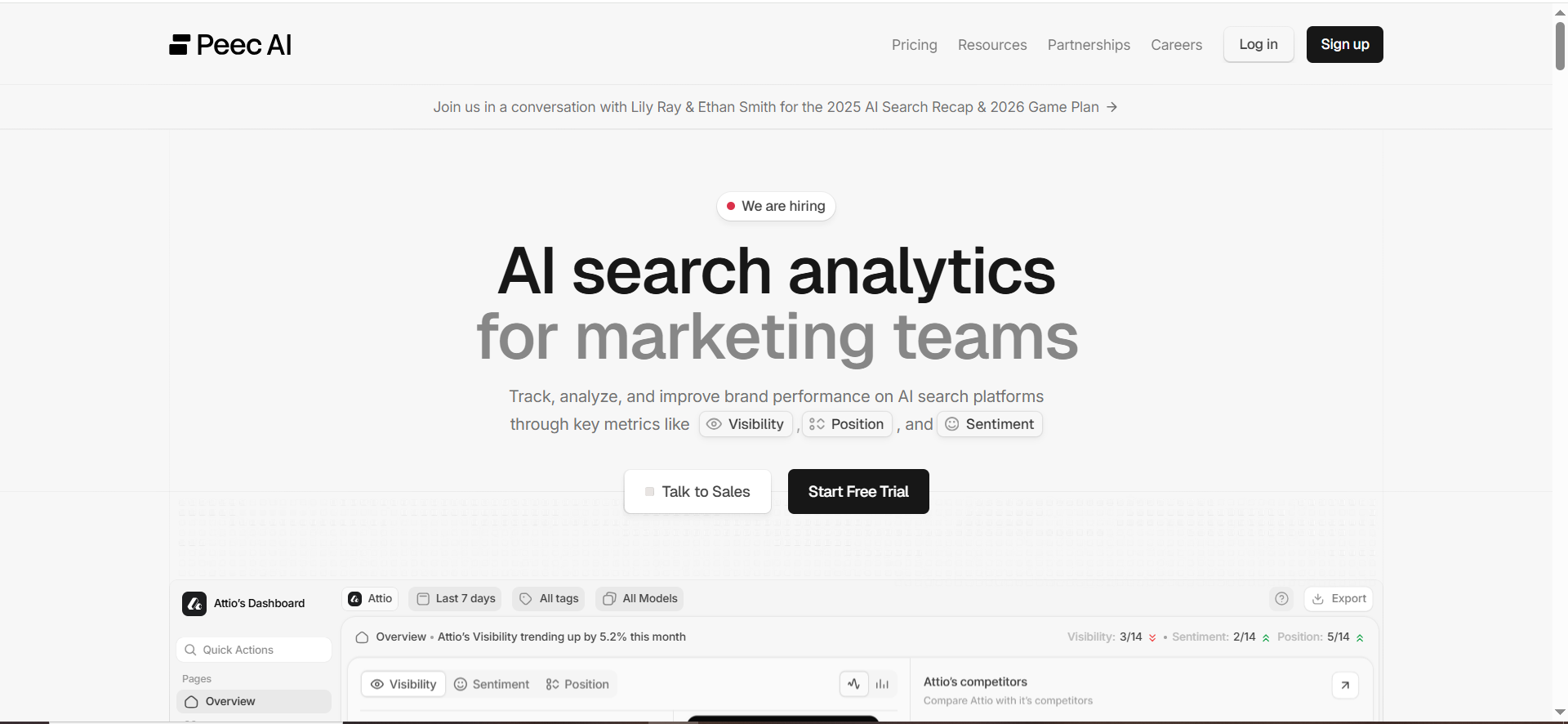
Peec AI is an AI search analytics platform aimed at marketing teams that want to track, analyze, and improve brand visibility across major AI platforms, which makes it relevant for teams comparing best AI visibility solutions for content optimization teams. Its positioning leans toward usable analytics rather than a purely technical SEO workflow. That matters because many teams buying these tools are not just search specialists. They are broader content, growth, or brand teams that need to understand what AI engines are surfacing and where competitors are winning.
Why teams use it
Teams usually move to Peec AI when they want more operational depth than a light monitor provides, especially for reporting to leadership with real-time dashboards. The platform offers multi-model tracking, project structure, integrations like GSC, GA, and Looker, and enterprise options such as API access and SSO on higher tiers. It is also investing in workflow features, including its Actions capability, which turns visibility data into prioritized optimization work rather than leaving users with a pile of charts.
What it’s good for
Peec AI is a strong fit for teams that need competitor benchmarking, more serious reporting, and a workflow that can support recurring optimization, especially if they care about share of voice in AI answers. It also fits agencies better than many beginner tools because of project structure and deeper reporting options. If your biggest frustration with Otterly AI is that the data is helpful but not quite enough to drive a repeatable operating rhythm, Peec AI is probably the cleanest step up for teams comparing AI visibility platforms.
When it’s a good fit
It is a good fit when you already know AI visibility is becoming important and you want a platform that can become part of the team’s regular reporting stack. It is especially useful for organizations that need to compare multiple brands, projects, prompts, or countries while still keeping the interface understandable for non-technical stakeholders working on category tracking.
When it’s not a good fit
If your needs are lightweight, Peec AI can feel like more systems than you need. Very small teams that simply want a quick pulse on brand mentions across a few prompts may not fully use the added analytical depth. In those cases, Otterly AI still offers a simpler route.
How to use it
The best way to implement Peec AI is to start with a focused set of commercial prompts, brand queries, and competitor prompts tied to revenue categories, which aligns well with teams evaluating GEO prompt monitoring tools. From there, use its reporting layer to identify which AI surfaces matter most for your market, which competitors dominate, and which cited pages repeatedly win mentions. The key is not to track everything, especially when teams are testing prompt variation across different AI surfaces.
Key capabilities
Compared with Otterly AI, Peec AI stands out for more flexible packaging, broad model support, deeper project and reporting structure, and workflow-oriented optimization support. For many teams, that makes it a better “grow with us” option.
Pricing
Peec AI’s pricing is publicly listed, but the current pricing page does not clearly expose a starting dollar amount in the page text I could verify. Pricing is publicly available on its plans page, and Enterprise pricing is custom.
Free tier?
Peec AI offers a self-serve “Get Started” path, but I could not verify a clearly labeled free tier from the official pricing page. A free tier is unclear from the public pricing page.
Downsides / limitations
The biggest downside is complexity creep. As platforms mature, they often gain more capability but require more process. Teams that just want a lightweight monitor may not need that extra weight. Still, for most serious operators, Peec AI improves on Otterly AI where it counts: competitive context, reporting depth, and actionability.
2. LLMrefs
What it does
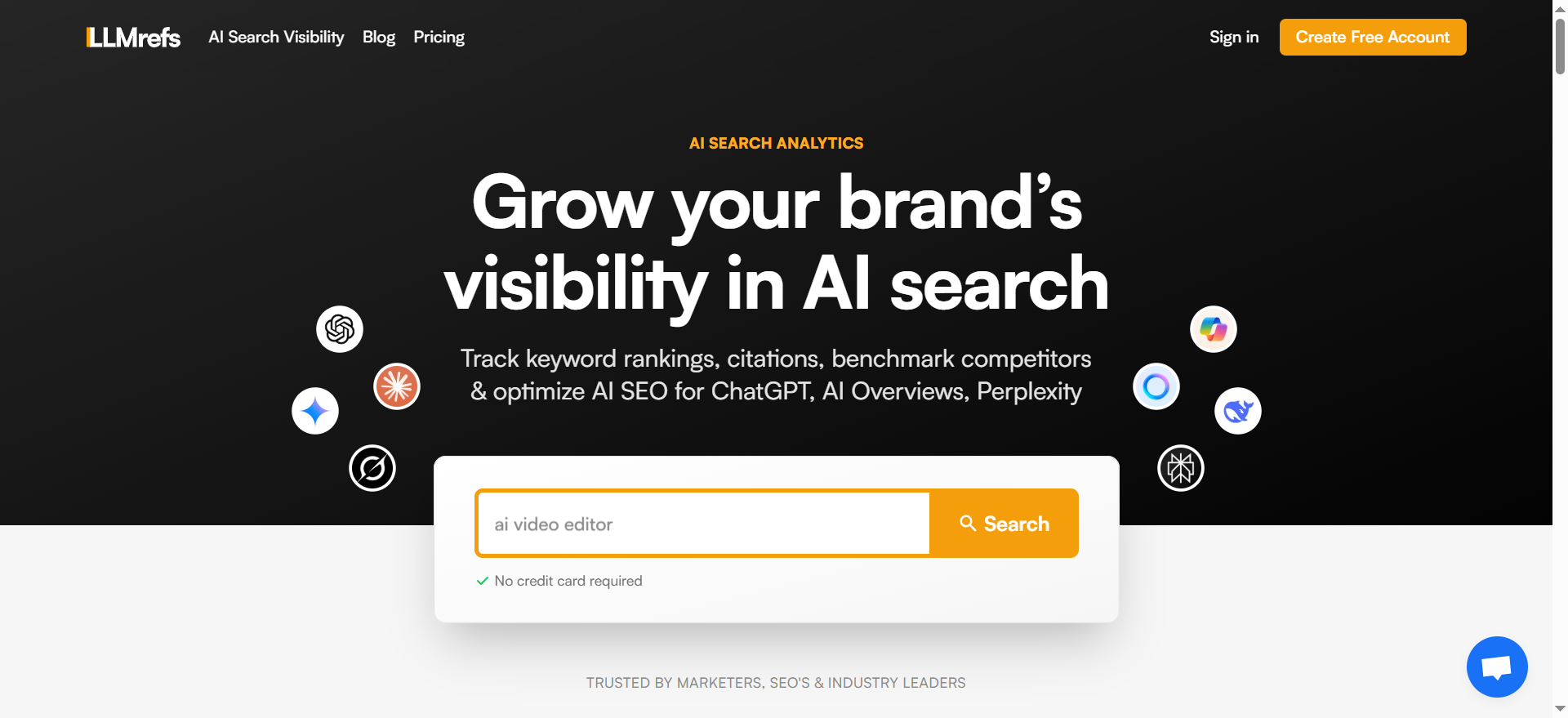
LLMrefs is an AI search visibility platform with a keyword-first workflow. That positioning matters. Many SEO teams still organize search strategy around topics and keywords, even when they understand that AI answer engines fan queries out behind the scenes. LLMrefs makes the jump into AI visibility easier by preserving that familiar mental model.
Why teams use it
Teams choose LLMrefs when they want AI visibility tracking without abandoning classic SEO habits overnight. The platform tracks keyword rankings, citations, benchmark competitors, and supports many major answer engines. It also emphasizes share of voice, position, and citation-level views that feel intuitive to SEO professionals.
What it’s good for
LLMrefs is very good for SEO-led teams, consultants, and agencies that want a bridge between rank tracking logic and AI answer visibility. It is especially helpful if the people buying the tool still think in terms of keyword sets, search demand, and comparative visibility. Instead of forcing a brand-new operating model, LLMrefs lets you evolve into AI monitoring using concepts your team already understands, which is useful if you are comparing AI marketing stacks.
When it’s a good fit
It is a strong fit for teams that want affordability, broad engine coverage, export options, and a fast learning curve when evaluating the best AI tools for digital marketing. If Otterly AI feels a little too report-centric but not structured enough for a more SEO-driven process, LLMrefs may feel more natural.
When it’s not a good fit
If you want heavier enterprise controls, formalized services layers, or a more comprehensive AI operations platform, LLMrefs may not be the best answer. It is focused, practical, and good value, but it is not pretending to be a giant enterprise suite.
How to use it
Start by grouping commercial and informational keywords by use case, then track how your brand appears across the engines that matter most in your category. Use the citation and competitor views to identify which pages, sources, and formats show up most often. Because LLMrefs still starts from keywords, it works well when you want to connect existing SEO planning to newer AI visibility metrics.
Key capabilities
The public site highlights tracking for brand mentions, sources, fan-out queries, country filters, and access to a wide range of AI engines, which is why LLMrefs fits buyers by comparing the best AI visibility tools by engine coverage. For buyers comparing against Otterly AI, the main edge is the keyword-first workflow plus broad coverage at a publicly visible starting price.
Pricing
LLMrefs’ pricing starts at $79/month for its All in One plan. That is the lowest paid plan publicly shown on the official site.
Free tier?
LLMrefs offers a free tier and also a 7-day free trial for the paid plan. The official site explicitly shows the free trial, and LLMrefs’ own pages describe the product as free to start.
Downsides / limitations
The main limitation is that some buyers will want more explicit enterprise packaging, support structure, or governance layers. But if your priority is value, ease of onboarding, and a workflow that feels familiar to SEO teams, LLMrefs is one of the strongest Otterly AI alternatives on the list.
3. AthenaHQ
What it does
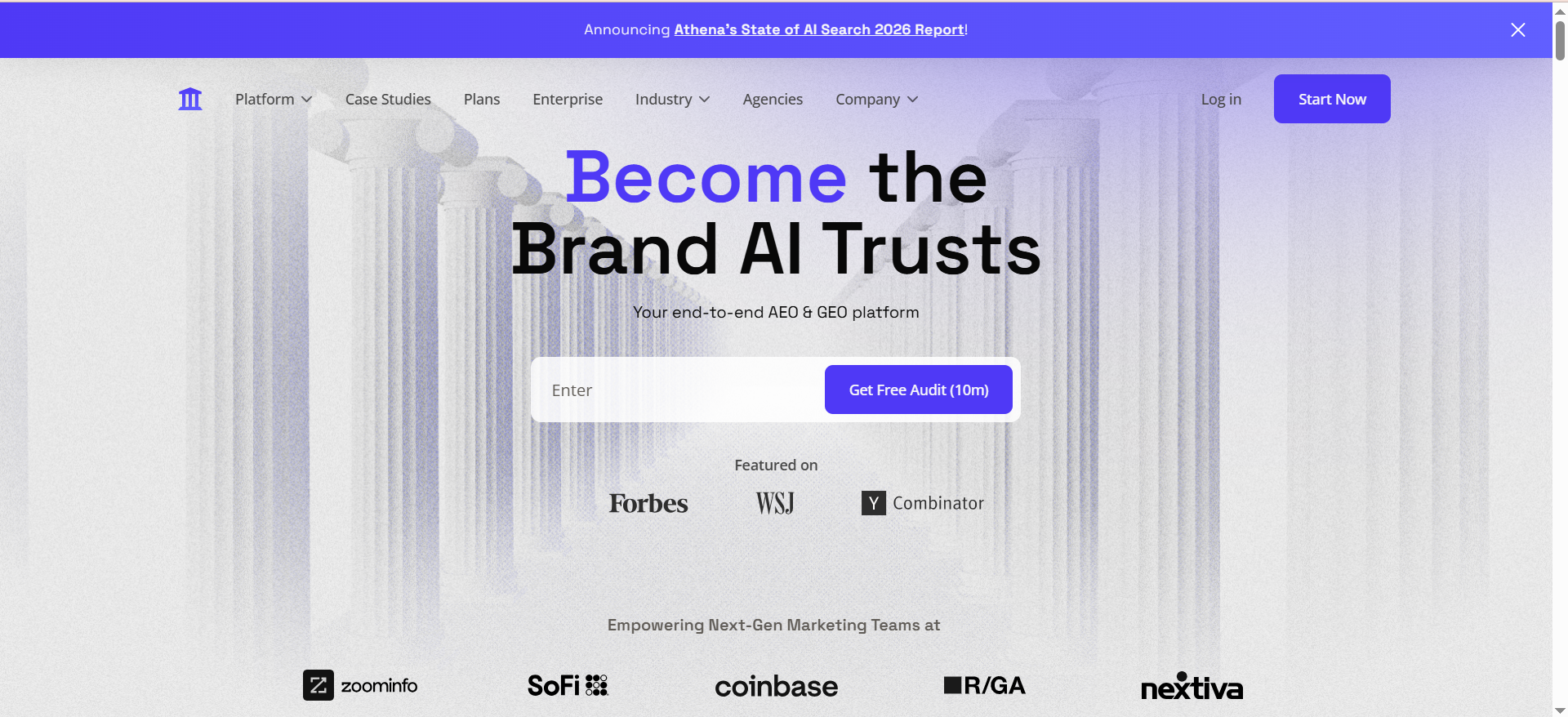
AthenaHQ positions itself as a broader AEO and GEO platform rather than a narrow monitor. That distinction is useful. Otterly AI is often evaluated for tracking and reporting, while AthenaHQ is usually evaluated as part of a wider system for understanding visibility, supporting content optimization, and scaling workflows across teams.
Why teams use it
Teams use AthenaHQ when they want more than surface-level visibility data and are looking for a broader AI visibility platform showdown before they commit. Its public materials emphasize credit-based AI response analysis, unlimited topics, prompt volume estimation, multiple countries, an Athena Citation Engine, and deeper content optimization capabilities, especially at the enterprise level. In other words, it aims to support both measurement and action.
What it’s good for
AthenaHQ is a good fit for brands that want to mature beyond monitoring into a more structured AEO and GEO program. It suits organizations that care about workflow depth, content recommendations, and enterprise support. If Otterly AI is beginning to feel like an excellent early-stage monitor but not a full operating platform, AthenaHQ is a logical upgrade path.
When it’s a good fit
It is a good fit for enterprise or late-growth teams that have enough traffic, enough stakeholder pressure, and enough content complexity to justify a more advanced system. It also makes sense for organizations that want more formal optimization guidance instead of just visibility charts.
When it’s not a good fit
Smaller teams may find the model heavier than they need, especially if they are still validating whether AI visibility deserves a dedicated budget. Credit-based packaging can also feel less immediately transparent than simpler per-plan pricing for buyers who want clean budget predictability from AI visibility tools.
How to use it
The best use of AthenaHQ is to treat it as part of your AI visibility operating system. Use it to estimate prompt demand, monitor where your brand is and is not present, prioritize high-value prompt clusters, and feed those learnings into content refreshes, PR, and product page improvements. The more mature your process, the more value you can extract.
Key capabilities
AthenaHQ’s differentiators include credit-based AI response analysis, content optimization support, multiple-country capabilities, and enterprise-tier features, which is useful for teams comparing AI visibility tools with bulk prompt upload and tagging. Those are meaningful differentiators for larger teams deciding whether to move beyond Otterly AI.
Pricing
AthenaHQ’s self-serve pricing starts at $295/month. Enterprise pricing is custom and quote-based.
Free tier?
AthenaHQ does not appear to offer a free tier. Its public pricing shows a self-serve paid plan and a custom enterprise plan, but no clearly labeled free tier or free trial.
Downsides / limitations
The main downside is fit, not quality. AthenaHQ is likely too much of a system for teams that only need straightforward monitoring. It is strongest when you have the bandwidth and internal demand to operationalize the insights.
4. Profound
What it does
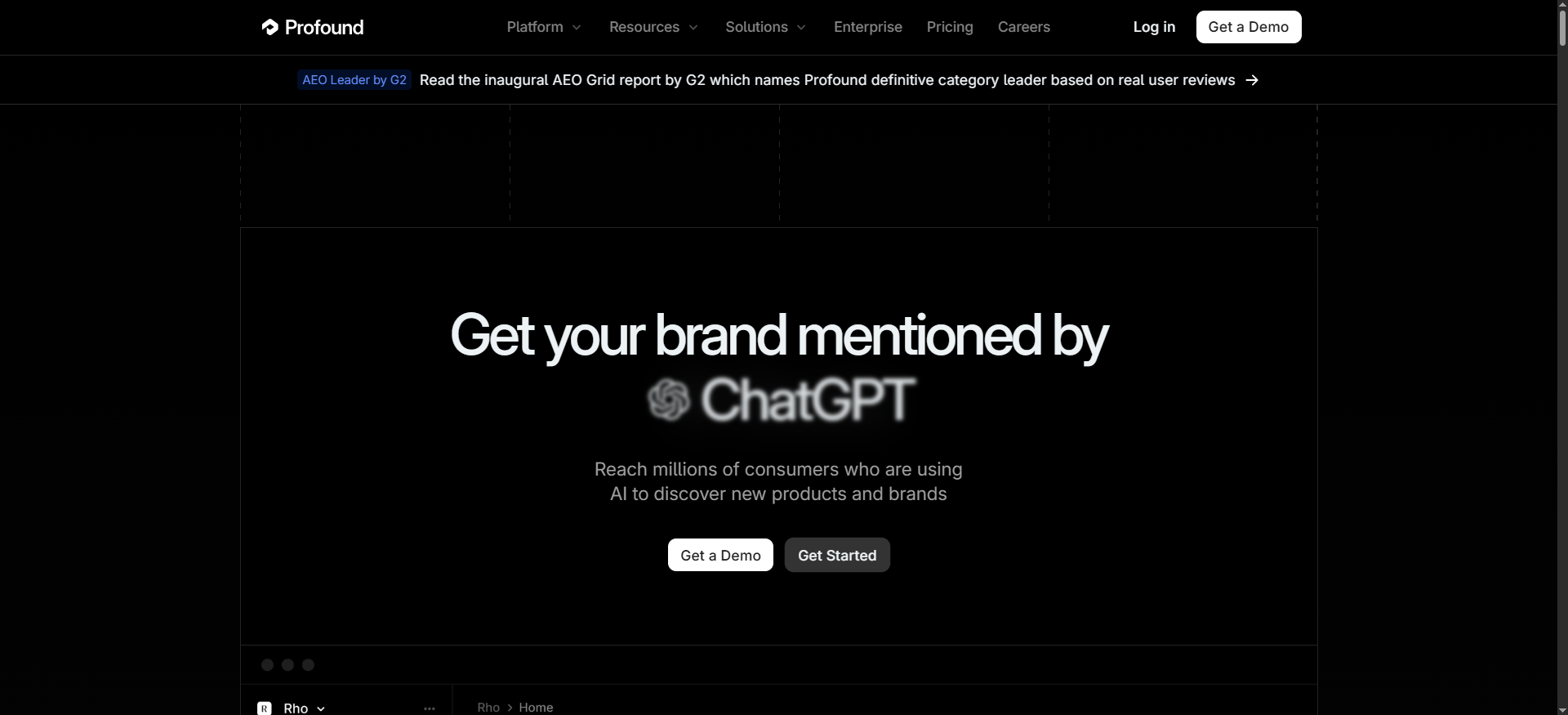
Profound is an enterprise-oriented AI visibility platform designed to help brands understand and improve how they appear in AI-generated answers. Its positioning clearly targets organizations that care about scale, governance, and business-level impact, not just surface metrics.
Why teams use it
Teams adopt Profound when AI search becomes important enough to require cross-functional visibility, stronger reporting, and confidence that the platform can scale with large brands. Public materials emphasize major engine coverage, enterprise security, citations analyzed daily, prompt analysis at scale, and specialized capabilities such as agent analytics and shopping visibility.
What it’s good for
Profound is especially strong for enterprise marketing teams, larger B2B SaaS organizations, and brands that need to tie AI visibility work to broader growth or attribution conversations around AI visibility metrics. It is also attractive when AI visibility has moved out of the experimental stage and into something leadership wants measured rigorously.
When it’s a good fit
It is a good fit when your organization needs a serious platform partner, not just a dashboard. That includes brands with multiple markets, products, or business units, plus teams that care about security and structured onboarding.
When it’s not a good fit
Profound will often be too heavy, and too enterprise-oriented, for smaller teams or first-time buyers. If you are still in the “we just need a cleaner monitor than manual checks” phase, the platform is probably more than you need.
How to use it
Use Profound when you want to build a repeatable AEO operating model with executive visibility. Start with your most commercially important use cases, benchmark your current presence, measure citation and visibility changes over time, and connect those outcomes to product, content, PR, and revenue discussions where possible.
Key capabilities
Public materials point to direct coverage across major answer engines, enterprise security, high-scale prompt and crawler analysis, and specialized features like shopping dashboards and agent analytics, which makes Profound relevant in any AI visibility platform buyer guide. Compared with Otterly AI, the differentiator is not simplicity. It is enterprise depth.
Pricing
Pricing is not publicly listed as a standard self-serve plan on Profound’s official pricing page. It is available through customized enterprise pricing by quote.
Free tier?
Profound does not offer a free tier. Its official pricing page is enterprise-led, and the site pushes buyers toward a demo or sales conversation instead.
Downsides / limitations
The trade-off is obvious: enterprise depth usually means a bigger budget, a more involved onboarding process, and more platform than a lean team requires. But for companies that need scale and maturity, Profound is one of the clearest step-up choices from Otterly AI.
5. Rankscale AI
What it does
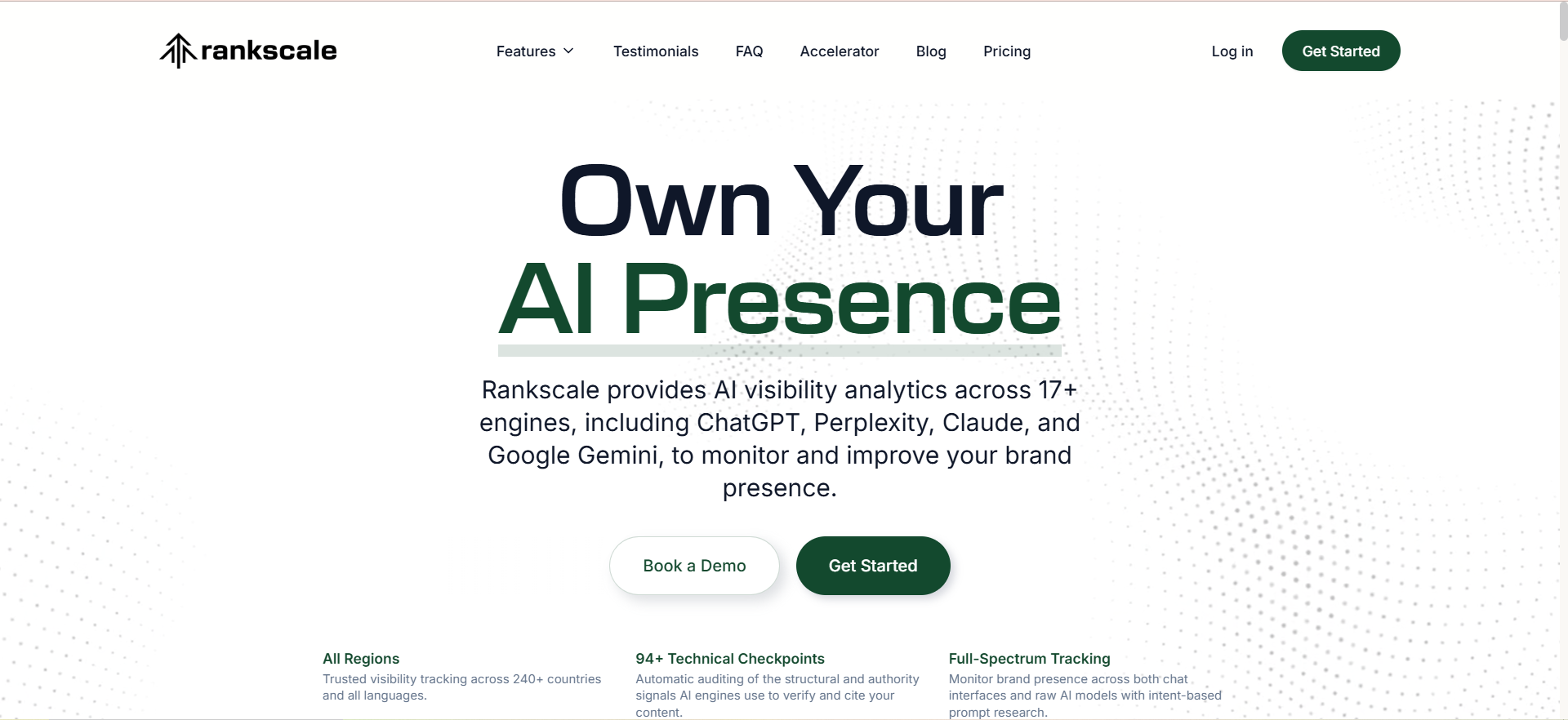
Rankscale AI focuses on tracking and analyzing how brands show up in AI-generated answers. Its public messaging emphasizes visibility tracking, mentions, citations, stability analysis, and competitive insights across engines like ChatGPT, Perplexity, Google AI Mode, and AI Overviews.
Why teams use it
Teams are drawn to Rankscale AI because it appears to offer a practical monitoring layer without the immediate complexity of more enterprise-heavy platforms. It is appealing for operators who want to understand where their brand stands and how competitors compare, without buying a bigger system than they can realistically implement.
What it’s good for
Rankscale AI is a strong candidate for lean internal teams, consultants, and budget-aware buyers who still want serious AI visibility data, especially if they are focused on monitoring SaaS brand visibility in ChatGPT and Perplexity. It can also suit teams that want focused rank-tracker style workflows for specific AI surfaces.
When it’s a good fit
It is a good fit when you want a tool that is clearly centered on tracking, mentions, and competitive monitoring. If your biggest question is “where are we visible, where are we weak, and which competitors are ahead?” Rankscale AI can be an efficient answer.
When it’s not a good fit
If you need clearer public packaging, polished enterprise procurement, or a broader optimization suite, Rankscale AI may feel less mature than some alternatives. Buyers should validate onboarding, support, and reporting depth during evaluation.
How to use it
Use Rankscale AI to build a focused benchmark set around high-intent prompts, then compare your mentions and citations against named competitors over time as part of a broader brand visibility audit on LLMs. This works best when your team needs directional insight quickly and can act on findings without a huge internal process.
Key capabilities
The public site and feature pages highlight AI rank tracking across specific engines, citation monitoring, visibility analysis, and competitive insights, which is why Rankscale AI fits buyers researching Google AI Overviews tracking tools. Against Otterly AI, the main appeal is a focused tracking posture rather than a feature-heavy all-in-one promise.
Pricing
Rankscale AI uses credit-based pricing, and its official pricing page says plans run from Essentials to Enterprise. The official page does not clearly expose a starting price in the page text I could verify, and it also offers custom plans.
Free tier?
Rankscale AI does not appear to offer a standard free tier, but it does offer free AI visibility audits and a free test on its official materials.
Downsides / limitations
The biggest limitation today is transparency. Compared with Otterly AI or LLMrefs, buyers may have to do more direct evaluation work to understand package fit. Still, it remains a credible alternative for teams that want straightforward AI visibility tracking.
How to choose the right Otterly AI alternative
There is no single best replacement for Otterly AI because teams buy these tools for different reasons. IIf your priority is a strong analytics layer that marketing teams will actually use, Peec AI is probably the best overall alternative for teams investing in AI visibility tracking tools and GEO services. If your team is SEO-led and still wants to work from keywords and familiar search concepts, LLMrefs is the easiest transition.
If you want a broader AEO and GEO platform with more optimization depth, AthenaHQ makes more sense for teams building an AI search visibility strategy. If you are an enterprise brand that needs scale, security, and executive-grade reporting, Profound is the obvious shortlist candidate. If you want a focused and practical monitoring option without immediately moving to heavyweight enterprise tooling, Rankscale AI is worth a serious look.
Use four filters when deciding, and one of the most important is reporting depth: can the platform answer stakeholder questions beyond brand mentions and support AI visibility metrics? First, workflow fit: does the platform match how your team actually researches, reports, and prioritizes? Second, reporting depth: can it answer stakeholder questions beyond brand mentions? Third, operating complexity: will your team really use the extra features? And fourth, commercial fit: do the pricing model, onboarding path, and support level match your stage right now?
A common buying mistake is overbuying, and the best platform is the one your team can use consistently enough to improve AI visibility month after month through evergreen content visibility in AI search. The best platform is the one your team can use consistently enough to improve AI visibility month after month, especially if you are building a long-term AI strategic visibility program.
When Otterly AI is still the better choice
Even in an alternatives article, it is worth saying this clearly: Otterly AI may still be the right choice for many buyers. If you want transparent public pricing, a faster ramp, practical brand and citation monitoring, workspaces, exports, and a Looker Studio connector, Otterly AI remains a compelling option for teams focused on AI citation tracking. It is especially suitable for smaller teams, consultants, and agencies that need to get moving now instead of running a long procurement process.
In other words, switch only when you have a real reason. Move away from Otterly AI when you need stronger competitive depth, more enterprise structure, broader operational workflows, or a different reporting model for AI-first search. Do not switch simply because another platform sounds more advanced.
Otterly AI competitors
If you’re searching for Otterly AI competitors, you’re probably not looking for just any AI visibility tool. You’re looking for a platform that can match or improve on what Otterly AI already does well: tracking brand visibility in AI-generated search experiences, monitoring citations, and helping teams understand how often they appear across tools like ChatGPT, Google AI Overviews, Perplexity, Gemini, and Copilot.
The good news is that Otterly AI is no longer the only serious option in this category. As AI search becomes more important for SEO, content strategy, digital PR, and brand visibility, a growing set of competitors has emerged for teams investing in most effective strategies for AI visibility enhancement.Some are designed for lean marketing teams that want simple monitoring, while others are built for SEO-led workflows, agency reporting, or enterprise-grade analytics that support content engineers driving AI search visibility. That means the best Otterly AI competitor depends less on the label “alternative” and more on the problem your team is trying to solve within a broader AI search visibility strategy.
For example, if you want a competitor with stronger analytics and reporting depth, Peec AI is one of the strongest names to consider. It is better suited to teams that need more structured workflows, better competitor tracking, and integrations that support recurring reporting.
If your team still works in a classic SEO model and wants a platform that feels closer to keyword tracking and share-of-voice analysis, LLMrefs is a natural Otterly AI competitor. It gives SEO teams a more familiar way to move into AI visibility tracking.
If your business is building a broader AEO or GEO strategy, AthenaHQ stands out as a competitor that goes beyond basic monitoring and fits teams investing in AEO tools for AI Overviews. It is better for organizations that want optimization guidance and a more comprehensive operating system around AI visibility.
On the enterprise side, Profound is one of the clearest Otterly AI competitors for larger brands that need scale, governance, and more advanced analytics, especially if they are evaluating the best AI tools for enterprise SaaS marketing. And for teams that want focused tracking around AI visibility, citations, and competitor benchmarking without jumping straight into a heavyweight platform, Rankscale AI is another credible option.
The most important point is this: not all Otterly AI competitors are competing on the same level or for the same buyer. Some compete on ease of use. Some compete on reporting depth. Some compete on enterprise readiness.
And some compete on pricing accessibility, so when evaluating Otterly AI competitors, it helps to compare platforms against the best AI visibility tools for share of voice. So when evaluating Otterly AI competitors, compare them based on workflow fit, reporting quality, prompt tracking flexibility, competitor intelligence, and how easily the platform fits into your existing marketing or SEO process.
In short, the top Otterly AI competitors are Peec AI, LLMrefs, AthenaHQ, Profound, and Rankscale AI. Each one overlaps with Otterly AI in AI visibility tracking, but each also serves a slightly different type of team. The right choice depends on whether you want simplicity, SEO familiarity, optimization depth, enterprise support, or a more focused monitoring tool for daily prompt runs.
FAQs
What is the best Otterly AI alternative overall?
Which Otterly AI alternative is best for agencies?
Which Otterly AI competitor is best for enterprises?
Is there a cheaper alternative to Otterly AI?
Should I switch from Otterly AI if I only need brand mention tracking?
What should I compare when evaluating AI visibility tools?
Final verdict
For most buyers evaluating Otterly AI alternatives, Peec AI is the strongest overall replacement because it balances depth, usability, and reporting maturity. LLMrefs is the best value pick for SEO-led teams. AthenaHQ is the better choice for buyers that want a broader AEO and GEO operating platform. Profound is the enterprise pick for scale and maturity. Rankscale AI is the practical contender for lean teams that still want focused visibility tracking.
The right decision comes down to how your team works. If you only need a monitor, Otterly AI may still be enough. If you need a system that helps you measure, explain, and improve AI visibility in a more structured way, one of these five alternatives will likely be a better long-term fit for teams building AEO-ready SaaS blogs.
📋 Get Listed / Advertisement
We update this guide monthly. Want your tool featured? Contact: [email protected].